UPSC biodata guide 2026
UPSC biodata and DAF format for civil services 2026
The UPSC DAF (Detailed Application Form) is the foundation for your personality test interview. Every item you fill becomes a potential interview question. Here is how to fill it strategically.
The ResumeVera team
Written from the recruiting bodies' own published formats and notifications, not from third-hand summaries.
Updated Oct 7, 2026
12 min

Section 01
UPSC DAF: sections and how to fill each strategically
The DAF is not a routine form. Every field you fill is material for the interview board. Be honest, specific, and deliberate in every section.
| 01 | Personal Details Full name, DOB, father's name, mother's name, permanent address, home state. This information is used to frame state-specific and regional knowledge questions. Know your home district well. |
| 02 | Educational Qualifications All degrees from Class 10 through graduation/postgrad. Include institution names. Boards and universities invite specific questions about your college's reputation, ranking, or location. |
| 03 | Service Preferences (cadre allotment) You rank your preferences across IAS, IPS, IFS, and the Group A and Group B services. Do not fill preferences mechanically based on prestige. Know why you prefer each service, the board will ask. Your cadre preference rank also signals your career values. |
| 04 | Optional Subject Your UPSC Mains optional subject must connect to your background or career narrative. If you chose Public Administration with a background in engineering, be ready to explain why. Link your optional subject to current affairs and policy questions, the board will probe this connection. |
| 05 | Hobbies & Interests Only write hobbies you practice regularly and can speak about for 5 minutes. The interview board will ask you to demonstrate, compare, or connect your hobby to current events or national issues. "Reading" is too generic. Specify the genre, recent books, or authors you admire. |
| 06 | Extracurricular Achievements Include national/state-level sports, arts, cultural prizes. The board uses these to assess character, discipline, and team orientation. Inflated achievements are spotted quickly. Be accurate. |
| 07 | Work Experience Full-time work experience before UPSC. Private, government, or NGO. Include designation, employer, and duration. Your work context shapes your service preference rationale. |
| 08 | Languages Known Languages you can read, write, and/or speak. Regional languages are relevant for cadre preference. The board may ask you to speak in your regional language briefly. |
Section 02
Who this guide is for
This guide is written for UPSC aspirants preparing DAF-based biodata and personality-test talking points. The goal is simple: make DAF details consistent, factual, and interview-ready. It is structured for readers who want direct examples, recruiter-friendly wording, and India-specific decisions rather than generic career advice.
| 01 | How to use this guide Read the format first, adapt the examples to your own background, then use the checklist and FAQs before submitting your upsc biodata. |
Section 03
UPSC biodata step-by-step playbook
Use this order to move from blank page to publish-ready application material. Each step is designed to improve recruiter readability and application-system clarity.
For each step, use specific evidence for your target reader: role, company, exam, portal, city, tools, documents and measurable outcomes where possible.
| 01 | 1. DAF details |
| 02 | 2. Education List degree, institution, year, and marks/CGPA only when they strengthen the application or are required by the process. |
| 03 | 3. Optional subject |
| 04 | 4. Work experience Convert responsibilities into evidence: task handled, tools or process used, team/client context, and result. Even short internships can show credible exposure. |
| 05 | 5. Hobbies |
| 06 | 6. Service preference |
| 07 | 7. Home state |
| 08 | 8. Current affairs links |
Section 04
India and global application guidance
Hiring expectations change by market. Indian applications often include portal keywords, campus or exam processes, CTC language, document checks, and local role-title variations. Global applications usually expect tighter privacy, fewer personal details, and stronger proof of role fit.
| 01 | UPSC biodata should reflect the official DAF, not a creative private-sector resume. |
| 02 | Every hobby, award, place, and work detail can become an interview question. |
| 03 | Do not inflate hobbies or achievements; consistency matters more than decoration. |
Section 05
UPSC biodata examples you can adapt
Use these examples as patterns, not as copy-paste text. The best application content sounds specific to your work and includes evidence that an interviewer can verify.
| 01 | Hobby: long-distance running. Prepare: personal routine, major Indian runners, basic physiology, and recent marathon news. |
| 02 | Home district: prepare geography, economy, local issues, culture, and administrative challenges. |
Section 06
Shortlist visibility checklist
Use this checklist before publishing, uploading, or sending your application. It helps recruiters, job portals, and screening systems understand your fit quickly without forcing unnatural keyword repetition.
| 01 | Lead with the target role or process The first screen should make it obvious why this upsc biodata is relevant and what outcome it supports. |
| 02 | Use exact but truthful keywords Mirror role, portal, exam, or company terms only when they genuinely match your background. |
| 03 | Add evidence after every major claim Use numbers, tools, documents, projects, clients, coursework, or outcomes so the content feels verifiable. |
| 04 | Keep formatting predictable Use standard headings and simple layouts so recruiters and upload systems do not have to guess where information lives. |
| 05 | Check the final version against the application instructions If the employer, portal, or exam body asks for a specific format, follow that over generic resume advice. |
Section 07
Official references and source notes
This guide is original ResumeVera guidance. The reference below was used to keep the advice aligned with official UPSC documentation.
| 01 | UPSC official website Official reference point for Civil Services notifications, DAF, and examination updates. Reference: https://www.upsc.gov.in/ |
Pro tips
Do these
Every single item in the DAF is a potential interview question; never fill anything you cannot speak about for 5 minutes
For hobbies: be specific and current ("Reading" → "Reading Indian foreign policy literature, currently Shyam Saran's 'How India Sees the World'")
Connect your optional subject to current policy debates, IAS board members often probe this connection
Know your home state's major current developments: economy, infrastructure, social issues, governance
Prepare the "Why this service preference" narrative for your top 3 choices
Address employment/education gaps directly in the Remarks section: the board respects transparency
Customize the first 3 lines for the exact role, company, exam, or portal instead of using the same version everywhere.
Add one proof point for every major claim: number, scope, document, tool, project, client type, or result.
Read the page aloud once; if a sentence sounds like generic advice, replace it with a concrete example.
Avoid these
Delete these
Listing generic hobbies (reading, listening to music) without being able to discuss them specifically
Inflating or exaggerating achievements, the UPSC board includes domain experts who can detect inconsistencies
Filling service preferences only by prestige (IAS → IPS → IFS without genuine reasoning)
Leaving work experience blank if you have relevant prior service, even private sector experience matters
Not knowing your optional subject's connection to current policy issues
Ignoring your home state, the board will ask hyper-local governance questions about your district
Using repeated keywords instead of useful examples, scripts, and proof.
Submitting without checking the latest employer, portal, or exam instructions.
Copying examples word-for-word instead of replacing them with your own truthful details.
Keywords
Keywords by category
Use these in your resume and profile to improve search visibility.
Core Phrases
Common Question Phrases
India-Specific Terms
Put this into a resume
Building and editing are free, and free PDFs carry a small watermark.
Make your biodata in this formatQuestions
Frequently asked questions
How this guide is maintained
We review this guide every quarter and after any change to the hiring rules or portal behaviour it describes. It was last reviewed on October 7, 2026. Figures come from named sources, shown beside the number. Where we are estimating rather than measuring, we say so.
Try it
Check the guide against your own file
Everything above is general. Your resume is not. Paste it in and the checker tells you which of these points your file actually breaks.
Check your resume free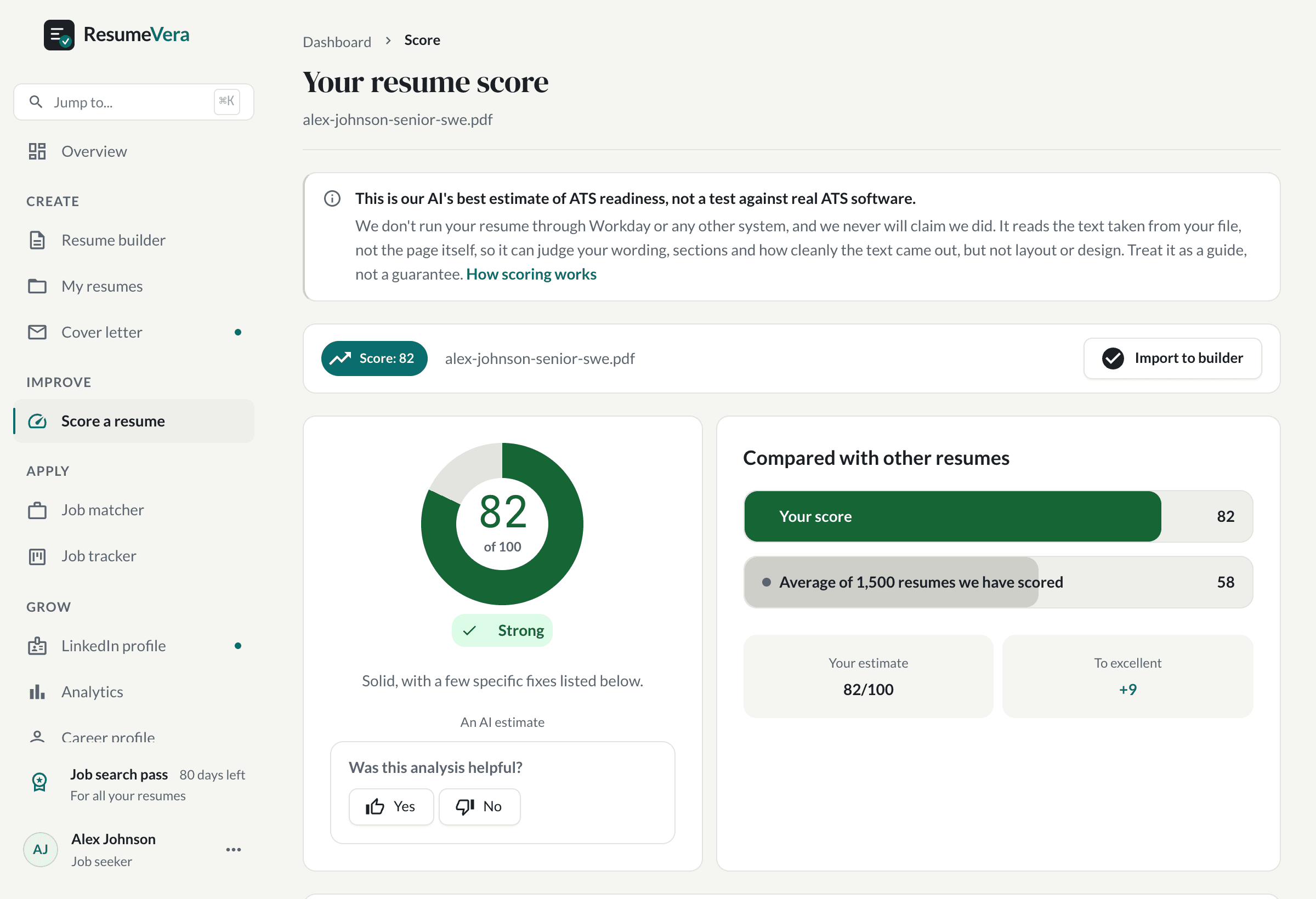
The real score page, with a sample resume and sample scores.
Is your resume ATS ready?
Run a free ATS score check and get specific improvements in seconds.