Leave encashment calculator on resignation 2026
Calculate your earned leave encashment payout on resignation or retirement. See gross amount, Section 10(10AA) tax exemption (₹25L limit), and net in-hand for private and government employees.
Employee Type
₹
Basic pay only, exclude HRA and allowances
%
Most private IT companies have 0% DA, enter 0 if not applicable
Earned Leave Days to Encash
days
Leave Encashment Payout
Gross Payout
₹50,010
Net (After Tax)
₹50,010
Fully tax-free, within exemption limit
Monthly Salary (Basic + DA)
₹50,000/month
Daily Rate (Salary / 30)
₹1,667/day
Gross Encashment (30 days)
₹50,010
Tax Exemption (Sec 10(10AA), least of actual, 10 months, ₹25L)
₹50,010
Net Payout
₹50,010
10 months salary cap: ₹5,00,000. Statutory limit: ₹25,00,000. Exemption = least of actual, 10 months, and ₹25L (lifetime across employers).
Switching jobs? Check your resume against ATS first.
Build My Resume, Free →What this assumes
- Your daily rate is one thirtieth of monthly basic plus DA, which is the standard convention
- Government employees are fully exempt under section 10(10AA)
- For everyone else the exemption is the least of the actual amount, ten months' salary, and the ₹25,00,000 statutory limit
- The limit is a lifetime one across employers, so earlier encashments reduce what is exempt now
This is an estimate for planning, not tax or financial advice. Your employer’s structure and your own tax position can change the figure.
Leave encashment, the key rules
What determines your tax-free amount and when you get paid.
₹25L tax-free limit (revised 2023)
The Section 10(10AA) exemption for private employees was raised from ₹3L to ₹25L in May 2023. This is a lifetime limit across all employers; keep records of exemptions claimed to avoid double-claiming.
Government employees: 100% exempt
Central and state government employees receive full tax exemption on leave encashment; there is no upper limit. The entire encashment amount is tax-free regardless of how large it is.
Paid as part of full and final
Leave encashment is settled along with unpaid salary, gratuity, and other dues in your Full & Final (F&F) settlement, typically processed within 30–45 days of your last working day.
Example: Basic ₹50,000/month, 0% DA, 30 earned leave days (private)
Monthly salary (Basic + DA) = ₹50,000. Daily rate = ₹1,667. Gross encashment = ₹50,000. Exemption = least of ₹50,000 (actual), ₹5,00,000 (10 months), and ₹25,00,000 (limit) = ₹50,000. Result: fully tax-free. You receive ₹50,000 with no TDS deducted.
Leave encashment quick reference
Payout at ₹50,000 basic, 0% DA, private sector.
10 leave days
₹16,667
15 leave days
₹25,000
20 leave days
₹33,333
30 leave days
₹50,000
45 leave days
₹75,000
60 leave days
₹1,00,000
90 leave days
₹1,50,000
All tax-free (within ₹25L lifetime limit at ₹50K basic)
Section 10(10AA) Exemption Rules
Government employees
Fully exempt, no limit
Private (retirement/death)
Fully exempt, no limit
Private (resignation)
Exempt up to ₹25L lifetime
10 months salary cap
Also applies as an additional cap
Lifetime limit
Cumulative across all employers
Amount above ₹25L
Taxable as salary income
Questions
Frequently asked questions
Leave encashment rules, tax, and F&F settlement.
After this job
See how you read against a specific posting
Paste the job description and the matcher compares it against your resume requirement by requirement, then shows the gaps.
Check your resume free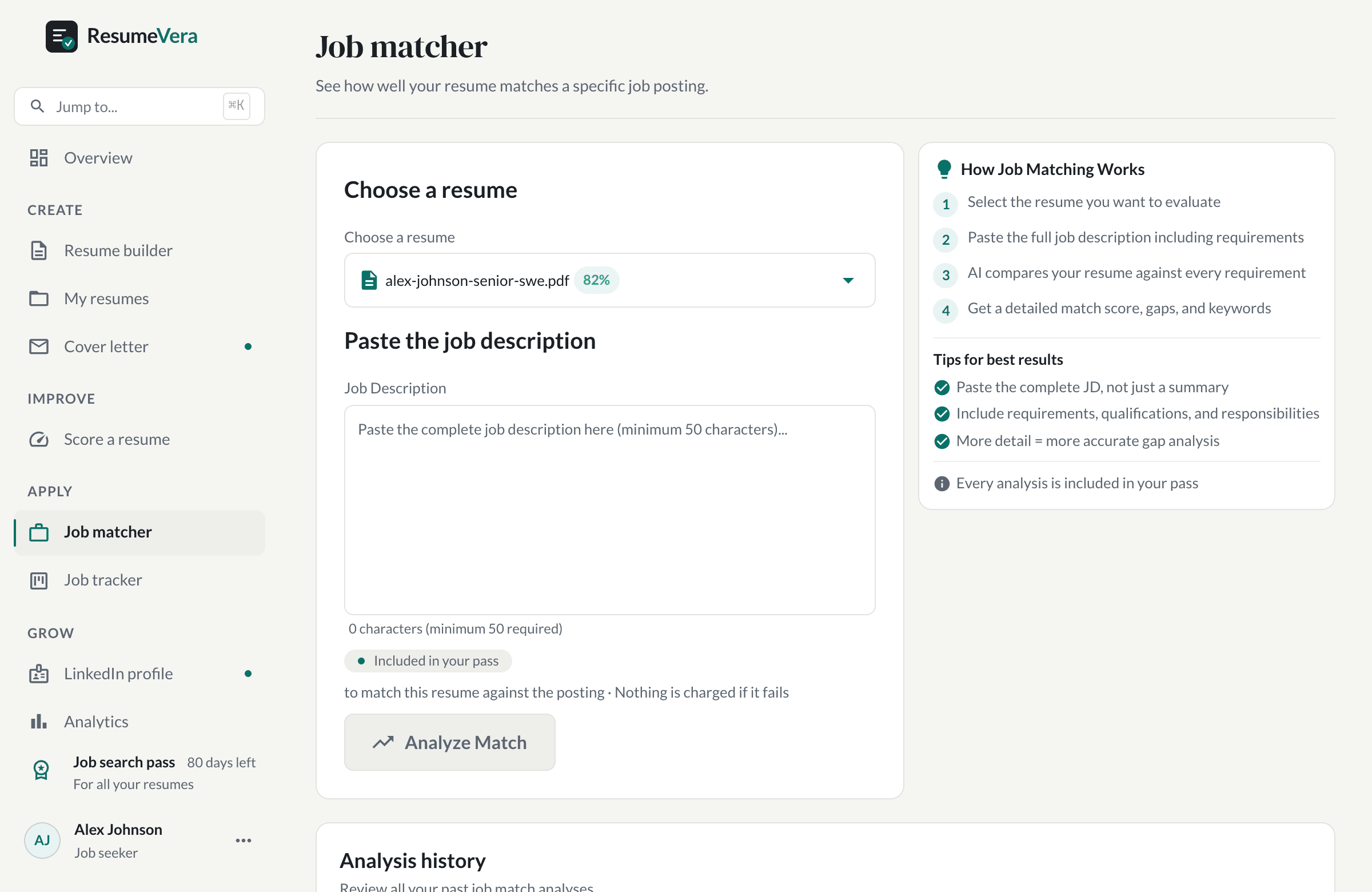
The real matcher, on a sample account.
Leaving your job? Make your resume land interviews.
Get an honest resume score in seconds, then fix what it finds. Free to start.