AWS skills for your resume in 2026
Which AWS services and certifications employers list, how to describe cloud work with real outcomes, and where AWS fits in DevOps and backend roles.
Market Demand
Demand and salary data
23% projected growth in cloud-related roles through 2033 (BLS), with AWS-specific roles leading the cloud hiring market
Growth rate
Top industries
Learning Path
Skill levels
Beginner
AWS Cloud Practitioner concepts, IAM basics, S3 storage, EC2 instances, VPC fundamentals, CloudWatch monitoring, basic CLI usage, understanding of regions and availability zones
Intermediate
Solutions architecture patterns, Lambda serverless functions, RDS and DynamoDB databases, CloudFormation/CDK infrastructure-as-code, API Gateway, SNS/SQS messaging, cost optimization strategies
Advanced
Multi-account architectures, SageMaker ML pipelines, EKS Kubernetes orchestration, advanced networking (Transit Gateway, PrivateLink), security automation (GuardDuty, Security Hub), disaster recovery design, Well-Architected Framework expertise
Section 01
Why AWS skills are essential in 2026
Amazon Web Services is one of the largest cloud platforms in 2026, and AWS skills show up in many cloud-related job postings as enterprises deepen their cloud commitments.
Organizations continue to move workloads from on-premises infrastructure to the cloud. Much of the new work sits where cloud computing meets artificial intelligence, machine learning, and data engineering.
What makes AWS particularly valuable in 2026 is its role as the backbone of AI infrastructure. Amazon Bedrock, SageMaker, and Trainium chips have made AWS a common choice for companies deploying generative AI applications at scale. Organizations need professionals who can architect AI-ready cloud environments, and they look for that expertise when hiring.
Beyond AI, AWS is widely used in several areas:
- Enterprise Cloud Migration: Large organizations are moving their final on-premises workloads to AWS, creating sustained demand for migration specialists
- Serverless and Event-Driven Architecture: Lambda, Step Functions, and EventBridge power modern microservices at companies like Netflix, Airbnb, and Capital One
- Data Engineering: Redshift, Glue, Athena, and Kinesis form the backbone of modern data platforms processing petabytes daily
- Security and Compliance: As regulatory requirements intensify, AWS security specialists who understand GuardDuty, Security Hub, and compliance frameworks are in demand
Section 02
How to list AWS on your resume
Simply writing "AWS" in your skills section barely scratches the surface of what hiring managers look for. Cloud roles require specific evidence of services used, architectures designed, and business outcomes delivered. Here is how to transform generic AWS mentions into resume content that gets interviews.
Skills Section Best Practices:
- List specific AWS services by category: Compute: EC2, Lambda, ECS, EKS | Storage: S3, EBS, EFS | Database: RDS, DynamoDB, Aurora
- Include your certifications prominently: AWS Solutions Architect Associate, AWS DevOps Engineer Professional
- Mention complementary tools: Terraform, CloudFormation, Docker, Kubernetes, GitHub Actions
Before and After Resume Bullet Examples:
| Weak Example | Strong Example |
|---|---|
| Used AWS for cloud infrastructure | Architected multi-region AWS infrastructure (EC2, ALB, RDS Aurora) serving 2M+ daily active users with 99.99% uptime and automated failover across 3 availability zones |
| Worked with AWS Lambda | Built serverless event-driven pipeline using Lambda, SQS, and DynamoDB that processed 5M+ daily events, reducing infrastructure costs by 62% compared to previous EC2-based architecture |
| Managed AWS security | Implemented AWS security posture management using GuardDuty, Security Hub, and Config Rules, achieving SOC 2 Type II compliance and reducing security findings by 78% in 6 months |
| Did DevOps on AWS | Designed CI/CD pipeline using CodePipeline, CodeBuild, and ECS Fargate, reducing deployment time from 4 hours to 12 minutes with zero-downtime blue-green deployments |
| Used AWS for data | Engineered real-time data lake on S3 with Glue ETL and Athena, consolidating 12 data sources and enabling self-service analytics for 200+ business users, saving $1.2M annually in licensing costs |
Key principles for AWS resume bullets:
- Name the services: Replace "AWS" with specific services (Lambda, S3, RDS) to demonstrate depth of knowledge
- Quantify scale: Include metrics like requests per second, data volumes, cost savings, and uptime percentages
- Show architecture decisions: Mention design patterns like serverless, microservices, or multi-region to demonstrate strategic thinking
- Highlight certifications: Place AWS certifications in a dedicated section near the top of your resume; they are immediate credibility signals
Section 03
AWS certifications: which ones matter most
AWS certifications are widely recognized credentials, serving as quick credibility signals to employers and sometimes listed as requirements in job postings. With certifications spanning foundational to specialty levels, choosing the right path requires understanding which certifications align with your career goals and the current job market.
Certifications and who they suit:
| Certification | Best For |
|---|---|
| Solutions Architect Associate | Most versatile; best first certification |
| Solutions Architect Professional | Senior architecture roles |
| DevOps Engineer Professional | CI/CD and automation roles |
| Security Specialty | Cloud security engineering |
| Machine Learning Engineer Associate | AI/ML roles |
| Data Engineer Associate | Data pipeline and analytics roles |
Recommended Certification Paths by Career Goal:
- Cloud Architect Path: Cloud Practitioner → Solutions Architect Associate → Solutions Architect Professional → Security or Advanced Networking Specialty
- DevOps Path: Cloud Practitioner → SysOps Administrator Associate → DevOps Engineer Professional
- Data and AI Path: Cloud Practitioner → AI Practitioner → Data Engineer Associate → Machine Learning Engineer Associate
- Security Path: Cloud Practitioner → Solutions Architect Associate → Security Specialty
The newest certifications, AI Practitioner, ML Engineer Associate, and GenAI Professional, suit professionals building AI solutions on AWS.
Certification Study Tips:
- Hands-on labs matter more than theory; use AWS Free Tier to build real projects
- Practice exams from official sources and platforms like Tutorials Dojo are essential
- Join AWS community forums and study groups for peer support
- Most certifications require 80-120 hours of dedicated study time
- Recertification is required every 3 years, but renewal exams are shorter and less expensive
Section 04
Learning roadmap: from beginner to AWS expert
Whether you are a complete cloud beginner or an experienced developer looking to specialize in AWS, this structured roadmap will guide you from foundational knowledge to expert-level proficiency, with estimated timelines and practical milestones for each stage.
Stage 1: Cloud Foundations (Weeks 1-6)
- Cloud computing concepts: IaaS, PaaS, SaaS, shared responsibility model
- AWS global infrastructure: regions, availability zones, edge locations
- Core services: EC2 (compute), S3 (storage), VPC (networking), IAM (security)
- AWS Management Console navigation and basic CLI commands
- Understanding pricing models: on-demand, reserved, spot instances
- AWS Free Tier setup and hands-on exploration
Milestone: Pass the AWS Cloud Practitioner exam. Resources: AWS Skill Builder (free), A Cloud Guru, Stephane Maarek Udemy courses
Stage 2: Associate-Level Skills (Months 2-6)
- Solutions architecture: high availability, fault tolerance, cost optimization design patterns
- Compute deep-dive: EC2 instance types, Auto Scaling, Elastic Load Balancing, Lambda functions
- Storage and databases: S3 lifecycle policies, RDS, DynamoDB, ElastiCache, Aurora
- Networking: VPC subnets, NAT gateways, Route 53 DNS, CloudFront CDN
- Security: IAM policies, KMS encryption, security groups, NACLs, AWS WAF
- Infrastructure-as-code: CloudFormation templates or AWS CDK with Python/TypeScript
- CI/CD basics: CodeCommit, CodeBuild, CodeDeploy, CodePipeline
Milestone: Pass the Solutions Architect Associate exam. Build and deploy a multi-tier web application on AWS. Resources: AWS Well-Architected Labs, hands-on workshops, Adrian Cantrill courses
Stage 3: Professional-Level Expertise (Months 7-12)
- Advanced architecture: multi-account strategies (AWS Organizations, Control Tower), microservices patterns
- Containers: ECS task definitions, EKS Kubernetes clusters, Fargate serverless containers
- Serverless deep-dive: Step Functions orchestration, EventBridge event-driven patterns, AppSync GraphQL
- Data engineering: Kinesis streaming, Glue ETL, Redshift data warehousing, Athena SQL analytics
- Monitoring and observability: CloudWatch dashboards, X-Ray tracing, CloudTrail auditing
- Cost optimization: Savings Plans, Reserved Instances, rightsizing, Trusted Advisor
Milestone: Pass a Professional-level or Specialty certification. Design and implement a production-grade architecture for a real project. Resources: AWS re:Invent session videos, AWS Architecture Blog, real-world project work
Stage 4: Specialization and Thought Leadership (12+ months)
- Choose a specialization: Security, ML/AI, Data Engineering, Networking, or Migration
- Contribute to open-source AWS tools (AWS CDK constructs, Terraform AWS modules)
- Build a portfolio of 3-5 AWS architecture case studies with diagrams and documentation
- Pursue specialty certifications aligned with your career path
- Engage with the AWS community: user groups, re:Invent, blog posts, conference talks
Key tip: AWS experience is best demonstrated through architecture diagrams, cost optimization case studies, and production deployment stories. Build real projects and document your design decisions; these are your strongest resume assets alongside certifications.
Related Roles
Roles that use this skill
Explore resume examples for roles that commonly require this skill.
Questions
Frequently asked questions
Skill Guides
Explore More Skills
Browse all our in-demand skill guides with demand data and learning paths.
View all skillsProve it
Claiming a skill and demonstrating one are different things
A timed assessment puts a result behind the word on your resume. Question count and duration are shown up front, and percentiles stay hidden until a domain has enough attempts to mean anything.
Join the waitlist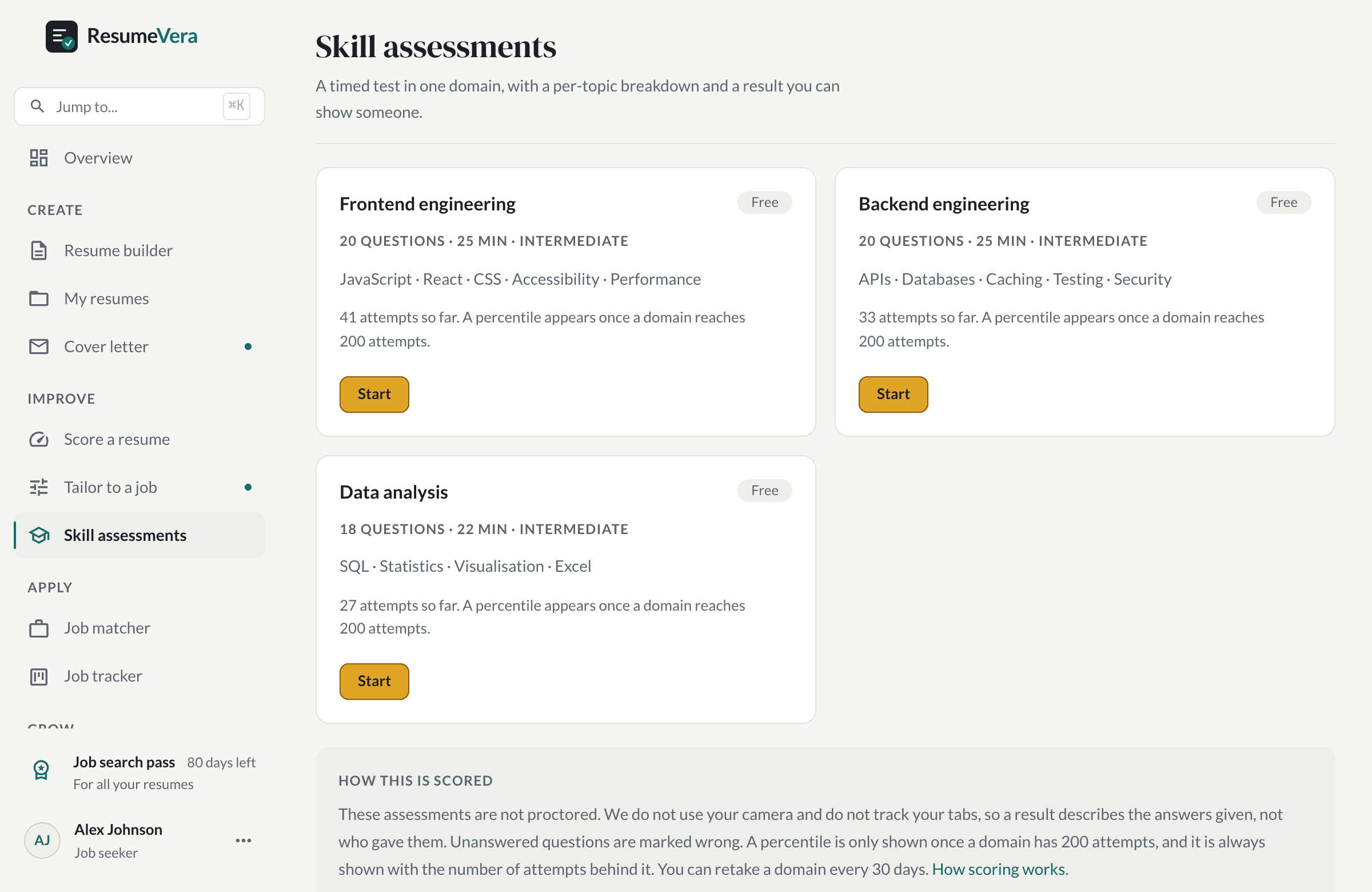
The real list. Percentiles stay hidden until a domain has enough attempts to mean anything.
Is your resume ATS-ready?
Run a free ATS score check and get specific improvements in seconds.