Docker and Kubernetes
What container skills look like at each level, the tools employers list alongside them, and how to describe DevOps work on your resume.
Market Demand
Demand and salary data
28% year-over-year growth in Kubernetes job postings
Growth rate
Top industries
Learning Path
Skill levels
Beginner
Understand Docker fundamentals including images, containers, Dockerfiles, volumes, and networking. Can build and run multi-container applications with Docker Compose. Familiar with container registries like Docker Hub and basic image optimization.
Intermediate
Proficient in Kubernetes core concepts: Pods, Deployments, Services, ConfigMaps, Secrets, and Ingress controllers. Can set up CI/CD pipelines with containerized builds, manage Helm charts, and work with managed Kubernetes services (EKS, AKS, GKE). Understands RBAC, resource limits, and horizontal pod autoscaling.
Advanced
Expert in production Kubernetes operations: custom operators, service mesh (Istio/Linkerd), multi-cluster federation, GitOps with ArgoCD/Flux, and advanced networking with CNI plugins. Can architect highly available, self-healing infrastructure with comprehensive observability using Prometheus, Grafana, and distributed tracing.
Section 01
Why Docker and Kubernetes skills matter in 2026
Docker and Kubernetes have become the foundational technologies for modern application deployment. Many enterprises now run Kubernetes in production, driven largely by AI/ML workload orchestration and the maturation of platform engineering practices.
For job seekers, the implications are clear: for DevOps engineers, Kubernetes expertise is close to a baseline expectation. Kubernetes appears in a large share of senior backend, platform engineering, and DevOps job postings across every major tech hub. The complexity and operational burden of Kubernetes also make experienced professionals valuable to employers.
Docker, while more mature as a technology, remains essential as the containerization layer that Kubernetes orchestrates. Together, these skills form the backbone of cloud-native development, microservices architecture, and modern CI/CD pipelines.
Companies ranging from startups to Fortune 500 enterprises have standardized on containers. At mid-level and senior DevOps or platform engineer roles, Kubernetes knowledge is effectively required, and many larger engineering organizations use Kubernetes as their primary compute platform.
Section 02
How to list Docker and Kubernetes on your resume
Listing Docker and Kubernetes on your resume requires more than just naming the technologies. Recruiters and hiring managers want to see impact-driven bullet points that demonstrate real-world experience with containers and orchestration at scale. Here are proven strategies to make your container skills stand out.
Resume Bullet Point Examples
Before (Weak):
- Used Docker and Kubernetes for deployment
- Worked with containers in the cloud
- Managed Kubernetes clusters
After (Strong):
- Architected and managed a 200-node Kubernetes cluster serving 50M+ daily requests, reducing infrastructure costs by 35% through right-sizing and horizontal pod autoscaling
- Built multi-stage Docker images that reduced container sizes by 60% (from 1.2GB to 480MB), cutting deployment times from 12 minutes to under 4 minutes across 15 microservices
- Implemented GitOps deployment pipeline using ArgoCD and Helm charts, enabling 40+ weekly production deployments with zero-downtime rolling updates and automated rollbacks
- Migrated monolithic Java application to 12 containerized microservices on EKS, improving deployment frequency from monthly to daily while reducing MTTR from 4 hours to 15 minutes
Skills section format: List specific tools and versions: Docker, Kubernetes (EKS/GKE), Helm, ArgoCD, Terraform, Prometheus, Grafana, Istio. Group them under "Container Orchestration & DevOps" or "Cloud Infrastructure" headings. Always mention the cloud provider's managed Kubernetes service you've used (EKS, AKS, or GKE).
Include certifications prominently: CKA (Certified Kubernetes Administrator), CKAD (Certified Kubernetes Application Developer), or CKS (Certified Kubernetes Security Specialist) carry significant weight with employers and can distinguish your resume from hundreds of applicants.
Section 03
Top certifications for Docker and Kubernetes professionals
Certifications validate your container orchestration expertise. In the competitive DevOps market of 2026, the right certifications help your resume stand out.
Must-Have Certifications
1. Certified Kubernetes Administrator (CKA) - A widely recognized certification for Kubernetes operations. This hands-on exam tests your ability to install, configure, and manage production Kubernetes clusters. It covers cluster architecture, networking, storage, troubleshooting, and security. Preparation often takes a few months.
2. Certified Kubernetes Application Developer (CKAD) - Focused on developers who build and deploy applications on Kubernetes. Tests your ability to define application resources, create multi-container pods, implement probes, use ConfigMaps/Secrets, and manage deployments. Ideal for software engineers transitioning to cloud-native development.
3. Certified Kubernetes Security Specialist (CKS) - The advanced security certification requiring CKA as a prerequisite. Covers cluster hardening, system hardening, supply chain security, monitoring and logging, and runtime security. Increasingly important as organizations prioritize container security.
4. Docker Certified Associate (DCA) - Validates Docker expertise including image creation, networking, orchestration, and security. While less common than Kubernetes certifications, it demonstrates deep containerization knowledge.
5. AWS Solutions Architect with CKA: AWS has no Kubernetes-specific certification, so pairing a cloud architecture certification with the CKA is how to show managed Kubernetes (EKS) expertise.
Recruiters often search their applicant tracking system for certification names such as CKA, so write them out in full with the abbreviation. When listing certifications on your resume, place them immediately after your name or in a dedicated "Certifications" section above your work experience. Include the certification date and ID number for easy verification.
Section 04
Docker and Kubernetes job market trends in 2026
The container orchestration job market in 2026 presents exceptional opportunities for skilled professionals. Understanding current trends helps you position your resume and career strategy effectively.
Key Market Trends
Platform Engineering Dominance: The rise of platform engineering as a discipline has created a new category of roles that center on Kubernetes expertise. Platform engineers build internal developer platforms (IDPs) on top of Kubernetes, abstracting infrastructure complexity for application developers.
AI/ML Infrastructure: The explosion of AI and machine learning workloads has dramatically increased demand for Kubernetes operators who can manage GPU scheduling, model serving infrastructure (like KServe and Seldon), and distributed training jobs. Companies running AI workloads at scale need engineers who can optimize Kubernetes for both traditional microservices and compute-intensive ML pipelines.
Multi-Cloud and Hybrid: Enterprises increasingly deploy Kubernetes across multiple cloud providers and on-premises data centers. Skills in multi-cluster management, service mesh federation, and tools like Rancher, Tanzu, or OpenShift are highly valued. Engineers who can architect and manage multi-cloud Kubernetes deployments are valued.
Security-First Approach: With the rise of supply chain attacks and container vulnerabilities, Kubernetes security expertise is increasingly critical. Knowledge of admission controllers, OPA/Gatekeeper policies, image scanning, runtime security (Falco), and network policies differentiates senior candidates.
GitOps Standardization: GitOps has become the de facto deployment methodology for Kubernetes environments. Proficiency with ArgoCD, Flux, and declarative infrastructure management is expected in most senior DevOps and platform engineering roles.
Section 05
Building a Docker and Kubernetes portfolio
A strong portfolio of containerized projects can set you apart from other candidates, especially if you're transitioning into DevOps or lack extensive professional Kubernetes experience. Here are portfolio project ideas that demonstrate real-world skills.
Portfolio Project Ideas
1. Microservices E-Commerce Platform: Build a multi-service application (product catalog, cart, payment, notification services) deployed on Kubernetes with Helm charts. Implement service-to-service communication via gRPC, API gateway with Ingress, and observability with Prometheus and Grafana. This demonstrates end-to-end container orchestration knowledge.
2. CI/CD Pipeline with GitOps: Set up a complete GitOps pipeline using GitHub Actions for CI and ArgoCD for CD. Include multi-stage Docker builds, automated testing, image vulnerability scanning with Trivy, and progressive rollouts with Argo Rollouts. Document the pipeline architecture in your portfolio README.
3. Kubernetes Operator: Build a custom Kubernetes operator using the Operator SDK that manages a specific application lifecycle (e.g., a database operator that handles backups, scaling, and failover). This demonstrates advanced Kubernetes knowledge and Go programming skills.
4. Infrastructure as Code Repository: Create a Terraform + Kubernetes project that provisions a complete EKS/GKE cluster with node pools, networking, RBAC, monitoring stack, and ingress controller. Include cost optimization features like cluster autoscaler and spot instance integration.
Host your projects on GitHub with comprehensive documentation, architecture diagrams, and clear README files. Link to your portfolio from your resume's projects section and include a brief description of the infrastructure complexity each project demonstrates. Recruiters and hiring managers frequently check GitHub profiles, and a well-organized Kubernetes portfolio can be worth more than a certification.
Related Roles
Roles that use this skill
Explore resume examples for roles that commonly require this skill.
Questions
Frequently asked questions
Skill Guides
Explore More Skills
Browse all our in-demand skill guides with demand data and learning paths.
View all skillsProve it
Claiming a skill and demonstrating one are different things
A timed assessment puts a result behind the word on your resume. Question count and duration are shown up front, and percentiles stay hidden until a domain has enough attempts to mean anything.
Join the waitlist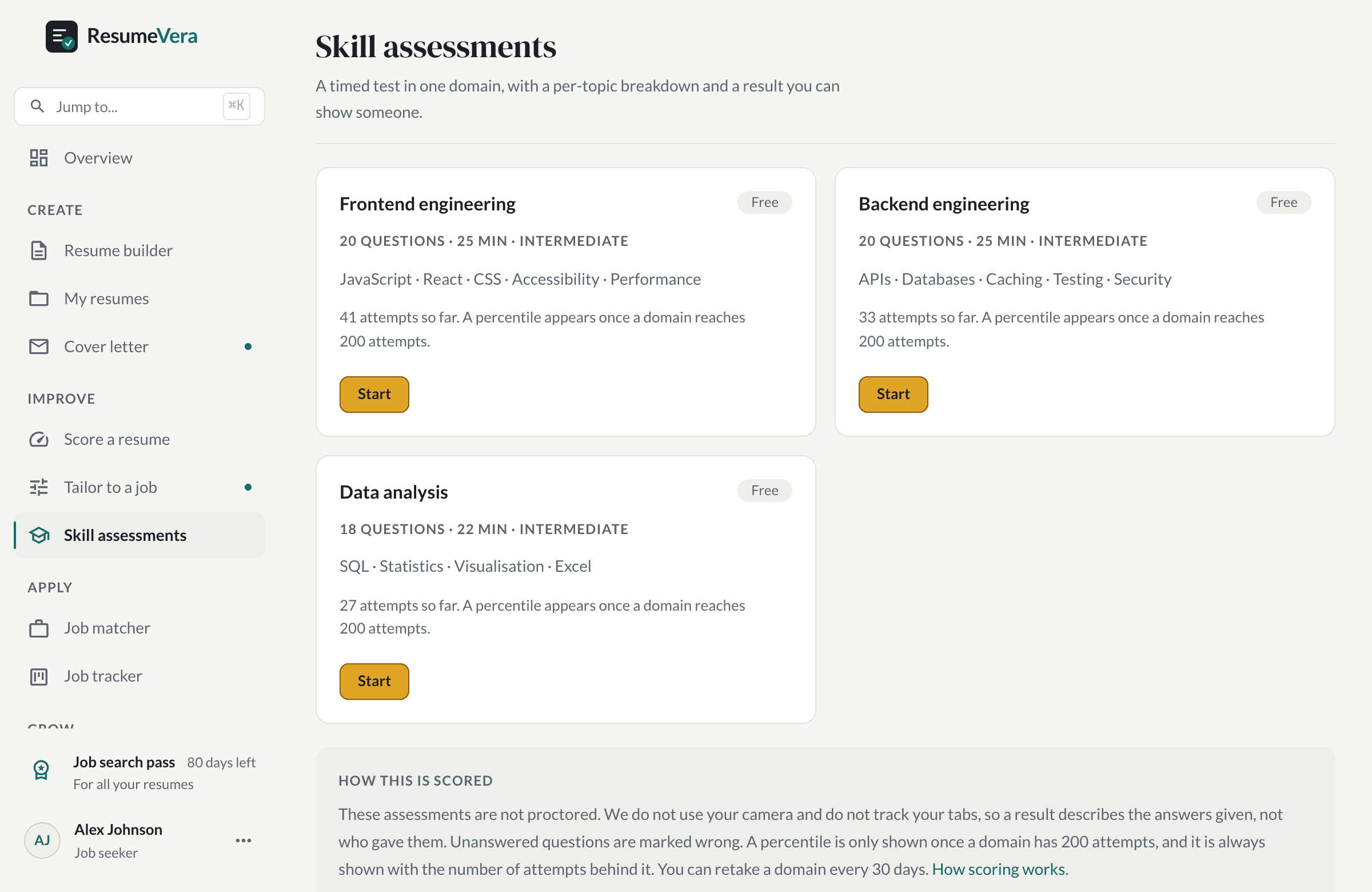
The real list. Percentiles stay hidden until a domain has enough attempts to mean anything.
Is your resume ATS-ready?
Run a free ATS score check and get specific improvements in seconds.