Leadership skills for your resume in 2026
What leadership looks like before and after a management title, and how to show it with people and outcomes rather than adjectives.
Market Demand
Demand and salary data
Demand for leadership and management skills is projected to grow steadily through 2030, with 61% of employers ranking leadership as a core competency
Growth rate
Top industries
Learning Path
Skill levels
Beginner
Active listening, clear written and verbal communication, basic delegation, giving and receiving feedback, time management, conflict awareness, supporting team goals
Intermediate
Team building, performance management, coaching and mentoring, strategic delegation, cross-functional collaboration, change management, stakeholder communication, project leadership
Advanced
Organizational strategy, executive communication, culture building, transformational leadership, talent development programs, crisis management, P&L ownership, board-level presentations, driving organizational change at scale
Section 01
Why leadership skills are essential in 2026
Leadership is a highly valued professional skill in 2026, and it is no longer tied only to management titles. Employers look for it alongside communication, problem-solving, and adaptability.
Several forces are reshaping the modern workplace:
- AI-Driven Transformation: As artificial intelligence automates routine tasks, the uniquely human abilities of inspiring teams, making nuanced decisions, and navigating ambiguity have become more valuable than ever. Leaders who can guide teams through AI adoption while maintaining morale and purpose are in demand.
- Remote and Hybrid Work: Managing distributed teams across time zones requires a fundamentally different leadership toolkit than traditional office management. Emotional intelligence, asynchronous communication, and trust-building at a distance are now essential leadership competencies.
- Skills-Based Hiring: As more employers move to skills-based hiring, leadership is increasingly evaluated through demonstrated behaviors and outcomes rather than titles alone. This benefits professionals at all levels who can evidence leadership impact.
- Employee Engagement: Organizations now recognize that leadership quality affects retention, innovation, and revenue.
Leadership is no longer optional for career advancement. Whether you are an individual contributor looking to step into management, a mid-level manager aiming for executive roles, or a technical professional who wants to influence strategy, demonstrating leadership skills on your resume is a worthwhile career investment.
Section 02
How to showcase leadership on your resume
Leadership is one of the hardest skills to demonstrate on a resume because it is behavioral rather than technical. You cannot simply list "leadership"; you need to show evidence of leading people, projects, and outcomes through specific accomplishments. Here is how to make your leadership experience compelling and easy to scan.
Skills Section Best Practices:
- Be specific about leadership competencies: Team Leadership (12 direct reports), Cross-Functional Collaboration, Stakeholder Management, Change Management, Performance Coaching
- Include quantifiable scope: P&L Management ($5M budget), Program Management (3 concurrent workstreams), Talent Development (promoted 4 direct reports in 2 years)
- List leadership training and certifications: Certified Scrum Master, PMP, Executive Leadership Program (Wharton), Crucial Conversations Certified
Before and After Resume Bullet Examples:
| Weak Example | Strong Example |
|---|---|
| Led a team of developers | Led cross-functional team of 14 engineers and designers through 9-month product launch, delivering 2 weeks ahead of schedule and generating $2.8M in first-quarter revenue |
| Managed employees | Managed team of 8 account managers, implementing weekly coaching sessions and performance frameworks that increased team quota attainment from 72% to 94% within two quarters |
| Responsible for department operations | Directed operations for 3 regional offices (45 employees, $12M annual budget), reducing operational costs by 18% while improving employee satisfaction scores from 3.2 to 4.4 out of 5 |
| Helped with organizational change | Spearheaded company-wide digital transformation initiative across 6 departments, creating change management roadmap that achieved 89% adoption rate for new CRM platform within 90 days |
| Supervised interns and junior staff | Built and mentored internship program that grew from 3 to 15 participants annually, with 80% conversion to full-time hires, reducing external recruiting costs by $200K per year |
Key principles for leadership resume bullets:
- Quantify your scope: Team size, budget managed, revenue influenced, number of stakeholders
- Show outcomes, not activities: "Improved retention by 34%" is stronger than "conducted retention interviews"
- Demonstrate growth: Show how you developed others, promotions you facilitated, skills you coached, teams you built from scratch
- Use leadership verbs: Led, directed, spearheaded, championed, mentored, transformed, orchestrated, mobilized
Section 03
Common paths into leadership
Moving from individual contributor to people manager usually builds on work you already do. Common routes include:
- Project Management: PMP-certified project managers who lead cross-functional initiatives often transition into operational leadership roles
- Technical Leadership: Engineering managers and tech leads combine technical expertise with people management
- Sales Leadership: Sales professionals with a record of strong results can move into managing sales teams
Section 04
The leadership skills employers value most in 2026
Not all leadership skills are valued equally. In 2026, employers look for specific competencies that address the most pressing organizational challenges: navigating AI transformation, managing hybrid teams, and driving results in uncertain markets. Understanding which skills are most valued helps you target your resume and professional development strategically.
Ten leadership skills employers look for in 2026:
- Emotional Intelligence (EQ): The ability to recognize, understand, and manage your own emotions and those of others. Leaders with high EQ build stronger teams, resolve conflicts more effectively, and create psychologically safe environments where innovation thrives.
- Adaptive Leadership: The capacity to lead effectively through ambiguity, pivot strategies when circumstances change, and help teams embrace uncertainty. In a world reshaped by AI, geopolitical shifts, and rapid market changes, adaptability is a competency employers value highly.
- Communication and Influence: Clear, persuasive communication across all levels, from frontline teams to board presentations. This includes active listening, storytelling for buy-in, and the ability to translate complex ideas into actionable direction for diverse audiences.
- Coaching and Talent Development: Growing team members' skills and careers through structured feedback, development plans, and mentoring. Organizations increasingly expect leaders to be coaches, not just taskmasters. Leaders who develop talent are rewarded with higher retention and team performance.
- Strategic Thinking: The ability to connect day-to-day decisions to long-term organizational goals, identify emerging opportunities and threats, and allocate resources for maximum impact. Strategic leaders are promoted faster because they demonstrate executive-level judgment.
- Decision-Making Under Uncertainty: Making timely, well-reasoned decisions with incomplete information. In 2026, the pace of change means leaders rarely have perfect data. The ability to act decisively while managing risk is highly prized.
- Cross-Functional Collaboration: Breaking down silos and orchestrating work across departments, geographies, and functional areas. As organizations become more matrixed, leaders who can align diverse teams around shared goals are indispensable.
- Change Management: Planning and executing organizational changes, from technology implementations to restructuring, while maintaining team morale and productivity.
- Diversity, Equity, and Inclusion: Building inclusive teams and creating environments where all team members can contribute their best work. DEI competency is now a standard expectation for leadership roles, particularly at director level and above.
- AI Literacy for Leaders: Understanding how AI tools affect workflows, making informed decisions about AI adoption, and guiding teams through AI-driven transformation. Organizations increasingly expect leaders to be informed advocates for responsible AI use.
The strongest leaders demonstrate multiple competencies working together. For example, using emotional intelligence to drive change management or combining strategic thinking with cross-functional collaboration to deliver organizational transformation. Single-skill leaders are being replaced by multidimensional leaders who adapt their style to the situation.
Section 05
Learning roadmap: developing leadership skills
Unlike technical skills that can be learned through courses and certifications alone, leadership development requires a combination of formal learning, real-world practice, and continuous self-reflection. Here is a structured roadmap for building leadership capabilities at every career stage.
Stage 1: Individual Contributor with Leadership Potential (Months 1-6)
- Self-awareness: Take assessments like StrengthsFinder, DISC, or Myers-Briggs to understand your natural leadership style
- Active listening and empathy: Practice focused listening in meetings, summarize what others say before responding
- Initiative and ownership: Volunteer for cross-functional projects, lead a workstream, or coordinate a team initiative without being asked
- Feedback skills: Learn to give specific, actionable, and kind feedback using frameworks like SBI (Situation-Behavior-Impact)
- Time management and prioritization: Master your own productivity before trying to manage others' work
Recommended resources: "The First 90 Days" by Michael Watkins, "Radical Candor" by Kim Scott, Dale Carnegie Leadership Training
Stage 2: Emerging Leader / Team Lead (Months 6-18)
- Delegation: Learn to assign work based on team members' strengths and development goals, not just availability
- One-on-one meetings: Establish regular check-ins focused on development, obstacles, and career aspirations, not just status updates
- Conflict resolution: Practice mediating disagreements and finding solutions that address underlying interests, not just surface positions
- Meeting facilitation: Learn to run efficient, inclusive meetings that drive decisions and action items
- Stakeholder management: Build relationships with peers and senior leaders across the organization
- Basic coaching skills: Ask questions that help team members discover solutions rather than always providing answers
Recommended resources: "Crucial Conversations" by Patterson et al., Certified Scrum Master (CSM) for agile leadership, Harvard ManageMentor online courses
Stage 3: Manager / Senior Manager (Year 2-3)
- Performance management: Set clear goals (OKRs or KPIs), conduct meaningful performance reviews, manage underperformance constructively
- Team building: Hire effectively, onboard new team members, build team culture, and foster psychological safety
- Strategic communication: Present to executives, write persuasive proposals, and communicate vision to your team
- Change management: Lead your team through organizational changes, technology transitions, or process improvements
- Budget and resource management: Understand P&L basics, justify headcount requests, and allocate resources strategically
- Cross-functional leadership: Lead initiatives that span multiple departments without direct authority over all participants
Recommended resources: PMP certification, Prosci Change Management certification, executive coaching, MBA or Executive Education programs
Stage 4: Director / Executive Leader (3+ years)
- Organizational strategy: Contribute to or lead strategic planning, market analysis, and competitive positioning
- Culture building: Define and reinforce organizational values through your decisions, communications, and behaviors
- Executive presence: Communicate with confidence, credibility, and clarity at the board and C-suite level
- Talent strategy: Build succession plans, identify high-potential employees, and create leadership development programs
- External leadership: Represent your organization at industry events, build strategic partnerships, and contribute to thought leadership
Key tip: Leadership is learned through experience more than study. Seek out stretch assignments; lead a difficult project, manage a larger team, take on a turnaround situation, or volunteer for a cross-functional initiative. The most compelling leadership evidence on your resume comes from real challenges you navigated, not courses you completed.
Related Roles
Roles that use this skill
Explore resume examples for roles that commonly require this skill.
Questions
Frequently asked questions
Skill Guides
Explore More Skills
Browse all our in-demand skill guides with demand data and learning paths.
View all skillsProve it
Claiming a skill and demonstrating one are different things
A timed assessment puts a result behind the word on your resume. Question count and duration are shown up front, and percentiles stay hidden until a domain has enough attempts to mean anything.
Join the waitlist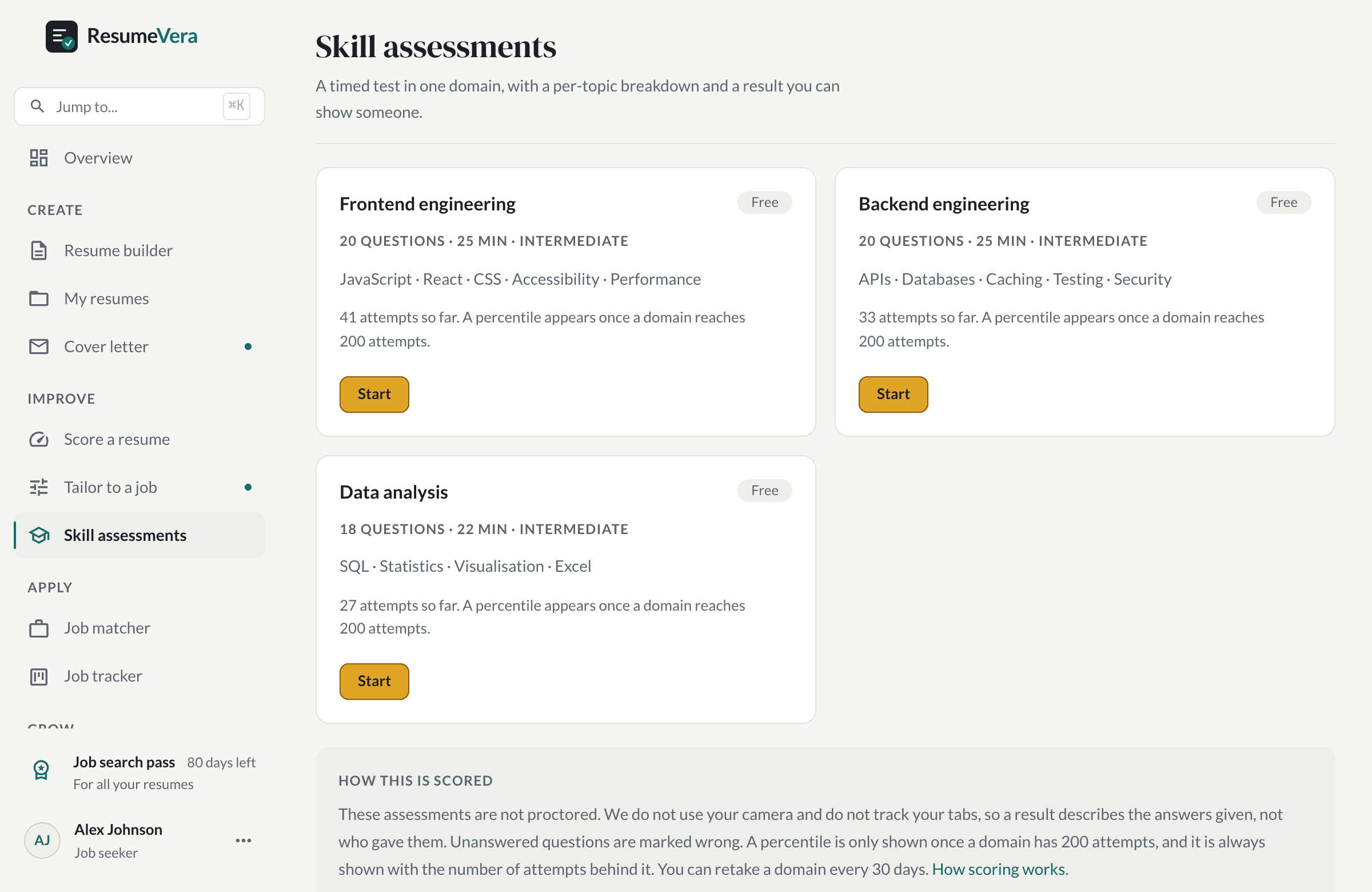
The real list. Percentiles stay hidden until a domain has enough attempts to mean anything.
Is your resume ATS-ready?
Run a free ATS score check and get specific improvements in seconds.