Machine learning skills for your resume in 2026
The machine learning skills employers list, from data preparation to deployment, and how to show model work with measurable results.
Market Demand
Demand and salary data
40% projected growth in AI/ML roles through 2030; 70% YoY increase in AI literacy requirements
Growth rate
Top industries
Learning Path
Skill levels
Beginner
Understand core ML concepts: supervised vs. unsupervised learning, regression, classification, clustering, and evaluation metrics (accuracy, precision, recall, F1). Can use scikit-learn for basic model training, perform data preprocessing with pandas and numpy, and create visualizations with matplotlib. Familiar with Jupyter notebooks and basic statistics.
Intermediate
Proficient in deep learning frameworks (PyTorch, TensorFlow/Keras), neural network architectures (CNNs, RNNs, Transformers), feature engineering, hyperparameter tuning, and model evaluation. Can build end-to-end ML pipelines, work with NLP tasks (text classification, sentiment analysis), and deploy models using Flask/FastAPI. Understands cross-validation, regularization, and ensemble methods.
Advanced
Expert in production ML systems: MLOps (MLflow, Kubeflow, SageMaker), distributed training, model optimization (quantization, pruning, distillation), large language model fine-tuning (LoRA, PEFT), RAG architectures, reinforcement learning, and custom model architectures. Can design ML system architectures, manage model serving at scale, and lead ML teams. Deep understanding of research papers and ability to implement novel approaches.
Section 01
Why machine learning skills are essential in 2026
Machine learning has become a highly sought-after technical skill.
The explosion of generative AI and large language models has further accelerated demand. Companies across every industry, from healthcare to finance to manufacturing, are racing to integrate AI capabilities into their products and operations. This is not limited to tech companies; traditional enterprises in banking, pharmaceuticals, automotive, and retail are building dedicated AI teams.
Machine learning knowledge is increasingly expected even in roles that are not purely ML-focused. Product managers, software engineers, data analysts, and business leaders are all expected to have at least foundational ML understanding. For those with deep ML expertise, the career opportunities are wide.
Section 02
How to list machine learning skills on your resume
Effectively showcasing Machine Learning skills on your resume requires demonstrating both technical depth and real-world impact. Hiring managers at top AI companies review hundreds of ML resumes. Here is how to make yours stand out.
Resume Bullet Point Examples
Before (Weak):
- Built machine learning models using Python
- Worked on NLP projects
- Experience with deep learning and neural networks
After (Strong):
- Developed and deployed a real-time fraud detection system using XGBoost and feature engineering on 50M+ daily transactions, reducing false positives by 34% and saving $2.3M annually in fraud losses
- Fine-tuned LLaMA-3 70B model using LoRA and PEFT for domain-specific medical question answering, achieving 91% accuracy on clinical benchmarks while reducing inference costs by 60% through 4-bit quantization
- Built end-to-end MLOps pipeline using MLflow, Kubeflow, and SageMaker, automating model training, evaluation, and deployment for 12 production models serving 8M daily predictions with 99.9% uptime
- Designed multi-modal recommendation engine combining collaborative filtering, NLP embeddings, and user behavior signals, increasing click-through rate by 28% and revenue per user by $4.50/month across 15M users
Skills section format: Organize ML skills into clear subcategories: ML Frameworks: PyTorch, TensorFlow, scikit-learn, Hugging Face Transformers | MLOps: MLflow, Kubeflow, SageMaker, Docker | Specializations: NLP, Computer Vision, Recommender Systems, LLM Fine-tuning | Languages: Python, SQL, Spark
Include links to your GitHub repositories, published papers, or Kaggle profile. For ML roles, a portfolio of well-documented projects carries more weight than generic bullet points. If you have publications or competition rankings, create a dedicated "Research & Publications" section on your resume.
Section 03
Top machine learning certifications and courses
The right certifications and courses signal ML competency to employers, especially for career changers or early-career professionals. Here are useful credentials for your resume in 2026.
Industry-Recognized Certifications
1. AWS Certified Machine Learning Engineer - Associate: Validates your ability to build, deploy and maintain ML solutions on AWS, from data preparation to model training in SageMaker and monitoring in production. It replaced the Machine Learning Specialty, which AWS retired in March 2026.
2. Google Professional Machine Learning Engineer: Validates expertise in designing, building, and productionizing ML models on Google Cloud. Covers ML model architecture, data processing, and responsible AI practices. Particularly relevant for roles at Google Cloud partner companies. Preparation time: 2-4 months.
Top Learning Platforms
Stanford CS229 (Machine Learning): Andrew Ng's foundational course remains a widely respected course for ML theory. Freely available on YouTube and Coursera, it provides the mathematical foundation that separates ML engineers from API users.
Fast.ai: The practical deep learning course that emphasizes building working models quickly. Known for its top-down teaching approach, fast.ai is ideal for software engineers transitioning to ML.
DeepLearning.AI Specializations: A comprehensive series covering deep learning, NLP, MLOps, and generative AI. The MLOps Specialization is particularly valuable for engineers focused on production ML systems.
When listing certifications on your resume, place them in a dedicated section with the certification date. Active certifications demonstrate current knowledge, which is critical in the rapidly evolving ML field.
Section 04
Machine learning job market trends in 2026
The ML job market in 2026 is shaped by several transformative trends that directly impact how you should position your skills and career strategy.
Generative AI and LLM Specialization
A major trend is the value placed on generative AI expertise. Specialists in LLM fine-tuning, RAG (Retrieval-Augmented Generation) architectures, and prompt engineering are sought after. Companies are building dedicated generative AI teams, and engineers who can fine-tune open-source models (LLaMA, Mistral, Gemma) for domain-specific applications are in demand.
MLOps and Production ML
The industry has shifted from valuing model development alone to prioritizing end-to-end ML systems. MLOps engineers who can build reliable training pipelines, model monitoring, feature stores, and automated retraining systems are now as valuable as research scientists. Tools like MLflow, Kubeflow, Weights & Biases, and cloud-native ML services are essential skills.
AI Safety and Responsible AI
As AI regulation increases globally, companies need ML professionals who understand fairness, bias mitigation, model explainability, and AI governance. Skills in responsible AI frameworks, adversarial robustness, and AI auditing are becoming differentiators for senior ML roles, especially in regulated industries like healthcare and finance.
Edge ML and Efficient Inference
The deployment of ML models on edge devices, mobile platforms, and IoT systems is growing rapidly. Knowledge of model compression, quantization, pruning, and frameworks like ONNX, TensorRT, and Core ML is valuable for roles in automotive, manufacturing, and consumer electronics.
Cross-Functional AI Roles
Companies increasingly seek ML professionals who combine technical skills with domain expertise. AI product managers, ML-focused solutions architects, and AI strategy consultants are emerging roles. The ability to translate business problems into ML solutions and communicate results to non-technical stakeholders is a valuable skill.
Section 05
Building a machine learning portfolio
For ML roles, your portfolio is often more important than your resume. A strong collection of well-documented projects demonstrates practical skills in a way that bullet points cannot. Here is how to build a portfolio that impresses hiring managers at top AI companies.
Essential Portfolio Projects
1. End-to-End ML Pipeline: Build a complete project from data collection through deployment. Use a real-world dataset, perform thorough EDA, engineer meaningful features, train and evaluate multiple models, and deploy the best model as an API with monitoring. Document your decision-making process, not just the final result. This single project demonstrates every skill an ML engineer needs.
2. LLM Application: Build a RAG-based application that fine-tunes or leverages a large language model for a specific domain (legal document analysis, medical Q&A, code review). Include proper evaluation metrics, prompt engineering strategies, and cost optimization. This demonstrates a skill many ML employers want in 2026.
3. Computer Vision Project: Implement an object detection, image segmentation, or visual search system. Use transfer learning with pre-trained models, custom data augmentation, and model optimization for deployment. Deploy on a cloud platform or edge device to show production readiness.
4. Kaggle Competitions: Participate in Kaggle competitions and document your approach, even if you don't win. A top-10% finish in a popular competition demonstrates competitive ML skills. Write a detailed blog post or notebook explaining your solution, feature engineering, and model selection process.
Portfolio Presentation Tips
Host projects on GitHub with clean README files that include: problem statement, approach, results with metrics, architecture diagrams, and instructions for reproduction. Create a personal website or blog that presents your projects as case studies. Link your portfolio prominently from your resume and LinkedIn profile. Include Jupyter notebooks with clear markdown explanations. ML hiring managers frequently review code quality and analytical thinking in notebooks.
Quality beats quantity. Three well-documented, end-to-end projects are worth more than twenty Jupyter notebooks with incomplete analyses. Focus on projects that solve real problems with measurable outcomes.
Related Roles
Roles that use this skill
Explore resume examples for roles that commonly require this skill.
Questions
Frequently asked questions
Skill Guides
Explore More Skills
Browse all our in-demand skill guides with demand data and learning paths.
View all skillsProve it
Claiming a skill and demonstrating one are different things
A timed assessment puts a result behind the word on your resume. Question count and duration are shown up front, and percentiles stay hidden until a domain has enough attempts to mean anything.
Join the waitlist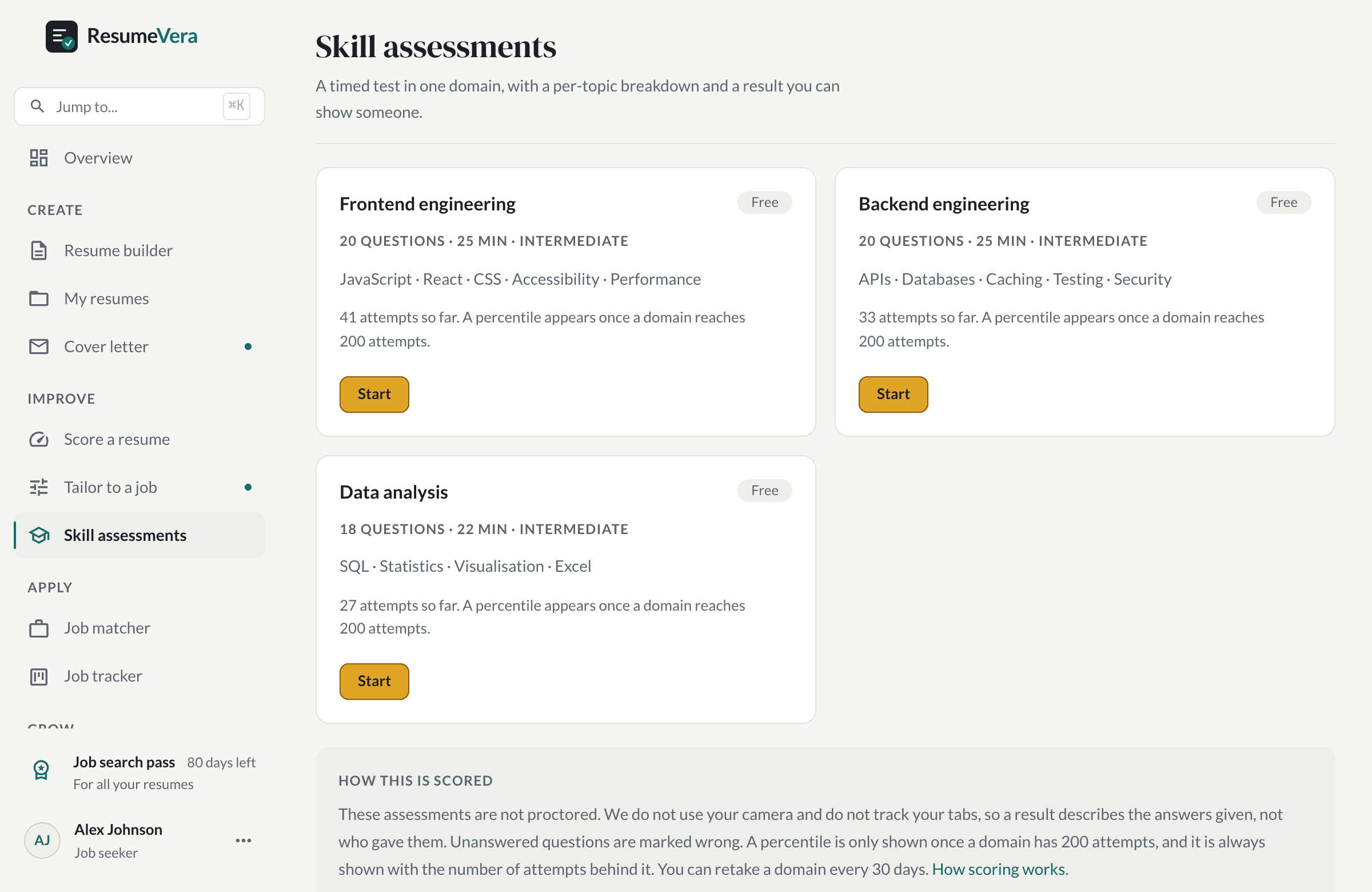
The real list. Percentiles stay hidden until a domain has enough attempts to mean anything.
Is your resume ATS-ready?
Run a free ATS score check and get specific improvements in seconds.