Python skills for your resume in 2026
Python across data, AI, backend and automation, the libraries employers list with it, and how to show Python projects on your resume.
Market Demand
Demand and salary data
17% projected growth in software developer roles through 2033 (BLS), with Python-specific roles growing faster
Growth rate
Top industries
Learning Path
Skill levels
Beginner
Variables, data types, loops, functions, conditionals, basic data structures (lists, dicts), pip package management, virtual environments
Intermediate
Object-oriented programming, decorators, generators, error handling, REST APIs (Flask/FastAPI), pandas, numpy, unit testing with pytest
Advanced
Async programming (asyncio), system design, ML frameworks (TensorFlow/PyTorch), distributed computing, performance optimization, contributing to open-source projects
Section 01
Why Python is essential in 2026
Python is one of the most widely used programming languages in 2026, and that is not accidental; Python's versatility spans web development, artificial intelligence, data science, automation, cybersecurity, and cloud computing, making it indispensable across virtually every technology sector.
Demand for Python is driven in large part by AI and machine learning work. Data roles that ask for Python are common in both the US and India.
What makes Python particularly valuable in 2026 is its central role in the AI revolution. Every major AI framework, TensorFlow, PyTorch, LangChain, Hugging Face Transformers, uses Python as its primary interface. As companies race to integrate generative AI into their products, Python developers who understand prompt engineering, RAG architectures, and LLM fine-tuning are in demand.
Beyond AI, Python remains the backbone of:
- Data Science and Analytics: pandas, numpy, and scikit-learn power data pipelines at companies from startups to Fortune 500s
- Backend Web Development: Django, Flask, and FastAPI serve millions of requests daily at companies like Instagram, Spotify, and Dropbox
- DevOps and Automation: Python scripts automate infrastructure, CI/CD pipelines, and cloud resource management
- Cybersecurity: Security analysts use Python for penetration testing, log analysis, and threat detection
Whether you are a career changer or an experienced developer adding Python to your toolkit, Python is a strong investment in your career.
Section 02
How to list Python on your resume
Simply writing "Python" in your skills section is not enough to catch a recruiter's eye. Hiring managers look for specific evidence of how you have used Python to deliver business value. Here is how to transform generic Python mentions into compelling resume content.
Skills Section Best Practices:
- List specific Python libraries and frameworks: Python, Django, Flask, FastAPI, pandas, NumPy, scikit-learn, TensorFlow, pytest
- Group by category: "Languages: Python, SQL, JavaScript" and "Frameworks: Django, FastAPI, React"
- Include your Python version experience if relevant (Python 3.10+)
Before and After Resume Bullet Examples:
| Weak Example | Strong Example |
|---|---|
| Used Python for data analysis | Built automated data pipeline in Python (pandas, NumPy) that processed 2M+ daily transactions, reducing report generation time from 4 hours to 12 minutes |
| Wrote Python scripts | Developed Python-based ETL scripts using Apache Airflow that consolidated data from 5 source systems, improving data accuracy by 34% |
| Worked on machine learning projects | Trained and deployed customer churn prediction model using scikit-learn and FastAPI, achieving 91% accuracy and saving $2.3M in annual retention costs |
| Did backend development in Python | Architected RESTful API with Django REST Framework serving 50K+ daily active users with 99.9% uptime and sub-200ms response times |
| Used Python for automation | Automated 15 manual QA workflows using Python and Selenium, reducing testing cycle from 3 days to 4 hours and catching 28% more defects |
Key principles for Python resume bullets:
- Quantify impact: Include metrics like processing speed, cost savings, accuracy improvements, or user counts
- Name the tools: Mention specific libraries (pandas, TensorFlow, Flask) rather than just "Python"
- Show business value: Connect your technical work to business outcomes: revenue, time saved, errors reduced
- Use action verbs: Start with "Built," "Architected," "Developed," "Optimized," or "Automated"
Section 03
Python skill gap: what employers want vs what candidates show
Despite Python's popularity, there is a significant gap between what employers search for and what most candidates actually demonstrate on their resumes. Understanding this gap gives you a major advantage in the job market.
Keywords employers often list:
- AI/ML Frameworks: TensorFlow, PyTorch, scikit-learn, LangChain, Hugging Face: many Python job postings mention at least one ML framework
- Cloud Integration: AWS (Boto3, Lambda, SageMaker), GCP (BigQuery, Vertex AI), Azure: cloud-native Python skills are widely sought
- Data Engineering: Apache Spark (PySpark), Airflow, Kafka, dbt: data pipeline skills are increasingly required even for non-data-engineer roles
- API Development: FastAPI and Flask are both common for APIs, with Django remaining strong for full-stack roles
- Testing and Quality: pytest, unittest, type hints (mypy), code quality tools (black, ruff, flake8)
What Candidates Typically Show:
- Generic "Python" without specific libraries or frameworks
- Academic projects without business impact metrics
- Outdated libraries (Python 2.x references, old framework versions)
- No mention of testing, CI/CD, or production deployment experience
- Missing cloud platform experience
How to Bridge the Gap:
The most successful Python resumes in 2026 demonstrate a T-shaped skill profile: broad Python fundamentals with deep expertise in one high-demand area. Here are combinations employers often recruit for:
- Python + AI/LLM Engineering: Experience with LangChain, vector databases (Pinecone, ChromaDB), RAG architectures, and prompt engineering
- Python + Cloud-Native Development: Serverless functions (AWS Lambda), containerization (Docker), and infrastructure-as-code (Terraform with Python CDK)
- Python + Data Engineering: Building production data pipelines with Airflow, PySpark, and modern data stack tools
- Python + Backend at Scale: FastAPI or Django with async capabilities, caching (Redis), message queues (Celery, RabbitMQ), and database optimization
Candidates who list specific Python frameworks and quantify their impact stand out from those who simply list "Python" as a skill. Include version numbers, deployment contexts, and measurable outcomes to differentiate your resume from the competition.
Section 04
Learning roadmap: from beginner to advanced
Whether you are starting from scratch or looking to level up your Python expertise, this structured roadmap will guide you from beginner to advanced proficiency, with estimated timelines and recommended resources for each stage.
Stage 1: Python Fundamentals (Weeks 1-8)
- Core syntax: variables, data types, operators, string formatting
- Control flow: if/else, for/while loops, list comprehensions
- Functions: parameters, return values, scope, lambda functions
- Data structures: lists, tuples, dictionaries, sets
- File I/O and error handling (try/except)
- Modules and pip package management
Recommended resources: Python.org official tutorial, Automate the Boring Stuff with Python (free online), freeCodeCamp Python course
Stage 2: Intermediate Python (Months 3-6)
- Object-oriented programming: classes, inheritance, polymorphism, encapsulation
- Decorators and generators
- Working with APIs: requests library, JSON parsing, authentication
- Database interaction: SQLAlchemy, psycopg2, MongoDB with PyMongo
- Web frameworks: Start with Flask or FastAPI for REST APIs
- Data manipulation: pandas fundamentals, NumPy arrays
- Testing: pytest, mocking, test-driven development basics
- Version control: Git workflows for Python projects
Recommended resources: Real Python tutorials, Corey Schafer YouTube series, Django or FastAPI official documentation
Stage 3: Advanced Python (Months 7-12+)
- Asynchronous programming: asyncio, aiohttp, async database drivers
- System design: microservices architecture, message queues, caching strategies
- Performance optimization: profiling (cProfile), Cython, multiprocessing
- Machine learning: scikit-learn for classical ML, TensorFlow or PyTorch for deep learning
- Cloud deployment: Docker containerization, AWS Lambda, CI/CD pipelines
- Advanced data engineering: Apache Airflow, PySpark, streaming data
Recommended resources: Fluent Python (book), fast.ai courses, AWS/GCP Python SDK documentation
Stage 4: Expert / Specialization (12+ months)
- Choose a specialization: AI/ML Engineering, Data Engineering, Backend Architecture, or DevOps
- Contribute to open-source Python projects on GitHub
- Build a portfolio of 3-5 production-quality projects with documentation
- Obtain relevant certifications: AWS Certified Machine Learning, Google Professional Data Engineer
- Write technical blog posts or speak at Python meetups/conferences
Key tip: Build projects at every stage. Employers value demonstrated ability over course certificates. A well-documented GitHub portfolio with real-world projects is your strongest resume asset alongside formal experience.
Related Roles
Roles that use this skill
Explore resume examples for roles that commonly require this skill.
Questions
Frequently asked questions
Skill Guides
Explore More Skills
Browse all our in-demand skill guides with demand data and learning paths.
View all skillsProve it
Claiming a skill and demonstrating one are different things
A timed assessment puts a result behind the word on your resume. Question count and duration are shown up front, and percentiles stay hidden until a domain has enough attempts to mean anything.
Join the waitlist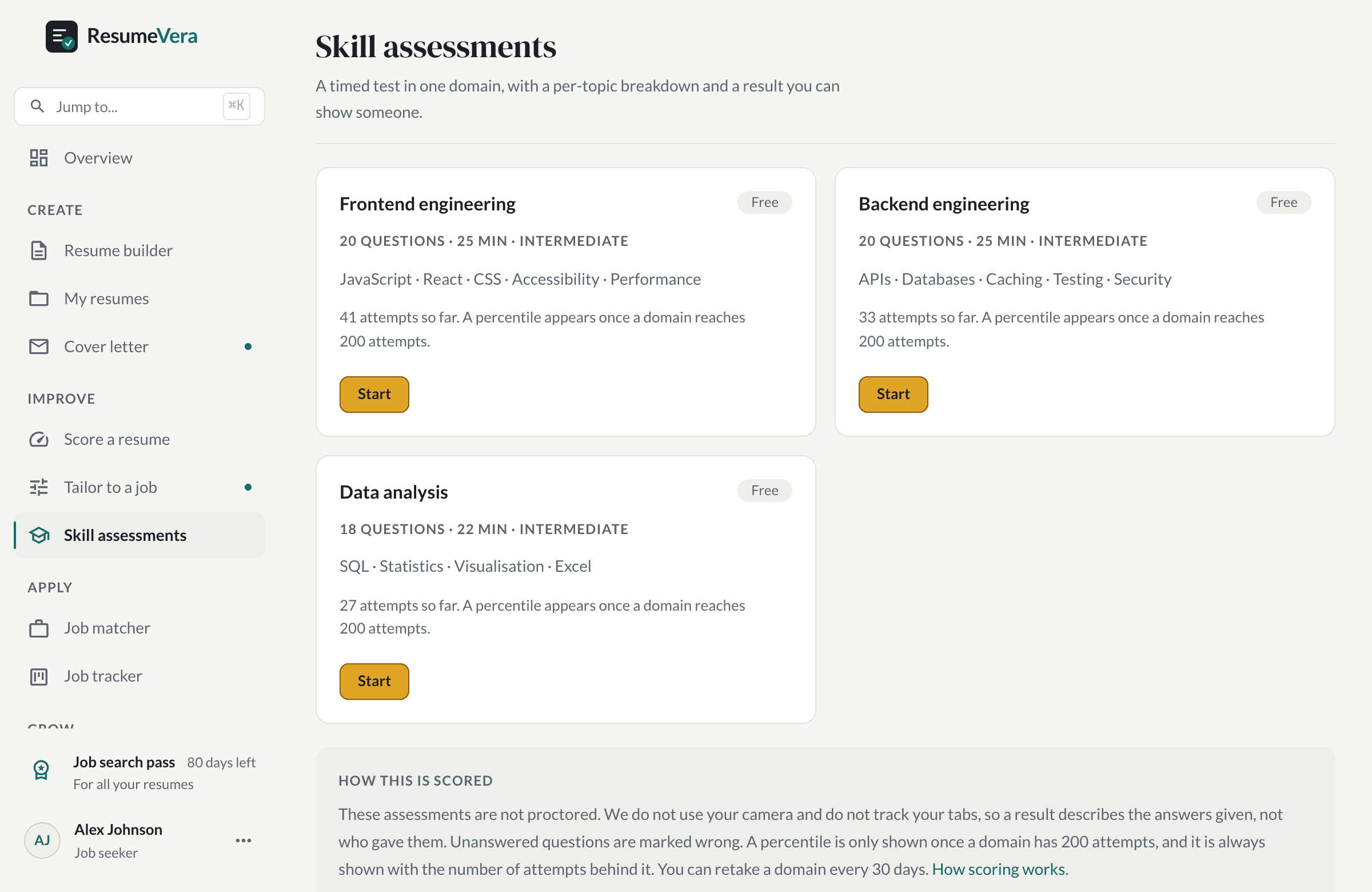
The real list. Percentiles stay hidden until a domain has enough attempts to mean anything.
Is your resume ATS-ready?
Run a free ATS score check and get specific improvements in seconds.