SQL skills for your resume in 2026
SQL from basic queries to performance tuning, the roles that use it most, and how to show database work on your resume.
Market Demand
Demand and salary data
9% projected job growth for database-related roles (BLS), with steady demand across all industries
Growth rate
Top industries
Learning Path
Skill levels
Beginner
SELECT, WHERE, ORDER BY, GROUP BY, JOINs (INNER, LEFT, RIGHT), basic aggregate functions (COUNT, SUM, AVG), INSERT/UPDATE/DELETE
Intermediate
Subqueries, CTEs, window functions (ROW_NUMBER, RANK, LAG/LEAD), indexing, query optimization, stored procedures, database design and normalization
Advanced
Query performance tuning, execution plans, partitioning, materialized views, database administration, replication, sharding, data modeling at scale
Section 01
Why SQL is essential in 2026
SQL (Structured Query Language) has remained a widely required technical skill for nearly five decades, and its relevance in 2026 is stronger than ever. While programming languages rise and fall in popularity, SQL maintains its position as the lingua franca of data, the one skill that connects data analysts, software engineers, product managers, and business intelligence professionals.
SQL is not just for database administrators; it appears in job postings for data analysts, backend developers, data engineers, business analysts, product managers, and even marketing analysts. Many open roles require SQL proficiency, which makes it a broadly useful skill across tech.
Several trends are amplifying SQL's importance in 2026:
- The Modern Data Stack: Tools like dbt, Snowflake, BigQuery, and Databricks have made SQL the primary interface for data transformation and analytics, replacing much of what was previously done in Python or proprietary ETL tools
- Analytics Engineering: The rise of analytics engineering as a discipline has created a new category of roles that are fundamentally SQL-centric
- AI and LLM Applications: Even as AI transforms the tech landscape, the data that powers AI models must be queried, cleaned, and transformed, primarily using SQL
- Cloud Data Warehouses: Snowflake, BigQuery, and Redshift have democratized access to massive datasets, but querying them still requires strong SQL skills
What makes SQL particularly valuable as a resume skill is its universality. Unlike Python or JavaScript, which are primarily developer skills, SQL bridges the gap between technical and business roles. A financial analyst who knows SQL can query databases directly instead of waiting for engineering support. A product manager with SQL skills can pull their own metrics. This versatility means SQL proficiency makes you more effective and more hireable regardless of your specific job title.
Section 02
How to list SQL on your resume
Listing SQL effectively on your resume requires specificity about which database systems you have worked with, the complexity of your queries, and the business impact of your data work. Recruiters look for much more than just the word "SQL."
Skills Section Best Practices:
- Specify database platforms: PostgreSQL, MySQL, Microsoft SQL Server, Oracle, SQLite, Snowflake, BigQuery
- List related tools: dbt, Apache Airflow, Tableau, Power BI, Looker
- Mention query complexity: Window functions, CTEs, query optimization, stored procedures
- Include data modeling skills: Star schema, normalization, dimensional modeling
Before and After Resume Bullet Examples:
| Weak Example | Strong Example |
|---|---|
| Wrote SQL queries for reporting | Developed 25+ automated SQL reports using PostgreSQL window functions and CTEs, reducing manual reporting time by 80% and serving 4 business units |
| Managed databases | Optimized 15 critical SQL queries on a 500M-row PostgreSQL database, reducing average execution time from 45 seconds to under 2 seconds through indexing and query restructuring |
| Did data analysis using SQL | Built customer segmentation model using advanced SQL (window functions, recursive CTEs) in BigQuery, identifying 3 high-value segments that drove $4.2M in targeted campaign revenue |
| Created stored procedures | Designed and maintained 30+ stored procedures in SQL Server for financial reconciliation workflows, processing $50M+ in daily transactions with zero data discrepancies |
| Worked with data warehouses | Architected Snowflake data warehouse schema using dimensional modeling (star schema), consolidating 8 data sources and enabling self-service analytics for 200+ business users |
Key principles for SQL resume bullets:
- Name your database: Always specify PostgreSQL, MySQL, SQL Server, or Snowflake rather than generic "SQL"
- Show query sophistication: Mention window functions, CTEs, query optimization, or execution plan analysis to demonstrate depth
- Quantify data scale: Include row counts, data volumes, or number of data sources to show you work with real-world data
- Connect to business outcomes: Tie your SQL work to revenue, cost savings, time reduction, or user impact
- Highlight data modeling: Employers value candidates who can design schemas, not just query existing ones
Section 03
Pay for roles that use SQL
Pay for SQL work depends on the role, your experience, your specialization, the database technologies you use, and location.
SQL rarely exists in isolation on a resume. Combining SQL with Python, cloud platforms, or BI tools makes you useful in more roles.
Section 04
SQL skill gap: what employers want vs what candidates show
Despite SQL being one of the most widely taught technical skills, a significant gap persists between what employers actually need and what candidates demonstrate. Understanding these gaps will help you position your SQL skills more effectively on your resume.
Keywords employers often list in 2026:
- Window Functions: ROW_NUMBER(), RANK(), DENSE_RANK(), LAG(), LEAD(), NTILE(): mid-to-senior SQL postings often ask for these, yet many resumes leave them out
- CTEs and Recursive Queries: Common Table Expressions for readable, maintainable query logic: essential for analytics engineering roles
- Query Performance Optimization: EXPLAIN/ANALYZE, indexing strategies, partitioning, materialized views: a common skill gap for SQL developers
- Modern Data Stack Tools: dbt (data build tool), Snowflake, BigQuery, Databricks SQL: rapidly growing in job postings
- Data Modeling: Star schema, snowflake schema, dimensional modeling, slowly changing dimensions (SCD): critical for data engineering roles
What Candidates Typically Show:
- Basic SELECT/WHERE/JOIN queries without demonstrating advanced techniques
- No mention of specific database platforms (just generic "SQL")
- Missing query optimization or performance tuning experience
- No experience with cloud data warehouses (Snowflake, BigQuery, Redshift)
- Academic datasets rather than production-scale data experience
- No mention of data modeling or schema design capabilities
Bridging the Gap: High-Impact Skill Combinations:
- SQL + dbt + Snowflake: The modern analytics engineering stack: a combination many analytics engineering roles ask for
- SQL + Python: Pair SQL for data extraction and transformation with Python for complex analysis and ML: a widely sought data skill pairing
- SQL + Cloud Platforms: BigQuery (GCP), Redshift/Athena (AWS), or Synapse (Azure): cloud SQL expertise is increasingly mandatory
- SQL + BI Tools: Combine SQL with Tableau, Looker, or Power BI for end-to-end analytics capabilities
One of the most overlooked resume strategies is demonstrating query optimization skills. In technical interviews, candidates are frequently tested on their ability to analyze slow queries and improve performance. On your resume, include specific examples: "Optimized query execution time from 45s to 0.8s by implementing composite indexes and restructuring subqueries into CTEs." This immediately signals production-level SQL expertise that distinguishes you from candidates with only academic experience.
Section 05
Learning roadmap: from beginner to advanced
SQL is one of the fastest technical skills to reach a productive level with, but mastering it for senior roles requires systematic progression. Here is a structured roadmap with realistic timelines and recommended resources.
Stage 1: SQL Fundamentals (Weeks 1-6)
- SELECT statements: columns, aliases, DISTINCT
- Filtering: WHERE, AND/OR, IN, BETWEEN, LIKE, IS NULL
- Sorting and limiting: ORDER BY, LIMIT/TOP
- Aggregate functions: COUNT, SUM, AVG, MIN, MAX with GROUP BY and HAVING
- JOINs: INNER JOIN, LEFT JOIN, RIGHT JOIN, FULL OUTER JOIN, CROSS JOIN
- Basic data manipulation: INSERT, UPDATE, DELETE
- Practice platform: Complete 50+ problems on LeetCode SQL or HackerRank
Recommended resources: SQLBolt (free interactive), Mode Analytics SQL tutorial, Khan Academy SQL course
Stage 2: Intermediate SQL (Months 2-4)
- Subqueries: scalar, column, table subqueries, correlated subqueries
- Common Table Expressions (CTEs): WITH clause, recursive CTEs
- Window functions: ROW_NUMBER, RANK, DENSE_RANK, LAG, LEAD, running totals, moving averages
- Set operations: UNION, INTERSECT, EXCEPT
- Database design: normalization (1NF through 3NF), primary and foreign keys, constraints
- Indexing basics: B-tree indexes, when and where to create indexes
- Practice: Build a complete database schema for a real-world application
Recommended resources: PostgreSQL official documentation, "Learning SQL" by Alan Beaulieu, DataCamp SQL track
Stage 3: Advanced SQL (Months 5-8)
- Query optimization: reading execution plans (EXPLAIN ANALYZE), identifying bottlenecks
- Advanced indexing: composite indexes, partial indexes, covering indexes, index-only scans
- Stored procedures and functions: PL/pgSQL or T-SQL
- Data warehousing concepts: star schema, fact and dimension tables, slowly changing dimensions
- Cloud SQL platforms: Snowflake, BigQuery, or Redshift. Complete a hands-on project
- dbt (data build tool): models, tests, documentation, incremental materialization
- Transaction management: ACID properties, isolation levels, deadlock prevention
Recommended resources: "SQL Performance Explained" by Markus Winand, use-the-index-luke.com, dbt documentation and tutorials
Stage 4: Expert / Production-Ready (8+ months)
- Database administration: replication, backup strategies, monitoring, capacity planning
- Advanced data modeling: dimensional modeling, data vault, activity schema
- Build a portfolio project: design and implement a data warehouse with automated pipelines
- Contribute to open-source database tools or write technical content about SQL optimization
Key tip: SQL mastery comes from working with real, messy data at scale. Supplement structured learning with Kaggle datasets, public APIs, or personal projects that require you to model, load, and query non-trivial data.
Related Roles
Roles that use this skill
Explore resume examples for roles that commonly require this skill.
Questions
Frequently asked questions
Skill Guides
Explore More Skills
Browse all our in-demand skill guides with demand data and learning paths.
View all skillsProve it
Claiming a skill and demonstrating one are different things
A timed assessment puts a result behind the word on your resume. Question count and duration are shown up front, and percentiles stay hidden until a domain has enough attempts to mean anything.
Join the waitlist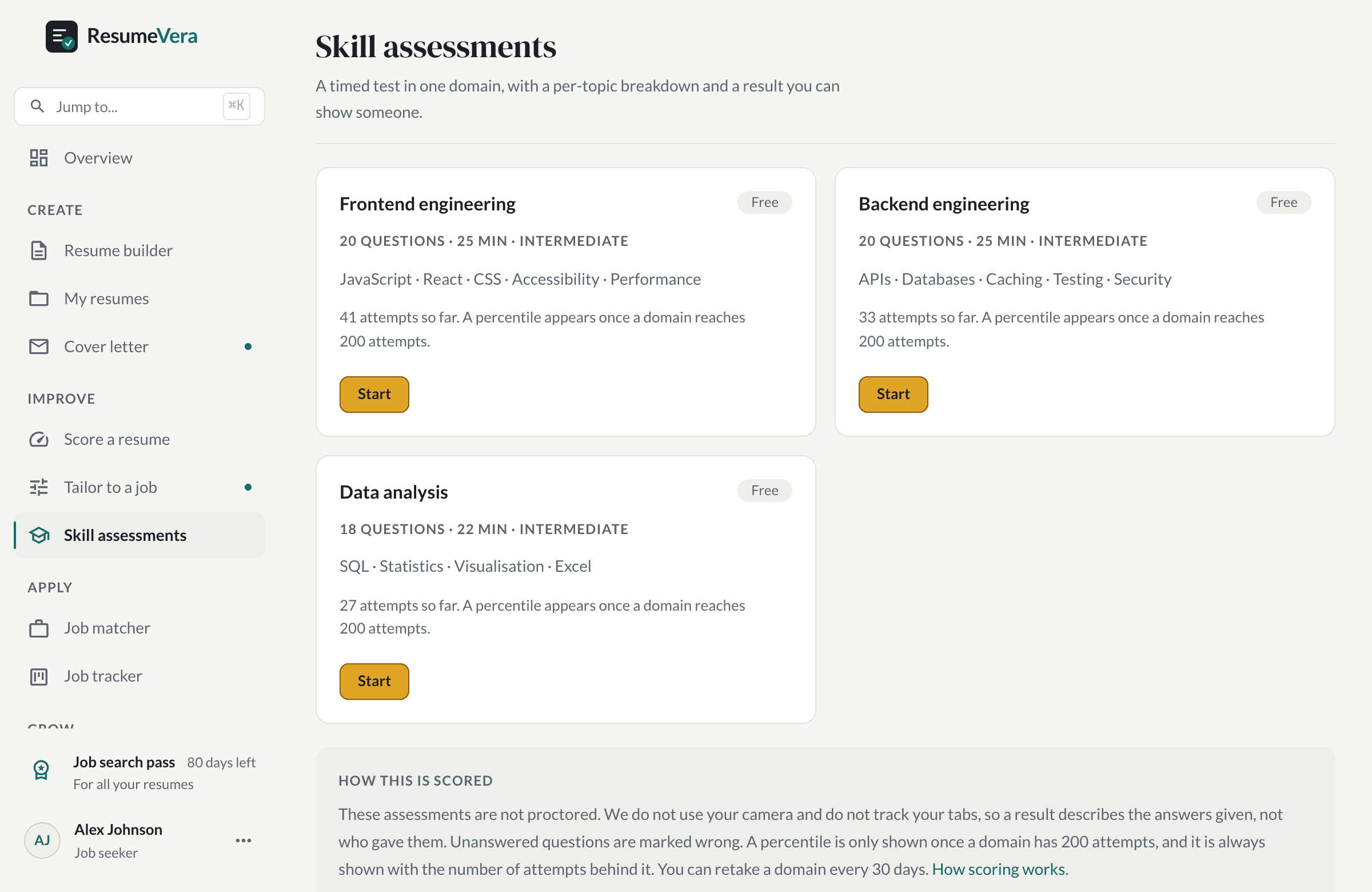
The real list. Percentiles stay hidden until a domain has enough attempts to mean anything.
Is your resume ATS-ready?
Run a free ATS score check and get specific improvements in seconds.