JavaScript skills for your resume in 2026
JavaScript across frontend, backend and full-stack roles, the frameworks employers list with it, and how to show your work on a resume.
Market Demand
Demand and salary data
22% projected growth in software developer roles over the next decade (BLS), with JavaScript as a core requirement
Growth rate
Top industries
Learning Path
Skill levels
Beginner
Variables (let/const), data types, functions, arrays, objects, DOM manipulation, event handling, ES6+ syntax, basic async (callbacks, promises)
Intermediate
Closures, prototypes, async/await, Fetch API, ES modules, TypeScript basics, React or Vue fundamentals, Node.js/Express, npm ecosystem, testing with Jest
Advanced
Design patterns, performance optimization, SSR/SSG (Next.js), state management, WebSockets, service workers, build tools (Vite/Webpack), CI/CD, micro-frontends, contributing to open source
Section 01
Why JavaScript is essential in 2026
JavaScript is the language of the web in 2026, running on virtually every website, mobile app, and an increasing number of server-side applications.
JavaScript developers are hired across e-commerce, fintech, big data analytics, and SaaS. Roles span frontend, backend, and full-stack positions.
Several key trends are driving JavaScript's continued popularity in 2026:
- TypeScript Adoption: TypeScript, JavaScript's typed superset, has become standard in professional development, and many job postings list it as preferred or required
- Full-Stack JavaScript: With Node.js, Deno, and Bun on the backend and React, Next.js, Vue, and Svelte on the frontend, JavaScript enables true full-stack development with a single language
- AI-Powered Development: JavaScript frameworks are rapidly integrating AI capabilities. Vercel's AI SDK, LangChain.js, and TensorFlow.js bring machine learning directly to web applications
- Edge Computing: Cloudflare Workers, Vercel Edge Functions, and Deno Deploy run JavaScript at the edge, creating new categories of applications and developer roles
- React Server Components: The evolution of React with Server Components and Next.js App Router has created new architectural paradigms that require deeper JavaScript expertise
Perhaps most importantly, JavaScript has a low barrier to entry. You can start building and deploying web applications within weeks, and the language keeps rewarding you as you grow. That accessibility makes JavaScript a valuable skill to add to your resume.
Section 02
How to list JavaScript on your resume
JavaScript is such a broadly used language that simply listing it on your resume barely differentiates you. The key is to specify your ecosystem expertise, which frameworks, runtimes, and tools you use, and demonstrate measurable impact through your work.
Skills Section Best Practices:
- Always list TypeScript alongside JavaScript if you have experience with it
- Specify frameworks: React, Next.js, Vue.js, Angular, Svelte, Node.js, Express, NestJS
- Include build and tooling: Vite, Webpack, ESLint, Prettier, npm/pnpm/yarn
- Mention testing tools: Jest, Vitest, Cypress, Playwright, React Testing Library
- List deployment platforms: Vercel, AWS, Cloudflare, Netlify
Before and After Resume Bullet Examples:
| Weak Example | Strong Example |
|---|---|
| Built web applications using JavaScript | Architected and shipped a Next.js 14 e-commerce platform with TypeScript, serving 150K monthly active users with 99.8% uptime and sub-1s page loads (Core Web Vitals all green) |
| Used React for frontend development | Migrated legacy jQuery codebase to React 18 with TypeScript, reducing bundle size by 42%, improving Lighthouse performance score from 55 to 94, and decreasing page load time by 2.3 seconds |
| Worked on Node.js backend | Built real-time notification system using Node.js, WebSockets, and Redis pub/sub, handling 10K+ concurrent connections with sub-50ms latency across 3 microservices |
| Did frontend testing | Established comprehensive testing strategy with Jest and Cypress, achieving 87% code coverage across 200+ React components and reducing production bugs by 63% quarter-over-quarter |
| Created responsive websites | Developed responsive, accessible (WCAG 2.1 AA) web application using React and Tailwind CSS, improving mobile conversion rate by 28% and achieving 98 Lighthouse accessibility score |
Key principles for JavaScript resume bullets:
- Specify your stack: "React 18 + TypeScript + Next.js 14" is far more compelling than "JavaScript"
- Include performance metrics: Lighthouse scores, load times, bundle sizes, Core Web Vitals
- Show architectural thinking: Mention SSR vs CSR decisions, state management choices, API design
- Highlight TypeScript: TypeScript experience is a significant differentiator; always mention it prominently
- Mention accessibility: WCAG compliance and accessibility testing show professional maturity
Section 03
JavaScript skill gap: what employers want vs what candidates show
The JavaScript ecosystem evolves rapidly, creating persistent gaps between what employers need and what candidates demonstrate. Here are common gaps in the 2026 job market.
Keywords employers often list:
- TypeScript: Listed in many JavaScript job postings, yet often missing from resumes. This is an easy way to stand out.
- React 18+ / Next.js 14+: Server Components, Suspense, streaming SSR. Employers want candidates who understand the latest React architecture, not just class components.
- Testing: Jest, Vitest, Cypress, Playwright, React Testing Library. Senior JS postings often ask for testing skills that resumes leave out.
- Performance Optimization: Core Web Vitals, bundle analysis, lazy loading, code splitting. Critical for senior roles.
- State Management: Zustand, Jotai, TanStack Query (React Query). The ecosystem has shifted away from Redux in many modern applications.
- Accessibility (a11y): WCAG 2.1 compliance, ARIA attributes, screen reader testing. Increasingly required, especially at larger companies.
What Candidates Typically Show:
- Generic "JavaScript" and "React" without version specificity or advanced concepts.
- No mention of TypeScript despite it being nearly universal in professional codebases.
- Missing testing experience. A major red flag for senior positions.
- Outdated patterns: class components, Redux boilerplate, Create React App (deprecated).
- No performance metrics or Web Vitals awareness.
- Portfolio projects without production deployment, monitoring, or CI/CD.
How to Bridge the Gap:
- Adopt TypeScript immediately: If you know JavaScript, TypeScript is a 2-4 week learning investment that instantly makes your resume more competitive. Start typing your existing projects.
- Learn modern React patterns: Server Components, Suspense boundaries, streaming SSR with Next.js App Router. These are the topics interviewers focus on in 2026.
- Add testing to every project: Write unit tests (Jest/Vitest), component tests (Testing Library), and E2E tests (Playwright). Testing coverage on your GitHub projects signals professional-grade development habits.
- Measure and optimize performance: Use Lighthouse, Web Vitals, and bundle analyzers. Include specific metrics in your resume bullets: "Improved LCP from 4.2s to 1.1s" is far more compelling than "optimized performance."
The strongest JavaScript candidates in 2026 show a modern, production-tested stack: TypeScript + React 18+ or Next.js 14+ + testing + CI/CD + performance awareness. This complete picture is what helps candidates get callbacks.
Section 04
Learning roadmap: from beginner to advanced
JavaScript has one of the broadest ecosystems of any programming language, which can make learning paths feel overwhelming. This roadmap provides a structured progression from zero to production-ready developer, with clear milestones at each stage.
Stage 1: JavaScript Fundamentals (Weeks 1-8)
- Core language: variables (let, const), data types, operators, template literals
- Control flow: if/else, switch, for/while loops, array methods (map, filter, reduce)
- Functions: declarations, expressions, arrow functions, closures, higher-order functions
- Objects and arrays: destructuring, spread/rest operators, object methods
- DOM manipulation: querySelector, event listeners, dynamic content creation
- Asynchronous JavaScript: callbacks, Promises, async/await, Fetch API
- ES6+ features: modules (import/export), classes, optional chaining, nullish coalescing
Recommended resources: javascript.info (The Modern JavaScript Tutorial), freeCodeCamp JavaScript course, Eloquent JavaScript (free online book)
Stage 2: Frontend Framework + TypeScript (Months 3-6)
- TypeScript fundamentals: types, interfaces, generics, type narrowing, utility types
- React fundamentals: components, JSX, props, state, hooks (useState, useEffect, useRef, useMemo)
- React ecosystem: React Router, form handling, context API, custom hooks
- Styling approaches: CSS Modules, Tailwind CSS, styled-components
- API integration: REST APIs, data fetching patterns, loading/error states
- Basic testing: Jest or Vitest, React Testing Library for component tests
- Build tools: Vite, understanding of bundling, dev servers, HMR
Recommended resources: React official documentation (react.dev), TypeScript Handbook, Josh Comeau's Joy of React course
Stage 3: Full-Stack and Production Skills (Months 7-12)
- Next.js: App Router, Server Components, SSR/SSG/ISR, API routes, middleware
- Node.js backend: Express or NestJS, REST API design, authentication (JWT, OAuth)
- Database integration: PostgreSQL with Prisma, MongoDB with Mongoose
- State management: Zustand or Jotai for client state, TanStack Query for server state
- Advanced testing: E2E testing with Playwright or Cypress, mocking strategies, CI integration
- Deployment: Vercel, AWS, Docker basics, environment variables, CI/CD with GitHub Actions
- Performance: Core Web Vitals optimization, code splitting, image optimization, caching
Recommended resources: Next.js documentation, Node.js official guides, Testing JavaScript by Kent C. Dodds
Stage 4: Senior-Level Mastery (12+ months)
- Architecture: micro-frontends, monorepo management (Turborepo), design systems
- Advanced TypeScript: conditional types, mapped types, template literal types, type-level programming
- Performance engineering: bundle analysis, tree shaking, service workers, streaming rendering
- Build a comprehensive portfolio: 3-5 production-deployed projects with CI/CD, monitoring, and documentation
- Contribute to open-source JavaScript/TypeScript projects
- Stay current: follow TC39 proposals, framework RFCs, and ecosystem developments
Key tip: The JavaScript ecosystem changes rapidly. Focus on mastering fundamentals and one framework deeply (React/Next.js is the safest bet for employability in 2026) rather than spreading thin across multiple frameworks. Deep expertise in one stack is more valuable than surface-level knowledge of many.
Related Roles
Roles that use this skill
Explore resume examples for roles that commonly require this skill.
Questions
Frequently asked questions
Skill Guides
Explore More Skills
Browse all our in-demand skill guides with demand data and learning paths.
View all skillsProve it
Claiming a skill and demonstrating one are different things
A timed assessment puts a result behind the word on your resume. Question count and duration are shown up front, and percentiles stay hidden until a domain has enough attempts to mean anything.
Join the waitlist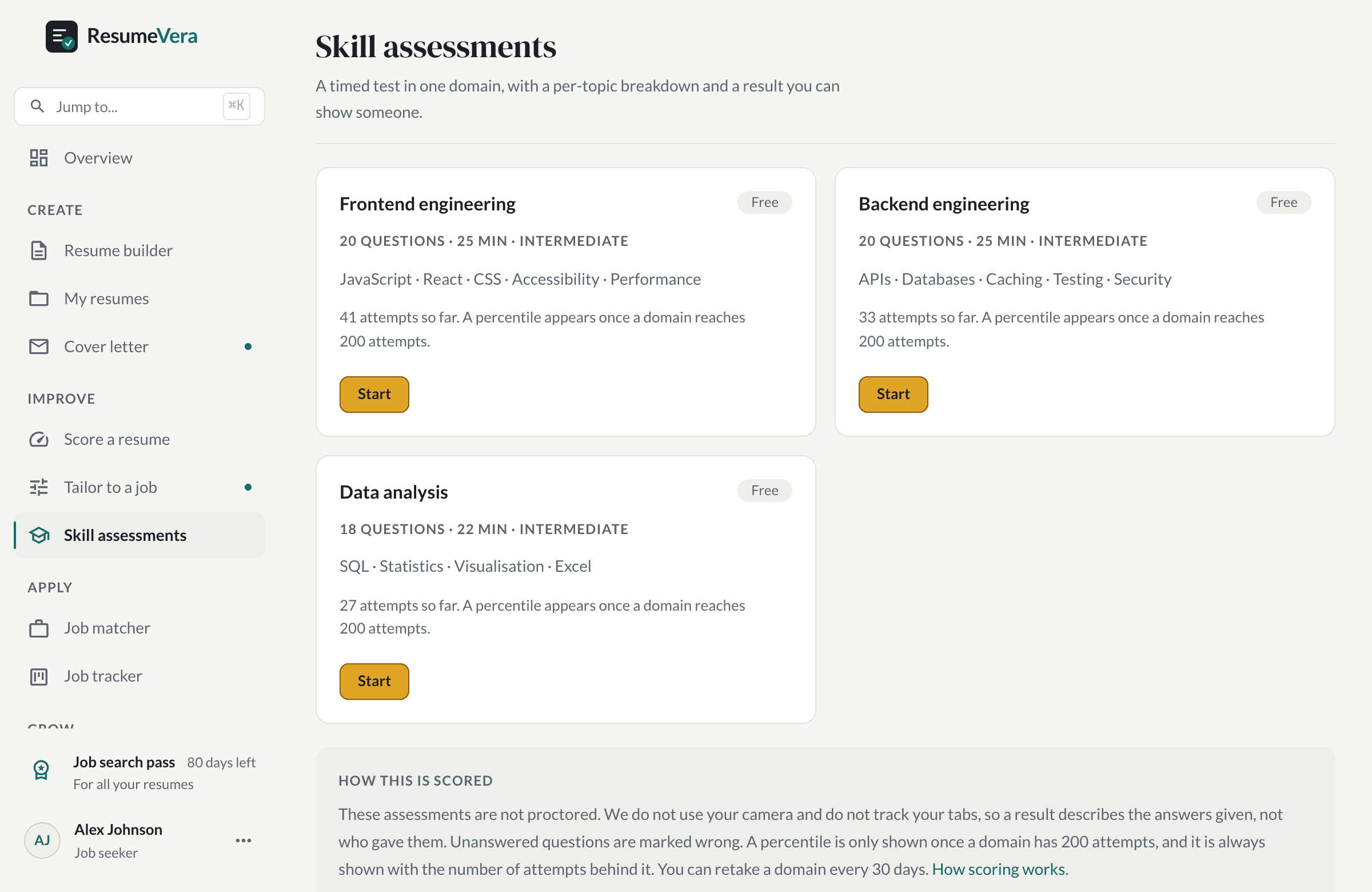
The real list. Percentiles stay hidden until a domain has enough attempts to mean anything.
Is your resume ATS-ready?
Run a free ATS score check and get specific improvements in seconds.