React skills for your resume in 2026
React from components to performance work, the tools employers list with it, and how to show frontend work with numbers from your own projects.
Market Demand
Demand and salary data
67% year-over-year growth in React developer demand globally (2025-2026)
Growth rate
Top industries
Learning Path
Skill levels
Beginner
JSX syntax, functional components, props, useState, useEffect, conditional rendering, lists and keys, event handling, basic form handling
Intermediate
Custom hooks, useContext, useReducer, useMemo/useCallback, React Router, API integration with TanStack Query, component patterns, basic testing with React Testing Library
Advanced
Server Components, Suspense, streaming SSR, Next.js App Router, performance profiling, state management architecture, design systems, micro-frontends, advanced TypeScript with React
Section 01
Why React is essential in 2026
React has been one of the most widely used frontend libraries for nearly a decade, and 2026 shows no signs of that changing. Created by Meta (formerly Facebook), React powers the user interfaces of some of the most-used applications on the planet: Instagram, WhatsApp Web, Netflix, Airbnb, Uber, Shopify, and Discord all rely on React for their frontend experiences.
Several major developments have reinforced React's position in 2026:
- React Server Components (RSC): The biggest architectural shift in React's history, RSC enables components that render on the server with zero JavaScript sent to the client. This dramatically improves performance and has been widely adopted through Next.js
- Next.js as the Standard: Next.js has become the de facto framework for production React applications, with its App Router, Server Actions, and built-in optimizations making it a sought-after React skill in job postings
- React 19 Features: New features including the use() hook, Actions, form handling improvements, and enhanced Suspense capabilities have modernized the developer experience
- React Native Growth: React Native continues to grow for mobile development, meaning React skills transfer directly to mobile app development; this widens the career paths available to React developers
- AI Integration: Vercel's AI SDK and similar tools make React a common interface for building AI-powered user experiences, from chatbots to generative UI
What makes React particularly valuable compared to competing frameworks is its ecosystem maturity and job market breadth. While Vue.js, Angular, and Svelte are all capable frameworks, Companies that standardized on React years ago continue to hire for it, and new companies choose React for its talent pool, third-party library ecosystem, and community support.
For your resume, React is a high-value frontend skill to list. Recruiters often search their applicant tracking system for it, and showing deep React expertise, not just basic component building but Server Components, performance optimization, and testing, sets you apart from other frontend candidates.
Section 02
How to list React on your resume
With so many developers listing "React" on their resumes, you need to demonstrate depth and impact to stand out. Here is how to present React skills that catch attention.
Skills Section Best Practices:
- Specify React version and paradigm: React 18+, Server Components, Hooks, TypeScript
- Include the meta-framework: Next.js 14 (App Router), Remix, Gatsby
- List state management: Zustand, Jotai, TanStack Query, Context API
- Mention styling approach: Tailwind CSS, CSS Modules, styled-components, Radix UI
- Add testing tools: React Testing Library, Jest/Vitest, Cypress, Playwright, Storybook
Before and After Resume Bullet Examples:
| Weak Example | Strong Example |
|---|---|
| Built React components for the website | Architected component library of 60+ reusable React components with TypeScript and Storybook, adopted by 4 product teams and reducing feature development time by 35% |
| Used Next.js for the frontend | Led migration from Create React App to Next.js 14 App Router with Server Components, reducing initial page load by 62% (LCP from 3.8s to 1.4s) and improving SEO rankings by 40% |
| Managed state in React application | Redesigned state management architecture from Redux to Zustand + TanStack Query, eliminating 3,200 lines of boilerplate code and reducing API-related bugs by 45% |
| Worked on React Native mobile app | Developed cross-platform mobile app with React Native and Expo, achieving 95% code sharing between iOS and Android, serving 50K+ monthly active users with 4.7-star app store rating |
| Implemented responsive design | Built accessible (WCAG 2.1 AA), responsive dashboard using React, Tailwind CSS, and Radix UI primitives, supporting 12 breakpoints and achieving 98 Lighthouse accessibility score |
Key principles for React resume bullets:
- Show modern patterns: Mention Server Components, Suspense, streaming SSR; this signals you are current with React's evolution
- Include performance metrics: Core Web Vitals improvements, Lighthouse scores, bundle size reductions, render time optimizations
- Demonstrate architectural decisions: Why you chose certain state management, rendering strategies, or component patterns
- Quantify component reuse: Number of components, teams using your library, reduction in development time
- Highlight TypeScript: React + TypeScript is the standard; mentioning both together strengthens your positioning
Section 03
Pay for React roles
React developer pay depends on experience, specialization, company type, and location.
In India, company type makes a big difference: product companies and GCCs often pay more than service companies for the same React experience.
Section 04
React skill gap: what employers want vs what candidates show
The React ecosystem has undergone significant architectural changes with Server Components and the Next.js App Router, creating a widening gap between what employers need and what most candidates can demonstrate. Here is what to focus on.
Keywords employers often list:
- Next.js (App Router): Many React job postings now mention Next.js, with the App Router and Server Components increasingly expected, not just the Pages Router
- TypeScript: Many React job postings require or strongly prefer TypeScript. React + TypeScript is the expected default, not a bonus
- Server Components and SSR: Understanding of server-side rendering, React Server Components, and hydration strategies, critical for senior roles
- Testing: React Testing Library, Jest/Vitest, Cypress/Playwright; senior React postings often ask for testing skills that resumes leave out
- Performance Optimization: React Profiler, useMemo/useCallback usage, code splitting, lazy loading, Core Web Vitals optimization
- Accessibility: WCAG compliance, semantic HTML in JSX, ARIA attributes, keyboard navigation, increasingly required at larger companies
What Candidates Typically Show:
- Basic React hooks (useState, useEffect) without advanced patterns
- Class components or outdated lifecycle methods
- Redux for all state management (Zustand, Jotai, TanStack Query are now preferred in many contexts)
- Create React App (deprecated) instead of Next.js or Vite
- No testing experience; the most consistent gap across React developer resumes
- No TypeScript; still surprisingly common despite TypeScript being the industry standard
- No understanding of Server Components or modern rendering patterns
How to Bridge the Gap:
- Master Next.js App Router: Build at least one project using the App Router with Server Components, Server Actions, and streaming. This is a strong differentiator for React developers in 2026
- Add TypeScript to all React projects: Convert existing projects or start new ones with TypeScript. Learn to type props, hooks, and API responses properly
- Implement comprehensive testing: Add React Testing Library for component tests and Playwright for E2E tests to your portfolio projects. Include test coverage metrics on your resume
- Optimize for performance: Profile your React applications with React DevTools, optimize re-renders, implement code splitting with React.lazy and Suspense, and measure Core Web Vitals
- Build a design system: Create a small component library using Radix UI or Headless UI primitives with Storybook documentation. This demonstrates architectural thinking that senior roles require
The most successful React candidates in 2026 present a modern, complete skill profile: Next.js 14+ with App Router, TypeScript, testing, performance optimization, and accessibility. Candidates who show this full stack stand out from those showing only basic React component skills.
Section 05
Learning roadmap: from beginner to advanced
React has a steeper learning curve than basic HTML/CSS/JavaScript, but it rewards investment with exceptional career opportunities. This roadmap assumes basic JavaScript knowledge and guides you to production-ready React expertise.
Prerequisites: Before starting React, ensure you are comfortable with JavaScript ES6+ features (arrow functions, destructuring, spread operator, array methods, promises, async/await) and basic HTML/CSS. If not, spend 4-6 weeks on JavaScript fundamentals first.
Stage 1: React Fundamentals (Weeks 1-6)
- JSX syntax and how it compiles to JavaScript
- Functional components and props (avoid class components; they are legacy)
- State management with useState: primitives, objects, arrays
- Side effects with useEffect: API calls, subscriptions, cleanup functions
- Event handling: onClick, onChange, onSubmit, form handling
- Conditional rendering and list rendering with keys
- Component composition: children, render props, compound components
- Basic styling: CSS Modules or Tailwind CSS with React
Recommended resources: react.dev official tutorial (the new documentation is excellent), Scrimba's React course, Build 3-4 small projects (todo app, weather app, quiz game)
Stage 2: Intermediate React + TypeScript (Months 2-5)
- TypeScript with React: typing props, state, events, refs, and API responses
- Advanced hooks: useRef, useMemo, useCallback, useReducer
- Custom hooks: extracting reusable logic (useDebounce, useFetch, useLocalStorage)
- React Router: dynamic routes, nested layouts, loaders, protected routes
- Data fetching: TanStack Query (React Query) for server state management
- Client state: Context API for simple state, Zustand for complex state
- Component testing: React Testing Library with Jest or Vitest
- Component documentation: Storybook for building and testing components in isolation
Recommended resources: TypeScript Handbook, TanStack Query documentation, Epic React by Kent C. Dodds
Stage 3: Next.js and Production Skills (Months 5-10)
- Next.js App Router: file-based routing, layouts, loading states, error boundaries
- Server Components: understanding client vs server components, when to use each
- Data patterns: Server Actions, API routes, database integration (Prisma)
- Authentication: NextAuth.js / Auth.js, session management, protected routes
- Performance: Image optimization, font optimization, code splitting, analytics
- E2E testing: Playwright or Cypress for full application testing
- Deployment: Vercel, Docker, CI/CD with GitHub Actions
- SEO: metadata API, OpenGraph tags, structured data, sitemap generation
Recommended resources: Next.js official documentation, Vercel templates, Build a full-stack application (blog, e-commerce, or SaaS dashboard)
Stage 4: Senior-Level Mastery (10+ months)
- Architecture: design systems with Radix UI, mono-repo management with Turborepo
- Advanced patterns: compound components, render props, higher-order components for library code
- Performance engineering: React Profiler, bundle analysis, streaming SSR, partial prerendering
- State machines: XState for complex UI state management
- React Native: extend your skills to mobile development
- Open source: contribute to React ecosystem projects (shadcn/ui, Radix, TanStack)
Key tip: Build and deploy at least 2-3 full-stack Next.js applications to production. Employers value deployed, working applications with real users far more than tutorial projects or certificates. Include links to live applications on your resume alongside their GitHub repositories.
Related Roles
Roles that use this skill
Explore resume examples for roles that commonly require this skill.
Questions
Frequently asked questions
Skill Guides
Explore More Skills
Browse all our in-demand skill guides with demand data and learning paths.
View all skillsProve it
Claiming a skill and demonstrating one are different things
A timed assessment puts a result behind the word on your resume. Question count and duration are shown up front, and percentiles stay hidden until a domain has enough attempts to mean anything.
Join the waitlist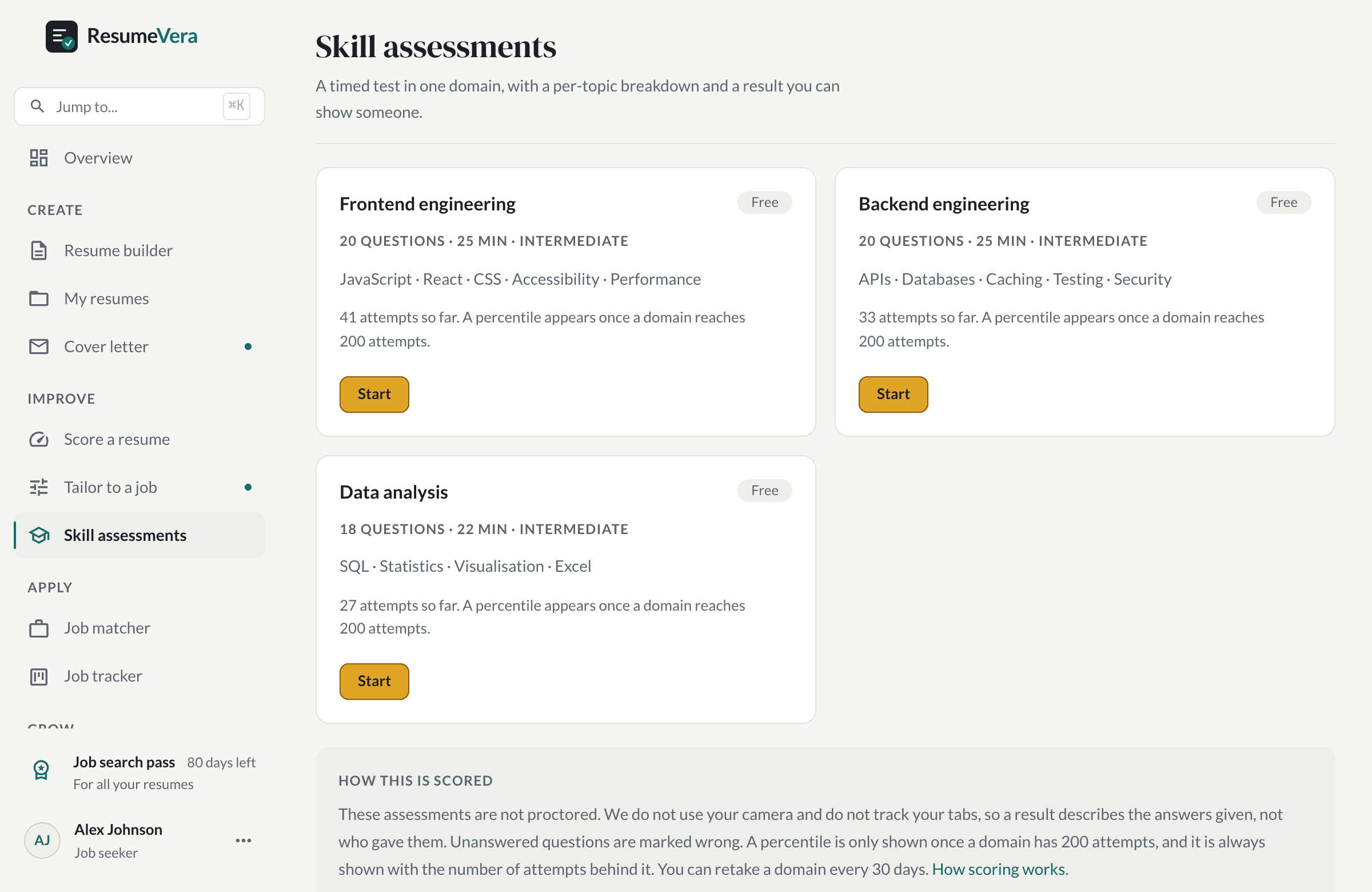
The real list. Percentiles stay hidden until a domain has enough attempts to mean anything.
Is your resume ATS-ready?
Run a free ATS score check and get specific improvements in seconds.