Salesforce CRM: The Platform Powering 9.3 Million Jobs by 2026
Salesforce developers earn $93K-$175K in 2026, with US job postings nearly doubling to 31,000+. Learn how to showcase your Salesforce expertise on your resume to land high-paying admin, developer, and architect roles.
0K+
US Job Postings
$0K+
Senior Dev Salary
0M
Projected Jobs by 2026
Roles that use Salesforce CRM, and what they pay
Median annual wage, national, May 2025
- $72,080
- $102,320
- $135,980
- $135,980*
- $166,790*
* BLS has no code for that exact title, so it is counted under a broader occupation. The role page says which. Source: BLS OEWS. These are the roles' wages, not a premium for the skill: no published source measures what one skill adds on its own.
Market Demand
Demand & Salary Data
15% year-over-year ecosystem growth rate
Growth Rate
$
+$22,000 average salary premium with Salesforce certifications
Avg. Salary Impact
31,000+ Salesforce roles in the US, up from 14,000 in 2024
Job Openings
Top Industries
Learning Path
Skill Levels
Beginner
Understand Salesforce fundamentals including navigation, standard objects (Accounts, Contacts, Opportunities, Leads), basic administration, reports and dashboards, and declarative automation with Flows. Familiar with AppExchange, data import tools, and user management basics.
Intermediate
Proficient in Salesforce administration and configuration: custom objects, validation rules, complex Flow automations, approval processes, and security models. Can build Lightning Web Components, write basic Apex triggers and classes, create SOQL queries, and integrate with external systems via REST APIs. Understands multi-org strategies and sandbox management.
Advanced
Expert in Salesforce architecture and platform development: complex Apex patterns, asynchronous processing (Batch, Queueable, Future), platform events, custom metadata-driven frameworks, and large data volume strategies. Experienced with Data Cloud, Agentforce, multi-cloud integrations (Sales, Service, Marketing, Experience Cloud), and enterprise-scale solution design across complex business domains.
Section 01
What Is Salesforce and Why Does It Matter in 2026?
Salesforce is the world's leading Customer Relationship Management (CRM) platform, commanding over 23% of the global CRM market share — more than the next four competitors combined. Originally launched in 1999 as a cloud-based sales automation tool, Salesforce has evolved into a comprehensive enterprise platform encompassing sales, service, marketing, commerce, analytics, and artificial intelligence capabilities.
In 2026, Salesforce's relevance extends far beyond traditional CRM. The platform's ecosystem is projected to create 9.3 million jobs worldwide, driven by enterprises investing heavily in digital transformation, AI-powered customer experiences, and data-driven decision making. The Salesforce economy generates trillions of dollars in business revenue annually, making it one of the most significant technology ecosystems globally.
For professionals, this translates into exceptional career opportunities. US job postings for Salesforce roles nearly doubled from 14,000 to 31,000+ between 2024 and 2025, reflecting explosive demand across industries. The consulting partner ecosystem grew 25% year-over-year, creating thousands of additional positions at implementation partners, agencies, and boutique consulting firms that serve the Salesforce market.
What makes Salesforce particularly attractive as a career skill is the 15% ecosystem growth rate, which consistently outpaces the broader tech industry. Unlike many technology skills that face commoditization or rapid obsolescence, Salesforce expertise becomes more valuable over time as organizations deepen their platform investments. Companies that adopt Salesforce rarely migrate away, creating long-term demand for professionals who can maintain, customize, and expand their implementations.
The introduction of Data Cloud and Agentforce has opened entirely new career paths within the ecosystem. Professionals with experience in these cutting-edge Salesforce technologies command a $15,000-$25,000 salary premium over their peers, reflecting the scarcity of talent in these emerging areas. As AI-powered CRM becomes the standard, these skills will only grow in importance.
Section 02
Salesforce Career Paths and Salary Data in 2026
The Salesforce ecosystem offers diverse career paths spanning administration, development, architecture, consulting, and specialized functional roles. Understanding the salary landscape helps you position your career strategy and negotiate effectively.
United States Salary Ranges
| Role | Entry-Level | Mid-Level | Senior |
|---|---|---|---|
| Salesforce Administrator | $65,000-$90,000 | $90,000-$120,000 | $120,000-$140,000 |
| Salesforce Developer | $93,000-$120,000 | $120,000-$155,000 | $155,000-$175,000 |
| Senior Salesforce Developer | $140,000-$160,000 | $160,000-$178,000 | $178,000+ |
| Salesforce Technical Architect | $150,000-$180,000 | $180,000-$220,000 | $220,000-$280,000+ |
| Salesforce Consultant | $85,000-$110,000 | $110,000-$150,000 | $150,000-$200,000 |
Salesforce developers earn between $93,000 and $175,000 in 2026, with senior developers commanding $178,000 or more. The most significant salary premiums exist at the architect level, where demand has surged 27% while supply grew just 4%, creating a massive talent gap that drives compensation upward.
Salesforce Administrators represent one of the most accessible entry points into the ecosystem, with salaries ranging from $90,000 to $140,000 depending on experience, certifications, and geographic location. Admins who develop automation and analytics skills can transition into more technical roles over time, significantly increasing their earning potential.
The addition of Data Cloud and Agentforce experience adds $15,000-$25,000 to base salary across all role levels. This premium reflects the novelty of these technologies and the scarcity of professionals with hands-on implementation experience. As organizations adopt these capabilities, early movers in the talent market benefit from significant compensation advantages.
Independent Salesforce consultants and freelancers command even higher rates, with experienced professionals billing $150-$250+ per hour depending on specialization. The consulting market continues to grow as organizations seek implementation partners and specialized expertise for complex projects.
Section 03
Essential Salesforce Certifications for Career Growth
Salesforce certifications are among the most valued credentials in the CRM and cloud technology space. Unlike many vendor certifications, Salesforce credentials carry genuine weight with employers and can meaningfully impact your salary and job prospects. The Salesforce certification program includes over 40 different credentials spanning administration, development, architecture, marketing, and specialized platform capabilities.
Must-Have Certifications by Career Path
1. Salesforce Certified Administrator — The foundational certification for anyone entering the Salesforce ecosystem. This exam validates your understanding of Salesforce configuration, user management, security settings, standard objects, reports and dashboards, and automation tools. It is a prerequisite for many advanced certifications and is the single most requested credential in Salesforce job postings. Average preparation time is 6-10 weeks for candidates with some platform familiarity.
2. Salesforce Certified Platform Developer I & II — Essential for developers building custom applications on the Salesforce platform. PDI covers Apex programming, Lightning Web Components, SOQL/SOSL queries, testing, and deployment. PDII is a significantly more challenging exam covering advanced integration patterns, asynchronous Apex, and enterprise design patterns. Developers with both certifications report an average salary premium of 20-25% compared to uncertified peers.
3. Salesforce Certified Application Architect / System Architect — For professionals pursuing architect-level roles, these domain-specific certifications validate expertise in data modeling, integration architecture, identity and access management, and development lifecycle management. Achieving the Certified Technical Architect (CTA) designation, the pinnacle of the Salesforce certification hierarchy, requires passing a rigorous review board and is held by fewer than 500 professionals worldwide.
4. Salesforce Certified Data Cloud Consultant — A newer certification that validates expertise in Salesforce's unified data platform. Given the $15K-$25K salary premium associated with Data Cloud skills, this certification offers exceptional return on investment for career-focused professionals.
5. Salesforce AI Associate / AI Specialist — These certifications cover Salesforce's AI capabilities including Einstein GPT, predictive analytics, and the Agentforce platform. As organizations embed AI throughout their Salesforce implementations, these credentials differentiate candidates who can deliver next-generation CRM solutions.
When listing certifications on your resume, place them in a prominent dedicated section. Include the full certification name, credential ID, and date earned. Active Trailhead Superbadges and Ranger status can supplement formal certifications and demonstrate hands-on expertise.
Section 04
Key Salesforce Skills and Technologies to Master
Success in the Salesforce ecosystem requires a blend of platform-specific skills and broader technology competencies. The following skills are most frequently cited in job postings and carry the greatest impact on salary and career advancement in 2026.
Core Platform Skills
Apex Programming: Salesforce's proprietary Java-like programming language is essential for developers. Mastery of Apex includes triggers, classes, batch processing, queueable and future methods, platform events, and governor limits management. Strong Apex skills are the single biggest differentiator between administrators and developers in terms of compensation, accounting for much of the salary gap between the two roles.
Lightning Web Components (LWC): The modern front-end framework for building Salesforce user interfaces. LWC uses standard web technologies including JavaScript, HTML, and CSS with a lightweight framework layer. Proficiency in LWC is now required for most developer positions, as Salesforce has deprecated the older Aura component framework for new development.
Salesforce Flows: The declarative automation tool that has replaced Process Builder and Workflow Rules. Flows enable complex business process automation without code, and advanced Flow skills are critical for administrators and consultants. Understanding when to use Flows versus Apex is a key competency that interviewers frequently assess.
SOQL and SOSL: Salesforce Object Query Language and Salesforce Object Search Language are essential for data retrieval and manipulation. Unlike standard SQL, SOQL has unique characteristics related to relationship queries, aggregate functions, and governor limits that require dedicated study.
Emerging High-Value Skills
Data Cloud: Salesforce's unified data platform for creating comprehensive customer profiles from disparate data sources. Skills in data modeling, segmentation, identity resolution, and activation within Data Cloud are among the most lucrative in the ecosystem today.
Agentforce: Salesforce's AI agent platform that enables autonomous customer interactions. Understanding how to build, configure, and deploy AI agents within the Salesforce ecosystem is rapidly becoming a key differentiator for senior professionals.
Integration Architecture: Experience with MuleSoft, Salesforce Connect, REST/SOAP APIs, and middleware platforms. As organizations connect Salesforce with dozens of external systems, integration expertise commands premium compensation. Professionals who can design scalable integration architectures are consistently among the highest-paid in the ecosystem.
DevOps and CI/CD: Salesforce DX, scratch orgs, source-driven development, and deployment automation using tools like Copado, Gearset, or native Salesforce CLI. Modern Salesforce development teams expect version control, automated testing, and continuous integration practices that mirror standard software engineering workflows.
Section 05
How to Showcase Salesforce Skills on Your Resume
Effectively presenting your Salesforce expertise on your resume requires a strategic approach that goes beyond simply listing the technology. Recruiters screening for Salesforce roles look for specific keywords, quantifiable achievements, and evidence of platform depth. Here are proven strategies to make your Salesforce resume stand out in a competitive market with 31,000+ open positions.
Resume Bullet Point Examples
Before (Weak):
- Managed Salesforce for the sales team
- Created reports and dashboards
- Did Salesforce customization and configuration
After (Strong):
- Architected and deployed a custom Salesforce CPQ solution serving 200+ sales representatives, reducing quote generation time by 65% and increasing average deal size by 18% ($2.4M annual revenue impact)
- Built 15 Lightning Web Components and 30+ Apex classes to automate the lead-to-opportunity conversion pipeline, improving sales team productivity by 40% and reducing manual data entry by 12 hours per week
- Designed and implemented a multi-cloud Salesforce integration connecting Sales Cloud, Service Cloud, and Marketing Cloud with three external ERP systems via MuleSoft, enabling a unified 360-degree customer view across 500K+ customer records
- Led Salesforce Data Cloud implementation that unified customer data from 8 disparate sources, enabling AI-powered segmentation that improved marketing campaign conversion rates by 35%
Skills section format: Organize your Salesforce skills into clear categories: Salesforce Platform: Sales Cloud, Service Cloud, Experience Cloud, Data Cloud, Agentforce | Development: Apex, Lightning Web Components, SOQL, Visualforce, Salesforce DX | Integration: MuleSoft, REST/SOAP APIs, Platform Events | Tools: Copado, Gearset, VS Code with SF Extensions. This structured approach helps both human reviewers and applicant tracking systems quickly identify your expertise areas.
Include your Trailhead profile link and Trailblazer rank if you have achieved Ranger status or hold multiple Superbadges. Many hiring managers review Trailhead profiles during screening, and a strong profile with relevant Superbadges demonstrates hands-on expertise that complements your professional experience and formal certifications.
For career changers entering the Salesforce ecosystem, emphasize transferable skills such as business analysis, process optimization, and stakeholder management alongside your platform certifications and project experience. Salesforce roles value business acumen as much as technical ability, making it one of the most accessible technology ecosystems for professionals transitioning from non-technical backgrounds.
Section 06
Salesforce Job Market Trends and Future Outlook
The Salesforce job market in 2026 presents exceptional opportunities driven by sustained enterprise adoption, AI integration, and an expanding partner ecosystem. Understanding these trends helps you make strategic career decisions and position your resume for maximum impact.
Key Market Trends
AI-Powered CRM Revolution: Salesforce's aggressive investment in AI through Einstein GPT and the Agentforce platform is transforming every role in the ecosystem. Organizations are seeking professionals who can implement AI-driven sales forecasting, automated customer service agents, and predictive analytics within their Salesforce environments. The demand for AI-skilled Salesforce professionals has grown dramatically, with related job postings increasing substantially year-over-year.
Technical Architect Talent Crisis: The most acute talent shortage exists at the architect level, where demand has increased 27% while supply grew just 4%. Technical Architects who can design enterprise-scale Salesforce solutions across multiple clouds command salaries well above $220,000. This gap is expected to widen as more enterprises undertake complex multi-cloud implementations that require seasoned architectural leadership.
Consulting Partner Ecosystem Boom: The Salesforce consulting partner ecosystem grew 25% year-over-year, creating thousands of positions at firms ranging from global system integrators (Accenture, Deloitte, Cognizant) to specialized boutique consultancies. Consulting roles offer accelerated career growth, exposure to diverse industries, and often higher total compensation through bonuses and utilization incentives.
Industry Cloud Specialization: Salesforce's industry-specific cloud solutions for financial services, healthcare, manufacturing, and the public sector are creating demand for professionals with combined platform and domain expertise. Specialists who understand both Salesforce capabilities and industry-specific regulations, workflows, and compliance requirements command premium salaries and enjoy lower competition for roles.
Data Cloud and CDP Adoption: As organizations prioritize first-party data strategies in a post-cookie world, Salesforce Data Cloud adoption is accelerating rapidly. Professionals skilled in customer data platform architecture, identity resolution, and data activation are among the most sought-after in the ecosystem, with demand far exceeding the current supply of qualified candidates.
Looking ahead, the Salesforce ecosystem shows no signs of slowing. With a 15% growth rate and Salesforce's continued investment in AI, data, and industry solutions, the platform remains one of the most reliable career bets in enterprise technology. Professionals who invest in emerging capabilities like Agentforce and Data Cloud today will be positioned to capture the highest-value roles as these technologies mature and achieve mainstream adoption over the next two to three years.
Related Roles
Roles That Use This Skill
Explore resume examples for roles that commonly require this skill.
Questions
Frequently asked questions
Skill Guides
Explore More Skills
Browse all our in-demand skill guides with demand data and learning paths.
View All SkillsProve it
Claiming a skill and demonstrating one are different things
A timed assessment puts a result behind the word on your resume. Question count and duration are shown up front, and percentiles stay hidden until a domain has enough attempts to mean anything.
Join the waitlist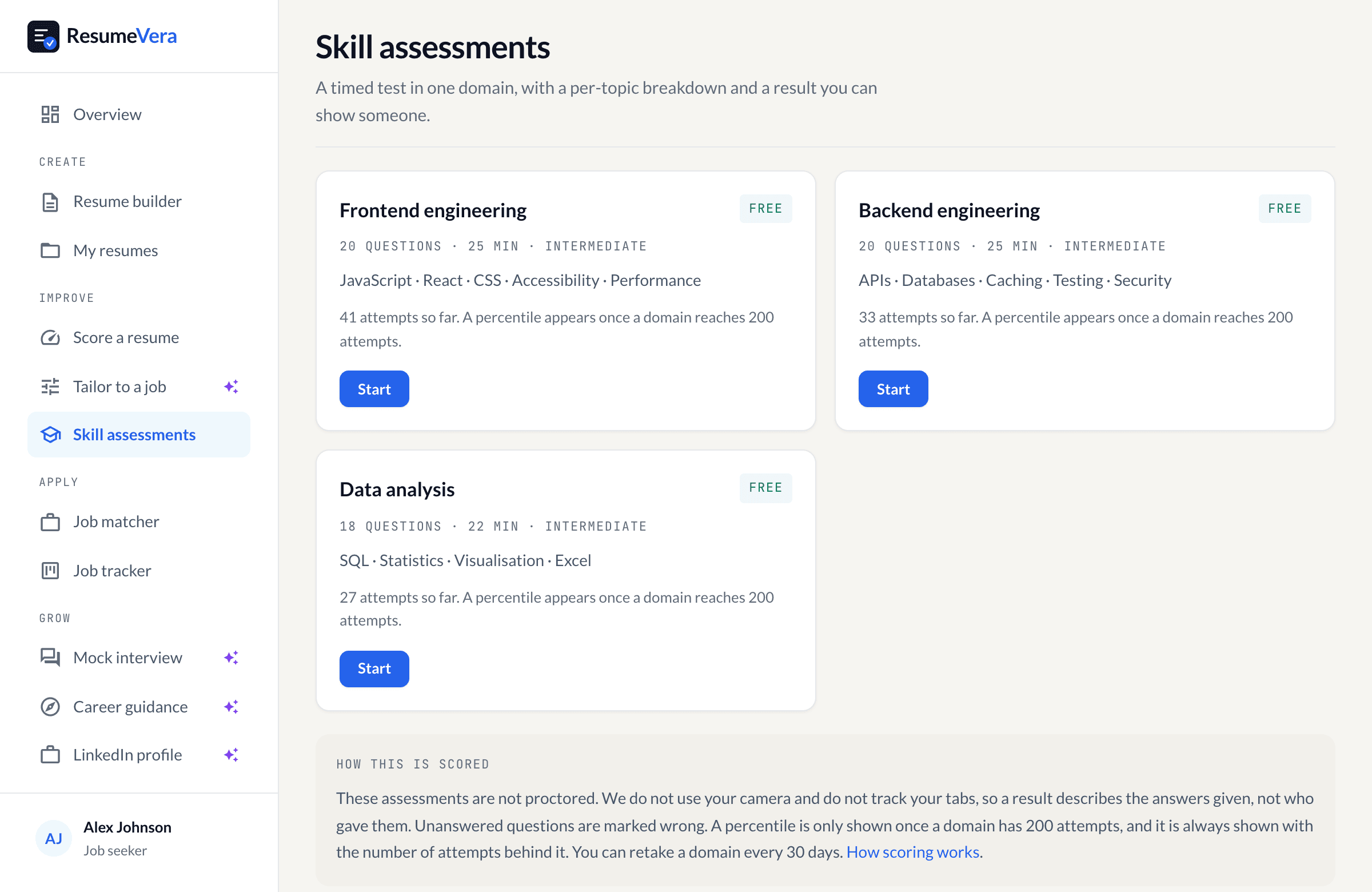
The real list. Percentiles stay hidden until a domain has enough attempts to mean anything.
Is your resume ATS-ready?
Run a free ATS score check and get specific improvements in under 60 seconds.