The careers holding up best in a frozen job market
Career Advice · ResumeVera Editorial · September 22, 2026 · 7 min read

The 2026 job market is often described as frozen, and the label fits. Hiring is cautious, openings per unemployed worker hit their lowest point outside the pandemic since 2017, and searches are taking longer. But frozen is an average, and averages hide the places where hiring is still happening. If you are considering a pivot, this is where the data points.
Where the growth actually is
The Bureau of Labor Statistics Employment Projections for 2024 to 2034, released in August 2025, show the US economy adding 5.2 million jobs over the decade, growth of 3.1 percent, much slower than the 13.0 percent recorded over the prior decade. The growth is highly concentrated. Healthcare and social assistance is projected to be the fastest-growing sector at 8.4 percent and to add nearly 2.0 million jobs, more than any other sector, driven by an aging population. Professional, scientific, and technical services is next.
Two lenses matter here, and confusing them is how people make bad choices. Fastest percentage growth is led by small occupations. Nurse practitioners are projected to grow fastest among detailed occupations, and wind turbine service technicians and solar photovoltaic installers top the percentage list, but combined they will add fewer than 20,000 jobs, so fast growth does not mean many openings. Most new jobs in absolute terms is where the real volume is, and that list is dominated by home health and personal care aides, software developers, registered nurses, and general and operations managers.
Match growth to pay before you commit
Growth alone is a trap if the pay does not work for you. Pair the projections with the May 2025 BLS wage data. Registered nurses combine large absolute growth with solid pay, a median of $97,550, rising to $112,350 at the 75th percentile and $137,470 at the 90th. Software developers remain among the best-paid large occupations despite a cooler tech hiring climate, with a median of $135,980 and a 90th percentile of $214,670, though the entry-level warning below applies here. Home health and personal care aides are the single largest source of projected new jobs, but pay sits well below the all-occupation median of about $50,980, so this is a volume opportunity, not a high-wage one.
This is exactly the kind of pairing our salary percentile guide is built to help with, growth outlook on one side, honest percentile pay on the other.
The entry-level warning
If you are early in your career, read the tech numbers carefully. Even in growing fields, the first rung has gotten harder to reach. The New York Fed put recent-graduate unemployment at 5.7 percent in early 2026, above the overall workforce rate, and entry-level postings have fallen sharply from their peak as some routine junior tasks get absorbed by AI and smaller teams. Software developer pay is strong at the median, but young-developer employment has been under particular pressure. The practical move is to target the growing fields where in-person judgment and human interaction are hard to automate, healthcare foremost among them, and to lean on internships, referrals, and demonstrable projects rather than cold applications.
How to use this if you are pivoting
Start from the most new jobs list, not the fastest growth list, if you want the best odds of an actual opening. Check the BLS wage percentiles for the target role in your metro, not just the national median. Convert the realistic percentile to take-home pay using a take-home pay calculator so the move actually improves your finances. Map the skills gap between your current role and the target, and close the smallest credible gap first.
A frozen market is not a closed one. It is a selective one. The people who do best in it are the ones who aim at the specific fields still adding jobs, go in with clear eyes about the pay, and stop treating the whole economy as if it were a single number.
Sources
- US Bureau of Labor Statistics, Employment Projections, 2024 to 2034, released August 2025.
- US Bureau of Labor Statistics, Occupational Employment and Wage Statistics, May 2025, released May 15, 2026.
- Federal Reserve Bank of New York, Labor Market for Recent College Graduates, Q1 2026 data.
Questions
Frequently asked questions
Get Free ATS Tips Every Week
Actionable resume and ATS tips, when we publish them. No spam. Unsubscribe any time.
Related Articles

Laid Off in 2026? Here's How to Rebuild Your Resume Fast
Getting laid off is disorienting, but the job market rewards people who move quickly and strategically. This practical guide walks you through rebuilding your resume, explaining gaps with confidence, and landing interviews within weeks of a layoff.
Read More

Should You Include a Photo on Your Resume in the United States?
Learn why including a photo on your resume is discouraged in the United States, the legal implications under EEOC and Title VII, how resume photo norms differ globally, and what personal information American recruiters actually expect to see in 2026.
Read More

The Netherlands Didn't Just Wake Up and Win. Neither Will Your Career — Here's the Playbook
Ronald Koeman's Dutch squad didn't reach the 2026 World Cup by accident. They had a four-year playbook. Your career needs one too. Here's the strategic framework that separates planned careers from accidental ones.
Read More
Try it
Check this against your own resume
The post above is general. Your file is not. The checker reads it the way a parser would and tells you which of these points it actually breaks.
Check your resume free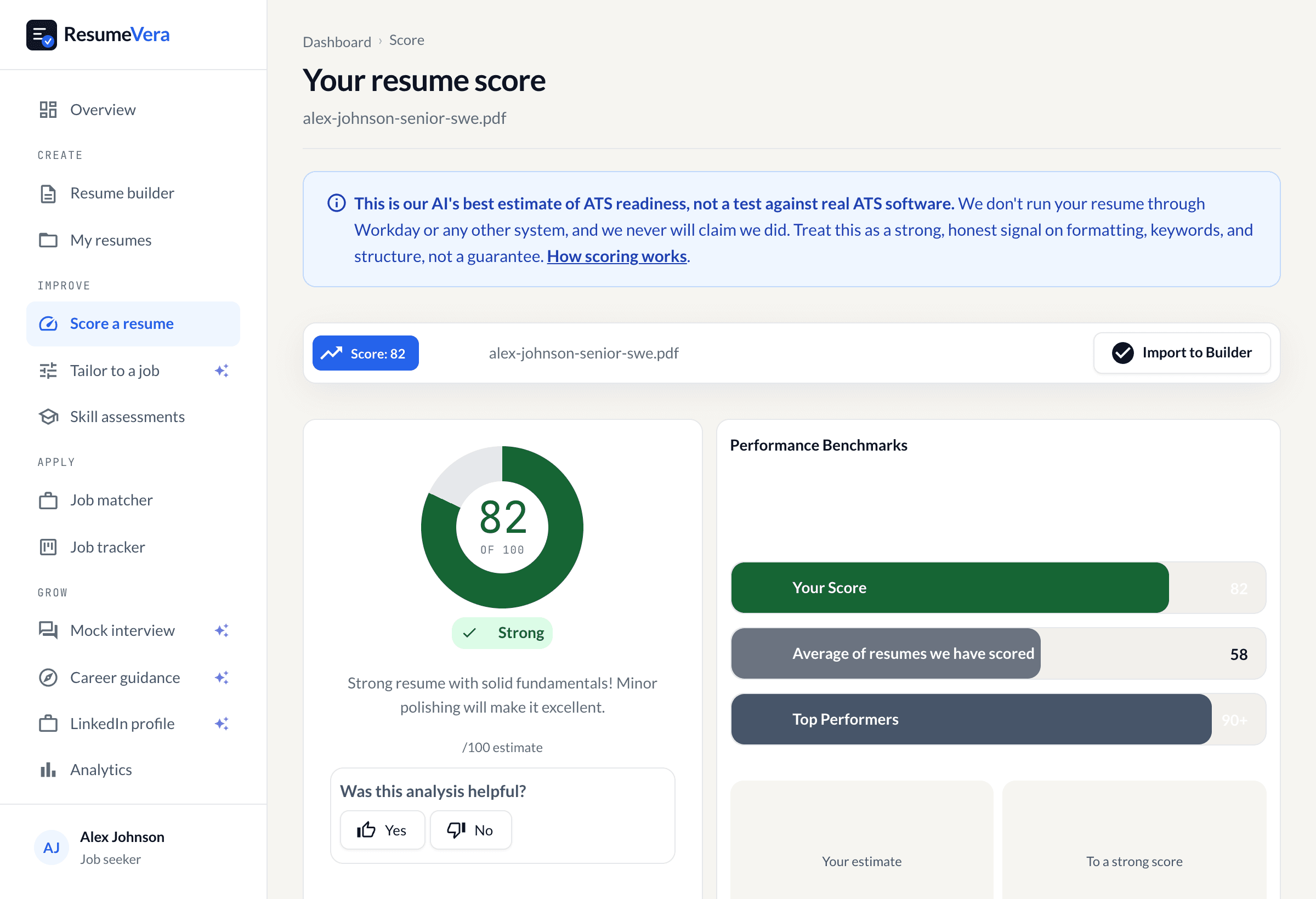
A sample resume in the real checker. The 82 and the sub-scores are what the scorer returns for it.
Now check it against your own resume
An honest, AI-estimated ATS score in 30 seconds. No account, no card.