Salary Guide, 2026
How to tell if you are underpaid, using real government wage data
Crowdsourced salary averages mix interns with directors and tell you very little about where you personally stand. The federal government publishes something better for free: five wage percentiles for almost every job in America. Here is how to read them and use them honestly.
The ResumeVera editorial team
Resume and hiring research, reviewed against current employer guidance.
Updated 2026-09-22T12:23:17.896Z
9 min

Section 01
Why percentiles beat averages
An average can be pulled up by a handful of very high earners, so it rarely tells you where you personally stand. A percentile does. If the median, the 50th percentile, for your job is a certain number, half of workers earn less and half earn more. If you sit at the 25th percentile, three out of four people in your role are out-earning you. That is a far more honest picture than a single headline number.
The Bureau of Labor Statistics publishes exactly this, for free, through its Occupational Employment and Wage Statistics program. The May 2025 estimates, released on May 15, 2026, cover roughly 830 occupations and more than 155 million wage and salary workers, with five wage points for each: the 10th, 25th, 50th, 75th, and 90th percentile.
Section 02
Three real US roles, five numbers each
Here is what those five numbers look like for three common occupations in the May 2025 release, alongside the mean, which is a different and less useful figure for benchmarking yourself.
| Occupation | 10th | 25th | Median | 75th | 90th | Mean |
|---|---|---|---|---|---|---|
| Registered nurses | $68,940 | $80,330 | $97,550 | $112,350 | $137,470 | $101,420 |
| Software developers | $82,460 | $105,210 | $135,980 | $171,980 | $214,670 | $148,100 |
| Accountants and auditors | $56,020 | $67,020 | $83,680 | $109,810 | $144,090 | $94,750 |
Figures are national, annual, and rounded to the nearest ten dollars. For context, the median wage across all US occupations in the same release was about $50,980, and the mean was $69,770.
Section 03
A four-step way to benchmark yourself honestly
Reading the five numbers correctly takes about ten minutes and works for any occupation covered by the survey.
| 01 | Find your exact occupation, not a broad family A specific title, like software quality assurance analyst rather than just software developer, carries a different set of five numbers. |
| 02 | Locate your percentile Put your current base pay against the five figures. Are you below the 25th, near the median, above the 75th? |
| 03 | Adjust for where you live National percentiles hide big geographic gaps. Always check your state and metro figures before drawing a conclusion. |
| 04 | Convert to take-home pay A gross figure is not what lands in your account. Run it through a take-home pay calculator so you compare net to net. |
Section 04
What BLS wages do and do not include
Be precise here, because this is where people misread their own situation. BLS OEWS wages are base pay plus incentive pay and cost of living allowances. They exclude overtime premiums, most bonuses, and the annualized value of stock. That is why a software developer base of $135,980 at the median looks lower than the total compensation numbers you see on sites that add equity and bonuses on top. Both can be correct, they are simply measuring different things. When you benchmark, always compare base to base.
Section 05
Turning a percentile into a plan
If you are below the median for your role and metro, you have three honest levers available: ask for a raise with the data in hand, change employers, since job switchers have historically captured larger raises than people who stay, or add a skill or credential that moves you toward the 75th percentile band. If you are already near the 90th percentile, further gains tend to come from scope and seniority rather than from matching the market, because at that point you effectively are the market.
None of this requires guesswork or a paid data subscription. The federal numbers are public, updated every spring, and are the most defensible salary benchmark you can bring into any conversation, including the one covered in our guide to negotiating with real numbers.
Section 06
Sources
Every figure above traces back to the same federal release, cross-checked against O*NET OnLine, which republishes the full percentile tables from the same data.
| 01 | US Bureau of Labor Statistics, Occupational Employment and Wage Statistics, May 2025 Primary source for all percentile, median, and mean wage figures. Released May 15, 2026. bls.gov/oes |
| 02 | O*NET OnLine Used to cross-check occupation-level percentile figures against the same underlying BLS release. onetonline.org |
Pro tips
Do these
Look up your exact occupation, not a broad job family, since pay can differ sharply between similar sounding titles.
Always check your state and metro figures, not just the national numbers.
Convert gross percentile pay to take-home pay before comparing it to an offer.
Avoid these
Delete these
Comparing your pay to a national average instead of the percentile for your exact occupation and metro area.
Treating the BLS base wage figure as if it already includes bonuses, overtime, or stock.
Using outdated salary data instead of the current May OEWS release.
Benchmarking against a broad job family instead of your specific occupation title.
Put this into a resume
Building and editing are free, and so is your first export.
Check My Resume FreeQuestions
Frequently asked questions
How this guide is maintained
We review this guide every quarter and after any change to the hiring rules or portal behaviour it describes. It was last reviewed on 2026-09-22T12:23:17.896Z. Figures come from named sources, shown beside the number. Where we are estimating rather than measuring, we say so.
By the numbers
155M+
wage and salary workers covered by the survey behind these numbers
BLS Occupational Employment and Wage Statistics, May 2025
$50,980
median annual wage across all US occupations
BLS OEWS, May 2025
5
wage percentiles published for almost every job in America, and most people have never looked at them
BLS OEWS, May 2025
~830
distinct occupations covered by the survey
BLS OEWS, May 2025
Try it
Check the guide against your own file
Everything above is general. Your resume is not. Paste it in and the checker tells you which of these points your file actually breaks.
Check your resume free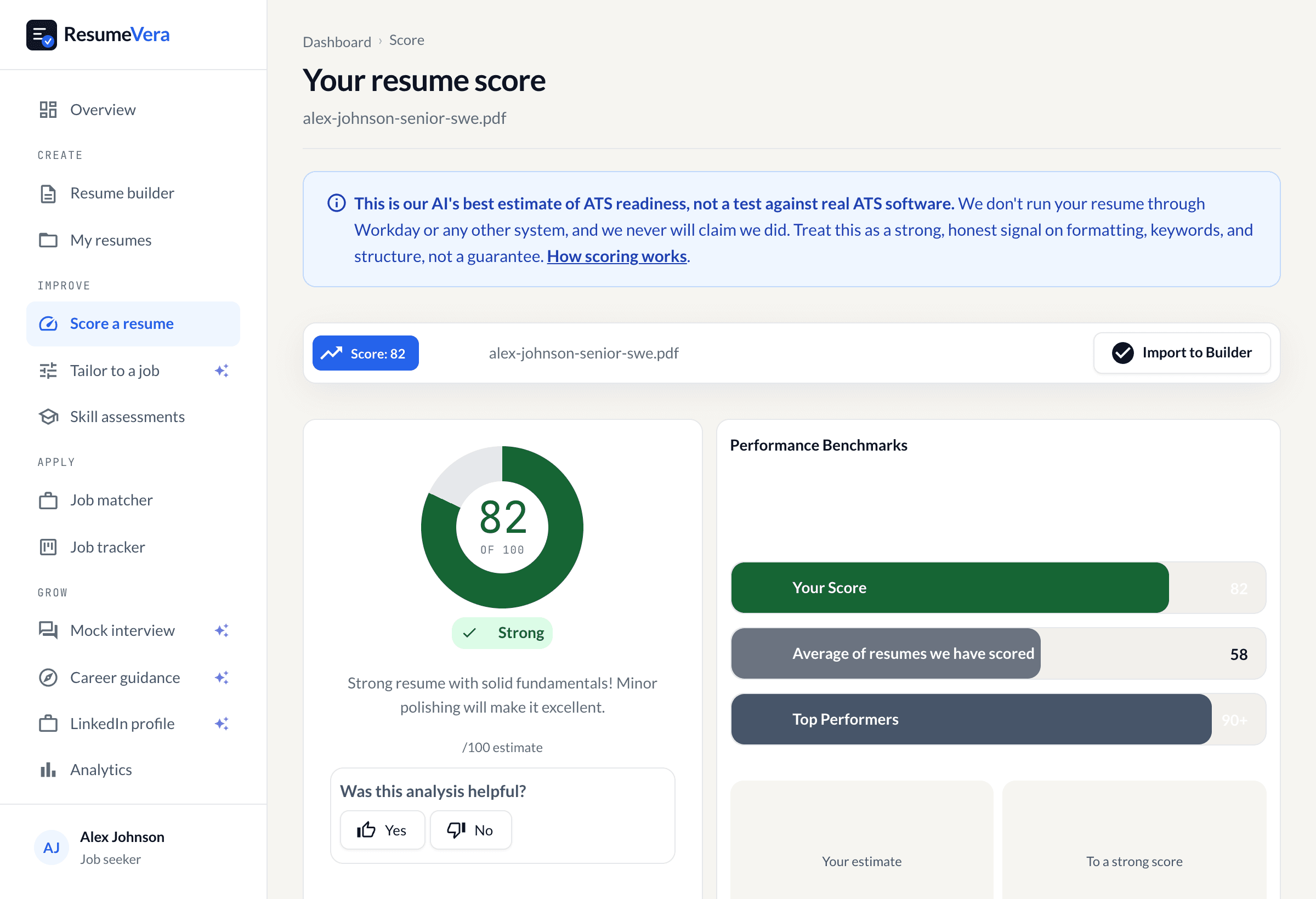
A sample resume in the real checker. The 82 and the sub-scores are what the scorer returns for it.
Is your resume ATS ready?
Run a free ATS score check and get specific improvements in under 30 seconds.