Salary Guide, 2026
Salary negotiation with real numbers, not just scripts
Most negotiation advice hands you a script and no number. This guide pairs the research on how negotiation actually plays out with the federal wage percentiles you can anchor your ask to, for your exact occupation.
The ResumeVera editorial team
Resume and hiring research, reviewed against current employer guidance.
Updated 2026-09-22T12:23:21.477Z
8 min

Section 01
First, the case for negotiating at all
The fear that asking will cost you the offer is mostly unfounded. A 2024 Harvard Business Review analysis concluded that negotiating is unlikely to jeopardize a job offer. Employers expect it, and they build room into the first number for exactly that reason.
Yet most people do not ask. The Resume Genius 2025 Salary Negotiation and Expectations Survey, fielded across 1,000 full-time US workers, found that 45 percent of professionals negotiated their starting salary while 55 percent accepted their initial offer without negotiating. A 2023 Pew Research Center survey found only 32 percent of men and 28 percent of women asked for higher pay the last time they were hired.
It costs them. Among Resume Genius respondents who did negotiate, 78 percent ended up with a better offer, 51 percent got the amount they asked for and 27 percent got somewhat more. Among Pew's negotiators, 28 percent got exactly what they asked for and 38 percent got more than the original offer, so roughly two out of three walked away with something better. New graduates are the least likely to ask, which is the worst possible time to leave money behind, since every future raise compounds off that first number.
Section 02
Now, the part the scripts skip: your anchor
An anchor is the number you open with, and it should be grounded in data, not a feeling. This is where the Bureau of Labor Statistics Occupational Employment and Wage Statistics percentiles do the heavy lifting. For your exact occupation, the May 2025 release gives you the 10th, 25th, 50th, 75th, and 90th percentile wages.
| 01 | Below the median for your role and metro Your ask is simple and defensible: based on federal wage data for this role in this area, the midpoint is X, and given my experience I would expect to be at or above it. |
| 02 | Strong, specific experience Anchor toward the 75th percentile band and justify it with evidence, not adjectives. |
| 03 | Frame a range, not a single number Put your real target at the bottom of your stated range so the whole range stays acceptable to you. |
Section 03
A worked example
Suppose you are an accountant weighing an offer. In the May 2025 data, accountants and auditors had a median of $83,680, a 75th percentile of $109,810, and a 90th percentile of $144,090. If you are offered $78,000 and you have five years of experience plus a CPA, you are being offered below the median for a profile that arguably belongs in the upper middle of the distribution. That gap, stated in those exact terms, is a far stronger case than saying you think you deserve more. For the full breakdown of how to read these percentiles, see our guide on how to tell if you are underpaid.
Section 04
Anchor to base pay, and know what the number excludes
Be careful to compare like with like. BLS wages are base pay plus incentive and cost of living pay, they exclude overtime, most bonuses, and equity. So when you anchor a base salary negotiation, the BLS percentile is the right yardstick. When there is equity or a large bonus on the table, negotiate those components separately rather than folding them into the base comparison.
Section 05
The non-salary levers
If the base is genuinely capped at the top of the band, there is still room. Most employers keep the offer on the table after a professional negotiation, so you can reasonably push on signing bonus, additional paid time off, a remote or hybrid arrangement, an earlier review date, or a title that sets up your next move. These matter, especially early in a career.
Section 06
A short, honest playbook
Negotiation is not a personality trait or a trick. It is a short, data-backed conversation that most employers expect and most candidates skip. The people who show up with the federal numbers in hand are the ones who stop leaving money on the table.
| 01 | Look up the five percentile numbers for your exact role and metro |
| 02 | Convert them to take-home pay so you are comparing net figures |
| 03 | Decide your target, usually median to 75th, higher with strong evidence, and your walk away minimum |
| 04 | Ask once, clearly, anchored to the data, then stop talking |
| 05 | Get the final number in an updated offer letter before you accept anything |
Pro tips
Do these
Anchor your ask to a specific BLS percentile for your exact occupation, not a round number.
State a range with your real target at the bottom, so the whole range stays acceptable.
Ask once, clearly, then stop talking. Silence after the ask works in your favor.
Get any negotiated change in writing in an updated offer letter before accepting.
Avoid these
Delete these
Accepting the first offer without asking, when most employers build in room to negotiate.
Anchoring to a feeling or a round number instead of a sourced wage percentile.
Comparing a BLS base wage figure to an offer that includes bonus and equity, or vice versa.
Negotiating without a stated range, so the conversation has nowhere to go.
Put this into a resume
Building and editing are free, and so is your first export.
Check My Resume FreeQuestions
Frequently asked questions
How this guide is maintained
We review this guide every quarter and after any change to the hiring rules or portal behaviour it describes. It was last reviewed on 2026-09-22T12:23:21.477Z. Figures come from named sources, shown beside the number. Where we are estimating rather than measuring, we say so.
By the numbers
45%
of professionals negotiated their starting salary
Resume Genius Salary Negotiation and Expectations Survey, 2025
78%
of people who negotiated ended up with a better offer
Resume Genius Salary Negotiation and Expectations Survey, 2025
28%
of women asked for higher pay the last time they were hired, versus 32% of men
Pew Research Center, 2023
0
documented cases in the research of a professional negotiation costing a candidate the offer
Harvard Business Review analysis, 2024
Try it
Check the guide against your own file
Everything above is general. Your resume is not. Paste it in and the checker tells you which of these points your file actually breaks.
Check your resume free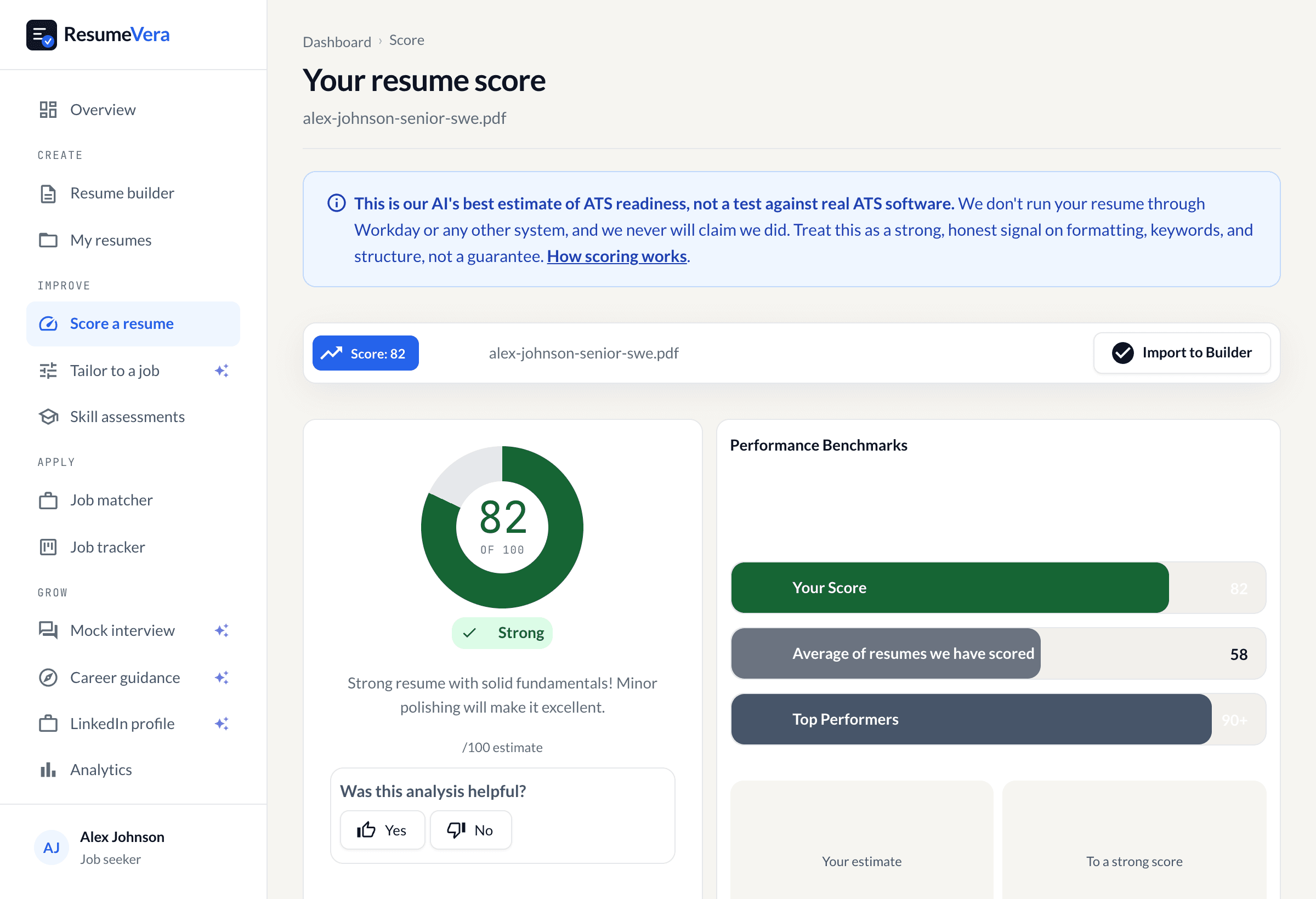
A sample resume in the real checker. The 82 and the sub-scores are what the scorer returns for it.
Is your resume ATS ready?
Run a free ATS score check and get specific improvements in under 30 seconds.