Do cover letters still matter? What the surveys actually say
Job Search · ResumeVera Editorial · September 1, 2026 · 10 min read
Search for whether cover letters still matter and you will find two confident, opposite answers, both citing surveys, often on the same page of results.
One says 83 percent of hiring managers read them. Another says 51.7 percent of recruiters never do. These are not competing interpretations of the same data. They are different studies asking different people different questions, and once you see that, the contradiction resolves into something you can actually act on.
The four studies, and who each one asked
Resume Genius surveyed 625 hiring managers. Eighty-three percent said they always or frequently read cover letters, with only 4 percent rarely or never. Forty-five percent said they read the cover letter before the resume. Forty-nine percent said a strong letter could convince them to interview a candidate they were otherwise unsure about. Among companies that do not require a letter, 73 percent still read it frequently or always when one is included.
Novorésumé surveyed over 200 US recruiters and HR professionals, publishing on 16 December 2025. It found that 51.7 percent of recruiters never read an applicant's cover letter. The same survey found that figure dropping sharply by seniority: 29.4 percent for heads of HR and 22.9 percent for HR managers.
That internal split inside a single survey is the most revealing number in this entire piece. The same study, asking the same question, got wildly different answers depending on the respondent's role. Recruiters skip. People closer to the hiring decision read.
ResumeBuilder surveyed hiring managers in 2024, with results widely reported as 26 percent reading cover letters regularly and 44 percent never doing so. We are including this one with a caveat: we could not locate the original release to confirm the exact question wording and whether the respondents were described as hiring managers or as business leaders, which would change how to read it. Treat it as directionally useful rather than precise.
ResumeGo ran an experiment instead of a survey, which makes it the most valuable of the four. Between 15 July 2019 and 10 January 2020 it sent 7,287 fictitious applications to real job postings across ZipRecruiter, Glassdoor and Indeed, in three groups: no cover letter, generic cover letter, tailored cover letter.
The callback rates were 10.7 percent with no letter, 12.5 percent with a generic one, and 16.4 percent with a tailored one. A tailored letter produced roughly 53 percent more callbacks than sending none.
Note what that experiment measures. Not what people say they do, which is what surveys capture and what people are unreliable about, but what actually happened to thousands of real applications.
Why the surveys disagree
Four things explain almost all of the variance.
Recruiters and hiring managers are not the same job. A recruiter screening 400 applications for one opening is optimising for speed and will use the resume. A hiring manager choosing between six shortlisted candidates is optimising for fit and has time to read. Both answer honestly and produce opposite statistics.
Volume changes everything. A role with 600 applicants and a role with 12 are different processes wearing the same name. Nothing about cover letter advice generalises across that gap.
Company size matters. At a large employer, an applicant tracking system may collect the cover letter field without anyone opening it. At a 30-person company, the founder may read every one.
Question wording is doing real work. "Always or frequently" and "read the majority of them" are not the same threshold, and a few points of difference in phrasing produce large differences in reported behaviour.
What AI has changed
There is a genuine structural shift underneath the survey noise, and the clearest articulation of it comes from Judd Kessler, an economist at Wharton.
His argument is about signalling. A cover letter used to be informative partly because writing a good one took a few hours. That cost was the signal. It told an employer something about how much you wanted the role, independent of anything the letter actually said.
As Kessler puts it, something that used to take a few hours to do well now takes a few seconds, and a signal that used to be costly has become cheap talk. He expects one of two outcomes: either cover letters remain required, everyone has AI write good ones, and they get ignored, or employers stop asking because they have realised the letters are not adding value.
He cites research on a job platform that introduced an AI cover letter assistant. Letters improved, and initially candidates using it got more interviews. As the tool spread, employers stopped relying on cover letters in their decisions altogether. The advantage lasted exactly as long as it was scarce.
The practical consequence is uncomfortable but simple. A letter that reads like it was generated from the job description is worse than no letter, because it consumes the reader's attention and returns nothing. The only letters that work now are ones containing something a model could not have produced without you.
When a cover letter earns its place
Four situations reliably justify the effort.
You are changing careers. Your resume shows a discontinuity. The letter is where you explain why the previous thing prepared you for this thing. Nothing else in your application can do that job.
You have a gap or an unusual path. Same logic. A recruiter forming a theory about a two-year gap will form a worse one than you would give them.
Someone referred you. Naming a person in the first line changes how the rest is read, and there is no field on an application form for it.
The employer is small. Fewer applicants, less automation, higher chance a decision-maker reads it personally.
Outside these, the test is whether you have something specific to say. If you have read about the company's work and can point at a concrete thing you would contribute to, write it. If you would be padding, the resume is doing the work anyway.
How to write one quickly and not generically
Three paragraphs is enough, and the shape barely varies.
Open with why this role, specifically. Not "I am excited by this opportunity," which could be anyone applying anywhere. Name the thing about this company or this position that made you apply.
Then give one piece of evidence that maps onto their problem. One. A letter that summarises your whole resume is redundant with the document sitting next to it. Pick the single most relevant thing you have done and explain the outcome.
Close by addressing whatever your resume makes them wonder about. The gap, the pivot, the missing credential. This is the paragraph that most obviously could not have been generated without you, which is precisely why it is worth including.
Our cover letter tool works from your resume and the specific posting rather than from the job title alone, which is the difference between a letter worth sending and one worth skipping. Whatever you use, read the output and replace anything that could apply to a different company without editing.
The short answer
Cover letters matter conditionally. They matter most at small companies, for senior roles, when someone referred you, and whenever your resume raises a question you would rather answer than have guessed at. They matter least in high-volume screening.
The 7,287-application experiment found tailored letters producing meaningfully more callbacks than none, and generic letters producing barely more than none. That gap between tailored and generic is the whole finding. It was true in 2019 and it is more true now that generic has become free.
Sources
- ResumeGo, Cover Letters: Just How Important Are They? Field experiment, 7,287 applications, 15 July 2019 to 10 January 2020. resumego.net
- Resume Genius, cover letter statistics, survey of 625 hiring managers. resumegenius.com
- Novorésumé, Are Cover Letters Dead in 2026? Survey of over 200 US recruiters and HR professionals, published 16 December 2025. novoresume.com
- Judd Kessler, AI Is Killing the Cover Letter, Knowledge at Wharton. knowledge.wharton.upenn.edu
Survey figures carry their sample sizes above so you can weigh them. Where we could not confirm a study's original wording, we have said so rather than presenting it as settled.
Questions
Frequently asked questions
Get free ATS tips every week
Actionable resume and ATS tips, when we publish them. No spam. Unsubscribe any time.
Related Articles

How long are people actually staying at their jobs now? What the newest BLS tenure data says
Every two years the federal government asks a very specific question: how long have you been with your current employer. The newest answer, released in September 2026, shows median tenure ticking up after a two year low, a sharp gap by age and industry, and a short tenure share that is actually falling. Here is what the data shows, and what it means for how you handle more than one short stint on a resume.
Read More
Is your raise actually keeping up with prices in 2026? What the wage data says
Three federal data sources answer the "am I getting ahead" question differently depending on how you ask it. Job switchers are clearly outrunning inflation. People who stay in their current job are barely breaking even. Here is what the real earnings report, the Employment Cost Index, and the Atlanta Fed's wage tracker each actually measure, and what to do with the gap between them.
Read More

How long does it actually take to find a job in 2026? What the federal data says
The median unemployed job seeker in 2026 has been searching for about eleven weeks. The average is more than double that, and the gap between the two numbers is the whole story. We checked the federal data on how long searches actually run, how that compares with past downturns, and what it means for planning your own.
Read More
Try it
Check this against your own resume
The post above is general. Your file is not. The checker reads it the way a parser would and tells you which of these points it actually breaks.
Check your resume free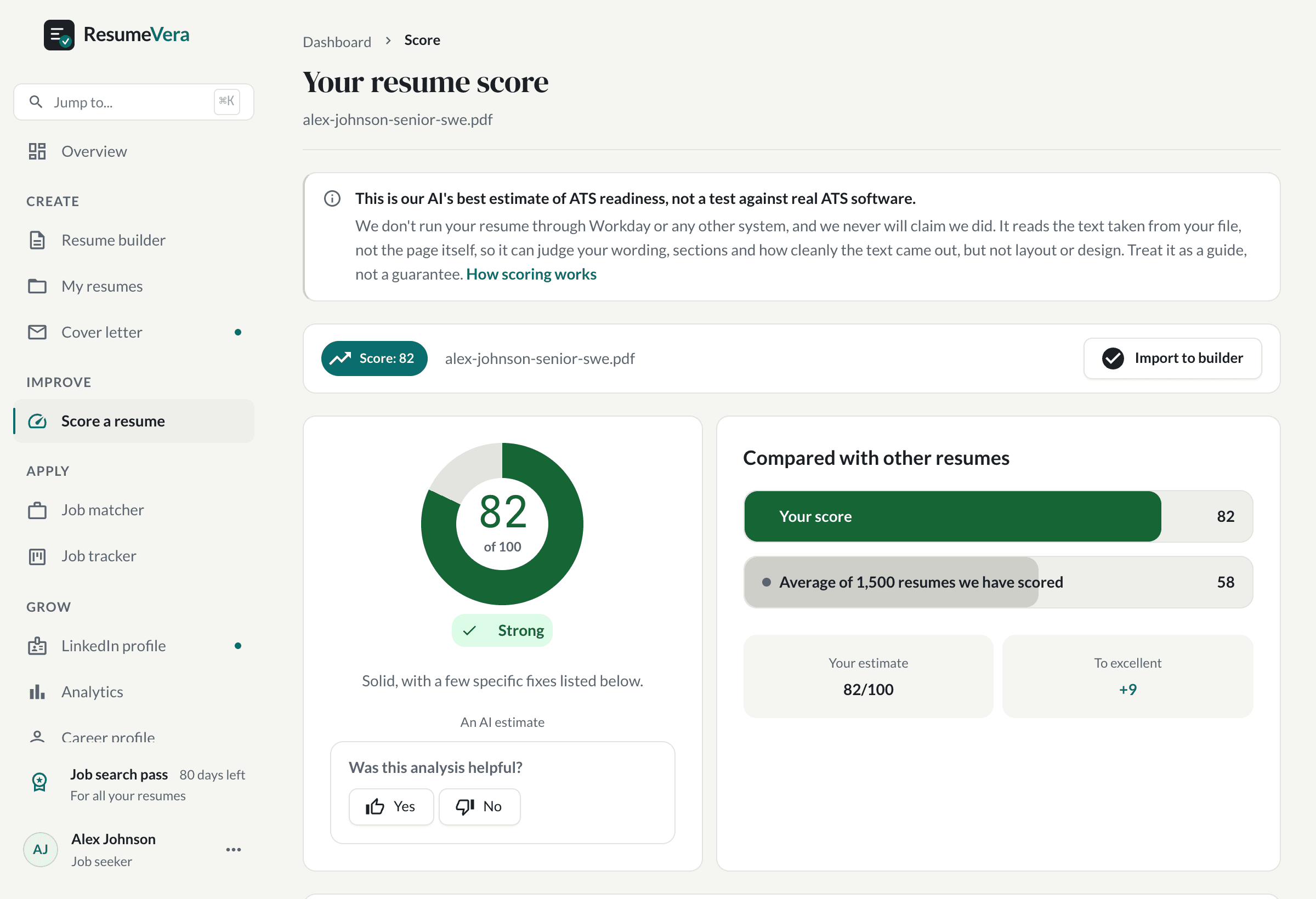
The real score page, with a sample resume and sample scores.
Now check it against your own resume
An honest resume score in seconds. No account, no card.