Is the September hiring surge real? We checked it against the data
Job Search · ResumeVera Editorial · September 1, 2026 · 9 min read

If you have been job searching for more than a year, you have seen the advice arrive on schedule. Around the last week of August, the posts start. The September surge is coming. Get your resume ready. Recruiters come back from holiday and the floodgates open.
It is one of those claims that gets repeated so consistently that nobody stops to check it. So we checked it.
The short version is that something real does happen in the early autumn, but it is smaller than advertised, it is concentrated in particular kinds of work, and it is not the biggest hiring moment of the year. If you plan your search around the September surge as it is usually described, you will probably mistime it.
What the claim actually says
The September surge, as it circulates, holds that hiring managers return from summer holidays, unfreeze their requisitions, and rush to fill roles before the end of the fiscal year. Applications get read faster. Interviews move quicker. The window is said to close around Thanksgiving.
There is a plausible mechanism in there. Decision makers really are away in July and August, and requisitions really do sit idle when the person who has to approve them is unreachable. The question is whether that produces a hiring surge or just a postings surge, and whether it is bigger than what happens at other points in the year.
What the data shows about when hiring happens
Start with the labour market as it stands. The most recent Employment Situation release from the Bureau of Labor Statistics, covering July 2026 and published on 7 August 2026, showed nonfarm payrolls falling by 23,000 and the unemployment rate at 4.1 percent. Local government education lost roughly 50,000 positions, retail trade lost about 19,000, and financial activities lost 14,000. Health care was one of the few clear gainers at roughly 22,000.
That release also revised the two prior months down by a combined 103,000. Over the preceding twelve months, average monthly job gains ran at about 34,000. This is not a market where a seasonal wave lifts everyone.
The Job Openings and Labor Turnover Survey adds the more revealing number. For June 2026, published on 4 August 2026, there were about 7.4 million job openings against roughly 5.3 million hires. Quits ran at 3.2 million and layoffs at 1.8 million.
Hold on to that gap between openings and hires. It is the structural fact underneath the seasonality question. Openings are not the same thing as jobs filled, and a rise in openings does not automatically mean a rise in people getting hired.
This is precisely where the September claim breaks down. Guy Berger, who was principal economist at LinkedIn and had access to data on when people actually start jobs rather than when postings appear, put it plainly: the busiest months for people starting new jobs are the beginning of the year, then June when students enter the workforce, then early autumn for some roles such as retail. He was more direct elsewhere, saying that January through March will always be a hotter time to find a job than the autumn.
Reporting on the same question has made the distinction explicit. The rise you see in September is a rise in vacancies. The rise in actual hires arrives later, in the winter.
The numbers we are not going to repeat
While researching this, we kept running into two figures. One says January brings a 300 percent spike in job applications or postings. The other says January brings 22 percent more hiring activity.
We could not trace either to a primary source. Both appear on career and recruitment blogs, and the pages that carry them hedge with language like "it is estimated that" and "can spike by up to," which is the tell. Neither the Bureau of Labor Statistics, nor Indeed, nor LinkedIn publishes anything resembling a specific 300 percent or 22 percent seasonal figure.
So we are not repeating them. The honest statement is that the first quarter is the stronger stretch for people starting jobs, sourced to economists who have seen the underlying data, without a fake precision attached to it.
Which sectors actually ramp up in the autumn
The autumn increase is real, but it is narrower than the general advice implies, and the composition has shifted in a way that matters if you are deciding where to spend your applications.
Indeed Hiring Lab's analysis of the 2025 season, published on 25 November 2025, found seasonal postings running about 11 percent above 2024 levels but still roughly 13 percent below where they sat in 2021 and 2022. More useful is what was inside that increase. Driving roles were up 153 percent and loading and stocking roles were up 49 percent. Seasonal retail was essentially flat at 1 percent, and seasonal sales roles were down 10 percent.
In other words, the autumn ramp has moved from the shop floor to the warehouse and the delivery route. If your mental model of seasonal hiring is a department store taking on extra staff, that model is roughly four years out of date.
There is a competition problem too. Indeed's October 2025 update found that job seeker interest in seasonal work was up 27 percent year over year and 50 percent above 2023, while seasonal postings had risen only 2.7 percent. More people chasing barely more roles is not a seller's market, whatever the season.
These are 2025 figures, and we are stating them as such. The equivalent 2026 season data will not exist until late in the year.
What this means for your search right now
None of this is an argument for doing nothing until January. That is the wrong lesson and it would cost you.
The autumn postings increase is real, and postings are how you find roles even if the hire lands months later. Time to hire in this market runs long, which means an application you send in September may well become a start date in the first quarter. The two peaks are not alternatives. They are connected.
What changes is how you plan.
Finish your resume now rather than in December. If your search is going to run across both windows, you want the document done before the busier stretch arrives, not being rewritten during it. Our free ATS score gives you a read on how a parser is likely to handle your file, and it does not require an account.
Set your expectations by sector rather than by month. If you are targeting logistics, warehousing, or delivery, the autumn genuinely is your window. If you are targeting a corporate role with a headcount approval attached to it, you are more likely looking at a first quarter start regardless of when you apply.
Track what you send. When your applications are spread across four or five months and the responses arrive in a different order than you sent them, memory stops being reliable. A job tracker is the difference between knowing which roles have gone quiet and guessing.
Do not treat November as a deadline. The advice that the window slams shut before Thanksgiving is the least defensible part of the whole claim. December is quiet, but quiet is not closed, and the January opening is stronger than the September one.
A calendar worth working to
Here is the version we would actually stand behind.
September through November is a real increase in postings, weighted towards seasonal and logistics work, with more candidates competing for them than in recent years. It is a good stretch to be applying and a poor stretch to be starting your resume from scratch.
December is genuinely slow for decisions. It is a good month to tidy up your materials, follow up on anything from the autumn that has gone silent, and prepare for what comes next.
January through March is when budgets reset, headcount is approved, and people actually start jobs. This is the stretch the September advice should have been pointing you towards all along.
The surge is not fake. It is just smaller, narrower, and earlier than the thing you should be planning around.
Sources
- U.S. Bureau of Labor Statistics, The Employment Situation, July 2026, released 7 August 2026. bls.gov
- U.S. Bureau of Labor Statistics, Job Openings and Labor Turnover Survey, June 2026, released 4 August 2026. bls.gov
- Indeed Hiring Lab, Seasonal Hiring Picks Up, but Signs of Hesitance Remain, 25 November 2025. hiringlab.org
- Indeed Hiring Lab, October 2025 US Labor Market Update, 16 October 2025. hiringlab.org
- WorkLife, Why the September Surge is overhyped for job seekers, quoting Guy Berger. worklife.news
- The Hill, What is the September Surge and can it help you find a new job? thehill.com
Labour market figures are revised regularly and the ones above carry their release dates for that reason. We update this piece when new releases change the picture.
Questions
Frequently asked questions
Get free ATS tips every week
Actionable resume and ATS tips, when we publish them. No spam. Unsubscribe any time.
Related Articles

How long are people actually staying at their jobs now? What the newest BLS tenure data says
Every two years the federal government asks a very specific question: how long have you been with your current employer. The newest answer, released in September 2026, shows median tenure ticking up after a two year low, a sharp gap by age and industry, and a short tenure share that is actually falling. Here is what the data shows, and what it means for how you handle more than one short stint on a resume.
Read More

Is your raise actually keeping up with prices in 2026? What the wage data says
Three federal data sources answer the "am I getting ahead" question differently depending on how you ask it. Job switchers are clearly outrunning inflation. People who stay in their current job are barely breaking even. Here is what the real earnings report, the Employment Cost Index, and the Atlanta Fed's wage tracker each actually measure, and what to do with the gap between them.
Read More

How long does it actually take to find a job in 2026? What the federal data says
The median unemployed job seeker in 2026 has been searching for about eleven weeks. The average is more than double that, and the gap between the two numbers is the whole story. We checked the federal data on how long searches actually run, how that compares with past downturns, and what it means for planning your own.
Read More
Try it
Check this against your own resume
The post above is general. Your file is not. The checker reads it the way a parser would and tells you which of these points it actually breaks.
Check your resume free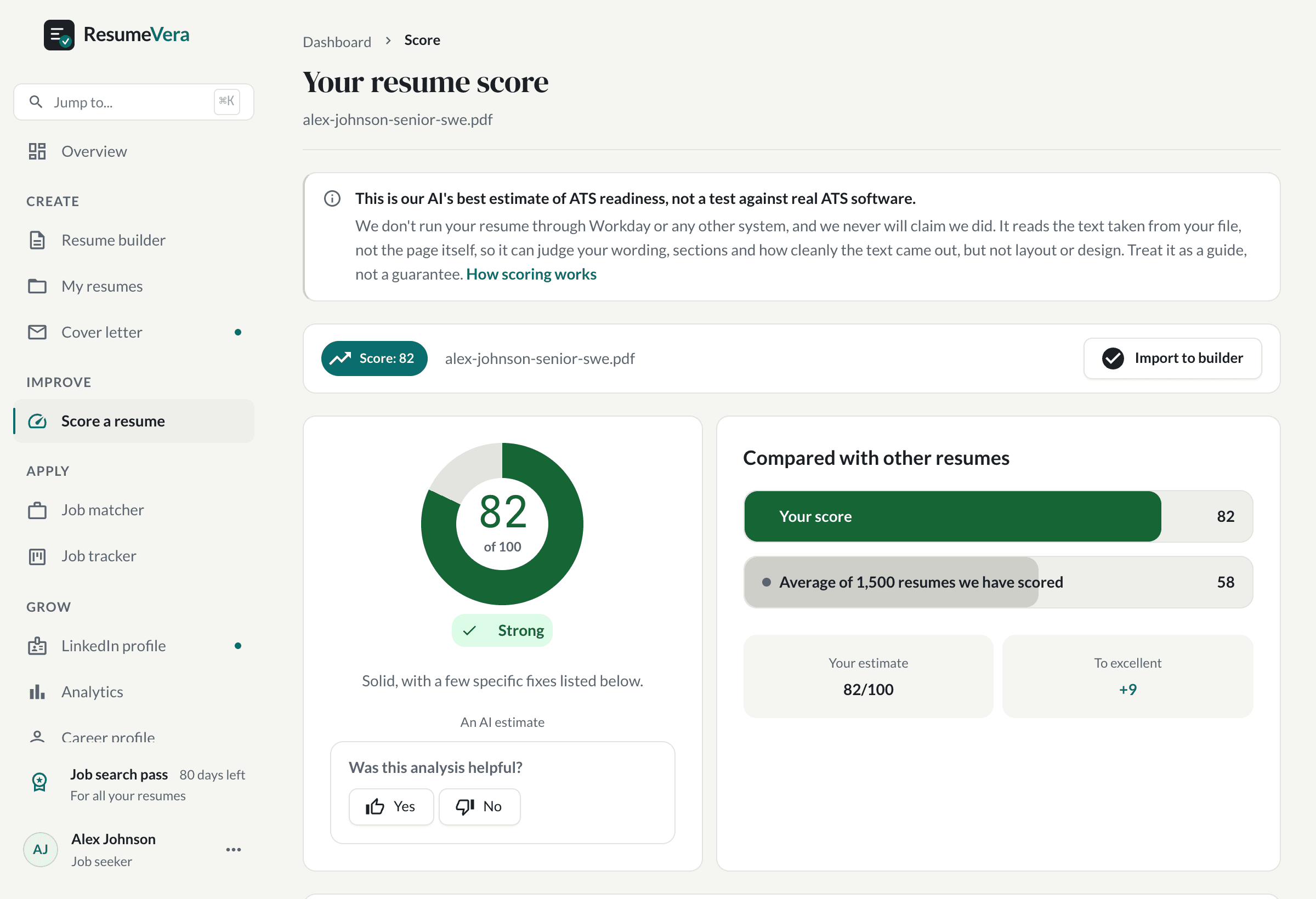
The real score page, with a sample resume and sample scores.
Now check it against your own resume
An honest resume score in seconds. No account, no card.