Why free resume builders charge you to download, and what to check before you pay
Job Search · ResumeVera Editorial · September 1, 2026 · 10 min read

The sequence is familiar enough that most people have been through some version of it. You find a resume builder advertised as free. You spend forty minutes filling in your history, choosing a template, watching it come together. You click download.
And there is a payment form.
We should be upfront about our position before going further. ResumeVera sells resume tools, so we compete with the companies this article is about. That is a reason to check what we tell you rather than take it on faith, which is why everything below is sourced to a statute, a court ruling, or a court filing you can read yourself.
The mechanic has a name
What happens at that download button is called negative option billing. You agree to something small, often framed as a trial for a nominal amount. Unless you take active steps to stop it, that agreement converts into a recurring charge at a substantially higher rate, typically billed every few weeks rather than monthly, which makes the annual total less obvious than it looks.
The model is not illegal in itself. Plenty of legitimate businesses use trials. What the law regulates is disclosure and cancellation.
The governing federal statute is the Restore Online Shoppers' Confidence Act, at 15 U.S.C. sections 8401 to 8405. For online negative option sales it requires three things: that all material terms be disclosed clearly and conspicuously before the seller obtains your billing information, that the seller obtain your express informed consent, and that there be a simple mechanism to stop the recurring charges.
That is the test worth applying. Not whether a site charges money, but whether it told you what the charge would be, when it would repeat, and how to stop it, before it took your card details.
What happened to Click to Cancel
You may have read that the Federal Trade Commission fixed this. It tried, and the rule no longer exists.
The FTC issued its Negative Option Rule, widely known as Click to Cancel, on 16 October 2024. It took effect on 14 January 2025, with the most demanding provisions deferred to 14 July 2025.
On 8 July 2025, six days before that deadline, the Eighth Circuit Court of Appeals vacated the rule in its entirety in Custom Communications, Inc. v. FTC. The grounds were procedural. The court found that the Commission had failed to conduct a preliminary regulatory analysis required under Section 22 of the FTC Act once it became aware the rule would have an annual economic effect exceeding 100 million dollars. The court described this as a fatal error and declined to reach the substantive challenges to the rule at all.
Worth being precise about what that means. A court did not decide that the practices were acceptable. It decided the agency had skipped a required step on the way to regulating them.
What still applies
The vacatur removed one rule, not the underlying law.
ROSCA remains in force. Section 5 of the FTC Act, covering unfair and deceptive practices, remains in force. And roughly 30 US jurisdictions have their own automatic renewal statutes.
California's is the one worth knowing about, because its reach is broad. The state's Automatic Renewal Law was amended by Assembly Bill 2863, enacted in September 2024 with changes effective 1 July 2025. It requires express affirmative consent to the automatic renewal terms, retention of consent records, and cancellation through the same medium you used to sign up. If you subscribed with a click, you must be able to cancel with a click.
If you have been charged by a service you do not remember agreeing to renew with, these are the provisions that matter, and your state attorney general's consumer protection office is the place to raise it.
What is currently before the courts
Two active cases concern this specific industry. Everything in this section is an allegation that has not been proven, and we are describing what the filings claim rather than asserting any of it as fact.
On 2 April 2026, Rocket Resume, Inc. filed suit against BOLD Limited and related entities in the Northern District of California, case number 5:26-cv-02852. The complaint alleges that Bold controls a large majority of the US online resume-building market through a portfolio of brands including Monster, CareerBuilder, Resume Genius, MyPerfectResume, LiveCareer, Zety and Resume-Now. It further alleges that these sites advertise free resume building, then charge at the download step, and convert low initial fees into recurring charges many times larger, with cancellation made deliberately difficult.
On 9 April 2026, a consumer class action was filed against Bold LLC in California Superior Court in San Diego County, case number 26CU019871C, concerning the same billing practices.
One detail from the first filing is worth carrying with you regardless of how the case resolves: the allegation that multiple sites which appear to be independent competitors are owned by the same company. If you are comparing resume builders and every option looks similar, it is worth checking who owns them.
We should also note what has not happened. We found no FTC or state attorney general enforcement order against any of these companies. Complaints exist, litigation is under way, and neither of those is a finding of wrongdoing.
How to check any resume builder before you pay
This takes about a minute and works on any site, ours included.
Find the price of the thing you actually want before you start building. Usually that is the download. If the pricing page describes plans without stating what one export costs, that is a deliberate choice about what to make easy to find.
Search the checkout page for the words trial, renew, recurring, auto, and the phrase every four weeks. Billing every four weeks produces thirteen charges a year rather than twelve, which is a meaningful difference presented as a trivial one.
Work out the annual cost yourself. Take the recurring amount, multiply by the number of billing periods in a year, and compare that with the number you were shown at the start.
Find the cancellation route before you subscribe, not after. If cancelling requires an email, a phone call, or a chat with a retention agent while signing up took one click, note the asymmetry. In California that asymmetry is also a legal problem.
Check what free means on that specific site. Free to build and paid to download is a common arrangement, and it is not deceptive if it is stated plainly. It is only deceptive when the word free is doing the advertising and the paywall appears after you have invested the time.
What we do instead
We think the one-time purchase is the honest structure for this product, because building a resume is not an ongoing service. You need it, you do it, you are done.
So ResumeVera sells passes rather than subscriptions. There is no renewal, which means there is nothing to cancel and nothing to forget about. Our pricing page shows what each pass costs and what it includes.
The ATS score is free and needs no account at all. It is an AI estimate of how a parser is likely to read your file rather than a real applicant tracking system test, and we describe it that way everywhere because the distinction matters. You can run it before deciding whether anything here is worth paying for.
Whether you use us or not, the checklist above works. The industry is under enough scrutiny right now that it is worth applying to everyone selling in it.
Sources
- Restore Online Shoppers' Confidence Act, 15 U.S.C. sections 8401 to 8405.
- Custom Communications, Inc. v. Federal Trade Commission, U.S. Court of Appeals for the Eighth Circuit, decided 8 July 2025, vacating the FTC Negative Option Rule.
- Federal Trade Commission, Negative Option Rule, 16 C.F.R. Part 425, issued 16 October 2024.
- California Automatic Renewal Law, Business and Professions Code section 17600 et seq., as amended by Assembly Bill 2863 (2024), effective 1 July 2025.
- Rocket Resume, Inc. v. BOLD Limited et al., No. 5:26-cv-02852, N.D. Cal., filed 2 April 2026. Allegations only.
- Rauf v. Bold LLC, No. 26CU019871C, California Superior Court, San Diego County, filed 9 April 2026. Allegations only.
- Federal Trade Commission, Operation AI Comply, announced 25 September 2024. ftc.gov
We have deliberately not published specific prices for any competitor. Pricing changes frequently and we will not repeat figures taken from review sites. Check each site's own checkout page and note the date you looked.
Questions
Frequently asked questions
Get free ATS tips every week
Actionable resume and ATS tips, when we publish them. No spam. Unsubscribe any time.
Related Articles

How long are people actually staying at their jobs now? What the newest BLS tenure data says
Every two years the federal government asks a very specific question: how long have you been with your current employer. The newest answer, released in September 2026, shows median tenure ticking up after a two year low, a sharp gap by age and industry, and a short tenure share that is actually falling. Here is what the data shows, and what it means for how you handle more than one short stint on a resume.
Read More

Is your raise actually keeping up with prices in 2026? What the wage data says
Three federal data sources answer the "am I getting ahead" question differently depending on how you ask it. Job switchers are clearly outrunning inflation. People who stay in their current job are barely breaking even. Here is what the real earnings report, the Employment Cost Index, and the Atlanta Fed's wage tracker each actually measure, and what to do with the gap between them.
Read More

How long does it actually take to find a job in 2026? What the federal data says
The median unemployed job seeker in 2026 has been searching for about eleven weeks. The average is more than double that, and the gap between the two numbers is the whole story. We checked the federal data on how long searches actually run, how that compares with past downturns, and what it means for planning your own.
Read More
Try it
Check this against your own resume
The post above is general. Your file is not. The checker reads it the way a parser would and tells you which of these points it actually breaks.
Check your resume free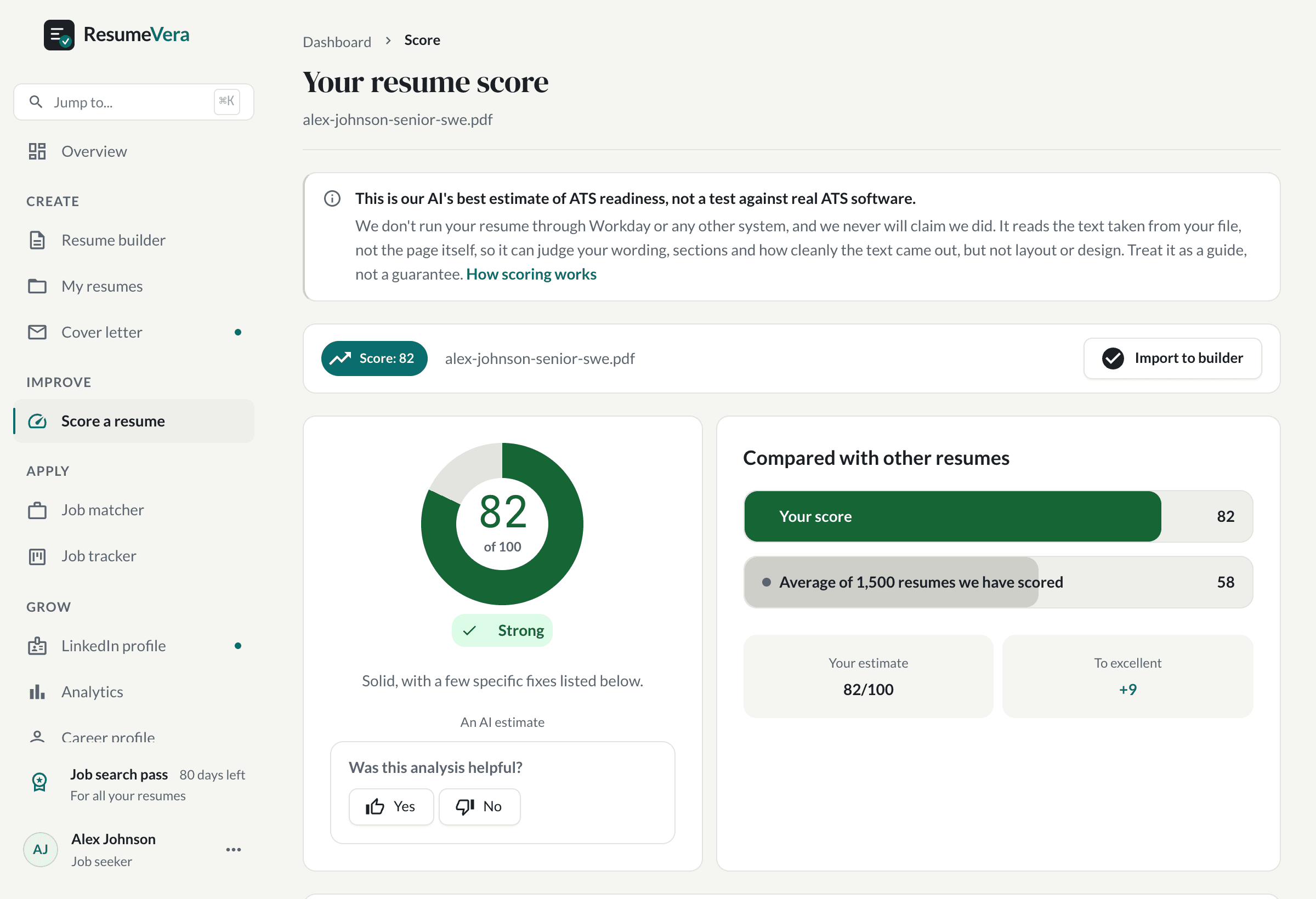
The real score page, with a sample resume and sample scores.
Now check it against your own resume
An honest resume score in seconds. No account, no card.