Pay Transparency Guide, 2026
Pay transparency laws by state in 2026, and what job seekers can do with them
Most coverage of these laws is written for employers worried about compliance. This is written for you, the person reading a posting and wondering what the range means. A dozen states now require it, and read well, it hands you real leverage before you ever say a number.
The ResumeVera editorial team
Resume and hiring research, reviewed against current employer guidance.
Updated 2026-09-22T12:23:24.459Z
7 min

Section 01
Where salary ranges are required in 2026
As of 2026, a dozen states require employers to disclose a salary range in job postings: California, Colorado, Hawaii, Illinois, Maine, Maryland, Massachusetts, Minnesota, New Jersey, New York, Vermont, and Washington. Several cities and counties layer their own rules on top of state law.
The rules keep tightening. California's law was amended by SB 642, effective January 1, 2026, to define pay scale as a good faith estimate of the range the employer reasonably expects to pay. Colorado was the first state to require ranges, back in 2021, and the map is still expanding. Delaware signed a pay transparency law in September 2025 that takes effect on September 26, 2027, requiring employers with 25 or more employees to include a good faith range.
Section 02
The remote work rule that helps you most
Here is the detail that matters even if you do not live in one of those states. If a remote role can be performed from a state with pay transparency requirements, that state's law generally applies regardless of where the employer is headquartered. In practice, many national employers post ranges on remote listings to stay compliant everywhere. So when you see a remote posting from a company based in a non-disclosure state that still shows a range, that is often why.
Section 03
What a posted range actually tells you
A range is a signal, and reading it well is a skill.
| 01 | Use it as your anchor Most transparency laws require a good faith range the employer genuinely expects to pay, not a placeholder. Treat the midpoint as the realistic target and negotiate from there. |
| 02 | Watch the width A tight, believable range signals a real, well defined role. An enormous range, a spread of $60,000 or more on a mid-level job, often means the employer has not committed to a level, or is hedging. |
| 03 | Treat a missing range as information In a state that requires one, a posting with no range is either non-compliant or a sign the listing is not a serious near-term hire. |
Section 04
What you can and cannot ask
Many states pair transparency with a salary history ban, which prohibits employers from asking what you currently earn. Employers can generally ask about your pay expectations, but not your history. If you are asked about past pay in a state that bans it, you can redirect to your expectations, grounded in the posted range and in federal wage data for your role. See our guide on reading BLS salary percentiles for how to check that number.
Section 05
Put it together
Pay transparency was designed to close wage gaps, but its most immediate benefit to you is simpler: it hands you the employer's own number before you ever say yours. Used well, that is one of the strongest negotiating positions a job seeker can walk in with.
| 01 | Check whether the role sits in, or can be performed from, a disclosure state |
| 02 | Read the posted range for its midpoint and its width |
| 03 | Cross-check the range against BLS wage percentiles for that occupation and metro |
| 04 | Anchor your expectations to the stronger of the two numbers, and bring that into the conversation described in our guide to salary negotiation |
Pro tips
Do these
Check whether a remote role can be performed from a disclosure state, since that can require a posted range regardless of where the employer is based.
Treat a missing range in a disclosure state as a signal worth noticing, not a normal omission.
Cross-check any posted range against BLS wage percentiles before you accept it as competitive.
Avoid these
Delete these
Assuming a posting with no salary range is normal, even in a state that legally requires one.
Treating an extremely wide posted range as a real, well defined offer.
Not checking whether a remote role can be performed from a disclosure state before assuming the law does not apply.
Volunteering your current salary in a state where employers are legally barred from asking for it.
Put this into a resume
Building and editing are free, and so is your first export.
Check My Resume FreeQuestions
Frequently asked questions
How this guide is maintained
We review this guide every quarter and after any change to the hiring rules or portal behaviour it describes. It was last reviewed on 2026-09-22T12:23:24.459Z. Figures come from named sources, shown beside the number. Where we are estimating rather than measuring, we say so.
By the numbers
12
US states that require a salary range in job postings as of 2026
State pay transparency statutes, compiled 2026
2021
the year Colorado became the first state to require pay ranges in job postings
Colorado Equal Pay for Equal Work Act
2027
the year Delaware's pay transparency law takes effect for employers with 25 or more employees
Delaware pay transparency law, signed September 2025
Jan 1, 2026
effective date of California's SB 642, which tightened the definition of a good faith pay scale
California SB 642
Try it
Check the guide against your own file
Everything above is general. Your resume is not. Paste it in and the checker tells you which of these points your file actually breaks.
Check your resume free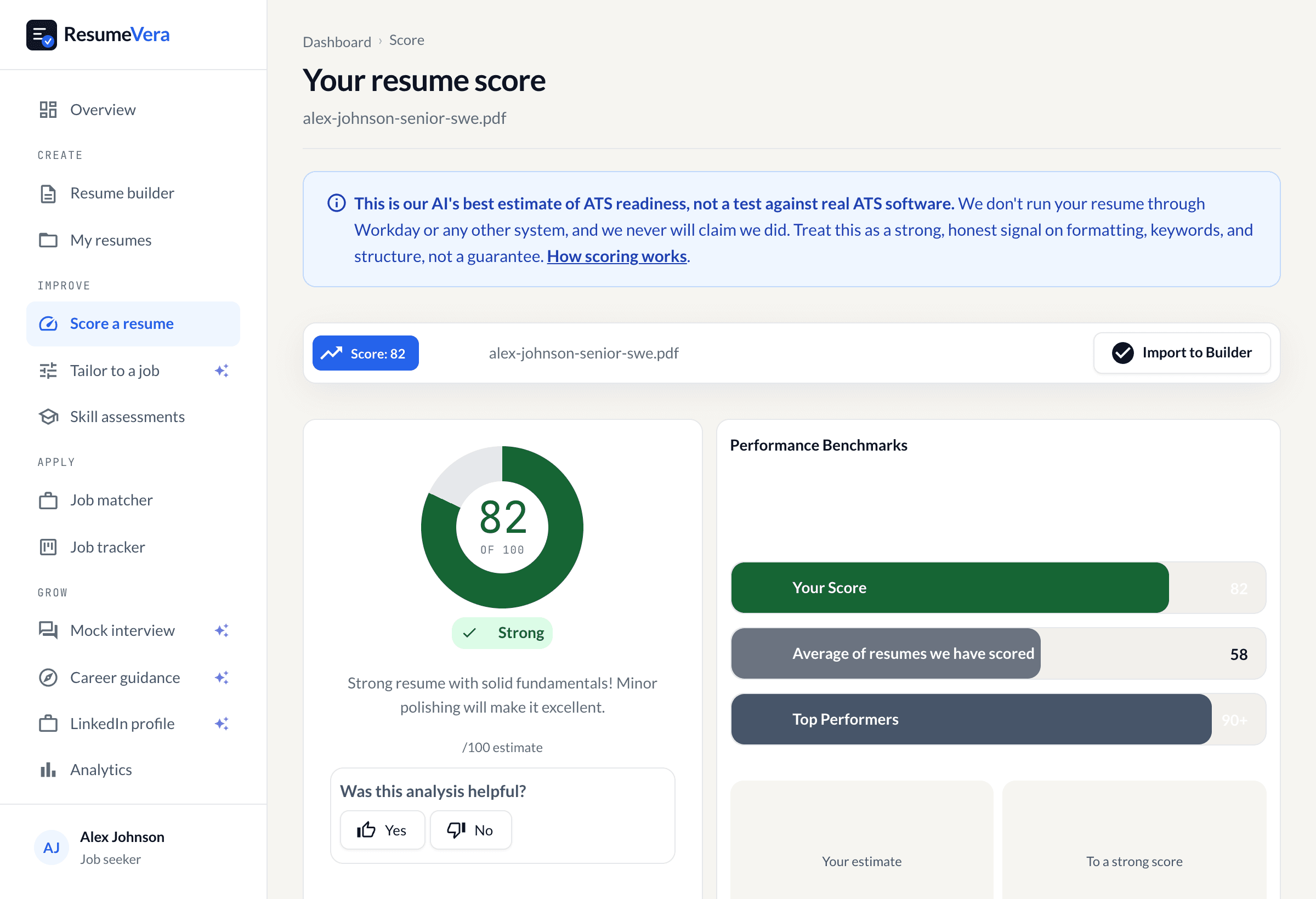
A sample resume in the real checker. The 82 and the sub-scores are what the scorer returns for it.
Is your resume ATS ready?
Run a free ATS score check and get specific improvements in under 30 seconds.