How recruiters really skim your resume, and what ATS software actually does
Resume Tips · ResumeVera Team · January 18, 2026 · 12 min read

The myth first: software is not secretly binning most resumes
You may have seen the claim that "75% of resumes are rejected by ATS before a human sees them." It gets repeated a lot, but nobody has ever produced a credible study behind it. It is worth knowing what an applicant tracking system (ATS) actually does, because the real problem is usually somewhere else.
Most ATS software does three ordinary things:
- It parses your resume. It pulls your name, contact details, job titles, employers, dates and skills into fields in a database.
- It stores your application. Every applicant for the role sits in one place, usually with the resume file attached.
- It lets recruiters search and filter. A recruiter can search for a skill, sort by location, or look at everyone who answered yes to a screening question.
Most systems do not score your fonts or reject you for a two-column layout. Automatic screening does happen, but it runs on rules the employer sets up. The most common are knockout questions, such as "Do you have the right to work here?" or "Do you have a valid licence?" Some employers also filter on criteria like a required degree or a long gap in employment. In a 2021 Harvard Business School and Accenture report, almost half of the companies surveyed said they screened out resumes with a work gap of more than six months. Answering screening questions honestly and explaining gaps matter more than any formatting trick.
Formatting still matters for a different reason. If your layout confuses the parser, your job titles or dates can land in the wrong fields, and a recruiter searching for your skills may not find you. That is a visibility problem, not an automatic rejection.
The part that is real: the quick human skim
Once a recruiter opens your resume, they decide fast whether to read further. In an eye-tracking study Ladders published in 2018, the average initial screen of a resume took 7.4 seconds. Ladders said resumes with simple layouts and clearly marked section and title headers did well, while cluttered layouts with long sentences, multiple columns and little white space did poorly.
That is one study from one company, so treat the exact number loosely. The broader point holds up: the first look is short, and it lands on the top of the page.
Where the eye goes first
Ladders' earlier 2012 eye-tracking report found that recruiters spent most of their review time on a handful of details:
- Your name
- Your current job title and company
- Start and end dates for your current role
- Your previous job title, company and dates
- Education
Beyond those, recruiters mostly scanned for keywords that matched the open role.
If those parts are hard to find or vague, the recruiter may move on before reaching the good material further down.
Seven things that make a skim go badly
1. A generic objective statement
Weak: "Seeking a challenging position in a dynamic company where I can utilize my skills..."
Better: "Senior Product Manager | Led 3 product launches in SaaS and mobile"
2. A wall of text under each job
Weak: Paragraphs describing job duties
Better: 3 to 5 bullets that say what changed because of your work. For example:
- Increased sales by 45% through a data-driven targeting strategy
- Reduced customer churn by redesigning the onboarding flow
3. Missing the words from the job description
Recruiters often search their ATS for the skills and titles in the job ad. If the role asks for "financial modelling" and your resume only says "spreadsheets," a search may not surface you, and a human skimming for that skill may not spot it either. Use the employer's wording where it truthfully describes what you did.
4. Inconsistent formatting
Weak: Mixed fonts, uneven spacing, random bolding
Better: One clean template with a consistent hierarchy of headings, titles and bullets
5. Gaps with no context
Weak: Leaving a gap unexplained
Better: A short line such as "Career break (Jan to Aug 2023): completed professional certifications" or "Freelance consulting"
6. Responsibilities instead of results
Weak: "Responsible for managing team and budgets"
Better: "Managed a 12-person team and a $4.2M budget, delivering 3 projects under budget"
7. An unprofessional email address
Weak: partylover2000@email.com
Better: firstname.lastname@email.com
Make the top third do the work
Because the first look lands near the top, put your strongest material there:
- Your name, in a larger bold font
- Your target job title or a short professional headline
- Contact details: phone, professional email, LinkedIn
- A one or two line summary with your most relevant achievement
- Your most recent job with two or three concrete results
Use numbers where you honestly have them
Numbers make results easy to spot in a skim. Good candidates include:
- Revenue or cost impact
- Team size managed
- Projects delivered
- Time saved or efficiency gains
- Customer or user growth
Only use figures you can explain in an interview. A made-up number is easy to spot and hard to defend.
Example: before and after
This is an illustrative example, not a real candidate.
Before
Objective: Seeking marketing position to utilize my communication skills
Experience:
Marketing Coordinator at ABC Company (2020 to 2023)
Responsible for social media management, email campaigns, and coordinating marketing events. Worked with team members to achieve company goals.
After
Marketing Coordinator | B2B SaaS | Email and social campaigns
Marketing Coordinator | ABC Company (2020 to 2023)
• Grew the email list from 12K to 85K subscribers
• Ran an Instagram campaign that generated 14K leads
• Managed a $450K budget across 12 campaigns
The difference: the job title is clear, the results are specific, and a recruiter can see what you achieved in one glance.
How ResumeVera can help
ResumeVera's ATS score is an AI estimate of how clearly your resume reads and how well it matches a job description. It does not run your resume through any employer's real ATS, and no tool can promise you will get past one. What it can do is point out missing keywords from the job ad, weak bullets and formatting that might confuse a parser.
Our AI can also suggest ways to rewrite duty-style bullets as results, using only what you tell it about your work.
Next step
Run your resume through the free ATS checker to see which keywords from a job description are missing, then fix the top third first.
Remember: the first look is short. Make the top of your resume easy to read.
Questions
Frequently asked questions
Get free ATS tips every week
Actionable resume and ATS tips, when we publish them. No spam. Unsubscribe any time.
Related Articles

The Wout Weghorst Resume: How to Write Your 'Super Sub' Moments So Recruiters Cannot Ignore You
Wout Weghorst came off the bench in the 2022 World Cup quarter-final and scored twice in extra time to nearly eliminate Argentina. Every career has moments like this. Here is how to put those clutch achievements on your resume so they hit recruiters the same way.
Read More

CV vs Resume 2026: Key Differences for US, UK, India & Global Applications
Understand CV vs resume differences across the US, UK, India, Europe, and global job markets. Learn length, photo rules, personal details, paper size, terminology, and how to adapt your document for international applications.
Read More

Graphic Designer Resume Examples 2026: Portfolio, ATS Keywords & Creative-Safe Format
Complete graphic designer resume guide for 2026. Learn how to balance creativity with ATS readability, what portfolio and software keywords matter, how to write strong project bullets, and how freshers and experienced designers should position their work.
Read More
Try it
Check this against your own resume
The post above is general. Your file is not. The checker reads it the way a parser would and tells you which of these points it actually breaks.
Check your resume free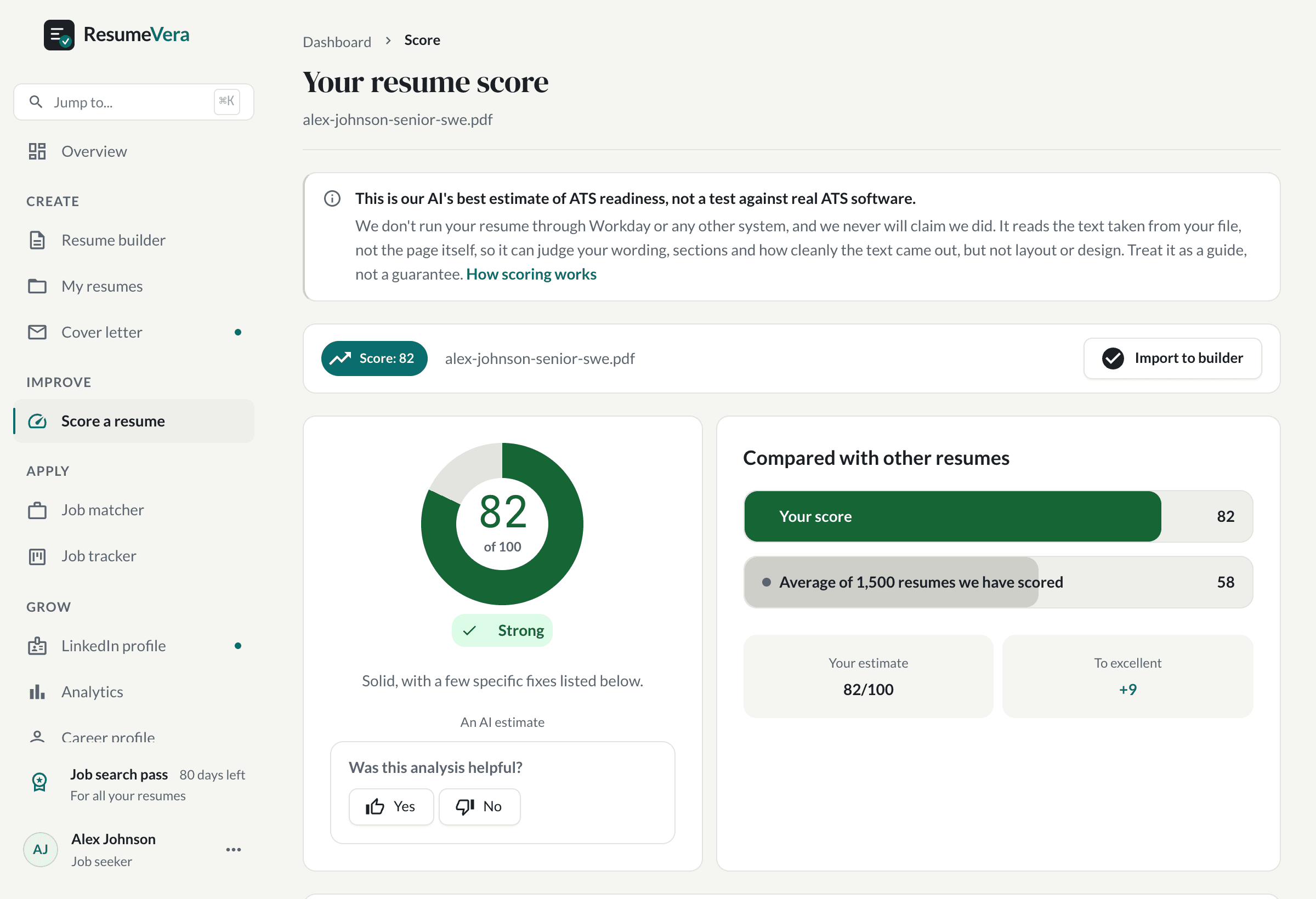
The real score page, with a sample resume and sample scores.
Now check it against your own resume
An honest resume score in seconds. No account, no card.