Entry level job search in the AI era: what the data actually says
Job Search · ResumeVera Editorial · September 1, 2026 · 11 min read

If you graduated in the last two or three years and the job search has felt disproportionately brutal, you are not misreading it. The data agrees with you, and it agrees in an unusually specific way.
What follows is the actual evidence, including the parts that complicate the story. We have been careful here because this is a topic where doom-laden coverage and vendor marketing both have an incentive to overstate, and where the underlying research is better and more cautious than the headlines built on it.
What the strongest study actually found
The most rigorous work on this comes from the Stanford Digital Economy Lab. The paper is "Canaries in the Coal Mine? Six Facts about the Recent Employment Effects of Artificial Intelligence," by Erik Brynjolfsson, Bharat Chandar and Ruyu Chen. It has been revised repeatedly since the first version in August 2025, and the current revision from August 2026 uses ADP payroll records covering millions of US workers through June 2026.
The headline finding: employment among workers aged 22 to 25 in the occupations most exposed to AI now stands about 19 percent below where it would be had it kept pace with that of their less-exposed peers of the same age. In the first version of the paper that figure was 13 percent. Experienced workers in the same occupations show no comparable gap.
Two details matter more than the number.
First, the mechanism. The effect operates primarily through reduced hiring of young workers rather than through increased separations. Nobody is being fired en masse. The doors are opening less often, which is a different and quieter kind of problem, and it is invisible in layoff statistics.
Second, the authors' own caution. They state plainly that they find no evidence of widespread, economy-wide job displacement. This is a concentrated effect on a specific population in specific occupations, not a general collapse. Anyone citing this paper to tell you AI is eliminating work in general is citing it against its own conclusion.
What the graduate numbers look like
The New York Fed maintains a quarterly dashboard on the labour market for recent college graduates, defined as people aged 22 to 27 with a bachelor's degree or higher. Through the second quarter of 2026 it put recent graduate unemployment at about 5.6 percent, with underemployment edging up to 42 percent.
Set that against the wider market. The Bureau of Labor Statistics reported overall unemployment at 4.1 percent for July 2026. Recent graduates are doing worse than the average worker, which historically has not been the usual relationship.
The underemployment figure deserves attention too, because it is easy to skim past. Forty-two percent means a large share of graduates who are working are in jobs that do not require the degree they hold. Employed is not the same as launched.
The employer forecasts, and why they moved
The National Association of Colleges and Employers surveys employers about graduate hiring plans. Its forecast for the class of 2026 is a useful illustration of how uncertain this all is.
In the autumn survey, collected between 7 August and 22 September 2025 from 183 respondents, employers projected a 1.6 percent increase in hiring. Essentially flat. By the Spring Update, published on 27 April 2026 with data collected in February and March, that had been revised up to 5.6 percent, with the largest companies of 5,000 or more employees projecting an 8.7 percent increase.
A forecast that moves from 1.6 to 5.6 percent in six months is not a precise instrument. We are including both numbers rather than the more flattering one because the gap between them is itself the honest signal: employers do not know either.
One finding from the same survey is worth carrying forward. Seventy percent of the employers reported using skills-based hiring, up from 65 percent. That is directly actionable, and we come back to it below.
The case against blaming AI for all of it
We would be doing the same thing we criticise if we presented the AI explanation as settled. It is not.
The Stanford team published a separate note examining whether the timing of these employment changes tracks interest rate movements rather than AI adoption. They did that work themselves, which tells you they take the alternative explanation seriously.
Indeed's Hiring Lab has made a different argument, that the struggles of new entrants stem less from employers pulling back on junior roles specifically and more from the overall decline in available jobs. On that reading, graduates are not being singled out. They are simply the most exposed group in a market where hiring has slowed generally, because they have no incumbent position to hold.
The Stanford paper's own reference list includes work questioning how graduate unemployment charts have been interpreted. This is a live disagreement among people who look at the data for a living.
Our reading is that the AI effect is real, well identified, and narrower than the discourse. It is one factor in a slow market, not the whole explanation. That distinction matters for you because the two diagnoses imply different responses.
What this changes about your resume
Here is the part most advice gets wrong.
The standard response to a hard market is to make your application look more professional. Better formatting, stronger adjectives, a more polished summary. That advice made sense when producing a polished document took effort and therefore signalled something about the person who produced it.
It signals almost nothing now. Every applicant has access to tools that generate fluent, well-structured, keyword-appropriate prose in seconds. Polish has become free, and anything free stops functioning as a signal.
What has not become free is evidence.
Name the thing you built and what it does. "Built a scheduling tool used by 30 people in my department" survives scrutiny. "Detail-oriented problem solver with strong communication skills" does not, and never did, but it used to at least cost you something to write.
Use numbers you can defend. Not invented percentages, which are now the single most common tell of a generated resume, but real quantities: how many, how long, how much. If you processed 200 orders a week in a summer job, that is a more useful line than any adjective.
Put projects where experience would go. If you have little employment history, the section labelled experience does not have to contain only jobs. Coursework projects, open source contributions, freelance work and things you built for yourself all demonstrate the same thing an internship demonstrates, which is that you have done the work rather than studied it.
Name your tools specifically. This is where the skills-based hiring shift becomes concrete. Seventy percent of NACE respondents said they hire on skills. Vague competence claims do not match against that. Named, verifiable tools and methods do.
You can check how a parser reads what you have written with our free ATS score, which needs no account, and build the document itself in the resume builder.
Where to point your applications
The occupational dimension of the Stanford finding is the practically useful part. The gap appears in occupations most exposed to what current AI systems do well. It does not appear uniformly.
Health care has been among the few consistent gainers in recent Bureau of Labor Statistics releases, adding roughly 22,000 positions in July 2026 while most sectors were flat or shrinking. Roles with a physical, licensed, or in-person component have generally held up better.
Rather than trusting any list in an article, including this one, check a specific field in the Bureau of Labor Statistics Occupational Outlook Handbook, which is free and maintained by the people who collect the underlying data.
Then be selective about where the effort goes. In a market with fewer openings and more applicants per opening, spraying applications is the worst available strategy, because the tailoring quality that actually differentiates you falls as volume rises. Our job matcher compares your resume against a specific posting so you can see where the fit is genuine before committing to it. It is also worth understanding how many of the postings you are looking at will not result in a hire at all, which we covered in our piece on ghost jobs.
The honest summary
Graduate hiring is measurably harder than it was, the effect is concentrated in AI-exposed occupations and operates through hiring rather than firing, and reasonable economists disagree about how much of it is AI versus a generally slow market.
None of that is within your control. What is within your control is that the currency of an application has shifted from polish to evidence, and that shift favours anyone willing to be specific about what they have actually done.
Sources
- Brynjolfsson, Chandar and Chen, Canaries in the Coal Mine? Six Facts about the Recent Employment Effects of Artificial Intelligence, Stanford Digital Economy Lab, August 2026 revision, using ADP data through June 2026. digitaleconomy.stanford.edu
- Stanford Digital Economy Lab, Canaries, Interest Rates, and Timing: More on the Recent Drivers of Employment Changes for Young Workers. digitaleconomy.stanford.edu
- Federal Reserve Bank of New York, The Labor Market for Recent College Graduates, updated quarterly. newyorkfed.org
- National Association of Colleges and Employers, Job Outlook 2026, autumn projection, 183 respondents, collected 7 August to 22 September 2025. naceweb.org
- National Association of Colleges and Employers, Job Outlook 2026 Spring Update, published 27 April 2026. naceweb.org
- U.S. Bureau of Labor Statistics, The Employment Situation, July 2026. bls.gov
- Indeed Hiring Lab, September 2025 Labor Market Update: The Squeeze on New Entrants Mirrors a Marketwide Decline. hiringlab.org
- U.S. Bureau of Labor Statistics, Occupational Outlook Handbook. bls.gov
The Stanford paper has been revised several times and the figure has moved with each revision. We cite the August 2026 version and will update this piece when the next one lands.
Questions
Frequently asked questions
Get free ATS tips every week
Actionable resume and ATS tips, when we publish them. No spam. Unsubscribe any time.
Related Articles

How long are people actually staying at their jobs now? What the newest BLS tenure data says
Every two years the federal government asks a very specific question: how long have you been with your current employer. The newest answer, released in September 2026, shows median tenure ticking up after a two year low, a sharp gap by age and industry, and a short tenure share that is actually falling. Here is what the data shows, and what it means for how you handle more than one short stint on a resume.
Read More

Is your raise actually keeping up with prices in 2026? What the wage data says
Three federal data sources answer the "am I getting ahead" question differently depending on how you ask it. Job switchers are clearly outrunning inflation. People who stay in their current job are barely breaking even. Here is what the real earnings report, the Employment Cost Index, and the Atlanta Fed's wage tracker each actually measure, and what to do with the gap between them.
Read More

How long does it actually take to find a job in 2026? What the federal data says
The median unemployed job seeker in 2026 has been searching for about eleven weeks. The average is more than double that, and the gap between the two numbers is the whole story. We checked the federal data on how long searches actually run, how that compares with past downturns, and what it means for planning your own.
Read More
Try it
Check this against your own resume
The post above is general. Your file is not. The checker reads it the way a parser would and tells you which of these points it actually breaks.
Check your resume free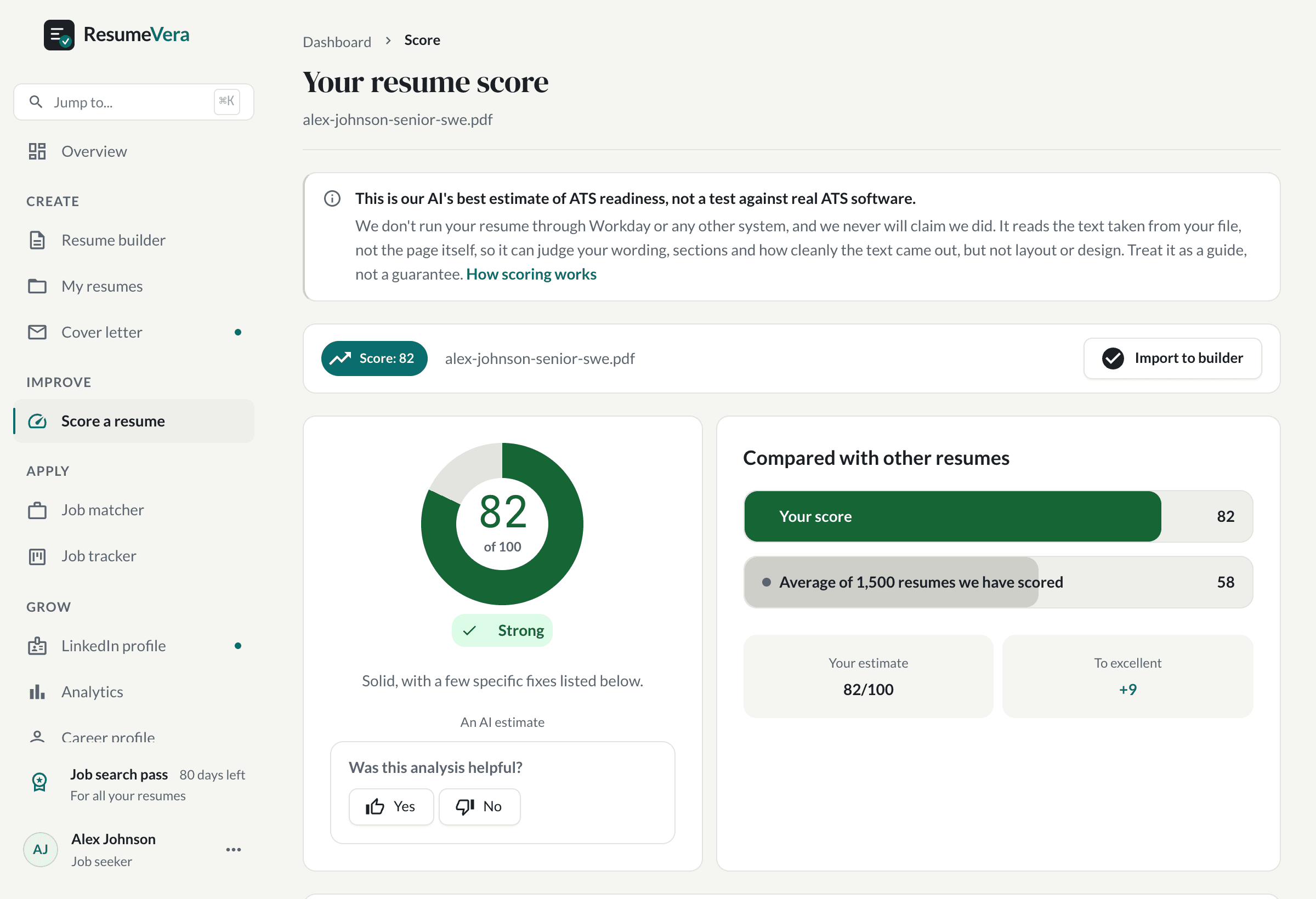
The real score page, with a sample resume and sample scores.
Now check it against your own resume
An honest resume score in seconds. No account, no card.