Ghost jobs, honestly: how many postings are real, and how to spot the ones that are not
Job Search · ResumeVera Editorial · September 1, 2026 · 11 min read

You send forty applications. You hear nothing back from most of them. Somewhere around week six, you come across a statistic saying one in three job postings is fake, and it lands with a kind of relief. It was not you. The system is rigged.
We went looking for where that number comes from. What we found is that ghost jobs are real and worth understanding, but almost every widely shared figure about them is being quoted in a way that means something different from what the study actually measured.
Here is the honest version.
Three studies, three different questions
The confusion is not that researchers disagree. It is that they measured different things and the results got flattened into one headline.
Greenhouse measured postings. In its 2024 State of Job Hunting report, published on 10 December 2024, the applicant tracking company reported that in any given quarter, 18 to 22 percent of the jobs posted on the Greenhouse platform are classified as ghost jobs. This figure comes from Greenhouse's own platform data rather than from a survey. It is the most direct posting-level measurement available from a company that can see inside the hiring process.
The important limit is in the wording. This is jobs posted on Greenhouse, not jobs posted everywhere. Greenhouse customers skew towards mid-size and larger companies with structured hiring, so the figure may not generalise to the whole market.
Clarify Capital measured how long postings stay live. In February 2026 the firm scraped 176,268 unique Indeed listings across 49 industries and every state, flagging listings that had been active for 30 days or more. It found about one in seven active posts met that threshold, with 4 percent live for four months or more. Wholesale was the worst sector at 51 percent.
Its earlier work asked employers directly. A 2022 survey of 1,045 hiring managers found that 43 percent were not actively trying to fill a posting they had live, and around half kept listings open because the company is "always open to new people." One in ten had a posting that had been live for six months or more. A follow-up published in 2025, covering 1,000 employers and 200 job seekers, found nearly one in three employers had postings active for 30 days or longer, which was roughly half the 2022 rate.
ResumeBuilder measured companies. This is the study behind the number you have probably seen, and it is the one most often misread. In May 2024 it surveyed 1,641 hiring managers through Pollfish, of whom 649 qualified and completed. Forty percent said their company had posted a fake job in the past year, and roughly 30 percent said they currently had one live.
Read that carefully. Forty percent of companies, not 40 percent of postings. A company that posts one questionable listing alongside forty-nine real ones counts fully in that 40 percent. Converting it into a posting-level claim is the single most common error in ghost jobs coverage, and it is how "40 percent of companies" became "one in three job ads is fake."
The number we are not going to print
Two figures circulate that we could not stand behind.
The first is "one in three job postings is a ghost job." As above, it is a company-level result wearing a posting-level costume. No study we found measures postings and arrives at one in three.
The second is a set of Greenhouse industry breakdowns, often given as something like 70 percent of companies having posted a ghost job with a percentage attached to each sector. These do not appear in any Greenhouse publication we could locate. They trace to Greenhouse internal data reported by the Wall Street Journal in January 2025. If you want to cite them, cite them that way. They are not from a Greenhouse report you can go and read.
We also want to flag two recruiter surveys that get quoted heavily. MyPerfectResume surveyed 753 US recruiters in August 2024 and found 81 percent admitting their employer posts ads for jobs that do not exist or are already filled. LiveCareer surveyed 918 HR professionals in March 2025 with similar results. Both are worth knowing about, and both are brands owned by Bold LLC, a company whose products compete with ours. We are telling you that because a survey commissioned by a company with an interest in the answer deserves a different weight than platform data, whoever owns it.
What the labour market data adds, and what it does not
The Bureau of Labor Statistics publishes a monthly survey that is often pulled into this conversation. For June 2026 it recorded about 7.4 million job openings against roughly 5.3 million hires.
That gap of just over two million is real and it is worth understanding. But it is not a count of ghost jobs, and anyone presenting it as one is misleading you. Openings exceed hires in every functioning labour market. Roles take weeks or months to fill, candidates decline offers, requisitions get cancelled, and a posting live on the last day of the month has not failed simply because nobody started that month.
What the gap does tell you is that a posting existing is weak evidence that a hire is imminent. That is the structural fact underneath the frustration, and it holds whether or not any individual listing was posted in bad faith.
What a ghost job actually is
The term covers several different situations, and it helps to separate them, because the ones that waste your time most are not always the ones that sound worst.
There is the role that was filled and never taken down. Careless rather than deceptive, and extremely common.
There is the evergreen pipeline posting, kept live so the company can collect resumes for a role it expects to open eventually. Around half the employers in the 2022 Clarify survey described something like this.
There is the posting kept up to project growth, so the company looks like it is expanding. The ResumeBuilder respondents named this directly, along with wanting existing staff to feel that workload relief was coming.
There is the role that exists but is already earmarked for an internal candidate, posted because policy requires an external advertisement.
And there is the requisition that has been frozen without anyone updating the listing, which in a market with the hiring pattern described above is probably the fastest-growing category of all.
Signals worth watching
None of these proves anything on its own. Treat them as reasons to spend fifteen minutes on an application rather than ninety.
Check how long the posting has been live. This is the single most useful signal, because it is the one the data actually supports. Most job boards show a posted date, and a listing that has been up for more than a month without changing is statistically a different proposition from one posted last week.
Watch for reposting. A listing that disappears and returns unchanged every few weeks is usually being refreshed to stay near the top of search results, which tells you something about the employer's urgency.
Look for specificity. A real, funded, currently open role usually has a named team, a described project, or a manager it reports to. A posting that could describe any company is easier to leave up indefinitely because nothing in it ever goes out of date.
Notice whether the process moves. An employer that runs a first conversation and then goes quiet for a month is showing you the shape of its intent.
What to actually do about it
The instinct when you learn about ghost jobs is to apply to more things, on the theory that if some fraction are fake you need to increase volume. We think that is backwards.
If somewhere between one in seven and one in five postings will not result in a hire, then the value of each application you send depends heavily on which ones you pick. Volume makes that worse, because tailoring quality drops as quantity rises, and the roles most worth your effort are the ones where a considered application actually competes.
Spend your effort where the match is real. Our job matcher compares your resume against a posting so you can see where you genuinely fit before committing an hour to it.
Then keep a record. Once your applications are spread across two or three months, you cannot hold in your head which employers went quiet, which reposted the same role, or which have now had a listing live for ninety days. A job tracker turns that into something you can look at, and the patterns become obvious quickly.
And keep the failure attribution honest in both directions. Some of your silence is ghost jobs. Some of it is a market where hires have been running well below openings for months. Very little of it is a machine automatically binning your resume, which is a related myth we have looked into separately.
Whether anyone is going to fix this
One jurisdiction has acted. As of 1 January 2026, Ontario requires employers with 25 or more employees to state in a publicly advertised job posting whether it is for an existing vacancy. The same rules require disclosure of AI use in screening, prohibit Canadian experience requirements, and oblige employers to tell interviewed candidates the outcome within 45 days.
In the United States, bills addressing job posting truthfulness have been introduced in several states including New York, California, New Jersey, Kentucky and Pennsylvania. We are deliberately not listing what any of them requires, because introduced is not enacted and we could not confirm the current status of each one. If a specific state matters to you, check the bill on the legislature's own site rather than trusting a summary.
Until something changes, the posting date is the most reliable tool you have.
Sources
- Greenhouse, 2024 State of Job Hunting Report, 10 December 2024. greenhouse.com
- Clarify Capital, Ghost Jobs Are Haunting the U.S. Job Market, February 2026 scrape of 176,268 Indeed listings. clarifycapital.com
- Clarify Capital, Survey: Job Seekers Beware of Ghost Jobs, 1,045 hiring managers, fielded 31 August to 1 September 2022. clarifycapital.com
- Clarify Capital, Ghost Jobs 2.0, 1,000 employers and 200 job seekers, 2025. clarifycapital.com
- ResumeBuilder.com, 3 in 10 Companies Currently Have Fake Job Postings Listed, surveyed May 2024, 1,641 hiring managers screened and 649 qualified completions. resumebuilder.com
- U.S. Bureau of Labor Statistics, Job Openings and Labor Turnover Survey, June 2026, released 4 August 2026. bls.gov
- Government of Ontario, Requirements related to publicly advertised job postings, in force 1 January 2026. ontario.ca
Survey figures above carry their sample sizes and fielding dates so you can weigh them yourself. Where a widely repeated number is missing from this piece, it is because we could not trace it to a study we could read.
Questions
Frequently asked questions
Get free ATS tips every week
Actionable resume and ATS tips, when we publish them. No spam. Unsubscribe any time.
Related Articles

How long are people actually staying at their jobs now? What the newest BLS tenure data says
Every two years the federal government asks a very specific question: how long have you been with your current employer. The newest answer, released in September 2026, shows median tenure ticking up after a two year low, a sharp gap by age and industry, and a short tenure share that is actually falling. Here is what the data shows, and what it means for how you handle more than one short stint on a resume.
Read More

Is your raise actually keeping up with prices in 2026? What the wage data says
Three federal data sources answer the "am I getting ahead" question differently depending on how you ask it. Job switchers are clearly outrunning inflation. People who stay in their current job are barely breaking even. Here is what the real earnings report, the Employment Cost Index, and the Atlanta Fed's wage tracker each actually measure, and what to do with the gap between them.
Read More

How long does it actually take to find a job in 2026? What the federal data says
The median unemployed job seeker in 2026 has been searching for about eleven weeks. The average is more than double that, and the gap between the two numbers is the whole story. We checked the federal data on how long searches actually run, how that compares with past downturns, and what it means for planning your own.
Read More
Try it
Check this against your own resume
The post above is general. Your file is not. The checker reads it the way a parser would and tells you which of these points it actually breaks.
Check your resume free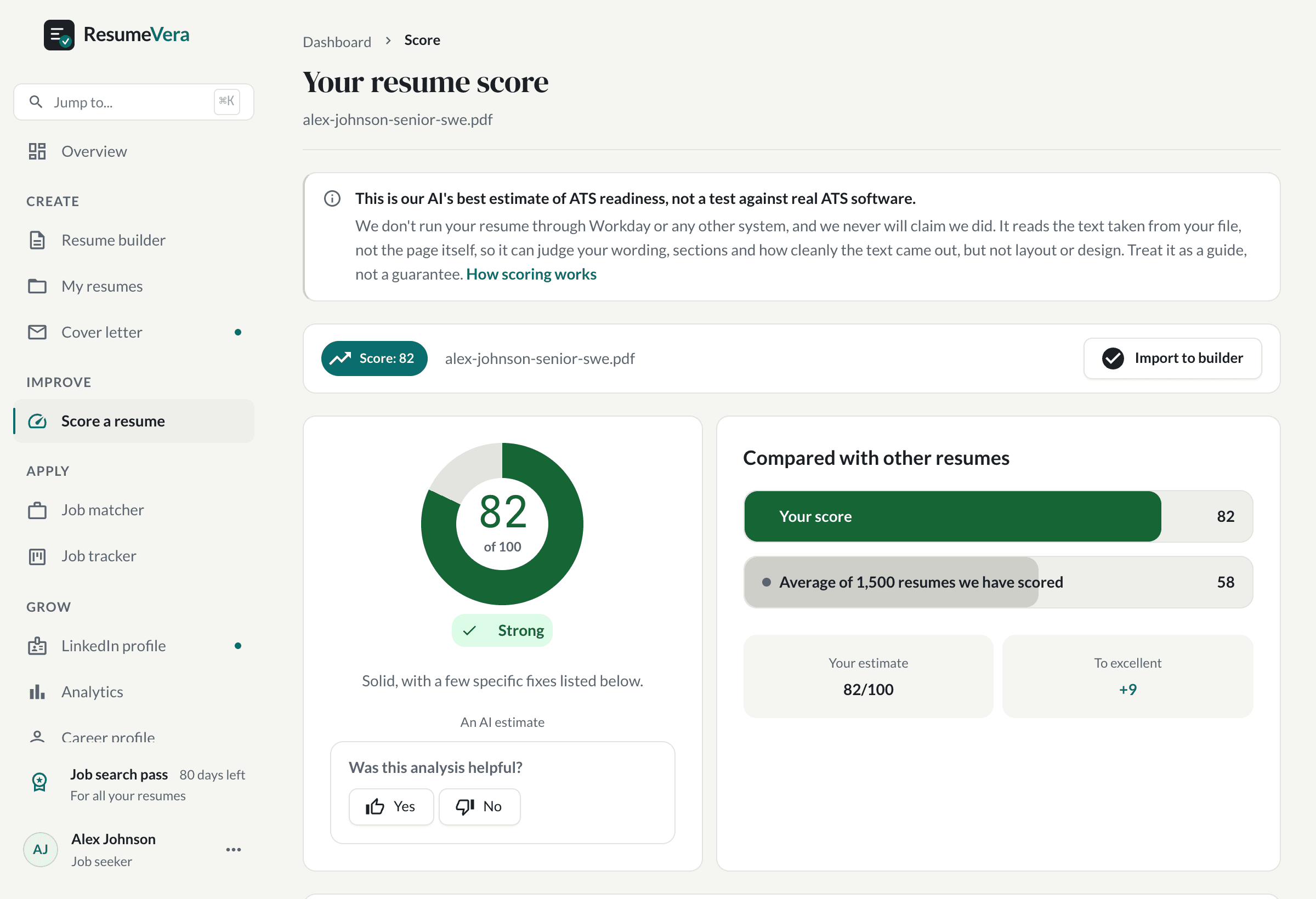
The real score page, with a sample resume and sample scores.
Now check it against your own resume
An honest resume score in seconds. No account, no card.