Last updated: October 2026 · 11 min read · By the ResumeVera editorial team
In this guide:
- The salary hike formula, worked on CTC rather than in-hand pay
- Why your take-home rises by less than your CTC
- Three worked examples at ₹6L, ₹12L and ₹25L
- Industry hike benchmarks for India in 2026 (Aon survey)
- How the tax regime changes your real gain
- How to negotiate with the net-gain number
When an offer letter says "20% hike", most people expect their monthly salary credit to rise by 20%. It usually does not. Income tax, your own PF contribution and the parts of CTC you never receive as salary all take a share of every extra rupee, and the share grows once the increment lands in a taxed slab.
This guide gives you the formula, shows the real in-hand gain at three salary levels using the same calculator that runs on this site, and compares your hike with India's 2026 industry averages.
See your real net gain
The salary hike calculator works out your take-home increase after tax. Enter your current CTC and the new CTC or hike percentage.
The salary hike percentage formula
Hike % = ((new annual CTC - old annual CTC) / old annual CTC) x 100
Use annual CTC, not monthly in-hand. Monthly pay moves with TDS timing, variable pay and one-off payouts, so it is a poor base for a percentage.
Example
- Old CTC: ₹6,00,000 a year
- New CTC: ₹7,20,000 a year
- Hike = ((7,20,000 - 6,00,000) / 6,00,000) x 100 = 20%
Working backwards from a percentage: new CTC = old CTC x (1 + hike% / 100).
Why your take-home rises by less than your CTC
Every extra rupee of CTC passes through these before it reaches your bank account:
- Income tax (TDS): charged at your marginal slab. Under the new regime for FY 2026-27 the slabs run from 5% (₹4 to 8 lakh) to 30% (above ₹24 lakh of taxable income), and a rebate makes tax zero up to ₹12 lakh of taxable income.
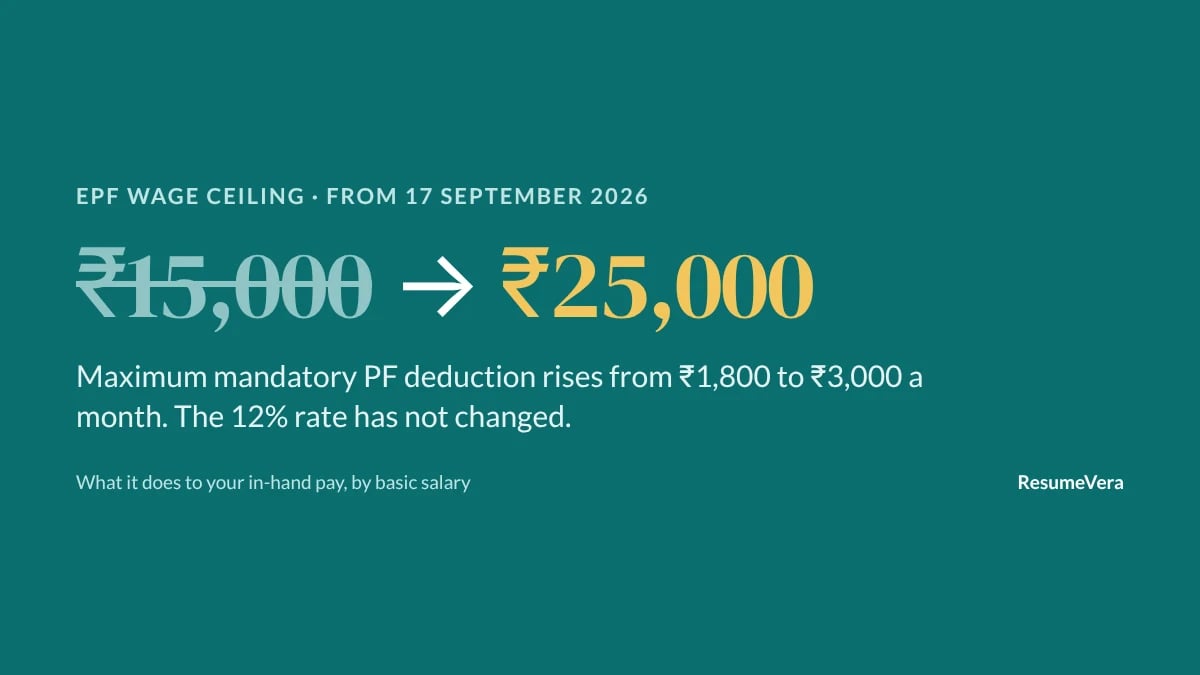
- Your PF contribution: 12% of basic salary, up to the ₹25,000 monthly wage ceiling in force from 17 September 2026, so at most ₹3,000 a month. A hike that raises your basic also raises this deduction until you reach the ceiling.
- Employer PF and gratuity: both sit inside CTC but are never paid to you as monthly salary, so part of any CTC rise goes there.
- Professional tax: charged by most states, at most ₹2,500 a year. Our examples leave it out.
In the three examples below, a 20% CTC hike becomes a 14% to 20% rise in take-home pay. While your income stays under the ₹12 lakh rebate limit, almost the whole hike reaches you; once the increment crosses into a taxed slab, more of it goes to tax.
Real net gain: three examples
All three use the new regime for FY 2026-27, basic at 40% of CTC, employer PF inside CTC, the ₹25,000 PF wage ceiling and no professional tax. These are the defaults of the calculators on this site.
Example 1: ₹6L to ₹7.2L (20% hike)
- Take-home before: ₹5,30,856 a year. After: ₹6,37,027.
- Income tax: zero in both years, because taxable income stays under the ₹12 lakh rebate limit.
- Your PF deduction rises from ₹28,800 to ₹34,560 a year, because basic rises with CTC.
- Real gain: ₹1,06,171 a year, about ₹8,848 a month.
- Real hike in take-home: 20.0%. With no tax in play, the take-home rises in step with CTC.
Example 2: ₹12L to ₹14.4L (20% hike)
- Take-home before: ₹11,04,912 a year, with zero tax thanks to the rebate. After: ₹12,62,092.
- Income tax after the hike: ₹78,202 including cess. Taxable income crosses ₹12 lakh, so the rebate no longer applies.
- Your PF deduction stays at ₹36,000 a year, because basic is already at the wage ceiling.
- Real gain: ₹1,57,180 a year, about ₹13,098 a month.
- Real hike in take-home: 14.2%. This is where the rebate cliff bites hardest.
Example 3: ₹25L to ₹30L (20% hike)
- Take-home before: ₹20,83,266. After: ₹24,23,721.
- Income tax rises from ₹2,96,634 to ₹4,46,559, so the hike costs ₹1,49,925 in extra tax.
- Real gain: ₹3,40,455 a year, about ₹28,371 a month.
- Real hike in take-home: 16.3%.
Your offer letter's split will move these numbers: a higher basic means more PF, HRA and rent change the old regime result, and professional tax takes a little more. Run your own figures in the salary hike calculator.
New regime slabs for FY 2026-27
| Taxable income (annual) | Tax rate (new regime) |
|---|---|
| Up to ₹4,00,000 | Nil |
| ₹4,00,001 to ₹8,00,000 | 5% |
| ₹8,00,001 to ₹12,00,000 | 10% |
| ₹12,00,001 to ₹16,00,000 | 15% |
| ₹16,00,001 to ₹20,00,000 | 20% |
| ₹20,00,001 to ₹24,00,000 | 25% |
| Above ₹24,00,000 | 30% |
The Section 87A rebate (up to ₹60,000) makes tax zero for taxable income up to ₹12,00,000. Salaried people also get a ₹75,000 standard deduction under the new regime. A 4% health and education cess applies to any tax due.
Source: Income Tax Department, salaried individuals for AY 2026-27. PF wage ceiling: EPFO wage ceiling FAQs (September 2026).
Three numbers people call a "hike"
| Metric | Formula | What it tells you |
|---|---|---|
| CTC hike % | ((new CTC - old CTC) / old CTC) x 100 | What the offer letter says |
| Take-home hike % | (new take-home - old take-home) / old take-home x 100 | What changes in your bank account |
| Real annual gain | New annual take-home - old annual take-home | The rupees you actually gain each year |
Negotiate on the real annual gain, not the CTC percentage. "About ₹28,000 more a month" is a clearer anchor than "20%", and it shows you know how your slab works.
When to switch regime after a hike
A hike can change which regime suits you. If you do not claim large HRA, home loan interest or Section 80C deductions, the new regime usually wins. If you do, the old regime can still come out ahead even at higher salaries. Do not assume last year's choice still holds: run both in the salary hike calculator after every revision.
India 2026 salary hike benchmarks by industry
From Aon's Annual Salary Increase and Turnover Survey 2025-26, which covered more than 1,400 organisations across 45 industries:
| Sector | Projected hike 2026 |
|---|---|
| Real estate and infrastructure | 10.2% |
| NBFCs (non-banking finance) | 10.1% |
| Automotive and vehicle manufacturing | 10.0% |
| Engineering design services | 9.8% |
| Retail | 9.6% |
| India overall average | 9.1% |
| Technology (product) | 8.5% |
| Technology (IT services and consulting) | 6.8% |
If your hike is below your industry's figure, you have a dated, sourced number to bring to your next review, or a reason to look at what other employers pay.
When switching jobs beats an internal hike
An internal hike near the 2026 average of 9.1% is easy to compare with an outside offer once you convert both to real annual gain. Before you decide, subtract what a move costs you: notice period buyout, unvested stock, a joining bonus with a clawback, and gratuity if you are close to five years. The notice period buyout calculator and the salary hike calculator cover the two biggest pieces.
How to use hike numbers in a negotiation
- Know your real gain: work out the monthly take-home difference, not just the CTC jump.
- Bring outside data: the Aon benchmarks above, plus pay data for your role from sources you can name.
- Split fixed and variable pay: variable pay raises CTC without raising guaranteed pay. Ask for the fixed component and negotiate on it.
- Watch the slab and rebate edges: as Example 2 shows, crossing ₹12 lakh of taxable income can take a large share of a hike. Ask for the figure that gets you the in-hand pay you need.
- Value the non-cash parts: stock grants, insurance cover and leave all have a value. Get them in writing and include them when you compare offers.
Frequently asked questions
How is salary hike percentage calculated?
Hike % = ((new CTC - old CTC) / old CTC) x 100, on annual CTC. Old CTC ₹10 lakh and new CTC ₹12 lakh is a 20% hike.
Why is my take-home increase less than my CTC hike?
The extra CTC is taxed at your marginal slab and part of it goes to PF. In our three examples a 20% CTC hike became 14% to 20% more take-home; under the ₹12 lakh rebate limit you keep almost all of it.
What is the average salary hike in India in 2026?
Aon's 2025-26 survey projects 9.1% overall, with real estate and infrastructure at 10.2% and IT services and consulting at 6.8%.
Should I choose the new or old tax regime after a hike?
Recalculate both after every hike. Without large HRA, home loan or Section 80C deductions, the new regime usually comes out ahead.
Is it better to get an internal hike or switch jobs?
Compare the real annual gain of each option, then subtract buyout, unvested stock and any gratuity you would give up.
What should I check in a new offer letter?
Fixed pay (basic, HRA and allowances), variable pay and its conditions, whether employer PF and gratuity are inside the quoted CTC, joining bonus conditions and clawback, stock grants and vesting, and insurance cover. Never compare headline CTC alone.