Self-appraisal comments for 2027: 60 examples by role and Aon's 9.1% raise forecast
Career Advice · ResumeVera Editorial Team · November 3, 2026 · 14 min read
Short answer: Write each self-appraisal comment as one line: what you did, the context, a measurable result, and your goal for next cycle. Keep pay out of the written review. For context, Aon's survey (14 October 2026) projects an average 9.1% salary increase in India for 2027, after an actual 9% in 2026.
Last reviewed: 3 November 2026. We update this page when the rules change.
Most self-appraisals fail for the same reason: they describe effort instead of results. Your manager is filling in ratings for a whole team, often in one sitting, and the comment that wins is the one they can copy into their own justification without editing.
Below you will find the formula, 60 example comments sorted by role, a rewrite table, and what the latest salary survey means for your expectations this cycle. If your company runs the common April to March financial year, this is the window to start drafting.
How do you write a self-appraisal comment that gets noticed?
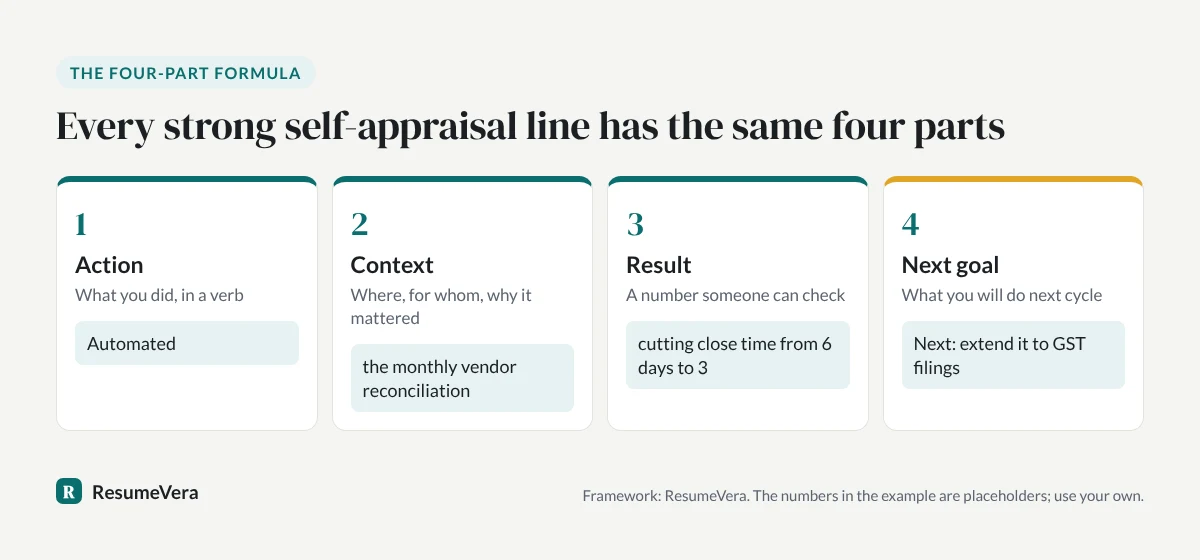
Use four parts, in this order. Every strong comment you will read below follows it.
- Action: what you personally did, starting with a verb (built, cut, closed, trained).
- Context: the problem, the deadline or the constraint that made it matter.
- Measurable result: a number, a before and after, or a named outcome.
- Next-cycle goal (optional): one line showing where you want to grow.
Where do the numbers come from?
Before you write anything, spend an hour collecting evidence: tickets closed, dashboards, sales reports, sprint boards, customer emails, audit reports. If you cannot find a number, use a before and after ("from three days to four hours") or a named outcome ("go-live happened on schedule").
Do not inflate. Your manager can check most of these figures, and one invented number undermines every true one next to it.
What does Aon's 9.1% raise forecast mean for your appraisal?
Salaries in India are projected to rise 9.1% on average in 2027, against an actual 9% increase in 2026, according to Aon's 33rd Annual Salary Increase and Turnover Survey, published on 14 October 2026.
The survey covers more than 1,200 organisations across 45 industries, according to the Aon press release.
Treat these as averages and projections from an employer survey. Your own increment depends on your employer, your rating and your role, which is exactly why the self-appraisal matters.
Which sectors are projected to give the highest increases in 2027?
In Aon's words, "NBFCs are projected to lead salary growth in 2027 at 10.1%, followed by energy at 9.9% and real estate and infrastructure at 9.8%".
| Sector | 2026 actual | 2027 projected |
|---|---|---|
| NBFCs | 9.6% | 10.1% |
| Energy | 9.7% | 9.9% |
| Real estate and infrastructure | 10.3% | 9.8% |
| Global Capability Centres | 9.3% | 9.4% |
| Technology platform and products | 9.5% | 9.5% |
| Banking | 8.6% | 8.5% |
| Technology consulting and services | 6.6% | 6.6% |
Source: Aon press release, 14 October 2026.
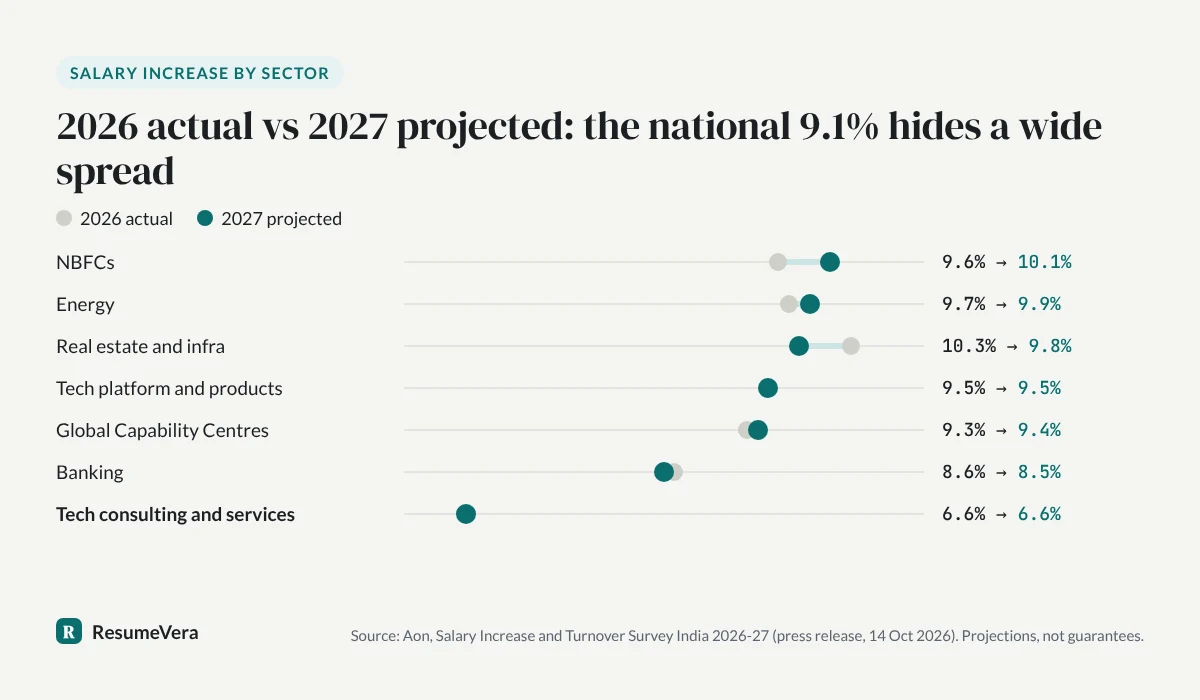
Two things stand out. Real estate and infrastructure is the only sector in this list projected to slow, from 10.3% to 9.8%. Technology consulting and services is flat at 6.6%, well below the national average, so if you work in IT services, a clear and evidenced self-review carries more weight than usual.
Is attrition rising again?
Attrition in India was 18.0% in 2026, against 16.2% in 2025 and 17.1% in 2024, according to Aon.
| Year | Attrition rate |
|---|---|
| 2024 | 17.1% |
| 2025 | 16.2% |
| 2026 | 18.0% |
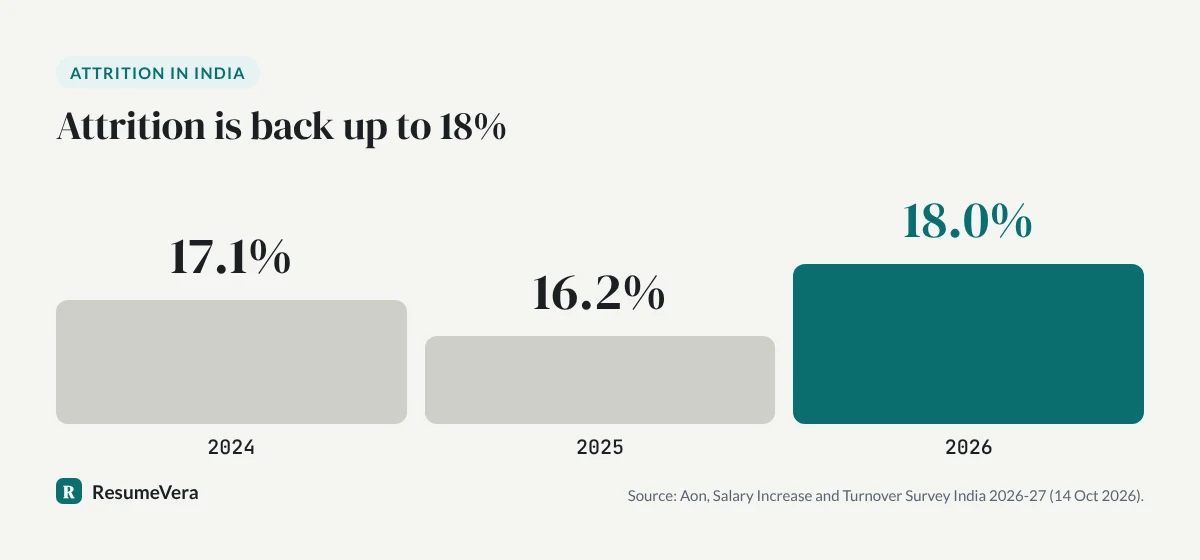
Higher attrition means employers have a reason to hold on to people who can show their value. It also means more people are moving. If your appraisal outcome disappoints and you decide to look outside, keep your applications organised in a free job application tracker.
One more change sits in the background: Aon found 65.4% of employers already compliant with the Wage Code, a further 20.9% expecting to be within six months, and 42.8% expecting payroll costs to rise by at least 1%. Our guide to the new salary slip format under the Labour Codes explains what that means for your payslip.
Weak vs strong: what does a good rewrite look like?
Vague adjectives give your manager nothing to defend in a calibration meeting. Here are four common lines, rewritten with the formula. The numbers are examples.
| Weak comment | Strong rewrite |
|---|---|
| I am a hard-working team player. | Covered two colleagues' accounts for 6 weeks during their leave with no missed deadlines. |
| Improved customer satisfaction. | Raised CSAT from 4.1 to 4.5 by calling back every unhappy customer within 48 hours. |
| Worked on many projects. | Delivered 4 client projects on time, including the largest renewal of the year. |
| Learned new skills. | Completed a Python course and automated the weekly reconciliation, saving 5 hours a week. |
60 self-appraisal comment examples by role
Every number in these examples is a placeholder. Replace each one with your own figure, or delete the claim if you cannot back it up. Copying a comment word for word is easy to spot; use them as patterns.
Self-appraisal examples for software engineers and developers
- Rebuilt the retry logic in the checkout service after repeated payment timeouts, cutting failed transactions from 1.8% to 0.4% over two quarters. Next cycle: apply the same pattern to refunds.
- Migrated 14 legacy batch jobs to the new scheduler with no missed runs, which let us retire two servers and save about ₹3 lakh a year.
- Wrote integration tests for the onboarding API, raising coverage from 42% to 78%, and production bugs from that module fell from nine in Q1 to two in Q3.
- Cut the main dashboard's load time from 6 seconds to 1.9 seconds by adding caching and paginating two heavy queries that users had complained about in support tickets.
- Covered on-call for the payments squad for 11 weeks, resolved 23 incidents and wrote runbooks for the five most frequent ones, so new engineers can now handle them alone.
- Reviewed 160 pull requests across three teams; my review checklist is now part of the team's onboarding document. Next cycle: run two review workshops for juniors.
- Shipped the bulk-upload feature two weeks before the client deadline, which the account team used to close the renewal of a 400-seat customer.
- Brought the CI pipeline down from 28 minutes to 11 by splitting the test suite and caching dependencies, saving the team an estimated 30 developer-hours a month.
- Fixed a memory leak in the notification worker that had caused three outages, and added alerts so the problem is now caught within 5 minutes instead of when customers report it.
- Mentored two new joiners through their first release; both shipped production features within six weeks. Next cycle: set up a structured buddy programme for the team.
Self-appraisal examples for data analysts
- Built a weekly sales dashboard in Power BI that replaced 6 manual Excel reports, saving regional managers about 10 hours a week.
- Found a duplicate-entry problem in the CRM export that had inflated lead counts by 12%, and worked with IT to fix it at source so reporting is now accurate.
- Analysed churn data for 18,000 customers and identified three cancellation drivers; the retention team's targeted offer then reduced monthly churn from 4.2% to 3.5%.
- Automated the month-end data pull with Python and SQL, cutting preparation time from three days to four hours.
- Ran an A/B test on the signup page with the product team that lifted conversion from 2.1% to 2.6%, and documented the method so other teams can reuse it.
- Cleaned and standardised three years of vendor data, which gave procurement clear spend figures to renegotiate two contracts.
- Answered 140 ad hoc data requests with an average turnaround of 1.5 days, and turned the 10 most repeated ones into self-serve reports.
- Completed an advanced SQL course and used window functions to rebuild the cohort report, which now runs in 2 minutes instead of 40. Next cycle: learn dbt.
Self-appraisal examples for customer service and BPO roles
- Handled an average of 62 calls a day while keeping CSAT at 4.6 out of 5, above the team target of 4.3.
- Reduced my average handling time from 7 minutes to 5.5 by building a set of tested answers for the 15 most common billing queries, which I shared with the team.
- Resolved 91% of tickets on first contact, up from 82% last cycle, after learning the refund and replacement processes end to end.
- Cut the escalated ticket backlog from 140 to 60 in six weeks during the festive peak by taking evening shifts and clearing the oldest cases first.
- Trained 8 new hires on the CRM tool and call scripts; all of them cleared their quality audit in their first month.
- Kept quality audit scores above 90% in every month of the cycle, with no compliance errors in handling customer data.
- Suggested a change to the IVR menu after noticing repeated misrouted calls; misroutes fell by 25% after the change. Next cycle: take on the quality coach role.
- Moved to the chat process mid-year when volumes rose and reached full productivity in three weeks, against the usual six.
Self-appraisal examples for sales and business development
- Achieved 112% of my annual target, closing ₹1.8 crore of new business against a target of ₹1.6 crore.
- Opened 9 new accounts in the Pune region, which had no active clients at the start of the cycle.
- Raised my proposal-to-close rate from 18% to 26% by qualifying leads more strictly and following up within 24 hours.
- Won back 4 dormant accounts worth ₹45 lakh in annual revenue by setting up quarterly business reviews with their procurement heads.
- Started a referral scheme with existing clients that brought in 23 qualified leads and 6 closed deals.
- Shortened the average sales cycle from 75 days to 52 by agreeing standard commercial terms with the legal team in advance.
- Kept the CRM fully updated, so my territory's pipeline forecast was within 8% of actuals every quarter.
- Represented the company at 3 industry events and generated 120 leads, 15 of which became live opportunities. Next cycle: grow mid-market revenue by 20%.
Self-appraisal examples for accountants and finance roles
- Closed the monthly books in 4 working days instead of 7 by reorganising the reconciliation checklist and automating bank statement imports.
- Reconciled GST input credit across 1,400 invoices and recovered ₹6.2 lakh of unclaimed credit.
- Prepared the schedules for the statutory audit, which closed with no major observations, down from three the previous year.
- Cleared a backlog of 210 vendor invoices within agreed payment terms, which repaired relationships with two key suppliers.
- Built a cash flow forecast in Excel that predicted month-end balances within 5%, helping treasury time short-term deposits.
- Spotted duplicate payments worth ₹2.4 lakh during a ledger review and added a validation check so they cannot repeat.
- Supported the ERP migration by mapping 600 ledger accounts and testing opening balances, and go-live happened on schedule.
- Took over TDS working papers from a departing colleague mid-year with no missed filing deadlines. Next cycle: own TDS compliance end to end.
Self-appraisal examples for team leads and managers
For a manager, the result is usually the team's result. Name what you changed, not just what the team delivered.
- Led a team of 7 through the platform migration, delivered on the planned date with no customer-facing downtime.
- Reduced voluntary exits from my team from 4 last cycle to 1 by holding monthly one-to-ones and agreeing a written growth plan with each person.
- Hired 5 engineers, filling each role in an average of 38 days against a department average of 60.
- Raised sprint predictability from 65% to 88% by limiting work in progress and breaking stories into smaller pieces.
- Prepared two team members for promotion through stretch assignments over the year; both were promoted to senior roles.
- Settled a long-running disagreement with operations over handovers by agreeing a shared checklist, and reopened tickets fell by 30%.
- Saved ₹12 lakh a year by consolidating three overlapping tools into one, with sign-off from finance and security.
- Ran quarterly skill reviews and arranged cloud and AI tool training for all 7 team members. Next cycle: build a succession plan for my own role.
Self-appraisal examples for freshers in their first appraisal
You will not have big business numbers yet. Show speed of learning, reliability and initiative instead.
- Completed onboarding training in 4 weeks instead of the planned 6 and was placed on a live client project in my second month.
- Fixed 35 bugs in the reporting module in my first quarter, with only two reopened after testing.
- Learned SQL and the team's reporting tool from scratch and now produce the weekly status report without help.
- Volunteered for the campus hiring drive and helped screen 80 candidates over two weekends.
- Documented the project environment setup, cutting a new joiner's setup time from two days to half a day.
- Received positive client feedback on 3 deliverables and asked for a review on every task so I could improve faster. Next cycle: own a small module end to end.
What to write after a difficult year
Do not hide a missed target; your manager already knows. State it plainly, give the reason once without blame, and spend most of the comment on what you did about it.
- My project was paused in Q2, so I moved to the support team, closed 180 tickets and learned a second product. Next cycle: return to development with that product knowledge.
- I reached 78% of target, mainly because two large deals moved into next year. I have since built pipeline coverage of 3 times target for the coming cycle.
- I was away on leave for 10 weeks. In the months I worked, I completed the vendor onboarding project and handed over cleanly. Next cycle: rebuild client contact in my territory first.
- A release I owned had a defect that affected 2,000 users. I led the fix within 6 hours, wrote the incident review and added the test that would have caught it.
How should you write about AI tools you used?
Established adoption of AI productivity tools among employers rose from 46.1% in 2025 to 56%, according to Aon's 2026 survey.
Around 60% of employers are prioritising upskilling, and Roopank Chaudhary, Rewards Consulting Leader, Talent Solutions, Aon India, pointed to talent premiums for AI, machine learning and data science roles increasing by approximately 10% from 2025 (Aon).
So it is reasonable to mention AI tools in your self-review, as long as the comment is about what you achieved with them. Three examples, again with placeholder numbers:
- Used an AI coding assistant to draft unit tests for the billing module, then reviewed and corrected each one myself; coverage rose from 40% to 70% in one sprint.
- Built prompt templates for first drafts of customer replies, which I edit before sending; my average response time fell from 9 hours to 4.
- Used an approved AI tool to list renewal dates across 50 vendor contracts, checked every date against the original, and flagged 6 auto-renewals in time to renegotiate.
Two warnings. First, do not claim credit for AI output as if you wrote it from scratch; say what the tool did and what you checked. Second, never paste confidential client data, code or financial records into an AI tool your employer has not approved. A comment that reveals you did that can cost you more than any rating.
If you want to show these skills outside your company too, our post on adding AI skills to your resume covers how to phrase them.
What should you not write in a self-appraisal?
- Blame. "The client kept changing scope" reads as an excuse. "Scope changed three times, so I set up a weekly sign-off" reads as ownership.
- Vague adjectives. Dedicated, passionate, hard-working, team player. Everyone writes them, so they carry no weight.
- Salary demands. A written self-review that asks for a specific hike puts your manager in an awkward spot and can be forwarded without your context.
- Other people's work. Write "I" for what you did and "the team" for what the team did.
- Confidential detail. Client names and figures your company keeps internal do not need to be in a form many people may read.
Should I mention salary in my self-appraisal?
No. Keep pay out of the written self-appraisal and raise it in the appraisal conversation, where you can respond to what your manager says. Use the self-review to build the case; use the meeting to ask. Our salary negotiation scripts for India give you the wording.
After the rating: estimate your hike
Once you have your rating and the increment letter, check the numbers yourself. Our post on how to calculate salary hike percentage walks through the formula, so we will not repeat it here.
- Use the salary hike calculator to turn a percentage into a new CTC.
- Use the CTC calculator to see how the components break down, and the in-hand salary calculator to see what reaches your bank account each month.
- If a performance bonus is part of the outcome, the bonus calculator shows what you keep.
- If you are weighing an outside offer against your revised package, compare job offers side by side.
Got your increment letter? Enter your current CTC and hike percentage to see the new figure before your appraisal conversation. Free to use.
Turn your appraisal into resume bullets
A good self-appraisal is a resume update you have already half-written. The same formula works for both: action, context, measurable result. Copy your strongest three or four comments into your resume while the numbers are fresh, remove anything confidential, and change "I" to a past-tense verb.
Then check how the bullets read as a whole.
See how your updated resume reads. Paste it into our checker for a free ATS score with no account. The score is an AI estimate, not a test by a real ATS.
What happens next
- When Aon publishes its next India salary survey, we will update the sector table and the forecast in this post.
- If Aon revises its 2027 projection after its 14 October 2026 release, we will change the figures and note the date here.
- As Wage Code compliance progresses, we will keep the linked salary slip guide current rather than expanding this section.
- Before the end of the current appraisal season, we will review the examples and add roles readers ask for.
Sources
Written and checked by ResumeVera Editorial Team. How we research and review
Questions
Frequently asked questions
Get free ATS tips every week
Actionable resume and ATS tips, when we publish them. No spam. Unsubscribe any time.
Related Articles

Leave Encashment on Resignation in India 2026: Tax Rules, ₹25L Exemption & Calculation
Leave encashment on resignation is taxable for private employees, but a ₹25 lakh lifetime exemption under Section 10(10AA) can make most of it tax-free. This guide covers the exact calculation, the CBDT notification that raised the limit, how the 10-month salary cap applies, and how to claim the exemption correctly.
Read More

CTC vs in-hand salary in India 2026: what's the difference and how to calculate both
CTC is what your employer spends on you. In-hand is what hits your bank account. Understanding every component of the gap between the two lets you evaluate offers accurately, negotiate smarter, and plan your finances correctly.
Read More

How to calculate salary hike percentage in India (2026): formula, tax and real gain
A 20% salary hike on paper rarely means a 20% rise in take-home pay. This guide covers the exact formula to calculate salary hike percentage, how income tax erodes the headline number, what a real net gain looks like after tax, and how India's 2026 appraisal benchmarks compare across industries.
Read More
Try it
Check this against your own resume
The post above is general. Your file is not. The checker reads it the way a parser would and tells you which of these points it actually breaks.
Check your resume free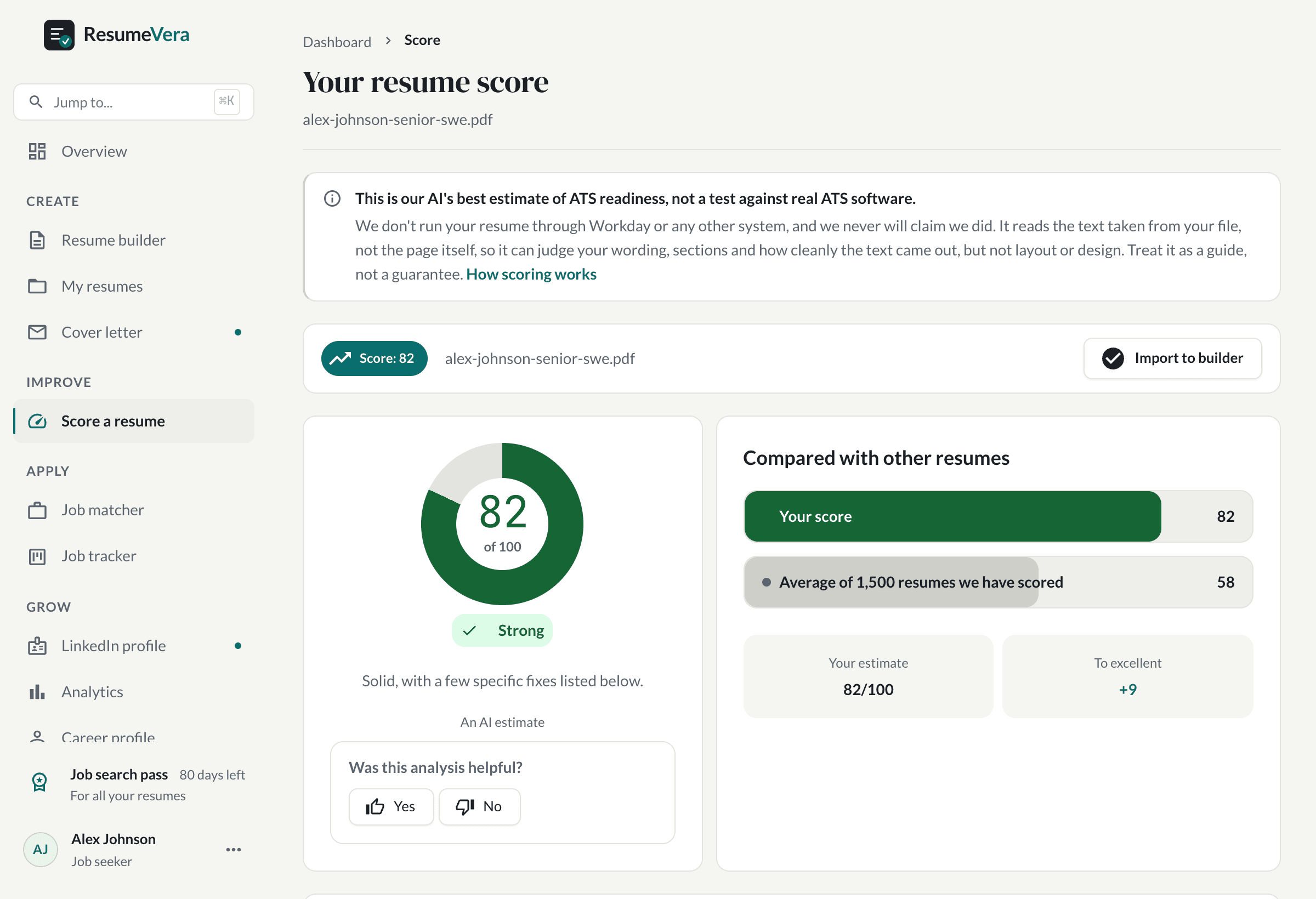
The real score page, with a sample resume and sample scores.
Now check it against your own resume
An honest resume score in seconds. No account, no card.