PF wage ceiling now ₹25,000: how much your in-hand pay drops
Career Advice · ResumeVera Editorial Team · November 12, 2026 · 8 min read
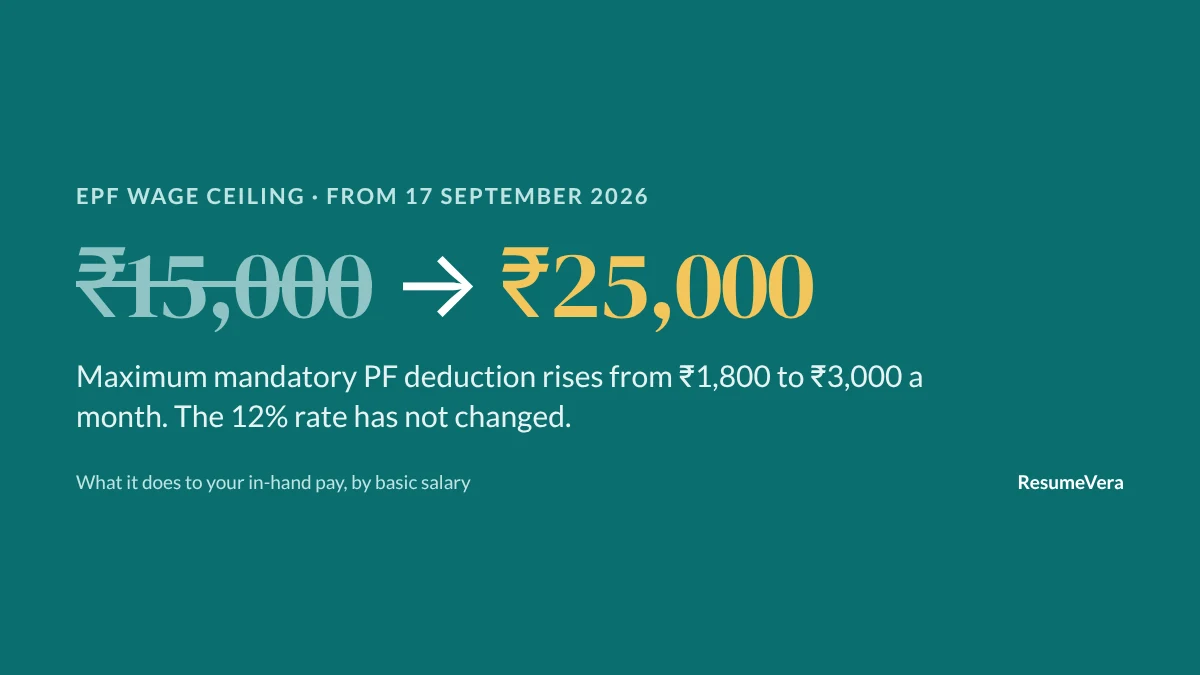
Short answer: The EPF wage ceiling is ₹25,000 a month from 17 September 2026, up from ₹15,000. If your PF was capped at the old ceiling, your deduction can rise from ₹1,800 to as much as ₹3,000 a month, so in-hand pay falls by up to ₹1,200. The rate is still 12%. Only the wage it is applied to has changed. Check your own figure in the take-home salary calculator.
Last reviewed: 12 November 2026. We update this page when EPFO or the Ministry of Labour and Employment publishes something new.
If your October or November salary credit was a few hundred rupees lighter than usual, and nothing else changed, look at the PF line on your payslip. For a large group of salaried employees it has gone up for the first time in 12 years.
This guide covers what changed and when, what it does to take-home pay at five basic-pay levels, who is newly pulled into PF, where the extra money actually goes, and what is still not confirmed about pension.
What changed, and from which date?
On 16 September 2026 the Union Cabinet approved raising the wage ceiling for mandatory EPFO coverage from ₹15,000 to ₹25,000 a month. The Cabinet release says the change brings over 51 lakh additional employees into coverage.
The Ministry of Labour and Employment notified it the next day. According to Legal 500's analysis of the notification, it is S.O. 5109(E) dated 17 September 2026, issued under section 2(89) of the Code on Social Security, 2020, and it took effect that day. It did not defer the change to 1 October.
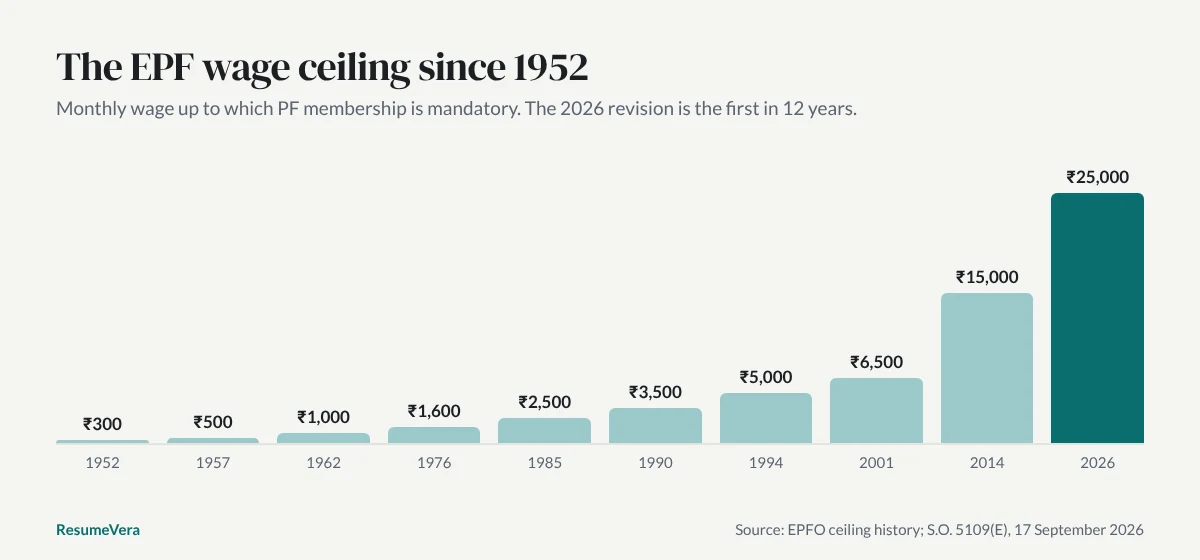
The previous revision was on 1 September 2014, when the ceiling went from ₹6,500 to ₹15,000.
What did not change
- The contribution rate. You still pay 12% of PF wages. Your employer still pays 12%, split between the pension scheme (EPS) and your PF account.
- Your CTC. Nothing in the notification changes the total your employer has agreed to spend on you. What can change is how that total is split between cash and PF.
- Your existing PF balance and service. Both carry on as before.
How much does in-hand pay fall?
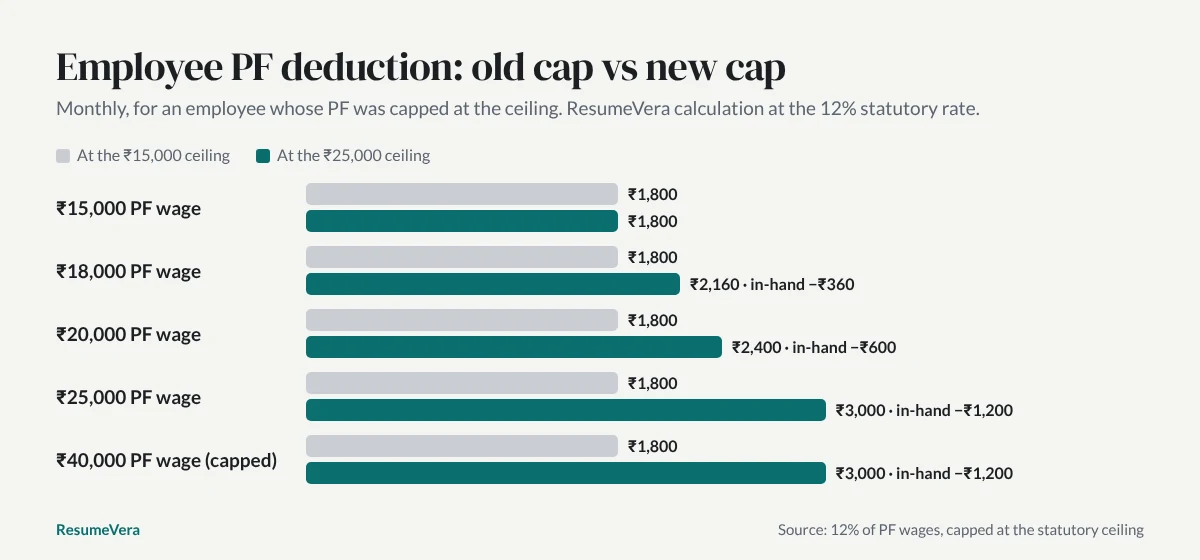
It depends on your PF wage (broadly basic pay plus dearness allowance) and on how your employer was calculating PF before. The table assumes your PF was capped at the old ceiling and your employer now applies the new one.
| Monthly PF wage | PF deduction before | PF deduction now | Change in in-hand pay |
|---|---|---|---|
| ₹15,000 | ₹1,800 | ₹1,800 | No change |
| ₹18,000 | ₹1,800 | ₹2,160 | ₹360 less |
| ₹20,000 | ₹1,800 | ₹2,400 | ₹600 less |
| ₹25,000 | ₹1,800 | ₹3,000 | ₹1,200 less |
| ₹40,000 (PF capped at ceiling) | ₹1,800 | ₹3,000 | ₹1,200 less |
These are ResumeVera calculations: 12% of the PF wage, capped at the ceiling in force. Income tax and professional tax are left out so you can see the PF effect on its own.
Three cases where the table does not apply to you
- You already pay PF on your full basic. Many employers deduct 12% of actual basic with no cap. If your basic is ₹40,000 and you already pay ₹4,800, nothing changes.
- You had no PF at all. If you earn up to ₹25,000 and were outside PF because you were above the old ceiling, the whole 12% is new. At ₹18,000 that is ₹2,160 a month off your in-hand pay, matched by your employer.
- Your employer's PF share sits inside your CTC. Then the employer's extra contribution also comes out of your cash salary. At a PF wage of ₹25,000 the drop can be up to ₹2,400 a month on an unchanged CTC, not ₹1,200. Our guide to CTC vs in-hand salary explains how to tell which structure you have.
Where does the extra money go?
None of it is lost. It moves from this month's bank credit into your retirement accounts, and your employer adds to it.
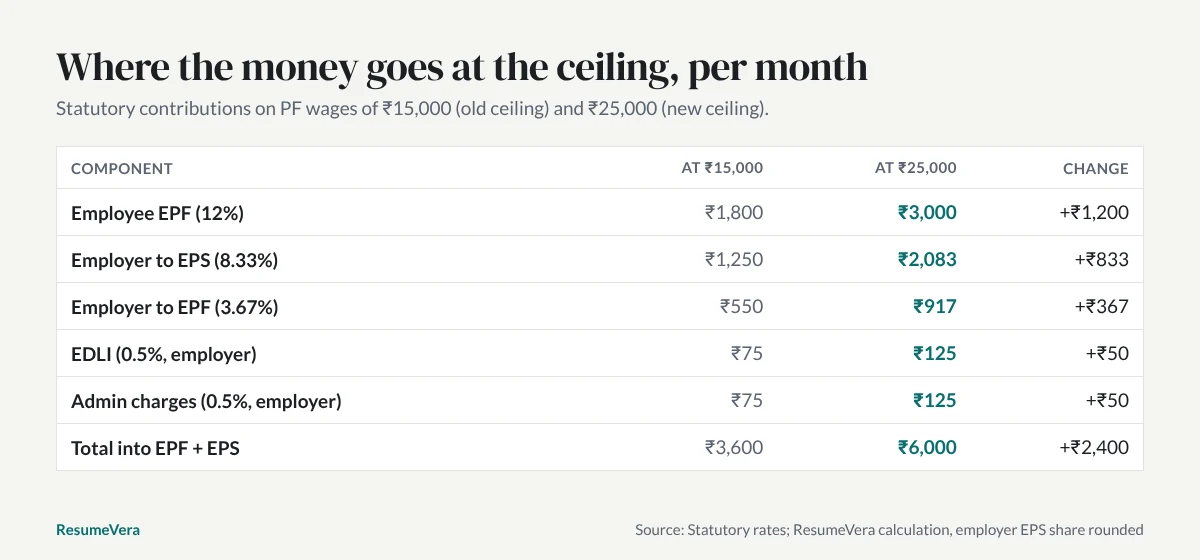
At a PF wage of ₹25,000, the statutory rates work out like this each month:
- Your 12%: ₹3,000 into your PF account, up from ₹1,800.
- Employer's 8.33%: ₹2,083 towards EPS, up from ₹1,250.
- Employer's 3.67%: ₹917 into your PF account, up from ₹550.
- EDLI and admin charges: 0.5% each, paid by the employer, ₹125 each at the ceiling.
Add the employee and employer shares and ₹6,000 a month now goes into EPF and EPS at the ceiling, against ₹3,600 before. That is ₹28,800 more a year.
To see how this compounds over your working years, put your new monthly contribution into the EPF calculator.
Who is newly covered?
PF membership is mandatory for employees whose wages are at or below the ceiling when they join a covered establishment. With the ceiling at ₹25,000, employees in the ₹15,000 to ₹25,000 band who were previously outside PF are now inside it. The Cabinet release puts this group at over 51 lakh people and says they also come under EPS pension and EDLI insurance cover.
If you are in that band and had no PF before September:
- Ask HR for your UAN and check that your Aadhaar, PAN and bank details are linked.
- Check the date your membership starts. Legal 500 reads the notification as making such employees members from 17 September 2026, without backdating.
- Keep your September and October payslips. They are your record of when deductions began.
If you earn more than ₹25,000 and were never a PF member, the change does not force you in.
Will your pension go up?
This is the part where many articles say more than the documents support.
What we can say: more money is flowing towards EPS for members at the higher ceiling. The Cabinet release confirms EPS cover extends to the newly covered band.
What limits it: the Ministry issued a second notification on 15 October 2026 amending the pension scheme. As reported by SCC Online, it fixes the wage ceiling for the Central Government's own EPS contribution at ₹15,000, with effect from 17 September 2026. So the Government's share does not rise with the new ceiling.
What we could not confirm: whether the salary cap used in the pension formula has moved from ₹15,000. We have not found a primary document that settles it. Until EPFO publishes one, do not assume a larger monthly pension, and be cautious of any calculator that shows one.
What to check on your payslip this month
- The PF wage line. Some payslips show "PF wages" or "EPF basic". If your basic is above ₹15,000, see whether this figure moved.
- The employee PF deduction. If it was exactly ₹1,800 and is now higher, your employer has applied the new ceiling. If it is still ₹1,800 and your PF wage is above ₹15,000, ask payroll why.
- September. The change landed mid-month. Practitioners have read the transition differently: some prorate the month across the two ceilings and some apply ₹25,000 to the whole month. Ask payroll which method was used and whether any arrears are due in either direction.
- Your EPF passbook. Employers usually remit by the 15th of the following month. Check that the October credit shows the higher employee share and the employer split.
- Your gross and CTC. If gross pay fell as well as in-hand, your employer's PF share is inside CTC.
Our guide to reading a salary slip shows where each of these lines sits.
See your new monthly in-hand figure. Enter your CTC and basic pay and the calculator shows PF, tax and take-home side by side. Free to use, no account needed.
Using this in an appraisal or a job offer
A lower in-hand figure on the same CTC is a fair thing to raise, and December to March is when most appraisal conversations happen.
- Ask whether employer PF is inside or outside CTC. If inside, the higher ceiling has cut your cash pay twice. Say so with the numbers from your payslip.
- Compare offers on in-hand pay. Two offers with the same CTC can differ by more than ₹2,000 a month depending on basic pay and PF treatment. The CTC calculator breaks an offer down.
- Do not ask to opt out. If your wage is at or below ₹25,000, PF is mandatory. The useful question is how the rest of the package is structured.
- If you are switching jobs, read our guide on EPF withdrawal and transfer so the higher balance moves with you.
If a move is on the cards, a quick pass through the free resume checker will show what your CV is missing for the roles you want. The score is an AI estimate, not a test by a real applicant tracking system.
Five things people are getting wrong
- "The PF rate went up." It did not. It is 12% on a higher wage base.
- "The new ceiling is ₹21,000." That figure circulated for years as a proposal. The notified ceiling is ₹25,000.
- "It starts on 1 October." The effective date is 17 September 2026.
- "Everyone above ₹15,000 loses ₹1,200." The change ranges from nothing to ₹1,200, and more only where PF is new to you or the employer share is inside CTC.
- "The minimum EPS pension has been raised." We have found no notification doing that. Treat reports about it as speculation until EPFO announces a decision.
What happens next
- EPFO guidance on the September transition: if EPFO publishes a clear method, we will add it here.
- Any decision on pensionable salary or minimum pension: we will update the pension section when there is a primary document to cite.
- April 2027 appraisals: the first full appraisal cycle where offers and revisions are built on the new ceiling.
This is general information, not tax, legal or financial advice. Payroll treatment differs between employers. For your own case, ask your payroll team and check the EPFO member portal.
Sources
- PM India, Cabinet approves enhancement of EPFO wage ceiling from ₹15,000 to ₹25,000 per month, 16 September 2026
- Legal 500, Revision to EPF wage ceiling: coverage, contributions and the September transition (analysis of S.O. 5109(E))
- SCC Online, Employees' Pension Scheme, 2026: wage ceiling for Central Government contribution fixed at ₹15,000, 17 October 2026
- EPFO, committee report with the history of wage ceiling revisions
- e-Gazette of India, for the text of S.O. 5109(E)
Written and checked by ResumeVera Editorial Team. How we research and review
Questions
Frequently asked questions
Get free ATS tips every week
Actionable resume and ATS tips, when we publish them. No spam. Unsubscribe any time.
Related Articles
Self-appraisal comments for 2027: 60 examples by role and Aon's 9.1% raise forecast
60 self-appraisal comment examples for engineers, analysts, BPO, sales, finance, managers and freshers, built on a four-part formula. Plus what Aon's projected 9.1% average increase for 2027 and rising attrition mean for your review.
Read More

Leave Encashment on Resignation in India 2026: Tax Rules, ₹25L Exemption & Calculation
Leave encashment on resignation is taxable for private employees, but a ₹25 lakh lifetime exemption under Section 10(10AA) can make most of it tax-free. This guide covers the exact calculation, the CBDT notification that raised the limit, how the 10-month salary cap applies, and how to claim the exemption correctly.
Read More

CTC vs in-hand salary in India 2026: what's the difference and how to calculate both
CTC is what your employer spends on you. In-hand is what hits your bank account. Understanding every component of the gap between the two lets you evaluate offers accurately, negotiate smarter, and plan your finances correctly.
Read More
Try it
Check this against your own resume
The post above is general. Your file is not. The checker reads it the way a parser would and tells you which of these points it actually breaks.
Check your resume free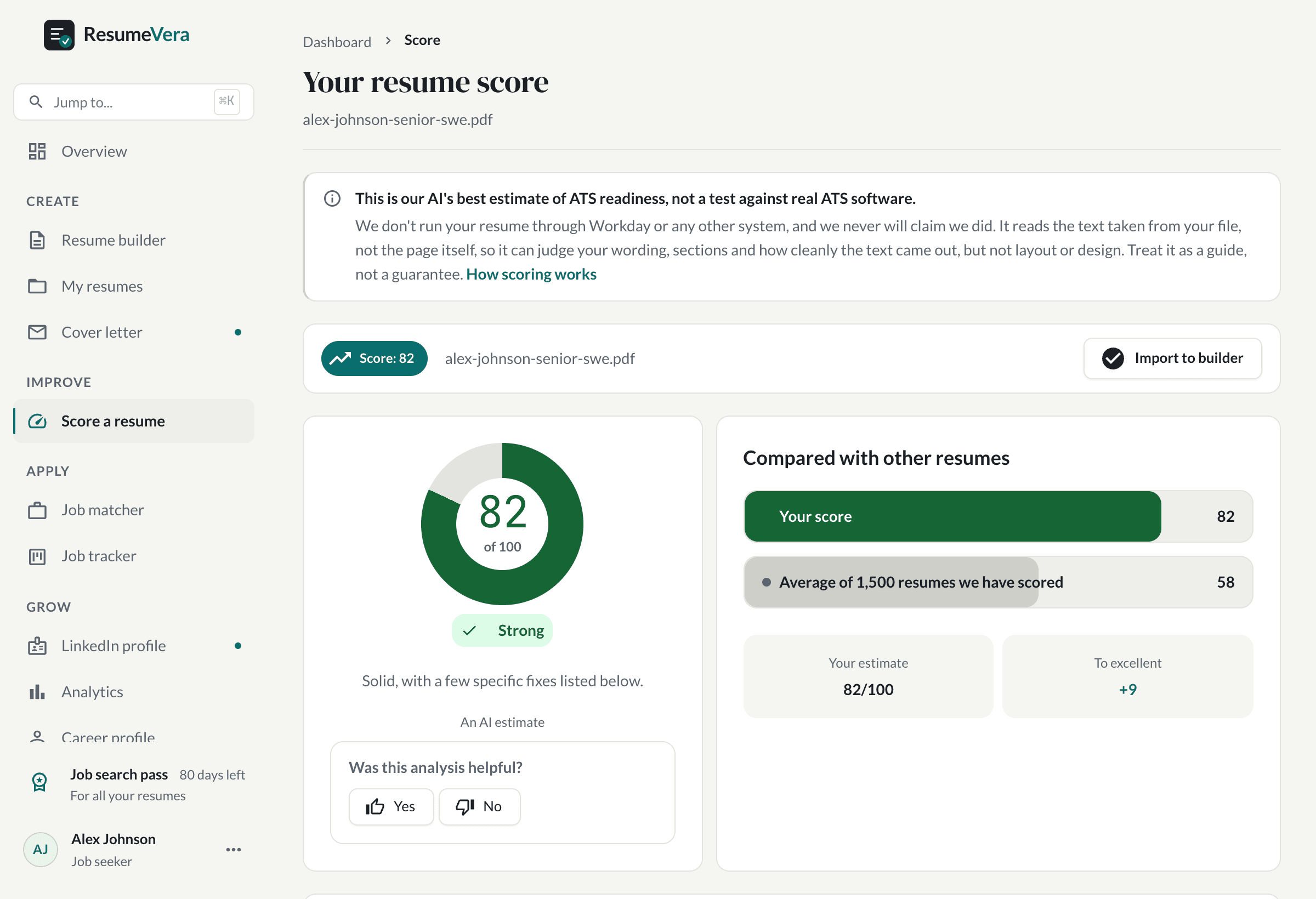
The real score page, with a sample resume and sample scores.
Now check it against your own resume
An honest resume score in seconds. No account, no card.