Written for the India job market, so salaries and formats follow Indian conventions. See the US version.
Career Growth
EPF withdrawal and transfer when you change jobs
Last reviewed: 4 October 2026. UAN, KYC, transfer or withdraw, claim types, waiting period as officially stated, tax, EPS pension, passbook, exit date, grievances and a sample HR email.
The ResumeVera editorial team
Resume and hiring research, reviewed against current employer guidance.
Updated 2026-10-05T06:01:51.105Z
17 min
Section 01
EPF withdrawal and transfer when you change jobs: the short answer
Last reviewed: 4 October 2026. This guide explains what official EPFO, Labour Ministry and Income Tax Department pages say about your provident fund when you leave one job and join another. It is not legal or tax advice. Rules in this area have been changing since 2025, so the pages we link have the final word, and you should read the current rule on the EPFO member portal before you act.
When you change jobs, your EPF money does not have to be touched at all. In plain terms you have two routes:
- Transfer the old balance into the account under your new employer. The EPFO FAQ says that on a change in employment the member should get the PF account transferred to the present establishment, and that a member whose UAN is seeded and fully KYC compliant does not need to file a transfer claim because an auto-transfer is triggered.
- Withdraw through a final settlement claim once you are eligible. The waiting period for this is where official sources currently differ: an EPFO FAQ page we read says two months, while October 2025 Board and Ministry releases say the period was changed to 12 months. Section 6 sets this out with dates.
What this page cannot tell you
Several EPFO pages returned access errors when we reviewed them, so some facts rest on pages that did load, on Press Information Bureau (PIB) releases and on Labour Ministry documents. The new Employees' Provident Funds Scheme, 2026 was notified in June 2026, but we could only read the first part of the official gazette text and could not read its withdrawal paragraphs. Your employer's HR team, the EPFO and your regional PF office decide your individual case. For a dispute, use the grievance routes in section 10 and the Labour Ministry at labour.gov.in.
Section 02
UAN: what it is and what it does
The Universal Account Number (UAN) is the single number that ties your EPF accounts together. The EPFO FAQ describes it as a 12 digit number allotted to each subscriber by linking it to the member's currently active PF account number (EPFO FAQ page), and the EPFO information booklet describes it as a permanent number that remains valid throughout the life of the member and does not change with a change of employment.
What the official pages say it does for you
- It is an umbrella over the Member IDs (PF account numbers) given by different employers, says the EPFO information booklet (Information booklet for EPF members (EPFO)).
- EPFO allots it on the employer's request, or you can generate it yourself with a valid Aadhaar number and registered mobile (booklet).
- Once activated, you can download your updated passbook, download your UAN card and list all your Member IDs against the UAN (EPFO FAQ page).
- You activate it only once. The booklet says you do not need to re-activate it every time you switch jobs, activation is free, and you simply declare your existing UAN to the new employer.
Practical points when you join a new employer
- Give your existing UAN to the new employer's HR so no second UAN is created.
- If two UANs have been allotted to you, report it to your employer and write to uanepf@epfindia.gov.in with both numbers (the address the booklet gives for UAN queries). We did not confirm in an official text what EPFO then does with the two numbers.
- The member portal warns that EPFO never asks you to share Aadhaar, PAN or bank details over the phone (EPFO unified member portal).
The Labour Ministry's annual report for 2025-26 says members can generate a UAN using Aadhaar Face Authentication on the UMANG app, made mandatory from 1 August 2025 (Annual Report 2025-26 (Ministry of Labour and Employment)).
Section 03
KYC and Aadhaar linking: what must be in place before any claim
The EPFO booklet defines KYC as a one-time process that verifies identity by linking your UAN with your KYC details. Check it before you leave your job, not after.
| Item | What the EPFO booklet says | Source |
|---|---|---|
| Minimum details | Mobile, Aadhaar and bank account number for online services | Booklet Q23 |
| Name match | Name per Aadhaar and PAN must match PF records | Booklet Q25 |
| Aadhaar-linked mobile | Online claim cannot be submitted without it | Booklet Q31 |
| PAN | Linking PAN with UAN lets you avail tax benefits on EPF withdrawal | Booklet Q24 |
How to update KYC
- Log in to the unified member portal with your UAN and password.
- Under Manage, choose KYC and enter PAN, bank account and Aadhaar details (booklet Q13).
- Wait for the employer approval and the UIDAI verification. The booklet says the status shows against the updated document on the same page and an SMS goes to your registered mobile.
The EPFO FAQ also says an online e-KYC facility is available on the portal and on the UMANG app to self-validate your UAN with Aadhaar without any intervention by the employer. The Labour Ministry annual report adds that from August 2025 the portal supports Aadhaar seeding, with employer auto-seeding when data matches and a direct route for the member when it does not.
A detail people overlook
- Self-service profile corrections. A PIB release of 19 January 2025 says members whose UAN is already validated through Aadhaar can update their profile without uploading documents, and that employer certification is needed only in certain cases where the UAN was obtained before 1 October 2017 (PIB: EPFO member profile update (19 January 2025)). Check the portal for how this works today.
If your employer does not approve your KYC, raise it with HR and, if needed, file a grievance on EPFiGMS (section 10). Which bank account details are accepted is shown in the KYC screen, so check it there.
Section 04
Transfer your PF to the new employer or withdraw it?
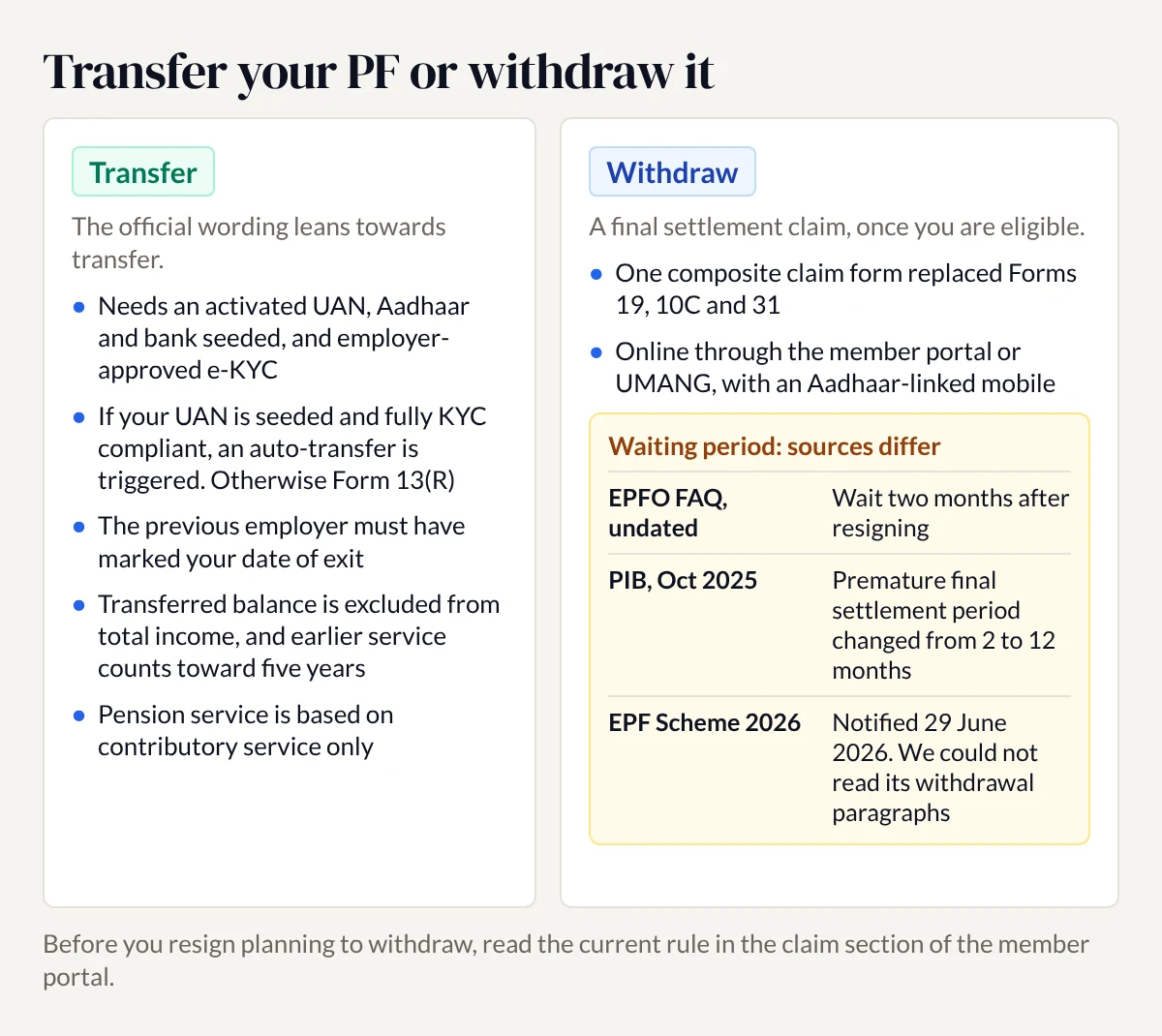
The official wording leans towards transfer. The EPFO FAQ says that on change in employment the member should necessarily get the PF account transferred to the present establishment by submitting Form 13(R). The EPFO settlement FAQs say the same (EPFO FAQs on settlement (EPFO)).
How transfer works
- Online transfer conditions (EPFO FAQ page): you have activated your UAN, your Aadhaar and bank account are seeded against the UAN, and the employer has approved the e-KYC.
- Auto-transfer. The same page says a member whose UAN is seeded and fully KYC compliant must not file a transfer claim, because on a change of employment an auto trigger is generated and the earlier PF amount is transferred into the new account.
- Date of exit. The FAQ says updating the date of exit of the previous job is mandatory for applying for an online transfer. This is why the previous employer marking your exit matters (section 9).
- Service standard. The EPFO Citizens' Charter lists settlement of Form 13 transfers at seven working days. The charter is dated November 2022 and its own next review date was November 2023, so treat it as a stated standard of that date, not a promise today (Citizens' Charter (EPFO)).
Why transfer can matter beyond convenience
- Tax. Income Tax Department pages say a balance transferred to another recognised fund on new employment is excluded from total income, and service with former employers counts toward five years (section 7).
- Pension. The EPFO FAQ says pension is based on contributory service only (section 8).
A worked example, with no figures
An employee leaves Company A and joins Company B after a gap. If the UAN is activated, KYC is approved and the exit date is marked, the FAQ describes an auto-transfer or a Form 13(R) online request that moves the old balance. If the exit date was never marked, the online transfer cannot be applied for, so the first step is Mark Exit (section 9), not a new account.
For what else you settle on leaving a job, see our guide to full and final settlement in India. This page does not repeat that ground.
Section 05
Final settlement claim types: Form 19, 10C, 31 and the composite claim
The EPFO FAQ explains that EPFO consolidated its settlement claim forms: one composite claim form (Aadhaar and non-Aadhaar) was issued to replace the existing claim forms 19, 10C and 31. The older instructions still help you understand what each form was for.
| Form | Used for (as the sources describe) | Source |
|---|---|---|
| Form 19 | Final PF settlement after leaving service | EPFO Form 19 instructions |
| Form 10C | EPS withdrawal benefit or scheme certificate | EPFO booklet and FAQ |
| Form 31 | PF advances (partial withdrawals) | EPFO FAQs, pmvbry page |
| Form 13(R) | Transfer of previous balance to new account | EPFO FAQ |
What the sources say about filing
- Online. The booklet says withdrawal, advance and pension claims (after e-Nomination) can be filed through the member portal or the UMANG app, and that online claims need an Aadhaar-linked mobile number.
- Attestation. An EPFO FAQ says three claim types, Form 19, 10C and 31, can currently be submitted without employer attestation. It adds that if the employer is not available, the bank manager of your savings account bank may attest the claim form. Older Form 19 instructions asked for submission through the last employer, so check which applies to you (Form 19 instructions (EPFO)).
- Payment. The Form 19 instructions say payment is made by direct credit to the claimant's bank account.
- Processing time. The EPFO FAQ says that as per the EPF Scheme a claim is required to be settled within 20 days, while the Citizens' Charter of November 2022 lists seven working days for Form 19. Both are stated standards, not promises.
- Auto-settlement. The Labour Ministry annual report 2025-26 says auto settlement of withdrawals up to Rs 5 lakh removes mandatory document uploading. That concerns process, not eligibility.
Final settlement or partial withdrawal?
Final settlement closes out the balance after you cease employment, while a partial withdrawal or advance takes part of it for specified needs. The October 2025 Board decision (section 6) merged 13 partial withdrawal provisions into a single rule in three types. The release text we read does not spell the three types out, so check the member portal for what each covers.
Section 06
Withdrawal conditions and the waiting period after you leave
Read the date next to each source here. We list what each official page says, in date order.
| Source and date | What it says | Where |
|---|---|---|
| EPFO FAQ page (undated) | Resignation: wait two months to withdraw PF | EPFO FAQ |
| EPFO Citizens' Charter, Nov 2022 | Form 19 settled in 7 working days | EPFO charter |
| PIB, 13 Oct 2025 | Premature final settlement period changed from 2 to 12 months | 238th CBT meeting |
| PIB, 15 Oct 2025 | 12 months, 25 per cent minimum balance, 75 per cent withdrawable at any time without any documentation | Labour Ministry |
| PIB, 2 Mar 2026 | EPF, EPS and EDLI Schemes, 2026 approved | 239th CBT meeting |
| Gazette, 29 June 2026 | EPF Scheme, 2026 notified (G.S.R. 525(E)) | e-Gazette, VISHWAS release |
What the October 2025 releases say
- The Board decided to change the period for availing premature final settlement of EPF from the existing 2 months to 12 months, and the pension withdrawal period from 2 months to 36 months (PIB: 238th meeting of the Central Board of Trustees, EPF (13 October 2025); also the EPFO press brief on the same meeting).
- Thirteen partial withdrawal provisions were merged into a single rule, up to 100 per cent of the eligible balance including the employer share can be accessed, and 25 per cent of contributions is earmarked as a minimum balance.
- The follow-up release of 15 October 2025 describes the premature final settlement period as extended to 12 months and says 75 per cent of the eligible amount is withdrawable at any time without any documentation, with full withdrawal also allowed under special situations (Ministry of Labour and Employment release, 15 October 2025 (labour.gov.in copy); also the EPFO copy of the same release). The two releases word the withdrawable share differently (up to 100 per cent of the eligible balance, and 75 per cent without documents), so read the portal for your limit.
- The Labour Ministry annual report 2025-26 says the minimum service requirement for partial withdrawals was reduced to 12 months (page 14).
What changed in 2026, and what we could not read
A March 2026 PIB release says the Board approved the EPF Scheme, 2026, EPS 2026 and EDLI Scheme 2026 to replace the current schemes, aligned with the Code on Social Security, 2020 (PIB: 239th meeting of the Central Board of Trustees, EPF (2 March 2026)). A PIB release of 29 July 2026 refers to the EPF Scheme, 2026 as notified by G.S.R. 525(E) dated 29 June 2026 (PIB: EPFO launches VISHWAS, 2026 and AMNESTY, 2026). The gazette copy (Employees' Provident Funds Scheme, 2026 (e-Gazette)) loaded only up to paragraph 45 for us, inside the chapter on transfer, nomination, payment and withdrawal, so we could not read the final settlement paragraph.
What we cannot confirm: the October 2025 releases say 12 months, the EPFO FAQ page still says two months and carries no date, and the final text of the 2026 Scheme was not readable. So we cannot confirm that the 12 month period is written into the 2026 Scheme, from which date the portal applies it, or whether the undated FAQ's two month line is superseded. Before you resign planning to withdraw, read the current rule in the claim section of the member portal or ask EPFO.
Where the labour codes fit
The four labour codes, including the Code on Social Security, 2020, became effective on 21 November 2025, and a PIB release says that during the transition the relevant provisions of existing Acts, rules, schemes and notifications continue in force (PIB: Government makes the four labour codes effective). A Labour Ministry FAQ says old rules remain in force until new rules are notified under the Code, to the extent they are in line with it (Labour Ministry FAQs on the labour codes). The Code's provident fund chapter covers schemes and transfer of accounts between establishments (Code on Social Security, 2020 (labour.gov.in)). We found no source stating which version of the scheme governs a particular claim today, so we make no claim on that.
Section 07
Tax on early EPF withdrawal: what Income Tax Department pages say
This section reports what the Income Tax Department's own pages say. It is not tax advice, and your total tax position depends on your income, so check your case with a qualified professional or the department. The department's site shows both the Income-tax Act, 1961 and the Income-tax Act, 2025, so check which Act and year apply to your payment.
Is the withdrawal taxable?
- Five years of continuous service. Schedule XI, Part A, paragraph 8 of the Income-tax Act, 2025 says the accumulated balance in a recognised provident fund is excluded from total income if the employee rendered continuous service for five years or more, or if the service ended because of ill-health, business contraction or closure, or circumstances beyond the employee's control, or if the balance is transferred to another recognised fund or notified pension scheme (Schedule XI, Income-tax Act, 2025 (Income Tax Department)). The Fourth Schedule, Part A, rule 8 of the 1961 Act is to the same effect (The Fourth Schedule, Income-tax Act, 1961 (Income Tax Department)).
- Earlier employers count. The explanation to rule 8 says that where the balance includes amounts transferred from earlier funds, continuous service under former employers counts towards the five years.
- When the exclusion does not apply. Paragraph 9 of Schedule XI (rule 9 of the 1961 Act) includes the balance in total income under a special computation, based on the tax that would have been payable had the fund not been recognised. A department tutorial puts it plainly: withdrawal after five years is exempt, and before five years it is computed as if the fund were not recognised from the beginning (Taxability of retirement benefits (Income Tax Department tutorial, as amended by Finance Act, 2025)). We give no worked tax computation because it depends on your own income history.
TDS on the payment
- Section 192A of the 1961 Act directs deduction of income-tax at ten per cent when the accumulated balance is includible in total income because the five-year rule does not apply, and no deduction is made where the payment is less than fifty thousand rupees (Section 192A (Income Tax Department)).
- The Income-tax Act, 2025 provision on the same subject reads similarly, with ten per cent deduction where the aggregate payment is Rs 50,000 or more (Section 392, Income-tax Act, 2025 (Income Tax Department)). The TDS rates page lists the same ten per cent rate (TDS rates (Income Tax Department)).
- Illustration, not advice. For a taxable payment of Rs 40,000 the proviso means no deduction under that section; for Rs 60,000 deduction at the stated rate would apply. Your actual tax is settled in your return.
- Form 121. The department's FAQ says Form 121 (earlier Forms 15G and 15H) corresponds to sections 393(6) and 393(7) of the 2025 Act and covers payment of accumulated balance due to an employee from a recognised provident fund, for eligible individuals whose estimated tax is nil (Form No. 121 FAQs (Income Tax Department)).
- PAN. The EPFO booklet says linking PAN with UAN lets you avail tax benefits on EPF withdrawal. We did not find a rate for a missing PAN on the pages we read, so we state none.
Section 08
EPS pension: what to consider before you withdraw
Part of your employer's contribution goes to the Employees' Pension Scheme (EPS), not to your PF balance. The EPFO FAQ says the employer pays 12 per cent of pay, of which 8.33 per cent is diverted to the Pension Fund. When you leave a job, the EPS side has its own choices.
What the EPFO sources say
- Eligibility. Pension on superannuation at 58 years; a member who leaves employment between 50 and 57 years can avail the early (reduced) pension (EPFO FAQ page).
- Formula. Pensionable salary (average of last 60 months) times pensionable service, divided by 70, based on contributory service only (FAQ).
- Before ten years of service. The booklet says a member who leaves or retires before completing 10 years can take a lump sum withdrawal benefit, or ask for a scheme certificate that records present and past service so that periods can be added together to reach 10 years. The FAQ says a member with 10 or more years of service and under 58 is issued a scheme certificate.
- Waiting period for pension withdrawal. The October 2025 Board decision extends this from 2 months to 36 months, and the Labour Ministry release says the longer wait is meant to encourage members to reach 10 years of service.
- Recent amendment. The March 2026 PIB release says EPS 1995 was amended to allow withdrawal benefits even for one month of contribution.
How to think about it
These points do not fit together neatly: one release raises the pension waiting period to 36 months, another says EPS now allows a withdrawal benefit for as little as one month of contribution, and we could not read either rule in full. We therefore cannot state your pension waiting period. What the sources do support is the choice: a scheme certificate keeps your service count across jobs, while a lump sum ends it. If you may reach ten years of service across employers, ask EPFO about the scheme certificate first.
Section 09
Check your passbook, and fix a missing exit date or a rejected claim
How to check the passbook
- Log in to the UAN member portal with your UAN and password (EPFO FAQ page).
- Open the Download menu and choose Download Passbook to get a PDF.
- Alternatively use the UMANG app, which the booklet says offers passbook view, online claim filing and claim tracking.
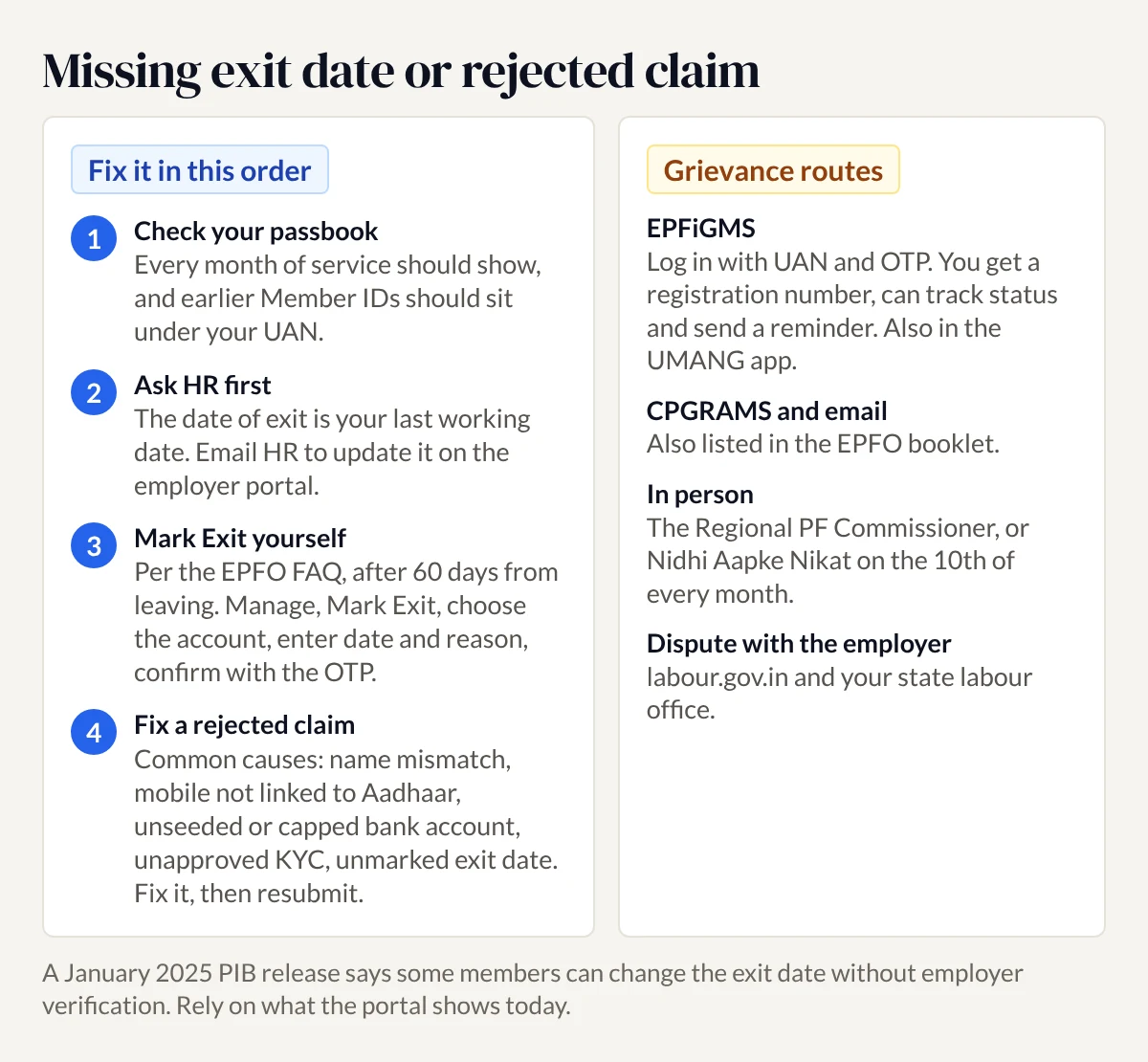
The EPFO FAQ says the passbook shows contributions. Check that every month of your employment shows an entry and that earlier Member IDs appear under your UAN before you file a claim. If you cannot see a passbook for an account, ask your employer for your PF statements.
If the employer has not updated your date of exit
- Ask first. The EPFO FAQ defines the date of exit as the last working date, or the date till when wages were earned. Email HR with a request (sample in section 10).
- Mark Exit yourself. The FAQ says that after 60 days from the date of leaving, the member can submit or update the date of exit online through the member portal. The booklet's steps: log in, go to Manage, click Mark Exit, choose the PF account number, enter the date and reason of exit, request an OTP on the Aadhaar-linked mobile, tick the checkbox and click Update.
- Newer self-service rule. A PIB release of 19 January 2025 says eligible members whose UAN is Aadhaar-validated can update their date of leaving themselves without uploading any document, except certain UANs obtained before 1 October 2017, where employer certification is needed. This may differ from the 60 day line, so rely on the portal.
If a claim is rejected or stuck
- We could not read an official list of rejection reasons, so we give none. The sources do show common causes of friction: name mismatch across Aadhaar, PAN and PF records, a mobile not linked to Aadhaar, an unseeded bank account, unapproved KYC and an unmarked exit date.
- Fix the item, then resubmit. If a detail such as Aadhaar linking cannot be corrected on the portal, ask your regional PF office how to correct it.
- If the employer defaulted on contributions, the FAQ says the PF due is paid only to the extent realised from the employer. Raise a passbook gap in writing and through a grievance.
Section 10
Grievance routes and a sample email to HR
Official grievance routes
- EPFiGMS. The EPFO's grievance portal says grievances can be lodged by PF members, EPS pensioners, employers and others, based on UAN with OTP verification (a PPO number for pensioners). A registration number is generated, a status section is available, a reminder can be sent for pending grievances and the facility is also in the UMANG app (EPFiGMS: EPFO grievance management system).
- In person. The FAQ says you can approach the Regional PF Commissioner in charge of grievances, or attend Nidhi Aapke Nikat, held on the 10th of every month, at EPFO offices.
- Timeline. The November 2022 Citizens' Charter lists 7 working days as the general time limit for settling a grievance.
- Beyond EPFO. For a dispute with the employer, see labour.gov.in and your state labour office. If the issue is a missing document, see the experience letter format.
Sample email to HR to update the date of exit
This is a sample only, not a legal document. Replace every [bracketed] field and keep a copy.
Subject: Request to update date of exit in EPFO records, UAN [UAN number]
Dear [HR contact name],
I was employed with [company name] as [designation], Employee ID [employee ID], and my last working day was [last working date], as per my [relieving letter or resignation acceptance dated DD Month YYYY].
My EPFO UAN is [UAN number] and my PF Member ID with the company is [Member ID]. The EPFO passbook still shows no date of exit. I need it updated so that I can [transfer my PF to my new employer or file my final settlement claim]. Please mark the date of exit as [last working date] with reason [resignation] on the employer portal, and confirm to me by [date].
If the date is not updated by [date], I will use Mark Exit on the member portal and, if needed, lodge a grievance on EPFiGMS.
Thank you, | [Your name], [phone number], [personal email]
Related pages: resignation letter format and notice period buyout. Starting a new job soon? See background verification.
Section 11
Sources and references
Every legal or procedural claim above comes from the pages below, which we opened during our review on 4 October 2026. Several EPFO pages (including the main home page, the claim form guidance page and some FAQ documents) returned access errors, so we relied on the pages that loaded, on PIB and on Labour Ministry documents. Where a page was undated or an extract was incomplete we said so in the text. Rules in this area are changing, so check the current official page before you act. This page is not legal or tax advice.
- EPFO FAQ page (Employees' Provident Fund Organisation): UAN, KYC, transfer, composite claim form, 2 month wait line, 20 day settlement, date of exit, passbook, EPS, grievance. Page carries no date.
- Information booklet for EPF members (EPFO): UAN activation, KYC steps, Mark Exit procedure, claims online, scheme certificate. No edition date printed.
- FAQs on settlement and related processes (EPFO, pmvbry site): Three claim types without employer attestation, bank manager attestation, Form 13(R), Annexure K, employer default.
- Citizens' Charter (EPFO): Seven working day standards for Form 19, Form 13 and grievances, issue date November 2022.
- Form 19 instructions (EPFO): Older instructions: cancelled cheque, attestation, 2 month waiting line. Undated.
- EPFO unified member portal: Portal services and the warning against sharing details by phone.
- PIB: Dr Mansukh Mandaviya chairs 238th meeting of the Central Board of Trustees, EPF: 13 October 2025 decisions on partial withdrawal, 12 month final settlement, 36 month pension, 25 per cent minimum balance.
- EPFO press brief on the 238th CBT meeting: Same decisions as above, 13 October 2025.
- Ministry of Labour and Employment release, 15 October 2025 (labour.gov.in): 12 month period, 75 per cent withdrawable without documentation, 25 per cent retained, pension withdrawal wording.
- Ministry of Labour and Employment emphasizes benefits of EPFO reforms (EPFO copy): Same release, 15 October 2025.
- PIB: Dr Mansukh Mandaviya chairs 239th meeting of the CBT, EPF: 2 March 2026: EPF, EPS and EDLI Schemes 2026 approved; EPS one month withdrawal amendment.
- PIB: EPFO launches VISHWAS, 2026 and AMNESTY, 2026: 29 July 2026 release citing the EPF Scheme, 2026 as G.S.R. 525(E) dated 29 June 2026.
- Employees' Provident Funds Scheme, 2026 (Gazette of India): Notification of 29 June 2026; only the first part up to paragraph 45 could be read.
- Annual Report 2025-26 (Ministry of Labour and Employment): Aadhaar seeding, UAN via face authentication, auto-settlement, 12 month service for partial withdrawal.
- PIB: EPFO member profile update: 19 January 2025: self-service profile and date of leaving updates.
- EPFiGMS (EPFO grievance management system): Who can lodge a grievance, UAN and OTP, status, reminders, UMANG.
- PIB: Government makes the four labour codes effective: 21 November 2025 effective date and transition sentence.
- Labour Ministry FAQs on the labour codes (labour.gov.in): Old rules stay in force until new rules are notified, to the extent in line with Codes.
- The Code on Social Security, 2020 (labour.gov.in): Provident fund chapter, schemes and transfer of accounts. Extract was truncated.
- Schedule XI, Income-tax Act, 2025 (Income Tax Department): Paragraphs 8 and 9 on tax treatment of the accumulated balance.
- The Fourth Schedule, Income-tax Act, 1961 (Income Tax Department): Part A rules 8 and 9 and service with former employers.
- Section 192A, Income-tax Act, 1961 (Income Tax Department): 10 per cent TDS and the Rs 50,000 threshold wording.
- Section 392, Income-tax Act, 2025 (Income Tax Department): Corresponding TDS provision under the 2025 Act.
- TDS rates (Income Tax Department): 10 per cent rate for accumulated balance of provident fund taxable in the employee's hands.
- Form No. 121 FAQs (Income Tax Department): Form 121 replaces Forms 15G and 15H for eligible persons, including EPF balance payments.
- Taxability of retirement benefits (Income Tax Department tutorial): Plain summary of recognised provident fund withdrawal before and after five years.
Pro tips
Do these
Activate your UAN and complete KYC (Aadhaar, PAN, bank account) while you are still employed, so your old employer can approve it.
Check that the name on Aadhaar, PAN and your PF record is identical, because the EPFO booklet says it must match your PF records.
Download your passbook before your last day and again after your final contribution is credited.
Ask HR in writing to mark your date of exit, and keep the email with your relieving letter.
Give your existing UAN to the new employer on day one so that no second UAN is created.
Read the current withdrawal rule on the member portal before planning to use your PF as a bridge between jobs.
If you may reach ten years of contributory service across employers, ask EPFO about the EPS scheme certificate before withdrawing.
Keep screenshots and reference numbers of every claim, transfer request and grievance.
Avoid these
Delete these
Opening a fresh PF account or UAN with the new employer instead of declaring the existing UAN.
Withdrawing without checking the current waiting period, tax treatment and minimum balance rules for your case.
Assuming the employer has marked your exit date when the passbook shows none.
Leaving a bank account that does not match your KYC details.
Sharing OTPs, Aadhaar, PAN or bank details with callers who claim to be from EPFO, although the member portal says EPFO never asks for them by phone.
Treating an undated FAQ or an old circular as the current rule.
Withdrawing the pension part without asking about the scheme certificate.
Ignoring missing contributions in the passbook until after the claim is filed.
Put this into a resume
Building and editing are free, and free PDFs carry a small watermark.
Check your resume for freeQuestions
Frequently asked questions
How this guide is maintained
We review this guide every quarter and after any change to the hiring rules or portal behaviour it describes. It was last reviewed on 2026-10-05T06:01:51.105Z. Figures come from named sources, shown beside the number. Where we are estimating rather than measuring, we say so.
By the numbers
12 digits
Length of the UAN, which the EPFO information booklet describes as valid throughout a member's life
https://www.epfindia.gov.in/site_docs/PDFs/MiscPDFs/Employees_Information_Booklet.pdf
2 to 12 months
Range reported across sources for the premature final settlement wait: an undated EPFO FAQ says 2 months, the October 2025 releases say 12 months
https://www.pib.gov.in/PressReleseDetailm.aspx?PRID=2178522®=3&lang=2
Rs 50,000
Threshold in the section 192A TDS proviso, below which no TDS under that section
https://www.incometaxindia.gov.in/w/section-192a
Try it
Check the guide against your own file
Everything above is general. Your resume is not. Paste it in and the checker tells you which of these points your file actually breaks.
Check your resume free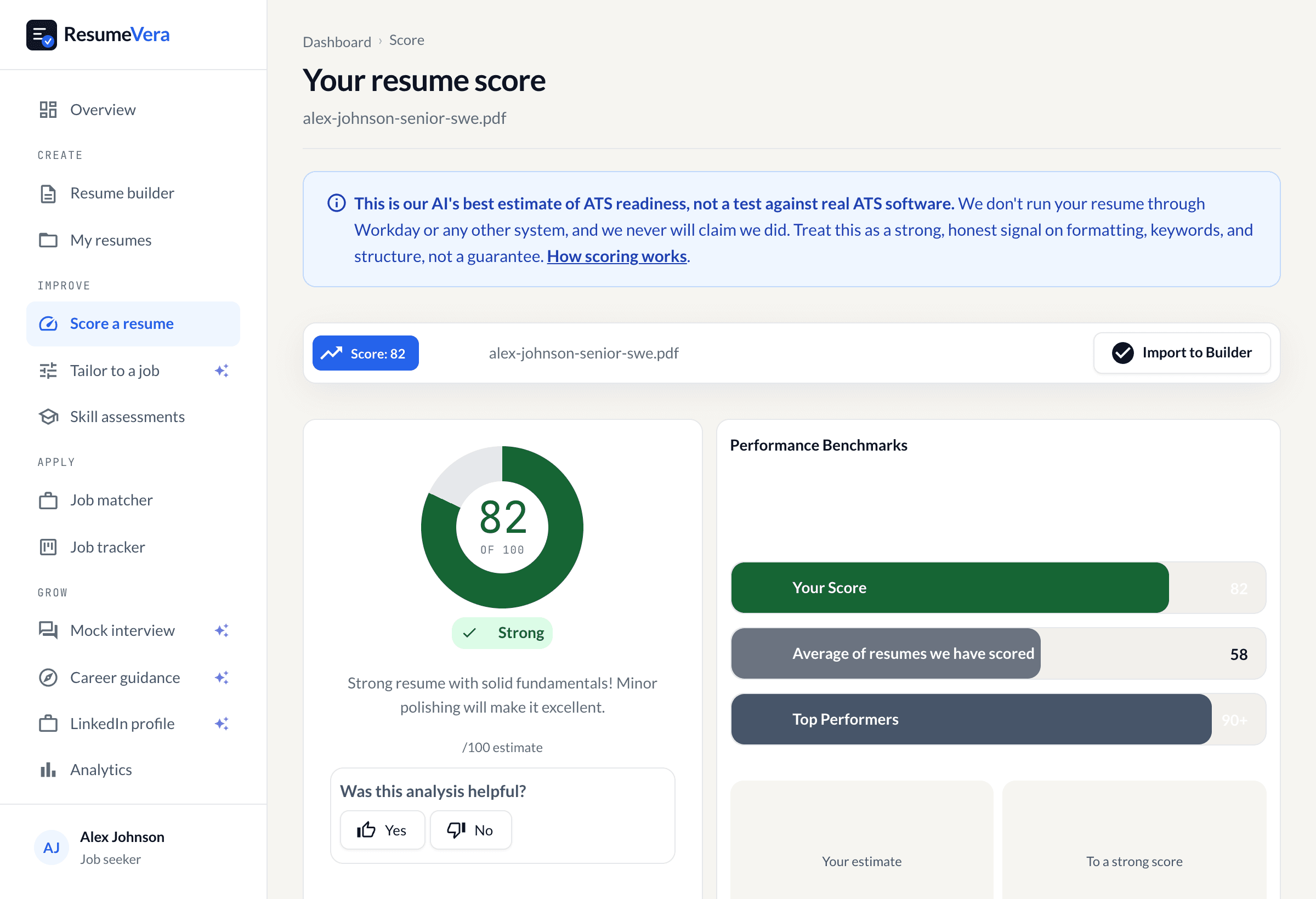
The real score page, with a sample resume and sample scores.
Is your resume ATS ready?
Run a free ATS score check and get specific improvements in seconds.