Written for the India job market, so salaries and formats follow Indian conventions. See the US version.
Career Growth
Background verification in India
Last reviewed: 4 October 2026. What is checked, how long it takes, the documents to keep ready, your data rights under the DPDP Act, official channels and what to do when a check fails.
The ResumeVera editorial team
Resume and hiring research, reviewed against current employer guidance.
Updated 2026-10-04T16:56:17.840Z
15 min
Section 01
Background verification in India: the short answer
Last reviewed: 4 October 2026. This guide explains what official sources say about background verification (BGV) and what Indian employers commonly do. It is not legal advice. Your offer letter, your employer's policy and the sources we link have the final word.
Background verification is the set of checks an employer runs, usually after an offer and before or just after joining, to confirm that what you told them is true. In practice it covers identity, education, past employment, address, any criminal record and references. Many employers make the offer conditional on it, and many hand the work to an outside agency.
Three points before the detail:
- No single law we read lays out a BGV procedure. What is checked, how long it takes and what happens on a mismatch is mostly employer practice and the terms you sign. The legal frame we could confirm from official text is data protection: the Digital Personal Data Protection Act, 2023 and the Rules notified in November 2025 (section 5).
- Official channels exist for parts of it: academic certificates through the National Academic Depository and DigiLocker, police clearance through the police and passport authorities, and your own provident fund record through EPFO (section 6).
- Most failed checks are mismatches, not lies: a name written two ways, an exit date that differs by a few weeks, a certificate the college has not uploaded. These are fixable if you notice them early (sections 7 and 8).
For the offer itself, read our guide to the offer letter and appointment letter format, which already covers conditions in an offer and what to check before you resign. This page goes deeper on verification only.
Section 02
What is checked: identity, education, employment, address, criminal record, references
Employers choose their own checks, so ask your recruiter for the list in writing. The right-hand column shows the official route we could confirm; where we found none, we say so.
| Check | What it usually compares | Official route we confirmed |
|---|---|---|
| Identity | Photo ID, name, date of birth, photo | UIDAI offline verification, with your consent |
| Education | Degree, mark sheets, institution, years | National Academic Depository and DigiLocker, with your consent |
| Employment | Employer names, dates, designation, exit | Your EPFO passbook is your own record; employer letters |
| Address | Current and permanent address | No single official channel found |
| Criminal record | Police or court records | Police clearance routes (passport authorities, state police) |
| References | A call or form from a former manager | None; employer practice |
Identity
The employer matches your name and date of birth across the documents you submit. UIDAI told verification entities in January 2023 to verify Aadhaar only after the explicit consent of the Aadhaar number holder, to use the QR code rather than a copy, and to offer other identification options (UIDAI urges verification entities to adhere to Aadhaar usage hygiene (Press Information Bureau, 10 January 2023)).
Education
The verifier confirms the degree, the institution and the years. NAD says employers and other persons can verify the authenticity of an academic award with the prior approval of the student (National Academic Depository, About (Ministry of Education / UGC)). More in section 6.
Employment
This is where most delays and mismatches arise. The checker contacts previous employers for dates, designation and sometimes reason for leaving. Keep your own paper trail (section 4). Our guides to the experience letter format and the salary slip format show what those documents normally contain.
Address
Typically a document check, sometimes a physical visit or a call. We found no official page describing a standard address-verification process, so we do not describe one. For what an official police portal accepts as address proof, see the Delhi Police list in section 4.
Criminal record
Employers may ask for a police clearance certificate or run a court or police record search. Section 6 covers the official police routes we could read. Whether a record disqualifies you is the employer's decision; we found no official rule.
References
Tell your referees before you list them, and confirm their contact details. See also our interview preparation guide.
Section 03
How long background verification takes, and why it gets delayed
No official source we read gives a standard turnaround for employer BGV. The time depends on the employer, the checks ordered and how fast third parties reply.
What we can say from official pages is the time of the individual steps they describe:
- Police clearance (Delhi example). The Delhi Police PCC FAQ says the certificate is issued "within 07 working days for Emigration purpose and within 21 days for Employment" (FAQ 23), and its Character Verification Report FAQ also says "within 21 days" (Frequently asked questions, Police Clearance Certificate (Delhi Police); Frequently asked questions, Character Verification Reports (Delhi Police)). These PDFs are undated and apply to Delhi only, so check the live portal and your state's police site.
- Education via NAD. The student must approve the verifier's request. NAD's FAQ says that if you do not approve or reject within a reasonable time the request is considered ineffective and the verifier must send a new one (National Academic Depository, FAQ (UGC / DigiLocker)). It states no fixed number of days.
Common causes of delay
This list is our own editorial summary, not from a government page.
- The candidate has not approved a consent request, or it went to an email address they do not check.
- A previous employer is slow to confirm dates, or has closed.
- The college has not uploaded records to NAD, so the verifier must write to the registrar.
If you are serving a notice period, ask the recruiter for the expected joining date and the stage of verification before you fix your last working day. See the resignation letter format guide for the resignation side.
Section 04
Documents to keep ready
Keep one folder of clear scans. Your employer's list decides what is needed.
Identity and address
- Aadhaar, PAN, passport, voter ID or driving licence, whichever the employer lists. Do not send a photocopy of Aadhaar casually: UIDAI's January 2023 guidance expects entities to verify with your explicit consent and to avoid storing the number (see section 5).
- Address proof. The Delhi Police PCC FAQ (FAQ 10) lists valid ID proofs such as Aadhaar, Voter ID, driving licence, passport, registered rent agreement, bank passbook and utility bills, with utility bills at least six months old (Frequently asked questions, Police Clearance Certificate (Delhi Police)). That is one police portal's list, not a rule for employers.
Education
- Degree certificate, provisional certificate if the degree is not yet issued, and all mark sheets.
- Your DigiLocker account, with the education documents fetched, if your institution is on it. NAD's FAQ says to check under Browse Documents, Education category, for your institution; if it is absent, the institute has to provide data first (National Academic Depository, FAQ (UGC / DigiLocker)).
Employment
- Offer and appointment letters, relieving letter, experience letter, last three or so salary slips and Form 16 where you have them. Our guide to the full and final settlement explains the exit paperwork you should collect.
- Your EPFO passbook. EPFO's FAQ says you can download it after logging in to the unified member portal, and that it shows records linked to your UAN (Frequently asked questions (Employees' Provident Fund Organisation)).
Other items
- Referee names and contact details, and any name-change proof (marriage certificate, gazette notification or affidavit).
Section 05
Consent and personal data: what the DPDP Act 2023 and Rules say
A background check processes a lot of your personal data: ID numbers, certificates, addresses, sometimes police records. The law that governs digital personal data in India is the Digital Personal Data Protection Act, 2023, No. 22 of 2023 (Ministry of Electronics and Information Technology), which received assent on 11 August 2023. Below is what the official text says, in short. It is not legal advice.
Who is who
The Act calls you the Data Principal (the person the data is about) and the employer, or whoever decides why and how data is used, the Data Fiduciary (section 2).
Consent
- Grounds (section 4). Personal data may be processed for a lawful purpose with the person's consent, or for certain legitimate uses.
- Notice (section 5). Before asking for consent, the fiduciary must tell you what personal data and what purpose, how you can exercise your rights, and how to complain to the Board.
- Quality of consent (section 6). Consent must be "free, specific, informed, unconditional and unambiguous with a clear affirmative action", and you can withdraw it at any time, with the ease of withdrawing comparable to the ease of giving it.
The employment ground, section 7(i)
Section 7 lists "certain legitimate uses" for which no consent is needed. One is processing "for the purposes of employment or those related to safeguarding the employer from loss or liability, such as prevention of corporate espionage, maintenance of confidentiality of trade secrets, intellectual property, classified information or provision of any service or benefit sought by a Data Principal who is an employee."
Two honest limits. First, that clause speaks of employment and employees; whether it covers pre-joining checks on a candidate is not answered in the text we read, and we do not claim an answer. Second, many employers will ask for written consent anyway, and in that case the notice and consent standards above are what you can ask them to meet.
Accuracy, erasure and your rights
- Accuracy (section 8(3)). Where data is likely to be used to make a decision that affects you, or disclosed to another fiduciary, the fiduciary must ensure its completeness, accuracy and consistency.
- Erasure (section 8(7)). Unless retention is necessary under a law, data is to be erased when you withdraw consent, or as soon as it is reasonable to assume the purpose is no longer served, whichever is earlier.
- Your rights (sections 11 and 12). To information about the processing, and to correction, completion, updating and erasure.
- Grievance (section 13). You have a right to readily available grievance redressal from the fiduciary, and must use it before approaching the Data Protection Board.
- Your duties (section 15). They include not impersonating anyone, not suppressing material information when providing data for a State-issued document or identifier, not filing false or frivolous complaints, and furnishing only verifiably authentic information when asking for correction or erasure.
The Rules and their status
The Ministry notified the Digital Personal Data Protection Rules, 2025 in November 2025. The Press Information Bureau says they give an 18-month phased compliance period; that fiduciaries must issue a separate consent notice that is clear and easy to understand; that requests for access, correction, updating or erasure must be addressed within a maximum of ninety days; and that a digital Data Protection Board will take complaints online (DPDP Rules, 2025 Notified (Press Information Bureau, 17 November 2025); Government notifies DPDP Rules to empower citizens and protect privacy (Press Information Bureau)). A PIB release of 27 January 2026 says the Board has been established (International Data Privacy Day (Press Information Bureau, 27 January 2026)), and a Ministry notice of 6 May 2026 invites applications for its Chairperson and Members (Appointment to the post of Chairperson and Other Members, Data Protection Board of India (Ministry of Electronics and Information Technology)).
We could not open the text of the Rules or a table of which provisions started on which date, so we do not say which duties bind an employer today. If the phasing is counted from November 2025, 18 months would end around May 2027, but that is our arithmetic, not an official date. Check the Ministry's current notifications.
Section 06
Official channels: police, education and EPFO
These are the official pages we could read, and what you can do yourself.
Education: National Academic Depository and DigiLocker
- NAD describes itself as a 24x7 online store house of academic awards (certificates, diplomas, degrees, mark sheets) digitised and lodged by academic institutions, run with the University Grants Commission, with DigiLocker as the single depository (National Academic Depository, About (Ministry of Education / UGC)).
- Verification is consent-based. Per NAD's FAQ, online the verifier generates an electronic consent request that you approve with Aadhaar or OTP authentication or eSign; offline, the verifier collects your written consent, digitally signs it and submits it (National Academic Depository, FAQ (UGC / DigiLocker)). You can also approve or reject a verifier's request (National Academic Depository, About (nad.digilocker.gov.in)).
- NAD states that these documents are recognised under the Information Technology Act, 2000 as equivalent to physical documents. NAD's benefits page lists quick verification with the student's prior consent as an advantage for employers (National Academic Depository, Benefits (Ministry of Education / UGC)).
- Limit: it only works for institutions that have uploaded your records. If yours has not, NAD's FAQ says to contact the institution's NAD Nodal Officer.
- DigiLocker describes itself as a secure cloud-based platform for storage, sharing and verification of documents and certificates, a MeitY initiative (DigiLocker (Ministry of Electronics and Information Technology)).
Police clearance
- Passport authorities. The Ministry of External Affairs page says Indian Missions issue a Police Clearance Certificate to Indian passport holders who have applied for residential status, employment or a long-term visa, or for immigration; it cannot be issued to persons going abroad on a tourist visa (Police Clearance Certificate (Ministry of External Affairs)). That page is about going abroad; it does not describe a certificate for a job inside India. The application form instructions require a valid passport and ask whether criminal proceedings are pending before a court in India, with documents attached if yes (Instructions for filling up the Police Clearance Certificate application (Passport Seva))..
- State police (Delhi example). Delhi Police's FAQ says an individual applying for a private job can apply for a PCC to show an employer, and that no validity date is fixed for an issued PCC because it reflects the record up to that time (FAQ 7 and 25; Frequently asked questions, Police Clearance Certificate (Delhi Police)). Its separate Character Verification Report FAQ says government and semi-government agencies that want a background check of candidates before appointing them can apply free of cost (Frequently asked questions, Character Verification Reports (Delhi Police)). Fees on these pages can change, so we quote none. We did not read other states' police pages; look for your own state police citizen-services portal.
Employment history: EPFO
EPFO's FAQ says your passbook shows employment records linked to your UAN, and describes a provision in the Member Profile section to mark your date of exit (Frequently asked questions (Employees' Provident Fund Organisation)). It is a record you can read before a verifier does. It only covers employments where you were an EPF member, so it will not show everything on your CV.
Section 07
Gaps, mismatched dates and mismatched names
Employment gaps
We found no official source that defines a "gap" or treats it as a failed check. It becomes a problem when the dates you gave do not match what the verifier hears, not because of the gap itself. Our editorial advice:
- Write exact start and end dates (day, month, year) on your CV and forms.
- Give a short, true reason for any long gap (study, caregiving, health, relocation, job search, freelance work) and be ready to explain it in one or two sentences.
Mismatched dates: a worked example
This is an invented illustration, not a real case. Your CV says you left Company A on 31 March. The relieving letter says 30 April, and your EPFO passbook shows an exit mark of 15 April. The verifier will see three dates.
- Decide which date is correct, using your last salary slip, the relieving letter and the full and final settlement.
- If the passbook is wrong, EPFO's profile route can be used. A PIB release of 19 January 2025 says members whose UAN is Aadhaar-validated can update details including date of joining and date of leaving without document upload, and that UANs obtained before 1 October 2017 still need employer certification (EPFO Simplifies Online Process for Member Profile Updation (Press Information Bureau, 19 January 2025)). Check the live member portal for the current process.
- If the letter is wrong, ask the previous HR in writing to correct it.
- Give the verifier one consistent set of dates and a short note explaining any residual difference (a sample is in section 9).
Mismatched names
Typical cases: initials versus full names, a changed surname after marriage, spelling differences between school and college, or an old name on a passport. What the official pages say:
- Aadhaar. UIDAI lists name, address, date of birth and other fields as demographic data that can be updated, with online updates for address and enrolment-centre updates for other changes, against supporting documents (Updating Data on Aadhaar (UIDAI)).
- EPFO. The FAQ says corrections of name or date of birth are made through the EPFO regional office, using a joint declaration with the employer or proof such as a marriage certificate (Frequently asked questions (Employees' Provident Fund Organisation)).
- Passport and PCC. The Passport Seva page says applicants whose name, parent's name, date of birth or birthplace differ between the passport and the PCC application must first get the passport reissued with current particulars, while address changes and a spouse's name added after marriage can be supported with documents (Document required for PCC issuance (Passport Seva)).
Worked example (invented): your degree says "Priya S. Nair" and your Aadhaar says "Priya Suresh Nair". Anchor on the name on your government ID, gather documents that link the variants (an affidavit or gazette notification if the name actually changed), and give the verifier a short name-variation note. Whether that settles it is the employer's call.
Section 08
If a check fails: discrepancy and dispute steps
A "failed" check usually means the report shows a discrepancy. What follows is the sequence we suggest (editorial), with the official pages that support each step. We found no official procedure for an employer's BGV dispute, so the first steps are about talking to the employer.
- Ask in writing which check and what the discrepancy is. Name the check (education, employment, address, criminal record) and ask for the specific mismatch, such as "your CV says 31 March, the former employer says 30 April".
- Ask what happens next and by when, and whether the offer stays open while you respond.
- Collect proof for your version. Letters, salary slips, the EPFO passbook, mark sheets, NAD or DigiLocker records, a police certificate.
- Send a short explanation note with the documents. Be factual. See the sample in section 9.
- Fix the record at the source if it is wrong. A former employer's letter, an EPFO profile entry, an Aadhaar update, a university correction. Sections 6 and 7 show the official routes.
- Ask for a re-check of that item, naming the documents that resolve it.
- Use your data rights where they apply. The DPDP Act gives rights to information about the processing and to correction of inaccurate data (sections 11 and 12), a grievance route with the fiduciary first (section 13), and then the Data Protection Board. The Rules, as PIB describes them, set a maximum of ninety days for responses (DPDP Rules, 2025 Notified (Press Information Bureau)). Which of these duties are in force against your employer today is the point we could not confirm (section 5). Section 15(d) asks you not to file false or frivolous complaints.
- If you have already resigned and the offer is withdrawn, keep every email and ask a qualified lawyer. We read no official source that says what you can claim; the offer-letter guide linked in section 1 has the limited text we could confirm on withdrawn offers.
Where labour-law channels fit, and where they may not
The Ministry of Labour's SAMADHAN portal says it serves "workmen/union and other stakeholders" for industrial disputes, claims under labour laws and other employment grievances, and can be used online, through the UMANG app or via a Common Service Centre (SAMADHAN portal FAQs (Ministry of Labour and Employment)). The Chief Labour Commissioner's page lists the sectors the central machinery handles and mentions a state sphere without detail (Industrial Relations (Chief Labour Commissioner)). Whether those routes cover a candidate who has not joined, or a role that is not a "workman", is not answered on those pages. Ask your state labour office.
The Press Information Bureau's November 2025 release says the four Labour Codes were made effective on 21 November 2025 and that, during transition, relevant provisions of existing labour Acts continue in force (Government makes the four Labour Codes effective (Press Information Bureau, 21 November 2025)). We could not confirm from official text which regime applies to your employer as of today.
What not to do
- Do not send altered documents to "fix" a mismatch. UIDAI's guidance says tampering with Aadhaar documents is punishable under section 35 of the Aadhaar Act.
Section 09
Two samples with [bracketed] fields
These are samples to adapt, not legal documents. Replace every [bracketed] field, delete lines that do not apply, and keep it short.
Sample 1: consent-check email to the recruiter or HR
Subject: Background verification for [Role], [Your name]: checks, consent and timeline
Dear [HR or recruiter name],
Thank you for the offer for [Role] dated [date]. I am happy to complete background verification and want to make sure I give the right documents and consent.
Could you please confirm in writing:
- Which checks will be run (identity, education, employment, address, criminal record, references, others), and whether any are optional.
- Whether [Company] or an external agency will run them, and the agency's name and contact.
- The consent form or notice I should sign, and the purpose for which my personal data will be used.
- How long my documents and the report will be kept, and who can see them.
- Whether I can have a copy of the report, and who to write to if I see an error.
- The expected time for completion, and the latest date by which you need my documents.
- Whether the offer or my joining date depends on the verification result.
I am sending [list of documents] with this email. Please use the masked version of my Aadhaar number where an Aadhaar copy is needed. My referees are [names and contact details], and they have agreed to be contacted.
Please let me know if anything else is required.
Regards,
[Your full name as on ID], [Phone], [Email]
Sample 2: explanation note for a mismatch
Subject: Clarification on [employment dates or name] in my background verification, [Your name]
Dear [HR or verification contact],
I understand the verification report shows a difference in [my date of exit from [Previous employer]: [date on your CV] versus [date reported] / my name: [name on document A] versus [name on document B]].
The correct [date / name] is [correct detail]. The difference arose because [short, true reason, for example: my relieving letter shows the end of my notice period while my last working day was earlier / my name is written with initials on my school records and in full on my Aadhaar].
I attach the following to support this: [relieving letter], [last salary slip], [EPFO passbook page], [mark sheet or certificate], [name-change proof, if any]. [I have also asked [Previous employer] to correct the letter and will forward it when received.]
Please let me know if you need anything else, and I would be grateful if the [employment / education / identity] check can be reviewed with these documents.
Regards,
[Your full name], [Phone], [Email]
Section 10
Sources and references
Limits. This page cannot know your employer's checks, your contract, your state's rules or the current commencement status of every data-protection duty. We could not open the full text of the DPDP Rules, so statements about them rest on Press Information Bureau releases. For disputes, contact your state labour office, the Ministry of Labour and Employment at labour.gov.in, or a qualified lawyer. We do not review or recommend any private verification company.
Every factual statement above comes from an official page opened on 4 October 2026. Where a page is undated we say so. Check each link for the current version.
- Digital Personal Data Protection Act, 2023 (Ministry of Electronics and Information Technology): Definitions, sections 4 to 8, 11 to 13, 15; the employment clause in section 7.
- DPDP Rules, 2025 Notified (Press Information Bureau, 17 November 2025): 18-month phasing, separate consent notice, ninety-day responses, digital Board.
- Government notifies DPDP Rules to empower citizens and protect privacy (Press Information Bureau): Rules notified; summary of the notice, rights and Board.
- DPDP Rules, 2025 Notified, press note (Press Information Bureau): Notification and rights summary used for the ninety-day response.
- International Data Privacy Day (Press Information Bureau, 27 January 2026): Board established; Rules notified November 2025; ninety-day response.
- Appointment to the post of Chairperson and Other Members in the Data Protection Board of India (Ministry of Electronics and Information Technology, 6 May 2026): Board established as a body corporate; refers to the DPDP Rules 2025.
- National Academic Depository, About (Ministry of Education / UGC): What NAD is; employers can verify with the student's prior approval.
- National Academic Depository, Benefits: Verification with prior consent listed as a benefit for employers and banks.
- National Academic Depository, FAQ (UGC / DigiLocker): Consent methods, validity, what to do if an institution has not uploaded, ineffective requests.
- National Academic Depository, About (nad.digilocker.gov.in): Consent-based verification and legal recognition under the IT Act, 2000.
- DigiLocker (Ministry of Electronics and Information Technology): How DigiLocker describes itself.
- Police Clearance Certificate (Ministry of External Affairs): Who the passport-route PCC is issued to and its limits.
- Instructions for filling up the Police Clearance Certificate application (Passport Seva): Valid passport; pending criminal proceedings question.
- Document required for PCC issuance (Passport Seva): Particulars must match the passport; reissue first.
- Frequently asked questions, Police Clearance Certificate (Delhi Police): Private job use, timing, documents, no fixed validity (Delhi, undated).
- Frequently asked questions, Character Verification Reports (Delhi Police): Government and semi-government agencies' candidate checks; timing (Delhi, undated).
- UIDAI urges verification entities to adhere to Aadhaar usage hygiene (Press Information Bureau, 10 January 2023): Explicit consent, alternatives, no storage, tampering offence.
- Updating Data on Aadhaar (UIDAI): Which demographic fields can be updated and how.
- Frequently asked questions (Employees' Provident Fund Organisation): UAN, passbook, exit date marking, corrections.
- EPFO Simplifies Online Process for Member Profile Updation (Press Information Bureau, 19 January 2025): Self-service updates for Aadhaar-validated UANs.
- Government makes the four Labour Codes effective (Press Information Bureau, 21 November 2025): Effective date and transition wording.
- SAMADHAN portal FAQs (Ministry of Labour and Employment): Who can raise employment grievances and how.
- Industrial Relations (Chief Labour Commissioner): Central sphere sectors; dispute handling.
Pro tips
Do these
Build a one-page timeline of education and jobs with exact dates and check it against every document before you apply.
Download your EPFO passbook and compare the joining and exit dates with your letters.
Check that your institution's records appear under Education in your DigiLocker account.
Ask the recruiter in writing for the checks, the agency, the consent form, retention period and expected timeline.
Use the masked Aadhaar where a copy is needed, and ask why the full number is required.
Tell your referees in advance and confirm their current phone and email.
Respond to consent requests quickly, including NAD requests, and check spam folders.
Fix wrong names or dates at the source (employer, EPFO, UIDAI, university) before verification starts.
Avoid these
Delete these
Rounding employment dates on the CV to whole months or years.
Hiding a gap or a short stint with dates that do not match the former employer's records.
Resigning before you know whether the offer depends on verification and what stage it is at.
Sending Aadhaar photocopies to anyone who asks without checking why and how they will be kept.
Ignoring a consent request from NAD or an agency, which stalls the check.
Listing referees who have not agreed or whose contact details have changed.
Sending an altered or forged document to fix a mismatch.
Arguing with the agency by phone with nothing in writing.
Assuming the first mismatch means the offer is gone, instead of asking what the discrepancy is.
Treating this guide or any sample as legal advice.
Put this into a resume
Building and editing are free, and free PDFs carry a small watermark.
Check your resume for freeQuestions
Frequently asked questions
How this guide is maintained
We review this guide every quarter and after any change to the hiring rules or portal behaviour it describes. It was last reviewed on 2026-10-04T16:56:17.840Z. Figures come from named sources, shown beside the number. Where we are estimating rather than measuring, we say so.
By the numbers
Section 7(i)
DPDP Act 2023 legitimate use for employment purposes
https://www.meity.gov.in/static/uploads/2024/06/2bf1f0e9f04e6fb4f8fef35e82c42aa5.pdf
90 days
Maximum time to address access, correction, updating or erasure requests, as stated by PIB on the DPDP Rules
https://static.pib.gov.in/WriteReadData/specificdocs/documents/2025/nov/doc20251117695301.pdf
11 August 2023
Assent date of the Digital Personal Data Protection Act, 2023 (No. 22 of 2023)
https://www.meity.gov.in/static/uploads/2024/06/2bf1f0e9f04e6fb4f8fef35e82c42aa5.pdf
Try it
Check the guide against your own file
Everything above is general. Your resume is not. Paste it in and the checker tells you which of these points your file actually breaks.
Check your resume free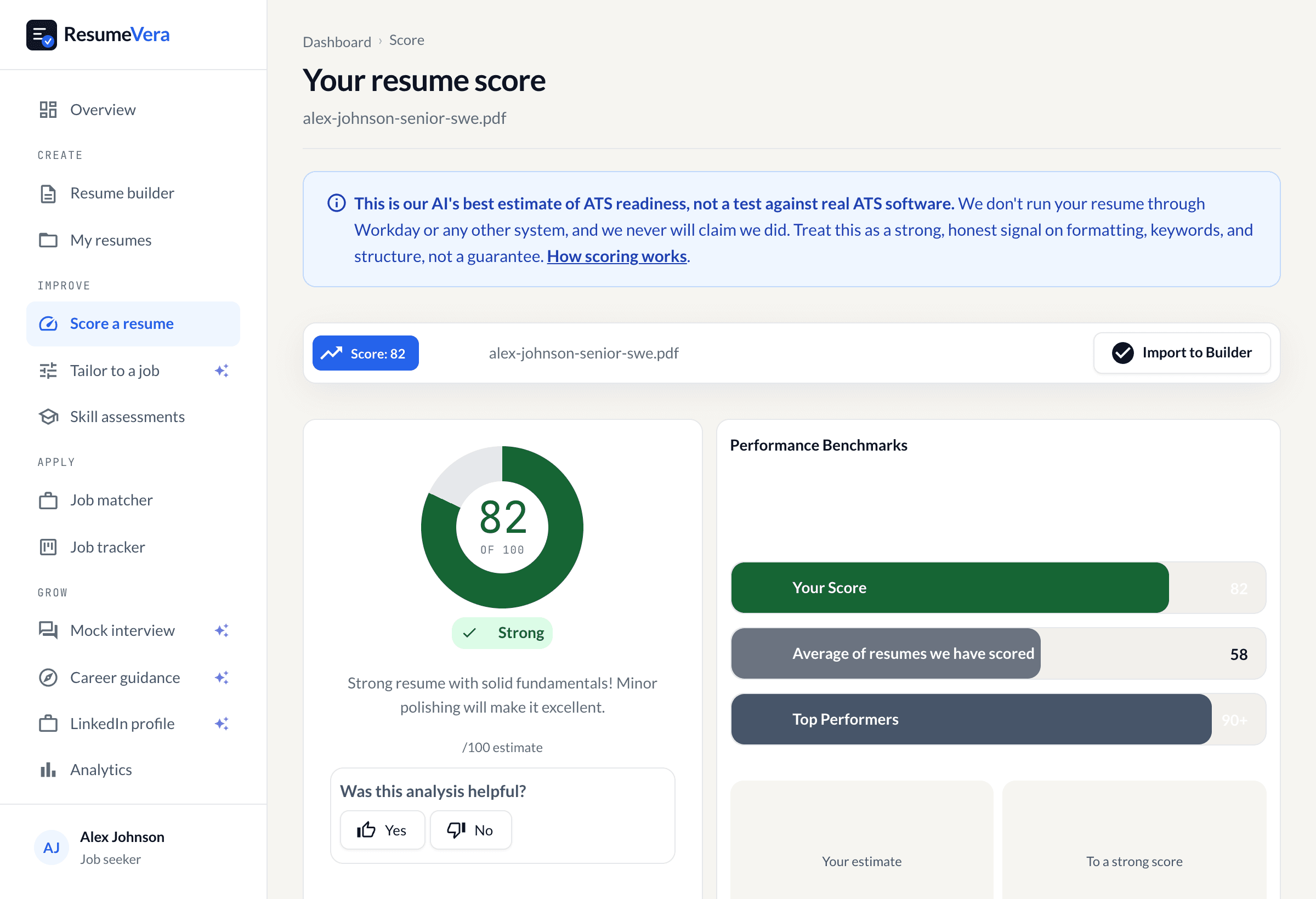
The real score page, with a sample resume and sample scores.
Is your resume ATS ready?
Run a free ATS score check and get specific improvements in seconds.