Written for the India job market, so salaries and formats follow Indian conventions. See the US version.
Career Growth
Offer letter and appointment letter in India
Last reviewed: 4 October 2026. How they differ, what each contains, what the official sources say employers must give in writing, sample templates, and what to check before you resign.
The ResumeVera editorial team
Resume and hiring research, reviewed against current employer guidance.
Updated 2026-10-04T16:18:39.698Z
17 min
Section 01
Offer letter and appointment letter: the short answer
Last reviewed: 4 October 2026. This guide explains what official sources say and what Indian employers commonly do. It is not legal advice. Your signed documents and your employer's policy decide the details, and the sources we link have the final word.
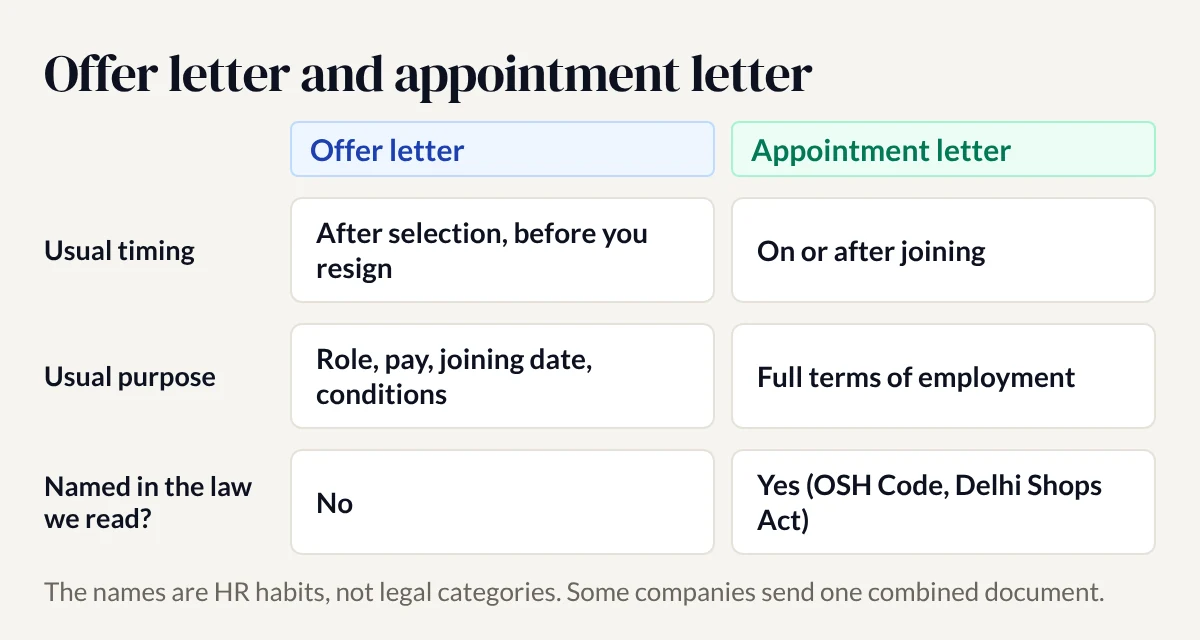
In everyday Indian hiring, an offer letter is the first written document: it tells you the company wants to hire you, for which role, at what pay and from roughly which date. An appointment letter (also called a joining letter or letter of employment) usually comes at or after joining and sets out the terms of the job in full. Some companies send one combined document, and some call the first one an "appointment letter" or a "letter of intent". The names are HR habits, not legal categories.
None of the official sources we read defines "offer letter" at all. The legal duty we could confirm is about the appointment letter (section 4 below). So treat the offer letter as the employer's promise on paper, and the appointment letter as the document that should carry the full, binding terms.
| Point | Offer letter | Appointment letter |
|---|---|---|
| Usual timing | After selection, before you resign | On or after joining |
| Usual purpose | Role, pay, joining date, conditions | Full terms of employment |
| Named in the law we read? | No | Yes (OSH Code, Delhi Shops Act) |
Do not resign on a verbal promise or a chat message, and do not assume the offer letter is the final contract: read what happens next (verification, documents, a separate appointment letter).
Section 02
What an offer letter usually contains
There is no government template for an offer letter, so contents vary. If an item below is missing, ask for it in writing before you accept.
- Your details and the employer's details: full name, company name, registered office or work location.
- Designation, department and reporting line: the job title as it will appear in your records. Ask about grade or level if the company uses one.
- Place of work: city, office, remote or hybrid, and any transfer clause.
- Expected date of joining and the last date by which you must accept.
- Compensation: usually an annual CTC figure with an attached breakup (see section 6), plus any joining bonus, variable pay and relocation support, each with its conditions.
- Conditions of the offer: background verification, reference checks, document submission, medical fitness, and proof of relieving from the current employer. This is the part to read most slowly.
- Probation and notice period: the length of probation and the notice period during and after it, or a statement that the appointment letter will carry them.
- Documents for day one: identity, address, education and experience documents, and relieving letter. For what experience documents should look like, see our guide on the experience letter format.
- Signature and acceptance block: who signed for the company and how you accept (signature, email reply or portal click).
Keep a copy of exactly what you accepted: the PDF, the email it came in, and when you replied. Download it from any portal, because links can expire.
Section 03
What an appointment letter usually contains
The appointment letter turns the offer into the terms you will work under. A Labour Ministry (PIB) summary of the Occupational Safety, Health and Working Conditions Code says every employee will be given an appointment letter "in the prescribed format specifying the details of the employee, designation, category, details of the wages, details of social security etc." (PIB document dated 22 November 2025). That is a summary of intent, and the exact prescribed format depends on rules we could not confirm as final (section 4).
In practice, a full appointment letter tends to cover:
- Employee and employer details, designation, category (permanent, fixed-term, contract) and joining date.
- Place of work, working hours, weekly offs and leave policy.
- Salary structure, pay date, deductions and statutory contributions (PF, and others if applicable).
- Probation: length, how confirmation is decided, and notice during probation.
- Notice period and what happens if either side does not serve it.
- Confidentiality, intellectual property and conduct rules.
- Any service bond, training cost recovery or non-compete wording (see section 8).
- A list of annexures: salary breakup, policies, job description.
As a state-level example, the Delhi Shops Act, 1954, page on the Delhi Labour Department site says the employer shall furnish every employee with a letter of appointment, and lists items such as the employer's name, the establishment's name and address, the employee's name, father's name and age, hours of work and date of appointment (The Delhi Shops Act, 1954 (Labour Department, Government of NCT of Delhi), section 34 as shown on that page). We did not read other states' laws.
Section 04
What the law says an employer must give you in writing
The labour codes
The Press Information Bureau stated on 21 November 2025 that the four Labour Codes (Code on Wages 2019, Industrial Relations Code 2020, Code on Social Security 2020 and the Occupational Safety, Health and Working Conditions Code 2020) "are being made effective from 21st November 2025", and that during transition the relevant provisions of the existing labour Acts and their rules "will continue to remain in force" (Government Makes the Four Labour Codes effective (Press Information Bureau, 21 November 2025)).
A Labour Ministry FAQ document (undated) says old rules remain in force "till final notification of new rules under the Code, to the extent these are in line with Codes" (FAQs on Labour Codes (Ministry of Labour and Employment)). The Ministry's Annual Report 2025-26 says the rules under the four Codes were pre-published for comments on 30 December 2025 (Annual Report 2025-26 (Ministry of Labour and Employment)). We could not find a page confirming final rules as of 4 October 2026, so check labour.gov.in.
Appointment letter under the OSH Code
Section 6(1)(f) of the OSH Code, as printed in the Ministry's PDF of the Code, requires the employer to "issue a letter of appointment to every employee on his appointment in the establishment, with such information and in such form as may be prescribed", and adds that where an employee has not been issued such a letter on or before commencement, it must be issued within three months of commencement (The Occupational Safety, Health and Working Conditions Code, 2020 (Ministry of Labour and Employment)). If the Code commenced on 21 November 2025 as PIB says, that window has already run; these sources do not say how it is enforced.
The Code defines "employee" widely, including people on wages doing managerial, administrative, technical or clerical work (section 2(t)). Which establishments the Code covers is set by its section 1, including size thresholds, so whether your employer is covered is a question for the labour office. Separately, a Ministry FAQ on the Code says it covers fixed-term employment workers, who "will get all benefits like appointment letters, annual health check-ups etc." (FAQs on the OSH Code, 2020 (Ministry of Labour and Employment)), and the Ministry's Compliance Handbook lists "Issuance of appointment letter to all employees" among employer duties (Compliance Handbook for Employers Under the Four Labour Codes (Ministry of Labour and Employment)).
Fixed-term employment
The Industrial Relations Code describes fixed-term employment as engagement of a worker "on the basis of a written contract of employment for a fixed period" (section 2(o); The Industrial Relations Code, 2020 (Ministry of Labour and Employment)). The Compliance Handbook says gratuity is payable to a fixed-term employee after one year of service. If your letter says "fixed term" or "contract", check the end date and whether renewal is promised or only possible.
Standing orders
The Industrial Relations Code applies its standing orders chapter to industrial establishments with three hundred or more workers (section 28(1)). The central model standing orders made under the older Industrial Employment (Standing Orders) Central Rules, 1946, classify workmen as permanent, probationers, badlis, temporary, casual and apprentices, and say a permanent workman's termination needs written notice (see section 7) (Industrial Employment (Standing Orders) Central Rules, 1946 (Ministry of Labour and Employment)). The Code's definition of "worker" excludes people mainly in managerial or administrative roles, and supervisors above a wage limit, so many salaried professionals may not be "workers" for these purposes. We did not verify how this applies to any specific job.
What is employer practice, not law
In the sources we read, the offer letter, CTC annexure, joining bonus, bond and relieving-before-joining conditions are matters of contract and company policy. What we could confirm in law is the appointment letter duty and the wage rules.
Section 05
Two sample templates with [bracketed] fields
These are samples to show the shape of the documents. They are not legal documents, and they are not a template an employer must use. Replace every [bracketed] field and have the real document checked by the company's own advisers.
Sample A: offer letter
[Company name], [registered office address]
Date: [date of issue]. Ref: [reference number]
Dear [candidate name],
We offer you the position of [designation] in [department], based at [work location], reporting to [manager designation]. Your expected date of joining is [date]. Please accept by [deadline] by signing below or replying to [HR email].
Your annual cost to company (CTC) is [amount in rupees], with the breakup in Annexure 1. The variable component of [amount or percentage] is payable subject to [conditions in Annexure 1]. A joining bonus of [amount], if any, is payable on [date] and recoverable only as stated in Annexure 2.
This offer is subject to: (a) satisfactory background verification, (b) submission of [list of documents] on or before [date], and (c) proof of relieving from your current employer by [date]. If any of these is not met, we will tell you in writing.
Your probation period will be [number] months and your notice period will be [number] days during probation and [number] days after confirmation, as set out in your appointment letter, which we will issue on or before your joining date.
Yours sincerely, [name, designation, signature]. Accepted by: [candidate signature and date].
Sample B: appointment letter
[Company name], [registered office address]
Date: [date]. Employee: [full name], [father's or guardian's name if the state or company format requires], [age or date of birth], [address].
1. Appointment. You are appointed as [designation], category [permanent / fixed term ending on [date] / contract], with effect from [joining date], at [work location].
2. Hours and leave. Working hours are [hours and days]. Leave follows [policy name and version], attached.
3. Remuneration. Your salary structure is in Annexure 1. Salary is paid on [date] of each month by [mode]. Statutory contributions and deductions are as per the law and Annexure 1.
4. Probation. You are on probation for [number] months from [joining date]. Confirmation will be communicated in writing. The probation may be extended once by [number] months if [stated reason].
5. Notice. Either party may end the employment by giving [number] days' written notice, or pay in lieu of the unserved part as set out in [clause or policy].
6. Other terms. Confidentiality and conduct terms are in Annexure 3. [Bond or cost recovery, only if applicable: period, amount and conditions in Annexure 2.]
Signed for [company]: [name, designation]. I have read and accept these terms: [employee signature and date]. A signed copy is to be given to the employee.
Section 06
How to read the CTC breakup
None of the official sources we read defines "CTC" (cost to company). It is an employer's yearly total, and your in-hand pay is smaller. See the CTC calculator and the salary hike calculator for arithmetic, and the guide on salary negotiation in India covers asking for more.
Read the breakup as a list of four kinds of items:
| Kind | Examples | Do you get it each month? |
|---|---|---|
| Fixed pay | Basic, allowances, HRA | Yes, before deductions |
| Variable pay | Performance bonus, incentives | Only if conditions are met |
| Employer-side | Employer PF, gratuity, insurance | No, not in your bank credit |
| One-time | Joining or retention bonus | Once, often with a recovery clause |
Points to check, with what the sources say
- Basic and the "wages" definition. The Code on Wages defines wages as all remuneration, but excludes items such as employer contribution to pension or provident fund, house rent allowance, gratuity and statutory bonus. If those excluded items exceed one-half (or another notified percentage) of total remuneration, the excess is added back into wages (section 2(y), Code on Wages, 2019 (Ministry of Labour and Employment); PIB factsheet: Code on Wages, 2019 Safeguards Workers (Press Information Bureau, 23 November 2025)). How your employer applies this to you is for payroll to explain.
- Provident fund. The EPFO FAQ page says an employee contributes 12 percent of basic wages plus dearness allowance plus retaining allowance, and the employer pays 12 percent of pay, of which 8.33 percent goes to the pension fund and the rest to EPF (Frequently Asked Questions (Employees' Provident Fund Organisation)). The page is undated and says "at present"; ask payroll whether PF is on actual basic or a capped amount.
- Gratuity. The Compliance Handbook says gratuity is paid after at least five years of continuous service (one year for fixed-term employees) at 15 days' wages for each completed year, subject to the notified maximum, within 30 days of becoming payable. Check whether the CTC counts a gratuity amount you receive only if you stay long enough.
- Variable pay. Ask whether the target is a minimum or a maximum, who it depends on, the payout date, and whether it is lost if you resign before it.
- Wage slip and deductions. Section 50 of the Code on Wages requires wage slips in the prescribed form and manner; section 18(1) says no deductions from wages except those authorised under the Code, and 18(3) caps deductions in a wage period at fifty percent. See our guide on salary slip format in India.
- Tax. The Income Tax Department's page says an employer who deducts tax under section 192 must issue Form 16 by 15 June after the financial year (Form 16 and Form 16A (Income Tax Department)). The page says it reflects the Income-tax Act, 1961 as amended by the Finance Act, 2026, so check which provisions apply to you.
A reconciliation you can do yourself
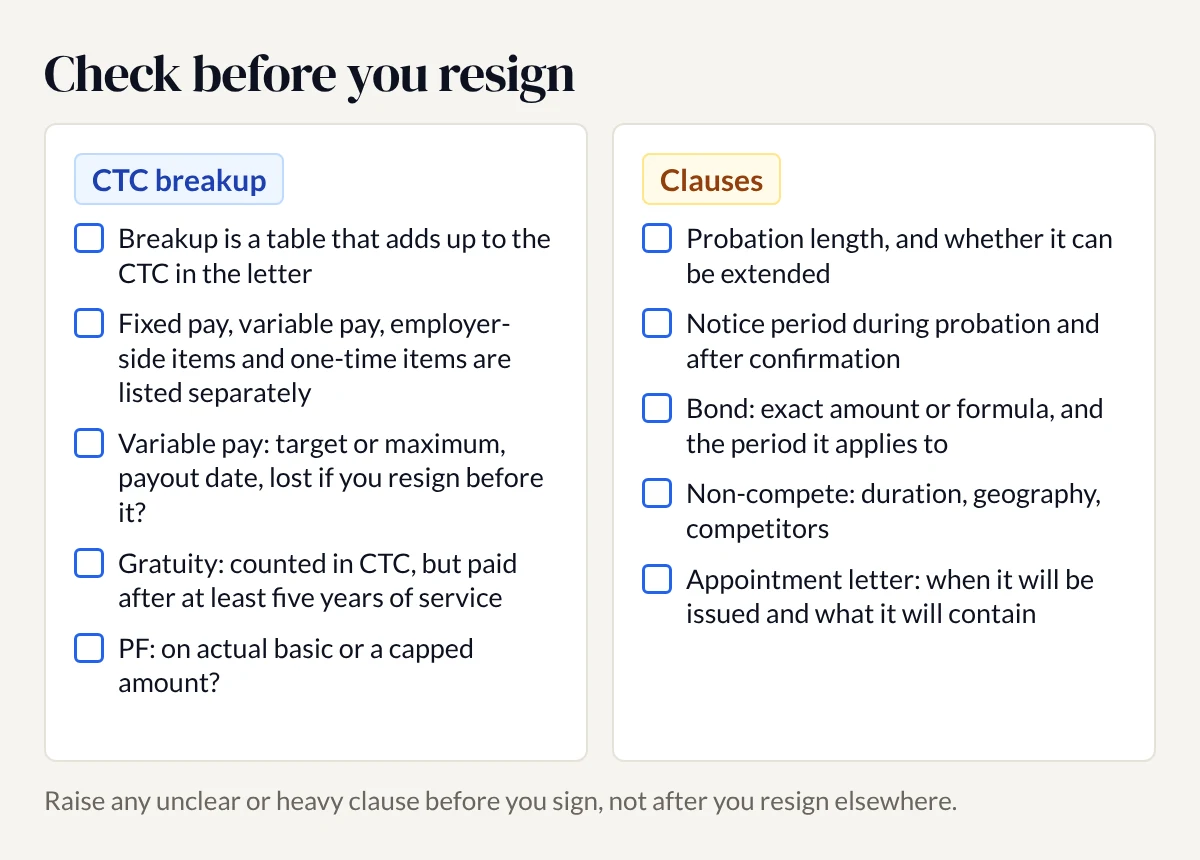
Ask for the breakup as a table and check that fixed pay + variable at target + employer PF + employer gratuity + other employer-side items + one-time items = the CTC in the letter. Estimate in-hand pay as fixed pay minus employee PF, professional tax and tax deducted at source. Those last two vary by state and your tax choices, so we give no numbers.
Section 07
Probation, notice period and confirmation
Probation and notice are mostly contract terms, so the letter is where you must look.
What the sources say
- The central model standing orders (Schedule I) define a probationer as a workman "provisionally employed to fill a permanent vacancy in a post" who "has not completed three months' service therein", and say probationers are not entitled to notice or pay in lieu if their services are terminated (clauses 2 and 13(2)).
- For a permanent workman under the same orders, termination needs notice in writing from either side: one month for workmen paid by the month and two weeks for others (clause 13(1)).
- The Delhi Shops Act page says an employer cannot dispense with an employee who has been in continuous employment for at least three months without one month's written notice or wages in lieu, and that an employee with three months' continuous service must give one month's written notice before leaving (section 30 as shown on that page).
These are examples from specific instruments with specific coverage, not a rule for every office job. Your letter may set longer or shorter terms, and whether a differing term is enforceable is a legal question we cannot answer.
Questions to ask before you accept
- How long is probation, and can it be extended? On what stated grounds?
- What is the notice period during probation and after confirmation? Is it the same for both sides?
- Is notice served by working, or can it be shortened by agreement? Our explainer on notice period buyout covers that.
- What happens to variable pay, leave balance and joining bonus if you leave during notice? See leave encashment on resignation.
- Is confirmation automatic at the end of probation or only by a written letter?
When you do leave, the Code on Wages section 17(2) says wages are payable within two working days of resignation, and our guide on full and final settlement covers the rest of the exit.
Section 08
Bond, notice recovery and restraint clauses
Three kinds of clause appear in appointment letters and deserve a slow read: a service bond (you agree to stay for a minimum period or pay), notice recovery (you pay for unserved notice days) and post-employment restrictions (non-compete or non-solicit).
What the primary text says
The Indian Contract Act, 1872 (India Code) says in section 27: "Every agreement by which any one is restrained from exercising a lawful profession, trade or business of any kind, is to that extent void", with a narrow exception for the sale of goodwill of a business. Section 74 says that when a contract names a sum payable on breach, the party complaining of the breach is entitled to "reasonable compensation not exceeding the amount so named" (The Indian Contract Act, 1872 (India Code, Government of India)).
Applying them to a particular bond or non-compete is for courts. We did not rely on any judgment, so we make no claim about whether a given bond can be enforced.
For recovery taken from your pay, section 18(1) of the Code on Wages says no deductions from wages except those authorised under the Code. We did not read the list of authorised deductions in detail, so we cannot say whether a particular notice-shortfall recovery qualifies. If a clause says the company will deduct from your final pay, ask HR which provision allows it.
What to ask for in writing
- The exact amount, or the formula, and the period it applies to. A reducing schedule (for example "pro rata for each completed month") is different from a flat sum.
- What counts as cost: actual documented training or relocation spend, or a round sum.
- Whether the amount reduces as you complete part of the period, and whether it can be waived.
- How a non-compete is limited: duration, geography, competitors.
Raise any unclear or heavy clause before you sign, not after you resign elsewhere.
Section 09
Red flags and fake offer letters
Fake offers use the same documents this guide describes. The strongest rule from official sources is simple: do not pay to get a job.
What official sources say
- The National Career Service (NCS) portal's "Beware of Misleading Communication" notice says NCS services are free of cost, that NCS does not charge any fee at any stage of registration, job application, interview processing and other employment related services, and that "Jobseekers should not pay fees to employers". It also warns that fraudulent websites and persons falsely claim association with NCS or the Ministry of Labour and Employment, and lists a toll-free helpline 1514 and the cyber crime number 1930 (National Career Service portal (Ministry of Labour and Employment), page as read on 4 October 2026).
- A Ministry of Home Affairs release of 4 February 2026 says a toll-free helpline "1930" has been operationalised for assistance in lodging online cyber complaints, and describes the Citizen Financial Cyber Fraud Reporting and Management System for reporting financial frauds (Indian Cyber Crime Coordination Centre release (Ministry of Home Affairs, 4 February 2026)). The National Cyber Crime Reporting Portal lists "Financial Fraud" as a complaint category (National Cyber Crime Reporting Portal (Ministry of Home Affairs)).
- For jobs abroad, a Ministry of External Affairs advisory dated 14 December 2023, as published on the Embassy of India, Bern site, tells job seekers to verify recruiting agents through emigrate.gov.in, notes that registered agents hold a licence number displayed in their premises and advertisements, sets a ceiling on agent service charges, and warns about unregistered agents on WhatsApp and social media with minimal contact details and no clarity on job terms (Advisory (Embassy of India, Bern, publishing a Ministry of External Affairs advisory)). We read only a copy, so check the current advisory for the fee ceiling and helplines.
Our own checklist (editorial, not from a government list)
- Any demand for money labelled registration, security deposit, laptop, training, visa, "refundable" fee or offer processing fee before you start work.
- An offer without an interview, or an interview only on a chat app.
- Sender addresses on free mail domains, or a domain that differs slightly from the company's real website.
- Pressure to accept within hours, or to keep the offer secret.
- No registered address, or a request for your bank login or OTP.
Verify the company independently: find its official site yourself (do not click the link in the message), call a published number, and ask for a name you can confirm on the company's official channels. If you have paid, call 1930 and report on the cyber crime portal without delay. Our interview preparation guide helps you ask the right questions in a genuine process.
Section 10
Before you resign, and if an offer is withdrawn
Checklist before you resign from your current job
- Have the written offer, signed on both sides if the company asks for it. A recruiter's call is not enough.
- List the conditions in the letter and mark which are cleared: background verification, documents, medical, references, system access. If verification is pending, ask HR in writing what the status is and what the company will do if it fails.
- Confirm the joining date and the last date to join. Compare it with your notice period so you know whether it is realistic.
- Read your current contract for notice period, bond, notice recovery, and variable pay rules. Our guide on the resignation letter format covers how to write the resignation.
- Ask whether the new employer will issue the appointment letter before your joining date and what it will contain, and whether it matches the offer.
- Plan the paperwork you will need: relieving letter, experience letter, final salary slips, Form 16, and your EPF details.
Revocation: what the primary source says, and what it does not
The only primary text we can cite on withdrawing an offer is the general law of contract. The Indian Contract Act, 1872, section 5, says a proposal "may be revoked at any time before the communication of its acceptance is complete as against the proposer, but not afterwards", and section 4 says communication of acceptance is complete as against the proposer "when it is put in a course of transmission to him, so as to be out of the power of the acceptor" (The Indian Contract Act, 1872 (India Code)).
Whether an offer letter is a "proposal" in that sense, whether your reply is the acceptance, what the letter's conditions allow, and what you could claim if an offer is withdrawn after you resign are legal questions. None of the sources we read answers them for your case, and we state no outcome. If an offer is withdrawn or delayed, ask in writing for the reason, keep the emails and the letter, and ask a qualified lawyer or your state labour office about your options.
Section 11
Sources and references
Limits. Rules are changing as the labour codes move from pre-published to final rules, states have their own laws, and your contract decides most terms. This page cannot tell you which regime covers your employer or what a court would decide. For disputes, contact your state labour office or the Ministry of Labour and Employment at labour.gov.in, or a qualified lawyer.
Every legal or payroll statement above comes from an official page fetched on 4 October 2026. Check each link for the current version.
- Government Makes the Four Labour Codes effective to Simplify and Streamline Labour Laws (Press Information Bureau): Effective date of the four Labour Codes, 21 November 2025; transition wording; mandatory appointment letters listed as a reform.
- The Occupational Safety, Health and Working Conditions Code, 2020 (Ministry of Labour and Employment): Section 6(1)(f) appointment letter duty; section 2(t) definition of employee.
- Occupational Safety, Health and Working Conditions (OSH) Code, 2020 summary (Press Information Bureau, 22 November 2025): Appointment letters in the prescribed format with employee, designation, category, wages and social security details.
- FAQs on the OSH Code, 2020 (Ministry of Labour and Employment): Q12: fixed-term employment workers get appointment letters and other benefits.
- Compliance Handbook for Employers Under the Four Labour Codes (Ministry of Labour and Employment): Appointment letter duty; gratuity eligibility, formula and 30-day payment; one-year gratuity for fixed-term employees.
- FAQs on Labour Codes (Ministry of Labour and Employment, undated): Old rules remain in force till final notification of new rules, to the extent in line with Codes.
- Annual Report 2025-26 (Ministry of Labour and Employment): Rules under the four Codes pre-published for comments on 30 December 2025.
- The Industrial Relations Code, 2020 (Ministry of Labour and Employment): Fixed-term employment definition; standing orders threshold; worker definition.
- Industrial Employment (Standing Orders) Central Rules, 1946, Schedule I (Ministry of Labour and Employment): Classification, probationer, notice for termination and exceptions.
- Code on Wages, 2019 (Ministry of Labour and Employment): Definition of wages, section 17(2), section 18 deductions, section 50 wage slips.
- Code on Wages, 2019 Safeguards Workers (Press Information Bureau factsheet, 23 November 2025): 50 percent rule and wage slips on or before wage payment.
- The Delhi Shops Act, 1954 (Labour Department, Government of NCT of Delhi): Notice (section 30) and letter of appointment (section 34) as an example of state law.
- The Indian Contract Act, 1872 (India Code): Sections 4, 5, 27 and 74.
- Frequently Asked Questions (Employees' Provident Fund Organisation): Contribution rates and split; page undated.
- Form 16 and Form 16A (Income Tax Department): Form 16 under section 192 and due date.
- National Career Service portal (Ministry of Labour and Employment): No fees to employers; helplines 1514 and 1930.
- Indian Cyber Crime Coordination Centre release (Ministry of Home Affairs, 4 February 2026): Helpline 1930 and financial fraud reporting system.
- National Cyber Crime Reporting Portal (Ministry of Home Affairs): Financial fraud complaint category.
- Advisory on overseas recruitment (Embassy of India, Bern, copy of Ministry of External Affairs advisory, 14 December 2023): Verify agents via emigrate.gov.in; warnings on unregistered agents.
Pro tips
Do these
Ask for the CTC breakup as a table and check it adds up to the CTC figure in the letter.
Get the appointment letter or its draft terms in writing before you resign.
Mark each condition in the offer letter (background check, documents, medical) and note when it is cleared.
Save the offer PDF, the acceptance email and the salary breakup in a folder you control.
Ask exactly how notice, probation extension and variable pay work if you leave early.
Verify the company through its official website and a published phone number.
If a bond or recovery clause worries you, ask for the formula and the cost it covers in writing before signing.
Avoid these
Delete these
Resigning on a verbal assurance or chat message.
Assuming the offer letter is the full contract and never reading the appointment letter.
Comparing CTC figures between offers without comparing fixed pay, variable pay and employer-side items.
Ignoring the notice, bond and recovery clauses in the current employer's contract.
Paying a registration, training or security fee to get a job.
Signing a letter with blank fields or a missing annexure.
Missing that conditions such as background verification are still pending on the joining date.
Treating this guide or any template as legal advice.
Put this into a resume
Building and editing are free, and free PDFs carry a small watermark.
Check your resume for freeQuestions
Frequently asked questions
How this guide is maintained
We review this guide every quarter and after any change to the hiring rules or portal behaviour it describes. It was last reviewed on 2026-10-04T16:18:39.698Z. Figures come from named sources, shown beside the number. Where we are estimating rather than measuring, we say so.
By the numbers
Section 6(1)(f)
OSH Code duty to issue a letter of appointment to every employee
https://www.labour.gov.in/static/uploads/2025/07/36fcfa5d8e6b9145e282bf7b950d6c47.pdf
2 working days
Wages payable after resignation, Code on Wages section 17(2)
https://www.labour.gov.in/static/uploads/2025/06/c328da14bbb15fc4ad571dc33e7a4ab3.pdf
1930
Helpline for lodging online cyber complaints, as stated by the Ministry of Home Affairs
https://www.pib.gov.in/PressReleasePage.aspx?PRID=2223095®=3&lang=1
Try it
Check the guide against your own file
Everything above is general. Your resume is not. Paste it in and the checker tells you which of these points your file actually breaks.
Check your resume free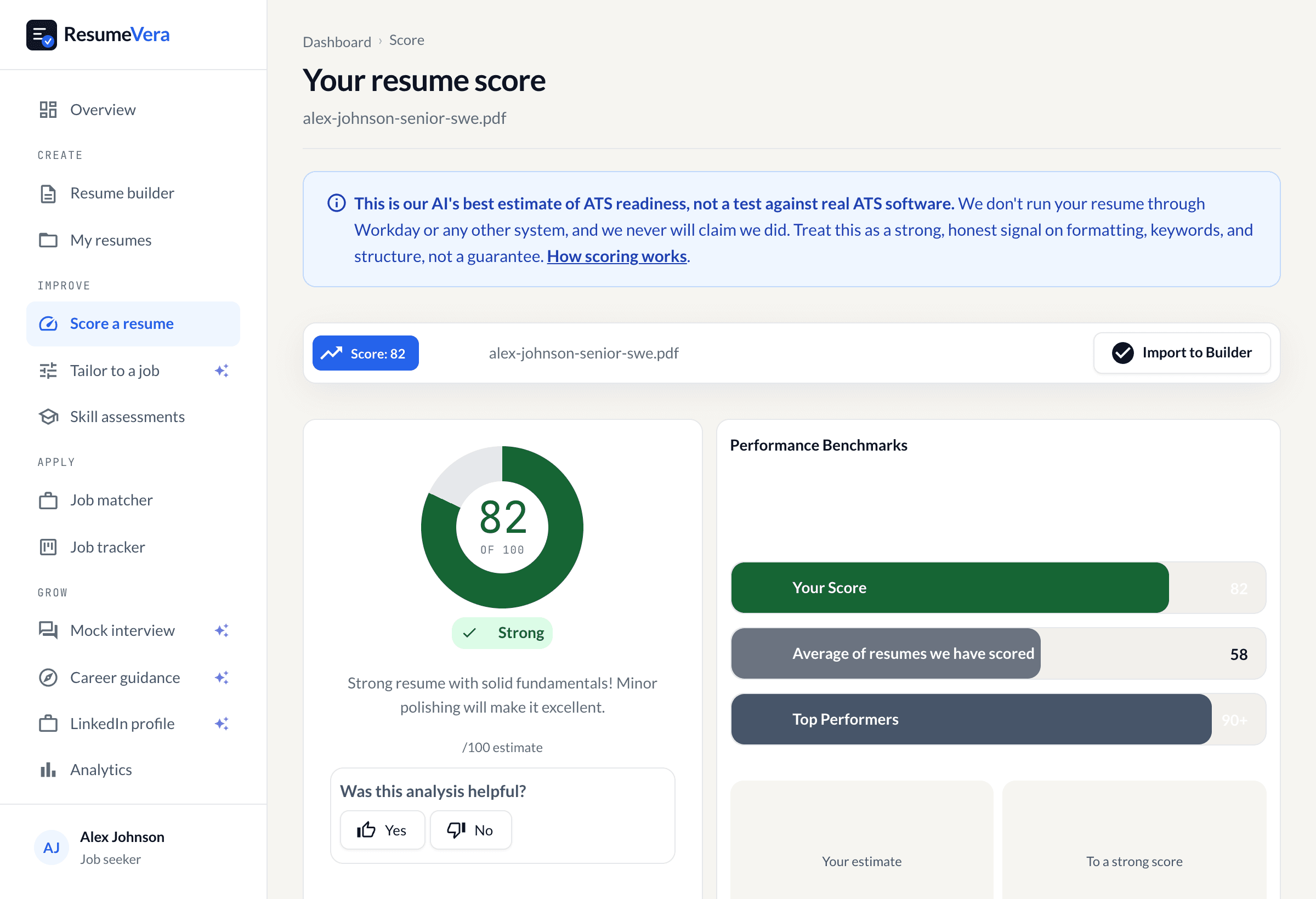
The real score page, with a sample resume and sample scores.
Is your resume ATS ready?
Run a free ATS score check and get specific improvements in seconds.