SEO & Digital Marketing
Digital marketing hiring remains resilient with 6% projected growth through 2032 and a 12% employment surge since 2022. SEO specialists with AI expertise earn 20-30% more, and 74% of enterprise companies plan to hire AI-skilled SEO professionals.
0
Higher pay for SEO specialists with AI skills
$0K
Median salary for senior SEO roles in 2026
0%
Enterprise companies hiring AI-skilled SEO specialists
Roles that use SEO & Digital Marketing, and what they pay
Median annual wage, national, May 2025
- $78,760*
- $74,750*
- $76,910
- $166,790
* BLS has no code for that exact title, so it is counted under a broader occupation. The role page says which. Source: BLS OEWS. These are the roles' wages, not a premium for the skill: no published source measures what one skill adds on its own.
Market Demand
Demand & Salary Data
6% (through 2032, BLS)
Growth Rate
$
+20-30% with AI expertise
Avg. Salary Impact
12% employment growth since 2022
Job Openings
Top Industries
Learning Path
Skill Levels
Beginner
You understand basic SEO concepts like keywords, meta tags, and on-page optimization. You can use Google Analytics to read traffic reports, set up basic social media campaigns, and create simple content optimized for search engines. You are familiar with Google Search Console and basic HTML.
Intermediate
You conduct comprehensive keyword research, build content strategies, perform technical SEO audits, and manage multi-channel digital campaigns. You use tools like SEMrush, Ahrefs, and Google Ads to drive measurable results, and you can analyze campaign ROI and optimize conversion funnels.
Advanced
You design and execute enterprise-level SEO and digital marketing strategies that drive millions in revenue. You lead teams, manage six-figure advertising budgets, leverage AI for personalization and automation, and present data-driven marketing strategies to C-suite executives.
Section 01
Why SEO and Digital Marketing Skills Are Thriving in 2026
The digital marketing landscape in 2026 is defined by two converging forces: the continued shift of consumer attention to digital channels and the transformative impact of AI on marketing operations. Together, these forces have created a job market where skilled digital marketers and SEO specialists are in higher demand and commanding better compensation than ever before.
U.S. marketing employment grew by 12% between 2022 and late 2024, significantly outpacing the overall labor market. Digital marketing hiring remains resilient in 2026, with roles projected to grow 6% through 2032 according to the Bureau of Labor Statistics. But the real story is in the specialization premium: professionals with hands-on AI, Python, SQL, and personalization experience now command 20-30% higher pay and significantly better career opportunities than those with only traditional marketing skills.
SEO, in particular, has undergone a renaissance driven by AI search integration. As Google, Bing, and other search engines incorporate AI-generated answers into their results, the role of the SEO specialist has evolved from keyword optimization to strategic content architecture, entity-based optimization, and AI search visibility. A Semrush study analyzing 3,900 SEO job listings found that AI-related skill requirements in SEO postings are up 21%, and 74% of enterprise companies plan to hire SEO specialists with AI expertise within the next 12 months.
The salary data reflects this evolution. The average SEO specialist salary in 2026 falls between $58,000 and $85,000 depending on experience and location, but senior SEO roles have reached a median salary of $130,000, nearly double the $71,630 median for other marketing positions. SEO salaries have increased 6% year-over-year, driven by growing demand for AI-era expertise. For digital marketers broadly, the combination of analytical skills, creative thinking, and technology fluency makes this one of the most versatile and rewarding career paths available.
Section 02
Core SEO Skills Employers Demand in 2026
SEO has evolved far beyond stuffing keywords into meta tags. The modern SEO professional is part strategist, part analyst, part technologist, and part content architect. Here are the core competencies that drive hiring decisions and salary negotiations in 2026.
Technical SEO: Understanding site architecture, crawlability, indexation, page speed, Core Web Vitals, structured data (schema markup), and mobile-first optimization is foundational. Technical SEO ensures that search engines can discover, render, and index content effectively. Professionals who can conduct comprehensive technical audits and implement fixes across large-scale websites are in the highest demand, particularly at enterprise companies and agencies.
Content Strategy and Optimization: Creating content that satisfies both search engines and users requires a deep understanding of search intent, topic clustering, internal linking architecture, and E-E-A-T (Experience, Expertise, Authoritativeness, Trustworthiness) principles. In 2026, content strategy also means understanding how AI-generated search results (like Google's AI Overviews) select and surface content, and optimizing accordingly.
AI and Automation in SEO: With AI-related skill requirements up 21% in SEO job postings, proficiency with AI tools is rapidly becoming a baseline expectation. This includes using AI for content generation and optimization, automating keyword research and competitive analysis, leveraging machine learning for rank tracking and prediction, and understanding how large language models process and prioritize content. SEO professionals who can build automated workflows using Python, APIs, and AI tools deliver dramatically more value than those relying on manual processes.
Analytics and Data Interpretation: SEO success is measured in data: organic traffic, keyword rankings, click-through rates, conversion rates, and revenue attribution. Mastery of Google Analytics 4 (GA4), Google Search Console, and SEO platforms like SEMrush, Ahrefs, and Moz is essential. The ability to build custom dashboards, conduct cohort analysis, and present data-driven insights to stakeholders separates senior SEO professionals from junior practitioners.
Link Building and Digital PR: Earning high-quality backlinks through digital PR, content partnerships, and strategic outreach remains a critical ranking factor. Professionals who can combine creative campaign ideation with data-driven outreach strategies build sustainable link profiles that drive long-term organic growth. This skill requires strong communication, relationship-building, and an understanding of journalistic and editorial standards.
Section 03
Essential Digital Marketing Skills Beyond SEO
While SEO is a cornerstone of digital marketing, the most marketable professionals in 2026 combine search optimization expertise with broader digital marketing competencies that drive comprehensive revenue growth.
Pay-Per-Click (PPC) Advertising: Managing campaigns on Google Ads, Microsoft Ads, Meta Ads, and LinkedIn Ads requires a blend of analytical precision and creative testing. PPC specialists who can optimize cost-per-acquisition, manage substantial budgets, and demonstrate clear ROI are among the highest-paid digital marketers. In 2026, AI-powered bidding strategies and creative automation have made PPC management more strategic and less manual, rewarding professionals who can set and monitor AI-driven campaigns effectively.
Content Marketing: Content remains the fuel that powers SEO, social media, email marketing, and thought leadership. Content marketers who can develop editorial calendars, write compelling copy, manage content production workflows, and measure content performance across the funnel are indispensable to modern marketing teams. The integration of AI writing tools has increased content velocity, making editorial judgment and quality oversight more valuable than raw writing speed.
Social Media Marketing: Building brand presence, engaging communities, and driving traffic through platforms like LinkedIn, Instagram, TikTok, and X requires platform-specific knowledge and creative adaptability. Social media managers who can analyze engagement metrics, run paid social campaigns, and create viral-worthy content contribute directly to brand awareness and lead generation.
Email Marketing and Marketing Automation: Email remains one of the highest-ROI marketing channels, and professionals who can build automated nurture sequences, segment audiences, write high-converting emails, and optimize send times using data are in consistent demand. Proficiency with platforms like HubSpot, Mailchimp, Klaviyo, or Marketo is frequently listed in digital marketing job postings.
Conversion Rate Optimization (CRO): Understanding how to design and run A/B tests, optimize landing pages, improve user experience, and increase conversion rates across the marketing funnel is a skill that directly impacts revenue. CRO professionals combine analytical thinking with UX design principles and persuasive copywriting to maximize the value of every visitor a marketing team drives to a website.
Section 04
How to Showcase SEO and Digital Marketing on Your Resume
Digital marketing is a results-driven field where quantifiable achievements matter far more than job descriptions. Your resume should read like a portfolio of measurable impact, demonstrating that you can drive business results through digital channels.
Lead with Revenue and Growth Metrics: The most impactful digital marketing resume bullets connect your work directly to business outcomes. Instead of "Managed SEO for company website," write "Grew organic traffic from 50K to 180K monthly sessions in 12 months through technical SEO overhaul and content strategy, generating $2.1M in attributed pipeline." Hiring managers want to see traffic numbers, conversion rates, revenue figures, and ROI percentages.
Specify Tools and Platforms: Create a dedicated tools section listing the platforms you are proficient with: SEMrush, Ahrefs, Moz, Google Analytics 4, Google Search Console, Google Ads, Meta Ads Manager, HubSpot, Salesforce Marketing Cloud, Mailchimp, Screaming Frog, and any AI tools you use. ATS systems scan for these specific keywords, and hiring managers use them to quickly assess your technical toolkit.
Highlight AI and Automation Skills: Given the 21% increase in AI-related skill requirements in SEO job postings, explicitly showcase any experience with AI tools for content optimization, automated reporting, programmatic SEO, or AI-powered campaign management. This differentiator can increase your salary offer by 20-30% compared to candidates without AI experience.
Show Campaign Diversity: Demonstrate experience across multiple channels: SEO, PPC, content, social, email, and CRO. Even if you specialize in one area, showing breadth proves you understand how digital marketing channels work together to drive results. Use phrases like "integrated multi-channel campaign" and "cross-channel attribution" to signal strategic thinking.
Include Certifications: Google Analytics Individual Qualification, Google Ads Certifications, HubSpot Inbound Marketing, SEMrush SEO Toolkit Course, and Meta Blueprint certifications all add credibility. These are often free or low-cost and demonstrate ongoing professional development. ResumeVera's resume builder helps you organize these credentials alongside your experience for maximum impact.
Section 05
SEO and Digital Marketing Career Paths
The digital marketing career ladder offers multiple specialization tracks and leadership pathways, each with distinct salary ranges and skill requirements. Understanding these paths helps you plan your development strategically.
SEO Specialist ($58,000-$85,000): Entry to mid-level SEO professionals manage on-page optimization, keyword research, content strategy, and technical audits. At this level, you are building the foundational skills that will support career advancement. The average SEO professional sees a salary increase of 8-10% per year during the first five years, and roughly 40% of SEOs get promoted or change roles within two years.
Senior SEO Manager ($100,000-$130,000): Senior SEO professionals lead strategy for large websites, manage teams, oversee technical SEO at scale, and present results to executives. The median salary for senior SEO roles has reached $130,000, reflecting the strategic value that experienced SEO professionals deliver. At this level, AI expertise and data analysis skills become significant salary differentiators.
Digital Marketing Manager ($80,000-$120,000): Marketing managers oversee multi-channel digital strategies encompassing SEO, PPC, content, social, and email. They manage budgets, coordinate team members, and are accountable for pipeline and revenue targets. Strong analytical skills and the ability to connect marketing activities to business outcomes are essential for success and advancement.
Director of Digital Marketing ($130,000-$170,000): Directors define the overall digital marketing strategy, manage substantial budgets, build and lead teams, and serve as the primary marketing stakeholder for executive leadership. At this level, strategic vision, leadership ability, and business acumen matter as much as technical marketing skills.
VP of Marketing / CMO ($170,000-$250,000+): The top of the marketing career ladder combines deep domain expertise with executive leadership. CMOs are responsible for brand strategy, market positioning, customer acquisition, and revenue growth across all channels. Many CMOs in 2026 rose through the digital marketing ranks, bringing data-driven thinking and technology fluency to traditionally brand-focused roles.
Freelance and Consulting ($75,000-$200,000+): Many experienced digital marketers build lucrative freelance or consulting practices. SEO consultants with proven track records can charge $150-$300+ per hour, while fractional CMOs provide executive-level marketing leadership to multiple companies simultaneously.
Section 06
The Future of SEO and Digital Marketing
The digital marketing landscape is evolving faster than at any point in its history, driven by AI integration, shifting search paradigms, and changing consumer behavior. Professionals who anticipate and adapt to these changes will thrive; those who cling to outdated tactics will be left behind.
AI Search and the New SEO: Google's AI Overviews, Bing's Copilot, and other AI-powered search experiences are fundamentally changing how users discover content. SEO in 2026 is no longer just about ranking on a traditional results page; it is about ensuring your content is selected and cited by AI systems. This requires expertise in structured data, entity optimization, topical authority building, and understanding how large language models evaluate content quality and relevance.
Personalization at Scale: AI enables marketers to deliver personalized experiences to individual users across email, web, advertising, and social channels simultaneously. Professionals who can implement personalization engines, build audience segments using behavioral data, and measure the impact of personalized campaigns are in extremely high demand. The ability to balance personalization with privacy compliance adds another layer of value.
Video and Visual Search: Short-form video (TikTok, YouTube Shorts, Instagram Reels) has become a primary content discovery channel. Digital marketers who can optimize video content for search, create compelling visual narratives, and measure video marketing ROI are increasingly valuable. Similarly, visual search capabilities on platforms like Google Lens and Pinterest are creating new optimization opportunities.
First-Party Data Strategy: With third-party cookies being phased out, digital marketers must build and leverage first-party data strategies. This includes developing lead magnets, creating gated content, building email lists, and implementing server-side tracking. Professionals who can design data collection strategies that respect user privacy while providing actionable insights will be essential to every marketing team.
Preparing for the Future: Continuously invest in learning AI tools, understanding new search paradigms, and building analytical skills alongside creative capabilities. The most successful digital marketers in 2026 and beyond will be hybrid professionals who combine strategic thinking with technical execution. Update your resume regularly with new skills and achievements using ResumeVera's resume builder, and use the free resume analyzer to ensure your profile reflects the latest industry expectations.
Related Roles
Roles That Use This Skill
Explore resume examples for roles that commonly require this skill.
Questions
Frequently asked questions
Skill Guides
Explore More Skills
Browse all our in-demand skill guides with demand data and learning paths.
View All SkillsProve it
Claiming a skill and demonstrating one are different things
A timed assessment puts a result behind the word on your resume. Question count and duration are shown up front, and percentiles stay hidden until a domain has enough attempts to mean anything.
Join the waitlist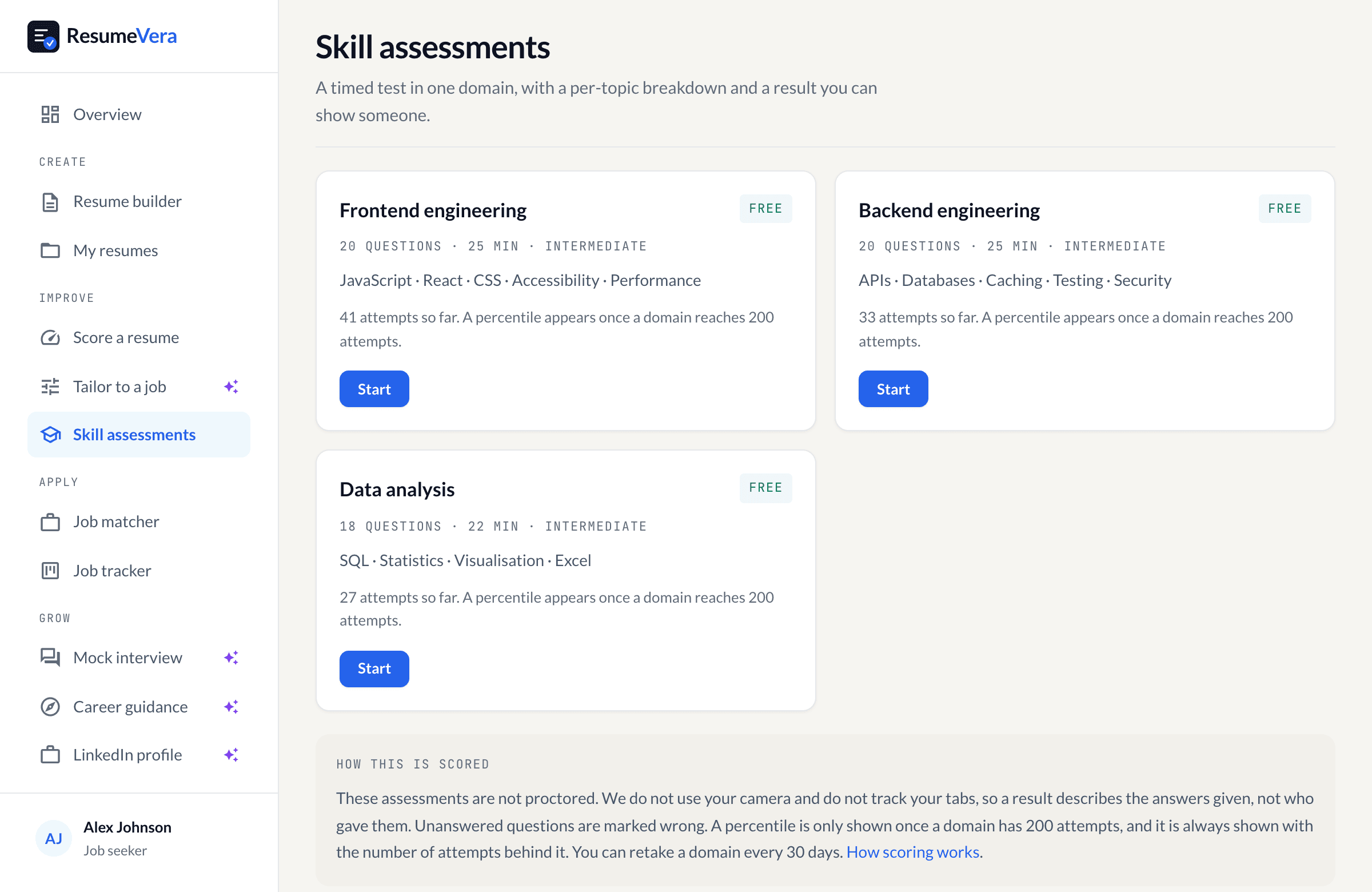
The real list. Percentiles stay hidden until a domain has enough attempts to mean anything.
Is your resume ATS-ready?
Run a free ATS score check and get specific improvements in under 60 seconds.