Canada's new Express Entry high-wage points: is your job worth 50, 70 or 100 CRS points?
Job Search · ResumeVera Editorial Team · November 3, 2026 · 11 min read
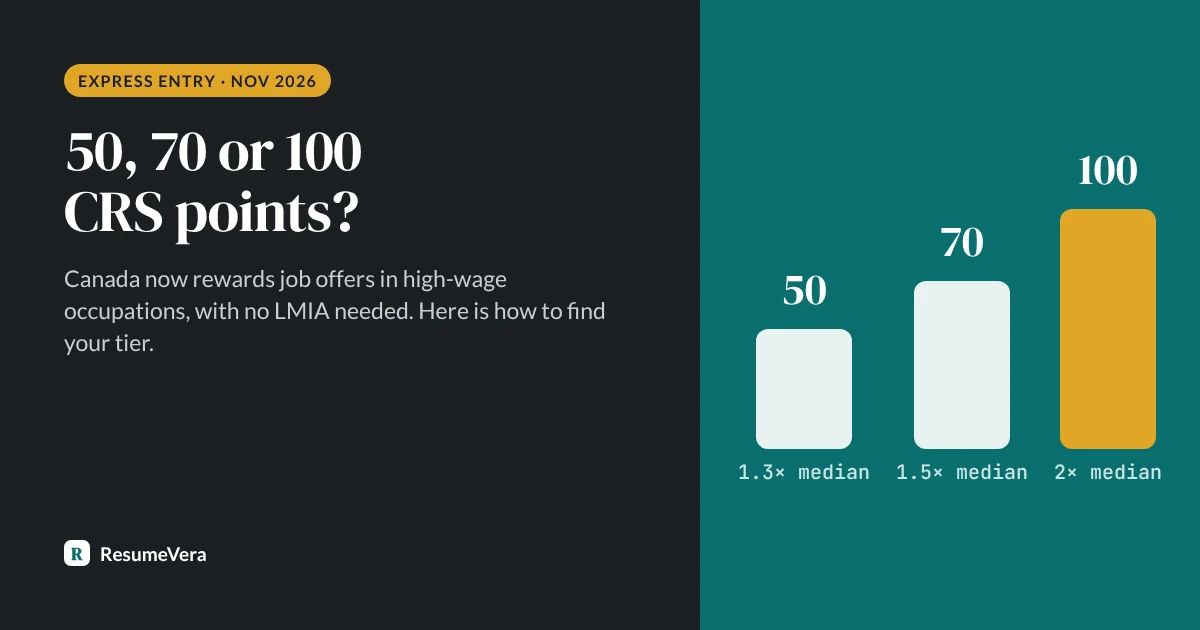
Short answer: Since 3 November 2026, Express Entry gives extra CRS points for work in 186 high-wage occupations. A job offer earns 100, 70 or 50 points depending on the occupation's wage tier, with no LMIA needed. High-wage Canadian experience is the alternative route; you get whichever scores higher. (Source: IRCC news release, 16 October 2026.)
Last reviewed: 3 November 2026. We update this page when the rules change.
Canada has changed what a job offer is worth in Express Entry, and it has done it by occupation rather than by salary. If your occupation is on the list, an offer or a year of Canadian work in it can add a meaningful block of points to your Comprehensive Ranking System (CRS) score. If it is not, nothing in this change helps you.
This guide covers the points, the tiers, which common tech and healthcare occupations sit where, three worked examples, and what is still unknown about Canada's next immigration levels plan.
What changed in Express Entry on 3 November 2026?
IRCC announced on 16 October 2026 that Express Entry is being refocused on high-wage occupations, according to its news release.
The new Labour Market Integration Factor took effect on 3 November 2026.
It gives points for two things: a qualifying job offer in a high-wage occupation, or at least 12 months of high-wage Canadian work experience. You cannot stack them. You get the higher of the two.
A total of 186 occupations qualify, per IRCC's backgrounder on the changes.
What counts as a high-wage occupation?
This is the part most people get wrong, so here is IRCC's own definition from the 16 October 2026 release:
"a high-wage occupation is one with a median wage of at least 1.3 times the median wage of the overall Canadian workforce. This is based on the typical earnings of an occupation, not an individual candidate's previous or current salary."
In plain terms: your pay slip does not decide your tier. Your NOC code does.
A well-paid developer in a 1.5x occupation stays in the 1.5x tier, however high their own salary is. A modestly paid manager in a 2x occupation sits in the 2x tier. What matters is that the job is genuinely in that occupation.
Do I need an LMIA for these points?
No. Under the new factor, a job offer does not need a Labour Market Impact Assessment (LMIA) to earn points, according to IRCC's backgrounder.
The same applies to job-offer eligibility for the Federal Skilled Worker Program (FSWP) and the Federal Skilled Trades Program (FSTP) under the new factor.
That removes a step for employers. It does not remove scrutiny: IRCC still checks that a job offer is genuine, so an offer written to fit a code rather than a real role is a risk, not a shortcut.
How many CRS points is a high-wage job offer worth?
The factor has two sub-factors. The figures below are as summarised by CIC News (secondary source) from IRCC's release.
| Occupation tier (median wage vs workforce median) | Job offer points | High-wage Canadian experience points (12+ months) |
|---|---|---|
| 2x or more | 100 | 70 |
| 1.5x or more | 70 | 40 |
| 1.3x or more | 50 | 20 |
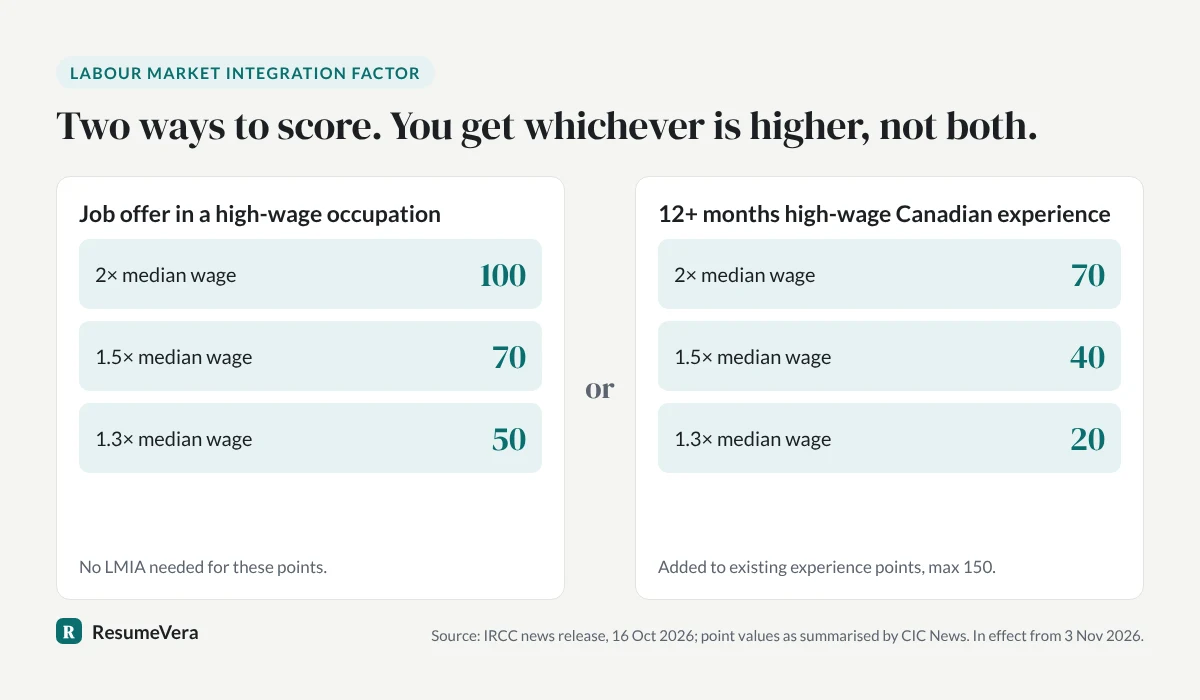
A job offer in a 2x occupation earns 100 points, in a 1.5x occupation 70 points, and in a 1.3x occupation 50 points.
High-wage Canadian work experience of at least 12 months earns 70, 40 or 20 points by the same three tiers.
The experience points are added to the points you already get for length of Canadian experience, which go up to 80 for five years, for a maximum of 150 in that sub-factor.
You receive whichever of the two sub-factors scores higher, not both.
Why the experience route can beat an offer
The experience sub-factor is not just 70, 40 or 20. It is that number plus your existing Canadian experience points, capped at 150.
So someone with several years of Canadian work in a high-wage occupation can score more through experience than through any job offer, because a job offer tops out at 100.
If you are already in Canada on a work permit, check both numbers before you chase an offer.
Is my NOC code on the high-wage list?
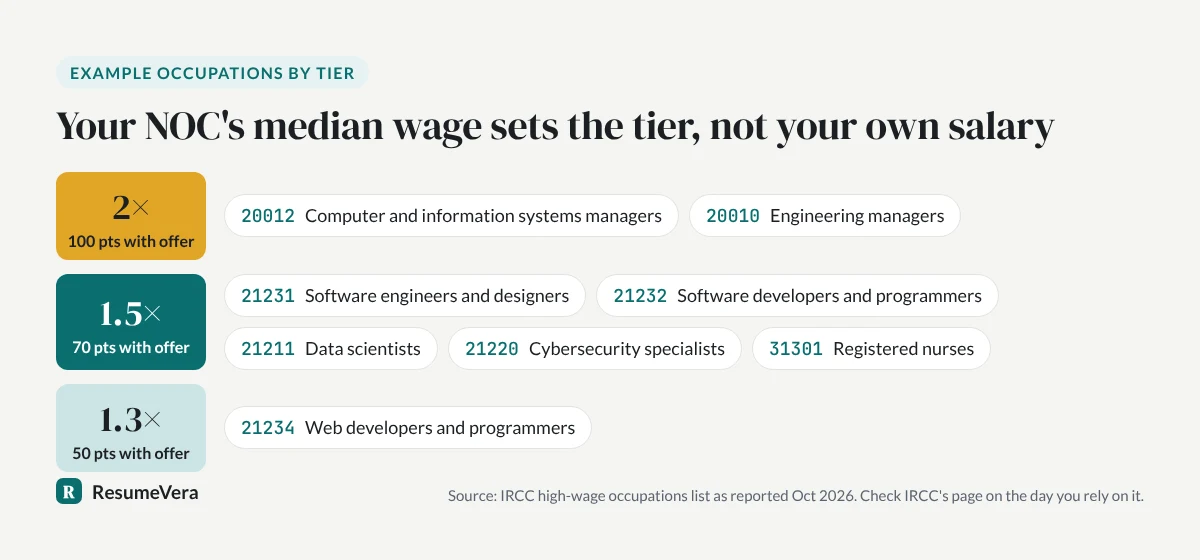
IRCC publishes the list on its high-wage occupations page. Here is where some of the most searched occupations sit as of 3 November 2026.
Your NOC, your tier
| NOC code | Occupation | Tier | Job offer points |
|---|---|---|---|
| 21234 | Web developers and programmers | 1.3x | 50 |
| 21231 | Software engineers and designers | 1.5x | 70 |
| 21232 | Software developers and programmers | 1.5x | 70 |
| 21211 | Data scientists | 1.5x | 70 |
| 21220 | Cybersecurity specialists | 1.5x | 70 |
| 31301 | Registered nurses | 1.5x | 70 |
| 20012 | Computer and information systems managers | 2x | 100 |
| 20010 | Engineering managers | 2x | 100 |
Note the split inside tech. Web developers and programmers (21234) sit in the 1.3x tier, while software developers and programmers (21232) and software engineers and designers (21231) sit in the 1.5x tier. That is a 20-point difference on a job offer between two codes many people treat as interchangeable.
How is the list built, and can it change?
IRCC builds the list from Job Bank, Labour Force Survey and Census data from the previous three years, according to its backgrounder.
Each occupation gets the highest tier it reached in any of those three years.
IRCC says the list will be maintained and updated. So a tier can move.
The rule that protects you: if you receive an Invitation to Apply (ITA), you are assessed against the list in force on the date of your ITA. A later change does not reach back.
The practical advice is simple. Check your NOC's tier on IRCC's page on the day you rely on it, whether that is the day you accept an offer, update your profile or plan around a draw. Do not rely on a screenshot, including the table above.
Choosing the right NOC is a resume question too
Your tier depends on the occupation your duties actually match, not your job title. If your title says "web developer" but your work is software engineering, the difference is 20 points on an offer, and it has to be supported by what you actually did.
We cover how to match duties to a NOC, without stretching them, in our guide to aligning your resume with your NOC code. The common errors that cause trouble later are in Express Entry resume mistakes to avoid.
Check your resume reads like the occupation you are claiming. Our free resume checker gives an AI estimate of how clearly your duties and keywords come through. It is not an IRCC assessment and does not predict an outcome.
Worked examples: what would you actually get?
These use the point values above. They show the Labour Market Integration Factor only, not your full CRS score.
Example A: software developer with a job offer
Priya is a software developer and programmer (NOC 21232, 1.5x tier) outside Canada. She has a genuine offer from a Canadian employer in that occupation, with no LMIA.
Her job offer is worth 70 points. She has no Canadian experience, so the experience sub-factor gives her nothing. Result: 70 points.
Example B: the same developer, already working in Canada
Now say Priya has worked in Canada as a software developer for more than 12 months, and also holds a qualifying offer.
Her two options:
- Job offer sub-factor: 70 points.
- Experience sub-factor: 40 points for high-wage Canadian experience in a 1.5x occupation, plus her existing points for length of Canadian experience.
She gets the higher of the two, not both. If her existing Canadian experience points are above 30, the experience route beats the offer. If they are 30 or below, the offer wins or ties.
The takeaway: look up your current Canadian experience points in your profile before you assume an offer is your best lever.
Example C: engineering manager with an offer
Arjun is an engineering manager (NOC 20010, 2x tier) with a genuine Canadian job offer. His offer is worth 100 points, the maximum for the job offer sub-factor.
If Arjun later works in Canada in that occupation for 12 months or more, his experience sub-factor would be 70 plus his existing Canadian experience points, up to 150. Over time that can overtake the 100 from the offer.
Example D: the near miss
Sam is a web developer and programmer (NOC 21234, 1.3x tier). A job offer earns 50 points. If Sam's real duties match software developers and programmers (21232), the honest NOC is 21232 and the offer would be worth 70. If they do not, 21234 is the right code and 50 is the right number. Picking a code for the points is how applications get into trouble.
I am already in the Express Entry pool. What do I need to do?
You do not need to re-apply. IRCC is recalculating scores for candidates already in the pool, according to its news release.
IRCC is pausing invitations while it recalculates, which it says "may take up to two weeks".
Do one thing now: make sure the job offer details in your profile are accurate. The recalculation can only use what your profile says.
A short checklist
- Find your NOC code on IRCC's high-wage occupations page and note its tier today.
- Check that the job offer details in your profile (employer, occupation, terms) match the real offer.
- Confirm your Canadian work experience dates and occupation, since 12 months of high-wage experience is the threshold.
- Compare your two sub-factor totals and know which one applies to you.
- Watch for the end of the invitation pause before expecting a draw.
Looking for a job offer in a high-wage occupation?
An offer is now worth more if it sits in the right NOC, and the LMIA step is gone for these points. That makes the employer side of the search easier to start, though not easy.
Three places to begin:
- Employers that have hired foreign workers before are warm leads. Our list of Canadian employers with an LMIA history shows who has done it.
- Job Bank and LinkedIn behave differently for newcomers. We compare them in Job Bank vs LinkedIn for a Canada job search.
- Canadian employers expect a Canadian-style resume. Use our Canada resume format guide before you send anything.
See what a Canadian salary looks like after tax. Before you weigh an offer, run the numbers through our free take-home pay calculator.
I am on an H-1B in the US. Should I look at Canada?
If you work in software engineering, software development, data science, cybersecurity or engineering management, your occupation is among the examples on the high-wage list above.
The facts that matter for you are the same as for anyone else:
- Your tier comes from your NOC code, not your US salary.
- US work experience is not Canadian work experience, so the experience sub-factor will not apply until you have worked in Canada for at least 12 months in a high-wage occupation.
- That means a genuine Canadian job offer is the realistic route to these points from the US, worth 50, 70 or 100 depending on the occupation.
- No LMIA is needed for the offer to count under the new factor.
Compare offers on take-home pay, not headline salary. Our Canada take-home pay calculator helps with the Canadian side.
If you are weighing Canada because of a layoff, your US clock matters first. Read our guide to the H-1B grace period after a layoff before you make plans. If you are staying and applying in the US for now, our US resume format guide covers what American employers expect.
What is Canada's immigration levels plan for 2027?
Levels Plan 2027-2029: status
Last checked: 3 November 2026.
Under the Immigration and Refugee Protection Act, the plan is due by 1 November, or within 30 sitting days. As of 3 November 2026, IRCC's levels page still shows the 2026-2028 plan.
On 16 October 2026, Immigration Minister Lena Metlege Diab said: "We will be announcing our immigration levels plan in November as it's scheduled and has been scheduled for decades" (Canadian Press, via CP24).
Finance Minister François-Philippe Champagne has said Budget 2026 will be released on 5 November 2026.
We are not publishing predicted 2027-2029 numbers. Nobody outside government has them yet.
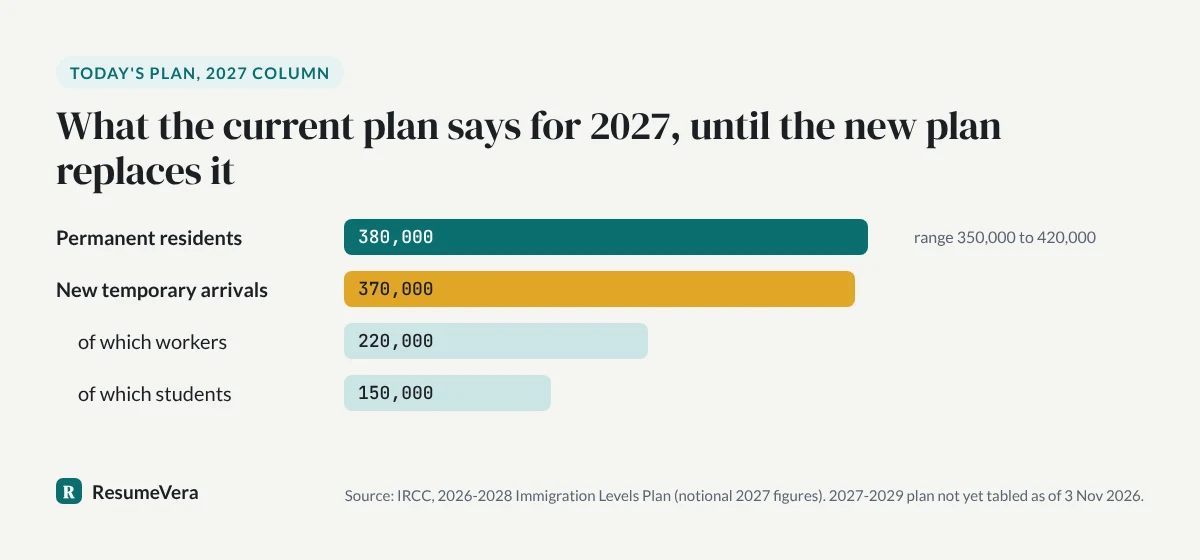
Until the new plan appears, the only official 2027 figures are the notional ones in the current 2026-2028 plan, published in IRCC's supplementary information for the 2026-2028 levels plan.
| 2027 category (current plan, notional) | Figure |
|---|---|
| Permanent residents (target) | 380,000 |
| Permanent residents (range) | 350,000 to 420,000 |
| Federal High Skilled | 111,000 |
| New temporary arrivals | 370,000 |
| of which workers | 220,000 |
| of which students | 150,000 |
The current plan's notional 2027 target is 380,000 permanent residents, within a range of 350,000 to 420,000.
Of those, 111,000 are under Federal High Skilled.
The same plan sets 370,000 new temporary arrivals for 2027: 220,000 workers and 150,000 students.
Why temporary resident numbers matter here
The government aims to bring non-permanent residents below 5% of the population by the end of 2027.
Statistics Canada's The Daily (23 September 2026) reported 2,779,774 non-permanent residents on 1 July 2026, "or 6.7% of the total population".
That was down 154,614 year on year, and below the peak of 7.2% on 1 October 2024.
Read together with the Express Entry change, the direction is clear: fewer temporary residents overall, and permanent residence steered towards higher-wage work. How that shows up in 2027-2029 targets is not yet known.
What happens next
- From 3 November 2026: IRCC's invitation pause while scores are recalculated, which it says "may take up to two weeks". We will note when invitations resume.
- 5 November 2026: Budget 2026 is due. We will check it for anything affecting Express Entry or levels.
- November 2026: the Immigration Minister has said the 2027-2029 levels plan will be announced in November. When it is tabled, we will replace the notional 2027 figures above and update the status box.
- Whenever IRCC updates the high-wage list: we will update the NOC table. Until then, treat IRCC's page as the only authority on your tier.
Is this legal advice?
No. This is general information, not legal advice. Your points depend on your full profile and on IRCC's assessment of your offer and experience. If your case is complex, for example a disputed NOC, a job offer you are unsure about, or mixed Canadian and foreign experience, speak to a Regulated Canadian Immigration Consultant (RCIC) or a Canadian immigration lawyer.
Sources
- IRCC, news release: Canada refocusing Express Entry on top talent that drives economic growth, 16 October 2026
- IRCC, backgrounder: Changes to Express Entry for high-wage occupations, October 2026
- IRCC, Express Entry high-wage occupations page, accessed 3 November 2026
- IRCC, Supplementary information for the 2026-2028 immigration levels plan, accessed 3 November 2026
- IRCC, Immigration levels plan page, accessed 3 November 2026
- Statistics Canada, The Daily, 23 September 2026
- CIC News (secondary summary of IRCC's release), October 2026
- Canadian Press via CP24, Immigration Minister Lena Metlege Diab on the levels plan timing, 16 October 2026
Written and checked by ResumeVera Editorial Team. How we research and review
Questions
Frequently asked questions
Get free ATS tips every week
Actionable resume and ATS tips, when we publish them. No spam. Unsubscribe any time.
Related Articles
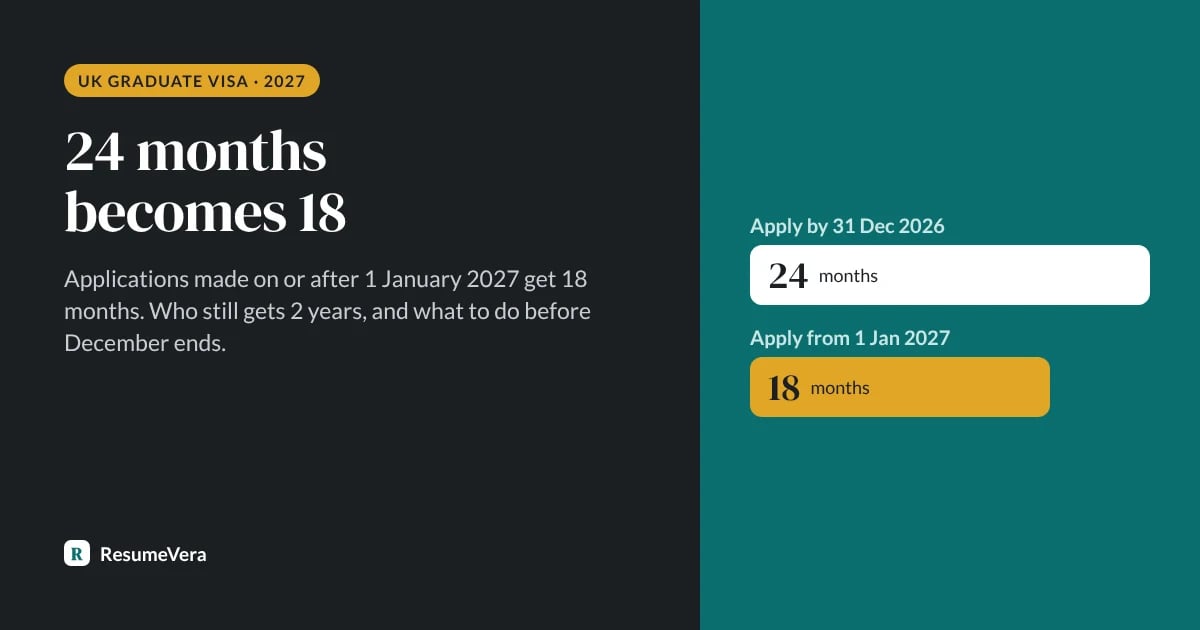
UK Graduate visa cut to 18 months from 1 January 2027: apply by 31 December for 2 years
The UK Graduate visa drops to 18 months for applications made on or after 1 January 2027. Here is who still gets two or three years, a decision table for the December deadline, what the Budget 2026 promise does and does not change, and a 90-day plan for your Skilled Worker job search.
Read More
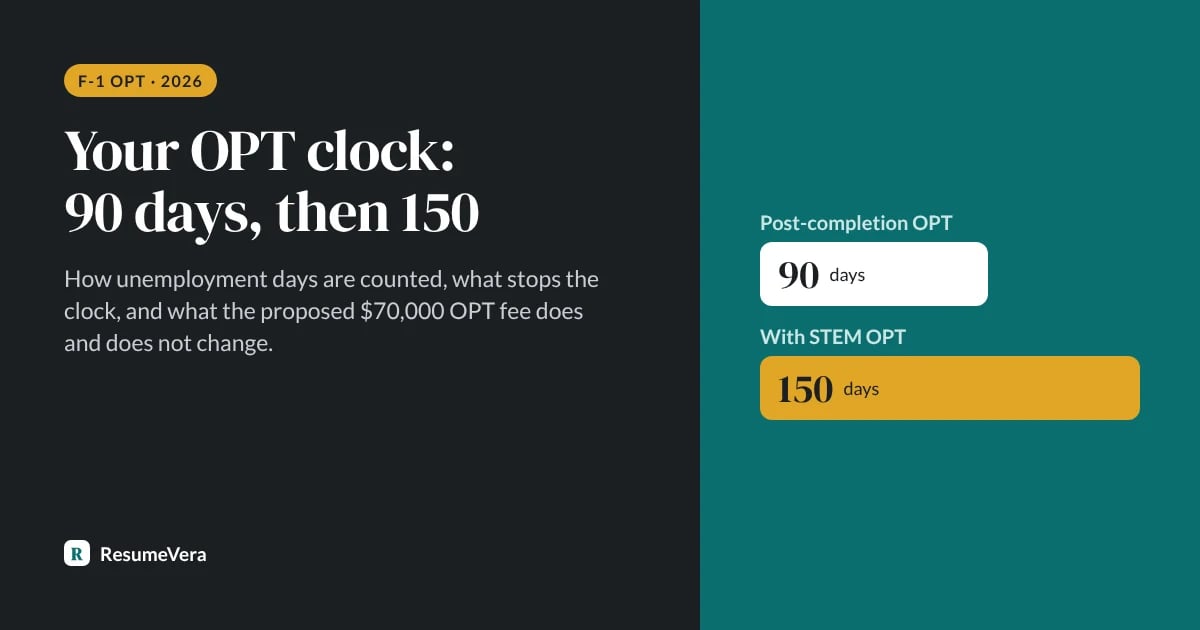
OPT unemployment days in 2026: the 90 and 150-day limits and the proposed $70,000 fee
Post-completion OPT allows 90 days of unemployment in total; STEM OPT raises that to 150, including any of the 90 you have left. Here is how the days are counted, what work stops the clock, worked examples, a 30-day job-search sprint, and where the proposed $70,000 OPT fee stands.
Read More
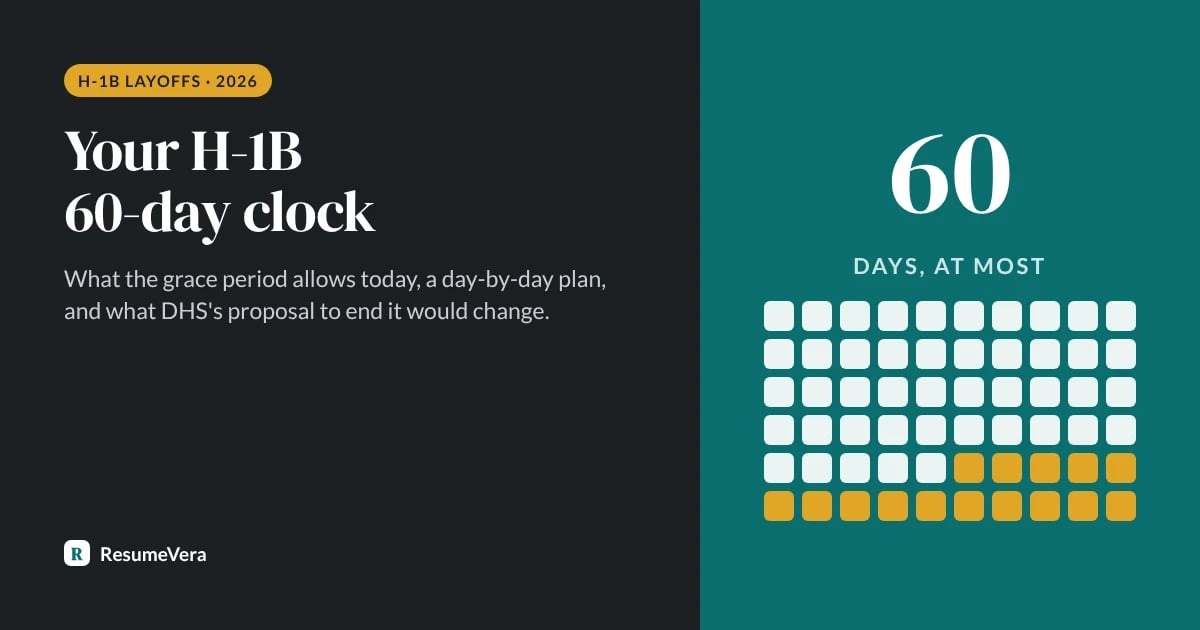
Laid off on an H-1B in 2026: your 60-day grace period and DHS's plan to end it
Laid off on an H-1B? You can generally stay up to 60 days, or until your I-94 ends if sooner, to transfer, change status or leave. DHS proposed ending the grace period on 11 September 2026, but it is not in force. Here is a day-by-day plan with worked date examples.
Read More
Try it
Check this against your own resume
The post above is general. Your file is not. The checker reads it the way a parser would and tells you which of these points it actually breaks.
Check your resume free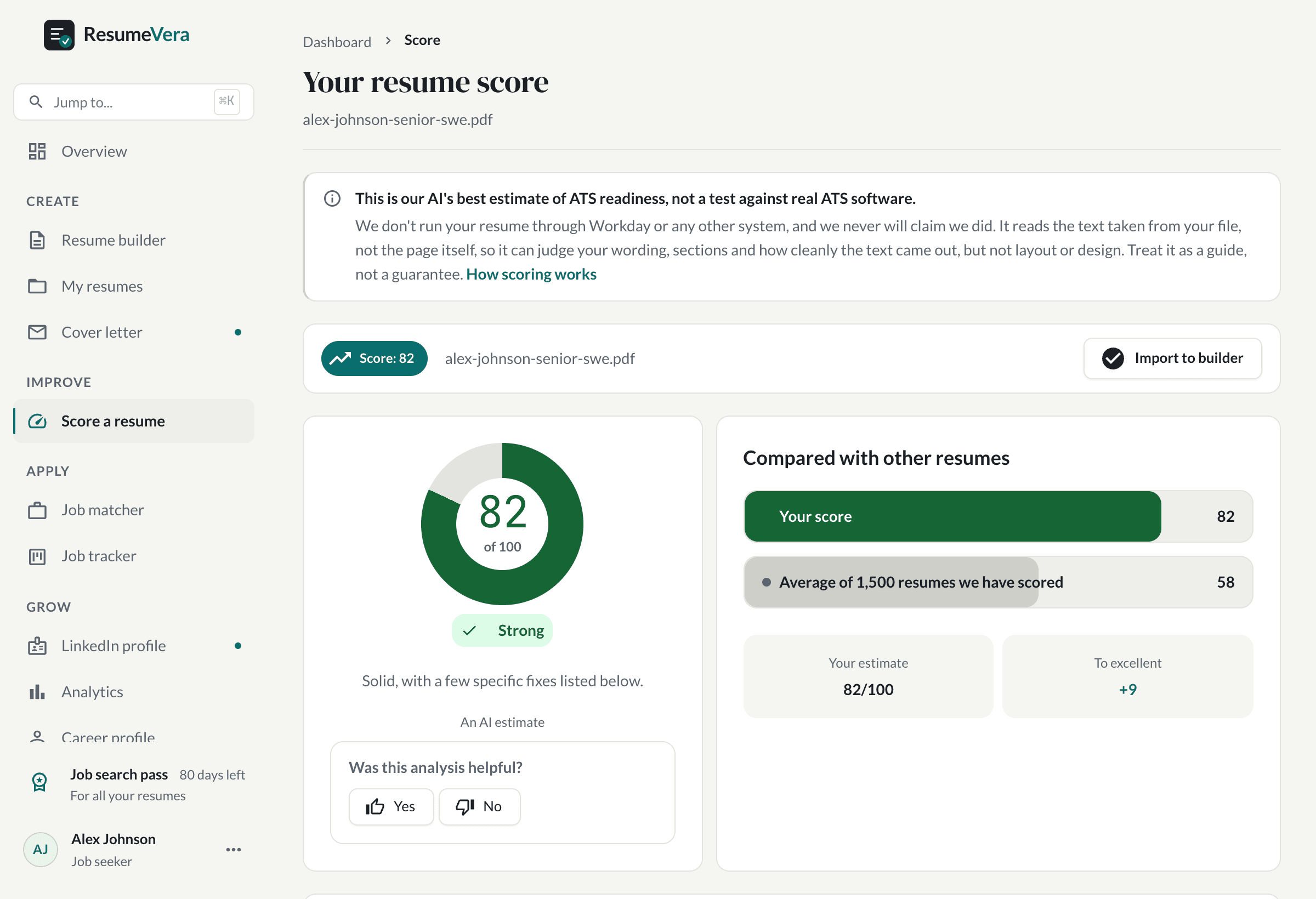
The real score page, with a sample resume and sample scores.
Now check it against your own resume
An honest resume score in seconds. No account, no card.