UK Graduate visa cut to 18 months from 1 January 2027: apply by 31 December for 2 years
Job Search · ResumeVera Editorial Team · November 3, 2026 · 11 min read
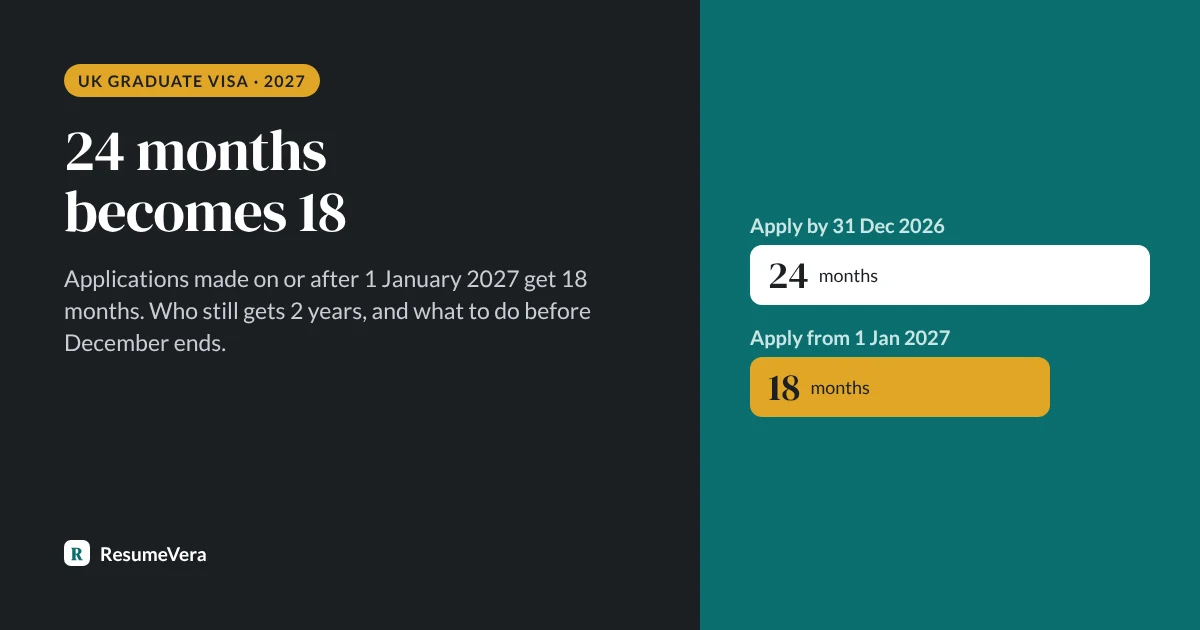
Short answer: Graduate visa applications submitted on or after 1 January 2027 get 18 months, not two years, under the statement of changes HC 1333 (14 October 2025). Apply on or before 31 December 2026 and you still get two years. PhD graduates keep three years either way. Your application date is what counts.
Last reviewed: 3 November 2026. We update this page when the rules change.
If you are finishing a UK degree this year, the calendar now matters more than it used to. Six months of post-study work time depends on which side of midnight on 31 December 2026 your application lands.
This guide covers what the rule actually says, who still gets two or three years, a decision table for the December deadline, and a 90-day plan for anyone who ends up on 18 months and needs a sponsored job sooner.
What exactly changes on 1 January 2027?
The Graduate route is being cut from two years to 18 months by the statement of changes to the Immigration Rules HC 1333, laid on 14 October 2025. This is already part of the Immigration Rules, not a consultation or a proposal.
The government explained the timing in paragraph 5.26 of the Explanatory Memorandum to HC 1333:
"The change to 18 months will apply to applications submitted on or after 1 January 2027, with PhD graduates continuing to receive three years of leave."
Two things follow from that sentence. The cut applies to new applications, not to people who already hold a Graduate visa. And doctoral graduates are outside it entirely.
The application date is what counts, not your course end date
The rule is tied to when you submit your Graduate visa application. When your course finished, when your dissertation was marked, and when your graduation ceremony takes place do not decide which length you get.
So a student who finished in September but waits until January to apply gets 18 months. A student who finished later but gets an application in before the end of December gets two years. If you are eligible to apply now, the safest move is not to wait.
A note on "HC 584"
Some websites cite "HC 584" as the statement that made this change. That is wrong. The correct reference is HC 1333, dated 14 October 2025. If an adviser, agent or article quotes HC 584 for the 18-month rule, treat the rest of what they say with some care too.
Who still gets two years, or three?
Based on the rules in force today, three groups are worth separating:
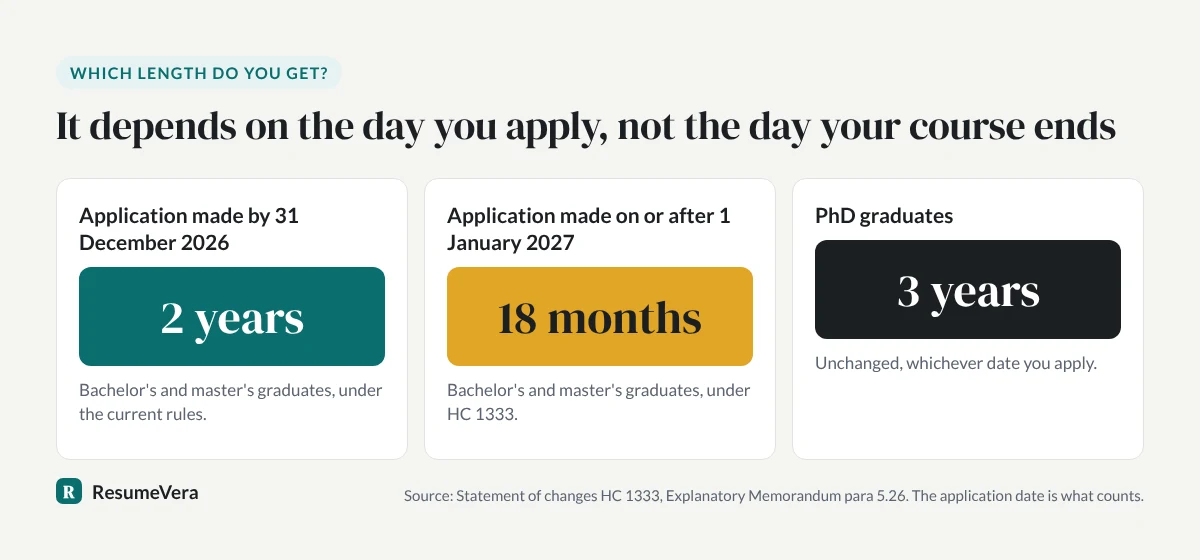
- Anyone who applies on or before 31 December 2026 and meets the Graduate route requirements: two years.
- PhD graduates, whenever they apply: three years. HC 1333 leaves this unchanged.
- Everyone else applying on or after 1 January 2027: 18 months.
There is a possible fourth group, which is where most of the confusion online comes from.
What the Budget 2026 promise says, and what it does not
The Budget 2026 document (HC 726), published on 28 October 2026, says the government will "increase the duration of the Graduate visa to two years for graduates from high compliance universities where there are strong labour market outcomes".
As of 3 November 2026, no change to the Immigration Rules has been laid to put this into effect. No list of qualifying universities has been published. There is no definition yet of "high compliance" or "strong labour market outcomes" for this purpose, and no start date.
That makes it a policy promise, not law. You cannot apply under it, and you should not plan on it. If you can apply before 31 December 2026, do not hold back in the hope that your university will make a list that does not yet exist.
What is law and what is only announced?
Here is the status of each change, as of 3 November 2026.
| Change | Status | Source |
|---|---|---|
| Graduate visa cut to 18 months for applications from 1 January 2027 | Law (in the Immigration Rules) | HC 1333, 14 October 2025 |
| PhD graduates keep three years | Law (in the Immigration Rules) | HC 1333, para 5.26 |
| Two years for graduates of high compliance universities | Announced only, no rules laid, no list published | Budget 2026, 28 October 2026 |
| Most Immigration Salary List and Temporary Shortage List entries removed at end of 2026 | Law (set out in HC 997) | HC 997 Explanatory Memorandum |
If you read a claim that is not in this table, check it against GOV.UK before acting on it.
Should you apply before 31 December 2026?
For most eligible graduates, yes. The only thing you gain by waiting is a shorter visa. The table below covers the common situations.
| Your situation | Can you apply before 1 January? | What to do |
|---|---|---|
| Course finished and your university has reported completion to the Home Office | Yes | Apply now. Applying on or before 31 December 2026 gets you two years. |
| Still waiting for results, or your university has not yet reported completion | Only once completion is reported | Ask your university when it will report. If that happens in 2026, apply straight away. If it slips into 2027, you will get 18 months. |
| Student leave ends before January | Yes, and you must | You have to apply while your Student leave is still valid, so you will be applying in 2026 anyway. Do not leave it to the last week. |
| PhD graduate | Yes | No deadline pressure from this change. You get three years whether you apply in 2026 or 2027, as long as you apply while your Student leave is valid. |
| Planning to travel over the winter break | Only from inside the UK | You apply from inside the UK. If you want two years, apply before you travel, and check the GOV.UK guidance on travel while an application is pending before you book. |
The basic eligibility checks
The general requirements on GOV.UK are short, but each one can trip you up close to a deadline:
- You apply from inside the UK.
- Your Student (or Tier 4) leave must still be valid on the day you apply.
- Your university must have told the Home Office that you have successfully completed your course.
You cannot extend a Graduate visa, so the length you are granted is the length you have. Requirements change, so read the current GOV.UK page yourself before you apply rather than relying on this summary or on a friend who applied last year.
The step most people miss
The completion report is out of your hands. Universities report on their own schedule, and December has holidays in it. Email your university's international student team now, ask when your completion will be reported, and ask whether it can be done before the December closure. That single email decides whether you get two years or 18 months.
How many people does the Graduate visa cut affect?
A lot of people, and a large share of them are Indian nationals. The Home Office's Why do people come to the UK? Study release for the year ending June 2026 gives these figures.
| Measure (year ending June 2026) | Figure |
|---|---|
| Graduate route grants, including dependants | 157,356 |
| Change on the previous year | Down 39% |
| Grants to Indian nationals | 64,495 |
| Indian share of all grants (ResumeVera calculation) | About 41% |
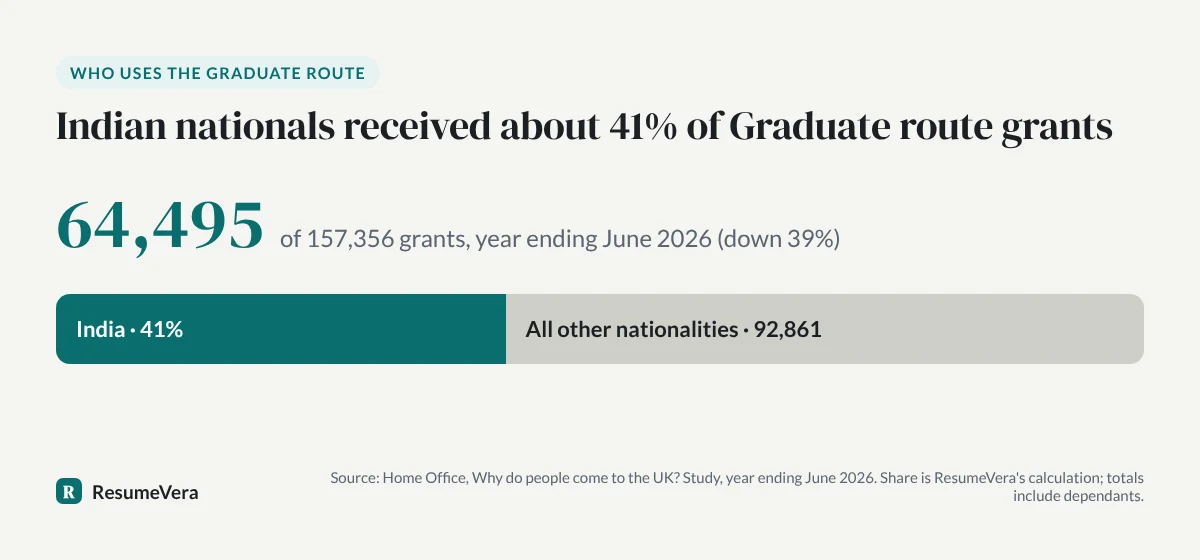
There were 157,356 Graduate route grants in the year ending June 2026, down 39% on the previous year. Indian nationals received 64,495 of them.
The 41% figure is our own calculation, dividing 64,495 by 157,356. The Home Office total includes dependants, so it is a share of grants, not a share of graduates.
If you are an Indian graduate
The 18-month clock hits hardest if you arrived planning to use the first year to settle in and the second to find a sponsored role. That second year is now half as long.
The practical gap we see most often is the CV itself. An Indian-format resume with a photo, date of birth and a long objective statement reads oddly to UK recruiters. Our guide on turning an Indian resume into a UK CV walks through the changes line by line.
What does 18 months mean for your Skilled Worker plan?
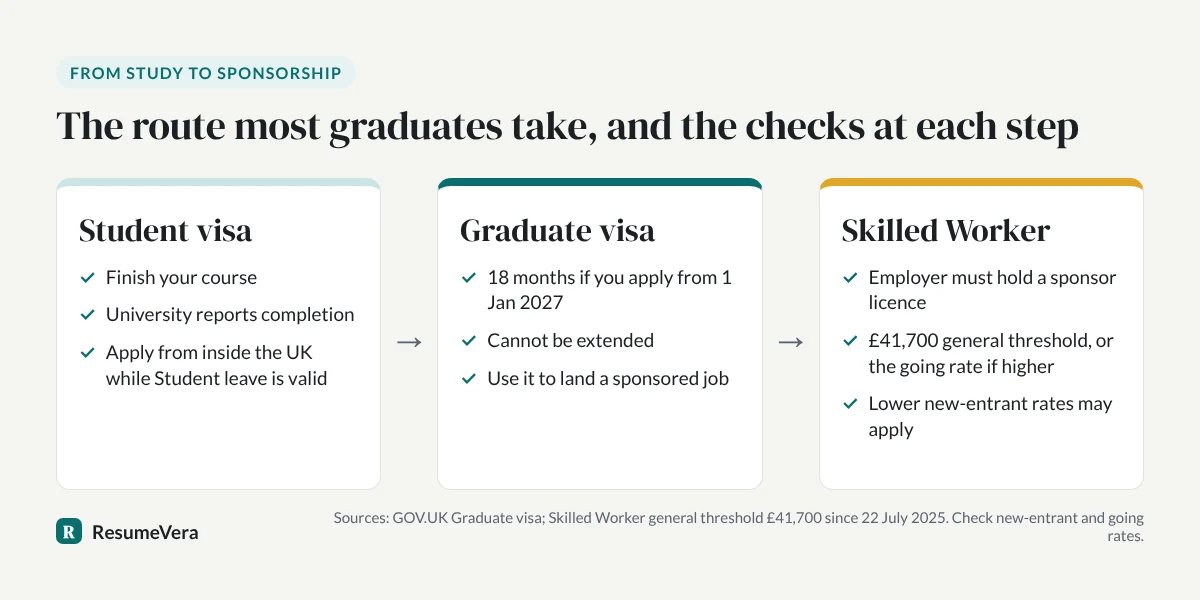
For most graduates, the Graduate visa is a bridge. The destination is the Skilled Worker route, which needs a job offer from a licensed sponsor at or above the relevant salary. A shorter bridge means less time to find that offer.
The salary you need to clear
The Skilled Worker general salary threshold has been £41,700 a year since 22 July 2025, or the going rate for your occupation if that is higher.
Lower "new entrant" rates apply to some applicants, including people switching from the Graduate route. That matters, because it can bring a graduate-level role within reach. The rates differ by occupation, so we keep them in one place: see our Skilled Worker salary threshold guide with current new-entrant and going rates.
When you compare offers, look at what the salary is worth after tax as well as whether it clears the threshold. Our UK take-home pay calculator shows the monthly figure.
Shortage lists are shrinking at the end of 2026
Under HC 997, most Immigration Salary List and Temporary Shortage List entries are set to be removed at the end of 2026.
Separately, the Migration Advisory Committee's Temporary Shortage List Stage 2 report (23 July 2026) recommended 28 occupations. That is a recommendation from an advisory body. Check which occupations the government has actually kept before you assume yours is on a list.
If you were counting on a shortage-list role to make the salary maths work, check again now rather than in the middle of your job search.
Only licensed sponsors count
A job offer only leads to a Skilled Worker visa if the employer holds a sponsor licence. The Home Office publishes the register of licensed sponsors. Our UK visa sponsor checker lets you search it by employer name before you spend time on an application.
A 90-day plan for graduates on an 18-month visa
With 18 months, the first three months matter more. The aim is to have your CV, target list and salary checks done early, so the rest of your visa is spent applying and interviewing, not preparing. The same plan works if you get two years, it just buys you more room.
Days 1 to 30: fix the CV and build a sponsor list
- Rewrite your CV for UK readers. Keep it short, with no photo and no personal details beyond contact information. Start from our UK CV format guide, and if you are aiming at sponsored roles, read how to write a CV for a Skilled Worker visa job.
- Run it through a checker. Use the free ResumeVera resume checker (linked below) to catch missing keywords and formatting problems. The score is an AI estimate, not a test by a real applicant tracking system, so use it as a second pair of eyes.
- Build a list of target employers that hold a sponsor licence. Search each one in the sponsor checker. Drop any that are not on the register.
- Decide your two or three target job titles. You need these to check salary rules in the next step.
Days 31 to 60: check the salary maths and start applying
- Check each target role against the salary rules. Look up the going rate and any new-entrant rate for the occupation. If a typical offer for that role sits below what you would need, it is a poor bet for sponsorship.
- Apply in batches and tailor each application. One tailored application is worth more than several generic ones.
- Track everything. Log the employer, role, date, contact and next step in a job application tracker, so follow-ups do not slip.
- Ask about sponsorship at the right time. Confirm the employer can sponsor before final rounds, not after an offer.
Days 61 to 90: review and adjust
- Look at your tracker. Which titles and employers are getting replies? Put more effort there.
- Revise the CV for the roles that are responding, and drop the ones that are not.
- Work out your remaining time. Count back from your visa end date, and leave enough room for the employer's sponsorship steps and your own switch application.
Get your UK CV ready this week. The resume checker is free to use and gives you an AI estimate of how your CV reads against a job description, with specific fixes. It cannot promise interviews, but it will show you what is missing.
What happens next
These are the dates and events that will change this advice. We will update this page when each one happens.
- 31 December 2026: the last day to submit a Graduate visa application and receive two years, under HC 1333.
- End of 2026: most Immigration Salary List and Temporary Shortage List entries are set to be removed, under HC 997.
- 1 January 2027: applications from this date receive 18 months. PhD graduates still receive three years.
- When the government lays rules for the Budget 2026 promise: we will add what "high compliance universities" means, which universities qualify, and from when.
- When the Skilled Worker thresholds or new-entrant rates change: we update the salary threshold guide first, and this page links to it.
Check an employer before you apply. Search any organisation by name to see whether it holds a Skilled Worker sponsor licence. Free to use, no account needed.
This is general information, not legal advice. Immigration rules change and individual cases differ. Before you apply, speak to your university's international student advice team or an OISC-regulated immigration adviser, and check the current requirements on GOV.UK.
Sources
- Home Office, Explanatory Memorandum to the statement of changes HC 1333, 14 October 2025
- Home Office, Statement of changes to the Immigration Rules HC 1333, 14 October 2025
- UK Government, Budget 2026 (HC 726), 28 October 2026
- Home Office, Explanatory Memorandum to the statement of changes HC 997
- Migration Advisory Committee, Temporary Shortage List Stage 2 report, 23 July 2026
- Home Office, Why do people come to the UK? Study, year ending June 2026
- GOV.UK, Graduate visa
- Home Office, Register of licensed sponsors: workers
Written and checked by ResumeVera Editorial Team. How we research and review
Questions
Frequently asked questions
Get free ATS tips every week
Actionable resume and ATS tips, when we publish them. No spam. Unsubscribe any time.
Related Articles
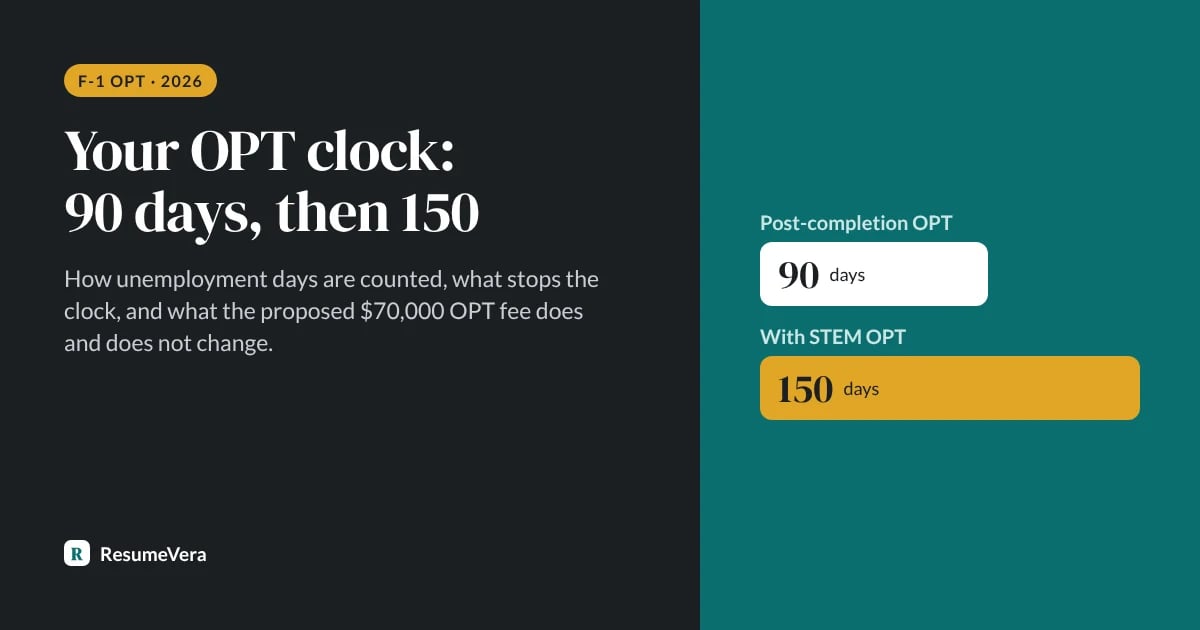
OPT unemployment days in 2026: the 90 and 150-day limits and the proposed $70,000 fee
Post-completion OPT allows 90 days of unemployment in total; STEM OPT raises that to 150, including any of the 90 you have left. Here is how the days are counted, what work stops the clock, worked examples, a 30-day job-search sprint, and where the proposed $70,000 OPT fee stands.
Read More
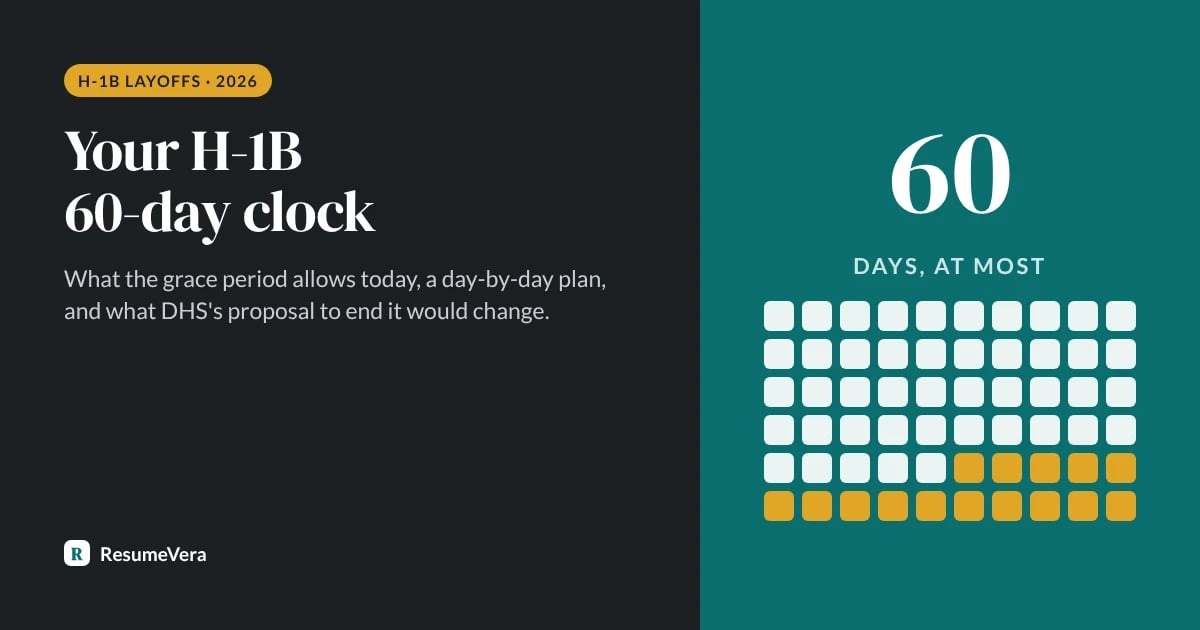
Laid off on an H-1B in 2026: your 60-day grace period and DHS's plan to end it
Laid off on an H-1B? You can generally stay up to 60 days, or until your I-94 ends if sooner, to transfer, change status or leave. DHS proposed ending the grace period on 11 September 2026, but it is not in force. Here is a day-by-day plan with worked date examples.
Read More
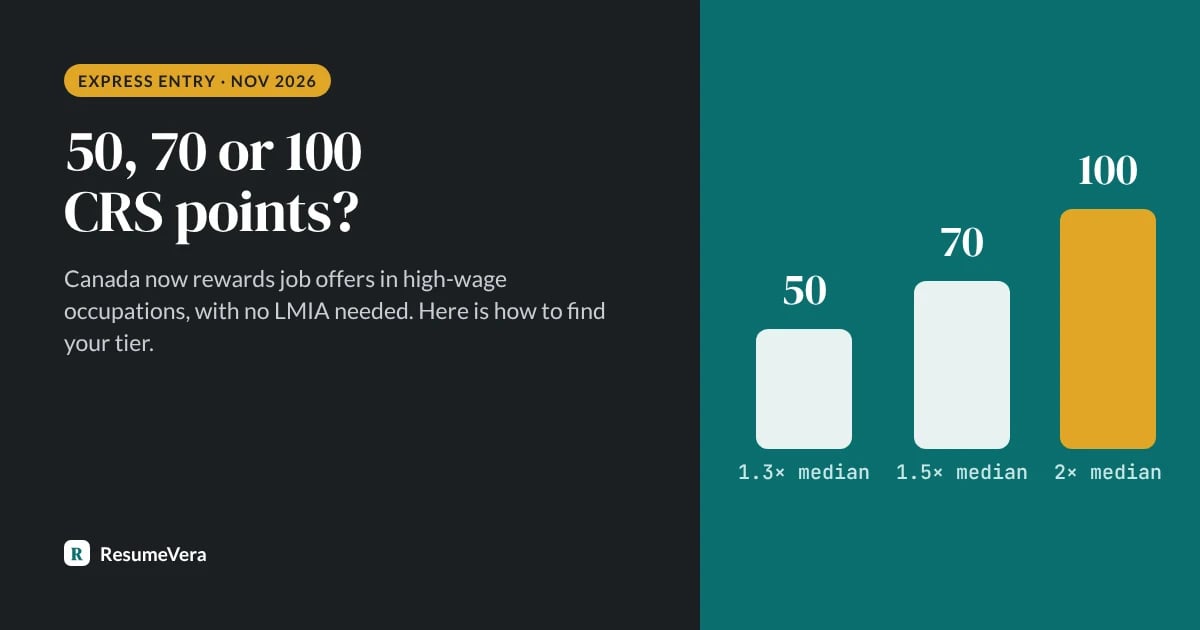
Canada's new Express Entry high-wage points: is your job worth 50, 70 or 100 CRS points?
Since 3 November 2026, Express Entry rewards work in 186 high-wage occupations. Here are the 50, 70 and 100 point tiers, where common NOC codes sit, worked examples, and the status of Canada's 2027-2029 levels plan.
Read More
Try it
Check this against your own resume
The post above is general. Your file is not. The checker reads it the way a parser would and tells you which of these points it actually breaks.
Check your resume free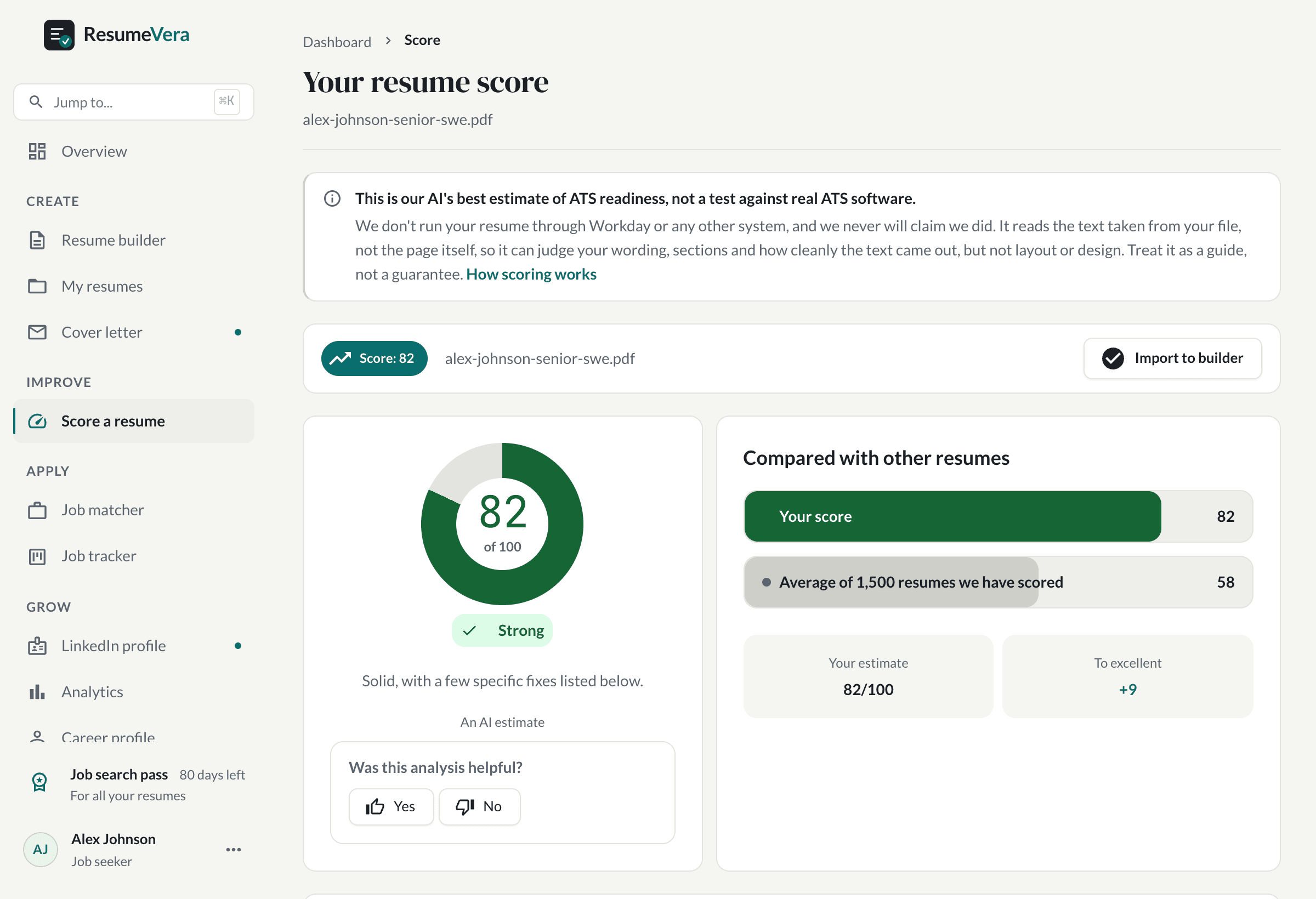
The real score page, with a sample resume and sample scores.
Now check it against your own resume
An honest resume score in seconds. No account, no card.