Laid off on an H-1B in 2026: your 60-day grace period and DHS's plan to end it
Job Search · ResumeVera Editorial Team · November 3, 2026 · 13 min read
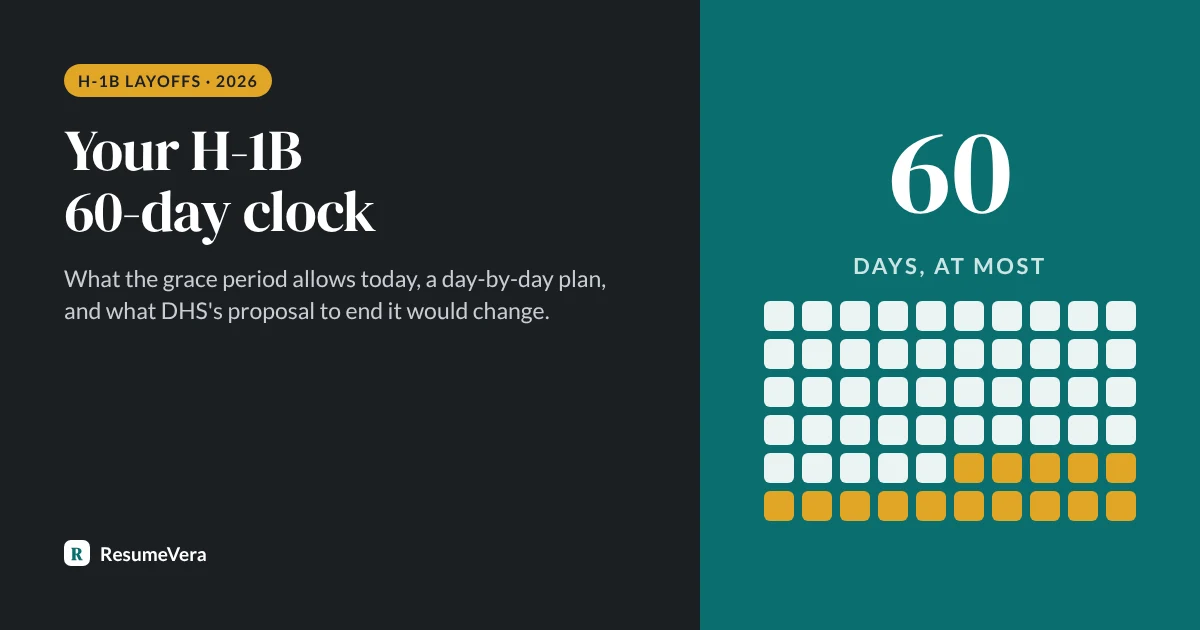
Short answer: If your H-1B job ends, you can generally stay for up to 60 consecutive days, or until your I-94 ends if sooner, to have a new employer file, change status or leave (8 CFR 214.1(l)(2)). DHS proposed ending this on 11 September 2026. It is not in force, so today's 60-day rule still applies.
Last reviewed: 3 November 2026. We update this page when the rules change.
If you were laid off this week, the most useful thing you can do today is write down two dates: your last day of employment and the end date on your I-94. Everything else in this guide hangs off those two dates.
Below you will find how the grace period works right now, a day-by-day plan for the 60 days, two worked examples with the dates counted out, and what the DHS proposal to remove the grace period would change if it became final. We also cover the rest of the 2026 H-1B picture briefly, so you know which headlines affect a transfer and which do not.
What is the H-1B 60-day grace period?
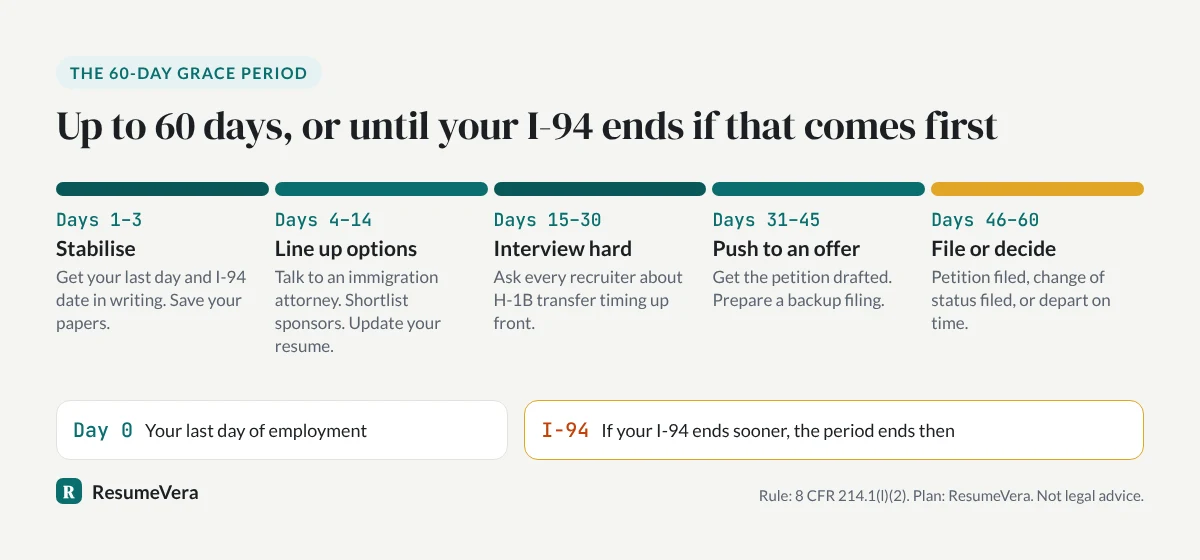
Under 8 CFR 214.1(l)(2), H-1B workers and certain other workers whose employment ends can be given a grace period of up to 60 consecutive days, or until the end of their authorized validity period if that is sooner.
The point of the grace period is to give you time to do one of three things: find a new employer to file for you, change to another status, or depart the US.
The four details people miss
- It is discretionary. The regulation says you may be given the grace period. It is not an automatic right, which is why acting early matters.
- Your I-94 can cut it short. The grace period ends at 60 days or at the end of your authorized validity period (the date on your I-94), whichever comes first.
- You get one per validity period. The rule allows one grace period per authorized validity period, so a second layoff inside the same validity period may leave you with no grace period at all.
- Leaving the US ends it. If you travel abroad during the grace period, the grace period is over.
You may not work during the grace period unless you have some other work authorization. Looking for work, interviewing and accepting an offer are fine. Doing paid work for a new employer before you are allowed to is not.
H-1B laid off: what are your options?
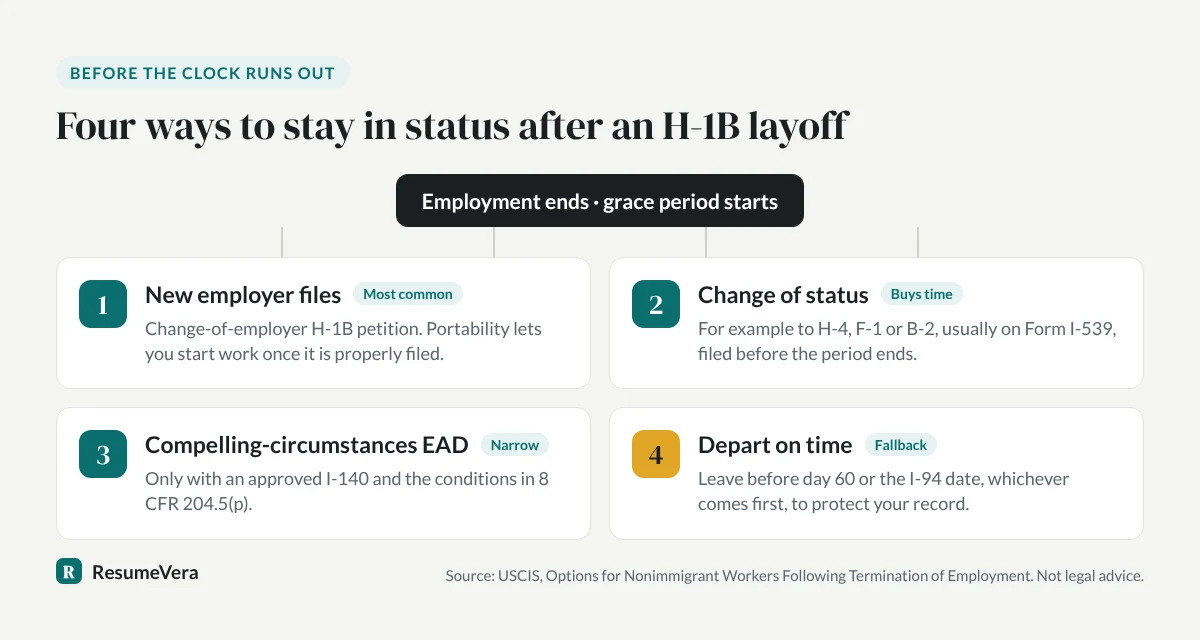
USCIS sets out the options in its guidance, Options for Nonimmigrant Workers Following Termination of Employment. There are four, and you can work on more than one at the same time.
1. A new employer files an H-1B petition for you
A new employer can file a non-frivolous petition for new employment within the grace period. This is the route most people want.
H-1B portability lets you start working for the new employer once the change-of-employer petition is properly filed. You do not have to wait for the approval to begin work.
2. Change to another status
You can file to change to another status, for example H-4 (if your spouse holds H-1B), F-1 (if you are going back to study) or B-2 (visitor), using Form I-539 where that form applies.
A change of status can buy you time to keep searching, but it changes what you are allowed to do. On B-2 or F-1 you are not an H-1B worker, so check with an attorney how you would move back to H-1B before you file.
3. A compelling-circumstances EAD
If your employer had already filed and won approval of an I-140 immigrant petition for you, you may be able to apply for a compelling-circumstances employment authorization document. The conditions are in 8 CFR 204.5(p), and you must meet all of them.
This route only exists for people with an approved I-140. If your green card process had not reached that stage, skip it.
4. Depart the US within the grace period
Leaving before the grace period ends keeps you from falling out of status. That matters if you want to come back on a new H-1B later. Departing on time is a plan, not a failure.
What can and cannot you do during the grace period?
| You can | You cannot |
|---|---|
| Stay in the US for up to 60 days, or until your I-94 ends if sooner | Work for pay without other work authorization |
| Apply, interview and accept a job offer | Travel abroad and keep the grace period (leaving ends it) |
| Start work for a new employer once its petition is properly filed (portability) | Count on a second grace period in the same validity period |
| File Form I-539 to change status, where it applies | Treat the grace period as guaranteed (it is discretionary) |
| Apply for a compelling-circumstances EAD if you have an approved I-140 | Use the EAD route without an approved I-140 |
Source: 8 CFR 214.1(l)(2) and USCIS guidance.
Your 60-day plan, day by day
Sixty days sounds like two months. In practice it is less, because an employer needs time to make an offer and then prepare a petition. Treat day 45 as your real deadline for having a filing in motion.
| Days | Focus | Concrete actions |
|---|---|---|
| 1 to 3 | Fix your dates | Get your last day of employment in writing. Download your most recent I-94. Work out your day 60 and compare it with the I-94 end date. Book a consultation with an immigration attorney. Collect approval notices and recent pay slips. |
| 4 to 14 | Build the pipeline | Rebuild your resume and run it through a free ATS check. List employers that file H-1B LCAs for your role. Apply every day and log each application. Check whether you have an approved I-140. |
| 15 to 30 | Interview and ask early | Tell recruiters your timeline in the first call. Ask each serious employer whether it files H-1B transfers and how quickly. If you have a spouse on H-1B, talk to an attorney about H-4 as a backup. |
| 31 to 45 | Decide on a backup | If no offer is close, choose your backup with your attorney: change of status, the EAD route if eligible, or a departure date. Start the paperwork for the backup now, not on day 58. |
| 46 to 60 | File or leave | If an employer has properly filed, confirm with your attorney when you can start work. If nothing is filed and no other status is in place, depart before day 60 or your I-94 end date, whichever is first. |
This plan is a working schedule, not a legal requirement. The only hard limits are the 60 days and your I-94 date.
Where most of the time goes
The slow part is rarely the paperwork. It is finding an employer that is willing to file for you. So spend the first two weeks on targeting rather than volume.
Our H-1B salary lookup by employer shows which companies file H-1B LCAs for your role and at what pay level, which is a fast way to build a shortlist of employers that already sponsor. Then keep every application, recruiter call and follow-up in a job application tracker so you can see at a glance what is moving on day 25.
If your resume has not been touched since you were hired, our guide to rebuilding your resume fast after a layoff walks through it in an afternoon. For layout, stick to the standard US resume format: no photo, no date of birth, and the most recent role first.
Check your resume before you send it out. The ResumeVera checker gives you a free ATS score with no account. It is an AI estimate of how parsing software reads your resume, not a test run on a real employer's system.
Worked example: counting your 60 days
The usual way to count is to treat day 1 as the day after your last day of employment. The exact counting method for your case is worth confirming with an attorney, because a one-day error at the end is the one mistake you cannot fix.
Example 1: Priya, last day 6 November 2026, I-94 valid to 2028
Priya's last day of employment is Friday 6 November 2026. Her I-94 runs to 2028, so it does not cut anything short. Her 60 days run from 7 November 2026 to 5 January 2027.
| Milestone | Day | Date |
|---|---|---|
| Last day of employment | Day 0 | 6 November 2026 |
| Grace period starts | Day 1 | 7 November 2026 |
| End of November | Day 24 | 30 November 2026 |
| Target for a filing in motion | Day 45 | 21 December 2026 |
| End of December | Day 55 | 31 December 2026 |
| Last day of grace period | Day 60 | 5 January 2027 |
Notice what sits inside that window: the year-end holidays, when hiring often slows and many HR teams are away. For Priya, the honest target is a signed offer by early December, not early January.
Example 2: Arjun, same last day, I-94 ends 20 December 2026
Arjun was also laid off with a last day of 6 November 2026, but his I-94 ends on 20 December 2026. Because the grace period ends at 60 days or the end of the validity period, whichever is sooner, his grace period ends on 20 December 2026.
That is day 44, not day 60. Arjun loses 16 days compared with Priya, and he should run the plan above on a compressed schedule: backup decision by early December, not mid-December.
If you have not looked at your I-94 since your last entry, look today. Read the date on the I-94 record itself rather than relying on memory or another document.
Does severance extend the H-1B grace period?
Not by itself, as a rule of thumb. The grace period is generally tied to when your employment ends, not to when your last payment arrives.
Where it gets less simple is garden leave. Some employers keep a laid-off worker on payroll for a period before the official end date, and that can change when your employment is treated as ending. Whether your package does that, and how it interacts with your status, depends on the exact terms.
This is a question for an immigration attorney, with your separation agreement in front of them. Do not assume a lump-sum severance payment moves your day 0.
Is the H-1B grace period being eliminated?
Not yet. DHS published a proposed rule titled "Eliminating the Discretionary 60-Day Grace Period" in the Federal Register on 11 September 2026 (91 FR 57807, docket USCIS-2026-0364).
It is a proposal and is not in force. Nothing changes until DHS publishes a final rule, and the current 60-day rule still applies today.
What the proposal would do
Under the proposal, DHS says affected workers "would be considered to be immediately failing to maintain their nonimmigrant status the day after the principal alien's employment or activity ceases." (DHS, Federal Register, 11 September 2026)
In plain terms: no 60-day cushion. Under the proposal, the day after your job ended you would already be out of status.
Who it would cover
| Covered classifications (proposal) | Dependents covered? |
|---|---|
| E-1, E-2, E-3 | Yes |
| H-1B, H-1B1 | Yes |
| L-1 | Yes |
| O-1 | Yes |
| TN | Yes |
Source: Federal Register, 11 September 2026.
What we do not know yet
- When, or whether, a final rule will be published.
- Whether a final rule would match the proposal or be changed after comments.
- Whether it would be challenged in court. Legal challenges are possible, not certain.
So if you are laid off before any final rule takes effect, plan around the current 60 days. Do not let the headline push you into leaving early when you do not need to.
How to comment before 10 November 2026
The comment period closes on 10 November 2026. If the grace period matters to you, say so on the record.
- Go to Regulations.gov.
- Search for the docket USCIS-2026-0364.
- Open the proposed rule and click Comment.
- Describe your own situation in plain words: what the 60 days let you do, or would have let you do. Specific, personal comments are more useful than copied text.
If you can comment before 10 November, do. After that date the window is closed.
The rest of the 2026 H-1B picture, briefly
Several other 2026 changes are in the news. Most of them matter for new lottery entrants and employers, not for a transfer during your grace period. Here is the short version.
| Change | Status | Affects a transfer? |
|---|---|---|
| Wage-weighted lottery selection (Federal Register) | Final rule published 29 December 2025, effective 27 February 2026 | No, it is about the cap lottery |
| $103,265 fee on cap-subject petitions (Seyfarth) | Proposed by DHS on 25 August 2026 | No, a transfer for someone already counted against the cap is not a cap-subject petition |
| $100,000 proclamation fee (Clark Hill) | Blocked by the courts; the First Circuit blocked reinstatement | Not while it is blocked |
| Higher DOL prevailing wage levels (CRS) | Proposed by DOL | Possibly, if it becomes final, because wage level affects what employers must pay |
For how the weighted lottery works and what to do before the FY2028 registration, which is expected in March 2027, read our guide to the 2026 US visa changes. We will not repeat it here.
The proposed prevailing wage increase
The Department of Labor has proposed raising the prevailing wage percentile at every level, according to CRS Insight IN12747. It is a proposal, not a final rule.
| Wage level | Current percentile | Proposed percentile |
|---|---|---|
| Level I | 17th | 34th |
| Level II | 34th | 52nd |
| Level III | 50th | 70th |
| Level IV | 67th | 88th |
Source: Congressional Research Service, Insight IN12747.
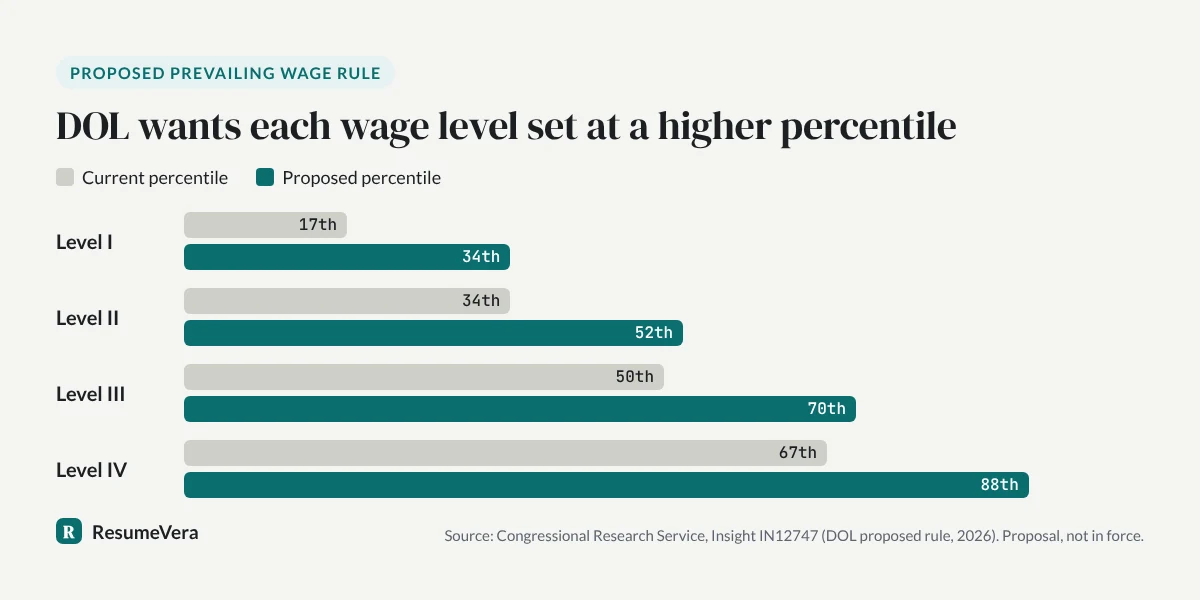
DOL estimates about $1.46 billion in first-year costs to employers, according to CRS. The SBA Office of Advocacy calculated that the average Level I prevailing wage would rise from $73,279 to $97,746, a 33.39% increase (SBA Office of Advocacy).
Why this matters to you during a grace period: if the proposal became final, an employer considering you at Level I would face a higher wage floor. Know your level and your market pay before the offer conversation. Our H-1B take-home pay calculator shows what a gross offer means in your bank account, which helps when you compare offers or decide how low you can go.
How hard is the job market right now?
Harder in tech than overall. Two numbers set the scene.
| Measure | Figure | Source |
|---|---|---|
| Tech job cuts announced, January to September 2026 | 165,925 | Challenger, Gray & Christmas |
| Same period in 2025 | 107,878 | Challenger, Gray & Christmas |
| Change | Up 54% | Challenger, Gray & Christmas |
| Tech share of all announced cuts in 2026 | 29% | Challenger, Gray & Christmas |
| Nonfarm payroll change, September 2026 | +29,000 | BLS |
| Unemployment rate, September 2026 | 4.2% | BLS |
Technology companies announced 165,925 job cuts in 2026 through September, up 54% from 107,878 in the same period of 2025, according to the Challenger, Gray & Christmas September 2026 report.
Nonfarm payrolls rose by 29,000 in September 2026 and unemployment was 4.2%, according to the Bureau of Labor Statistics.
What this means for your 60 days: you are competing with a lot of other laid-off tech workers, some of whom do not need sponsorship. That is the case for starting the backup plan early, being upfront about your timeline, and targeting employers that already file H-1B petitions instead of applying everywhere.
What about your spouse and children?
If your family is in the US as your dependents, ask your attorney in the first week how each of your options affects them. Under the DHS proposal, dependents of the covered classifications would be covered too.
If your spouse holds their own H-1B, switching to H-4 under their status may be your most realistic backup. Raise it with your attorney in the first week, not the last.
If you are on F-1 OPT or STEM OPT rather than H-1B, the rules are different. Our sister guide on OPT and STEM OPT unemployment days covers that.
Keep the 60 days visible. Log every application, interview and recruiter promise with dates, so you can see by day 30 whether your main route is working or it is time for the backup. Free to use.
What happens next, and what we will update
| Date | Event | What we will do |
|---|---|---|
| 10 November 2026 | Comment period on the DHS grace period proposal closes | Note the close and any reported comment totals |
| Not yet known | DHS publishes a final rule, or does not | Rewrite this page the day a final rule appears, including its effective date |
| Not yet known | Any court challenge to a final rule | Add the case and its status |
| Not yet known | DOL finalises or drops the prevailing wage proposal | Update the wage table |
| March 2027 (expected) | FY2028 H-1B registration | Link the updated lottery guide |
| Each month | New Challenger and BLS reports | Refresh the market table |
Disclaimer
This is general information, not legal advice. Grace period decisions are discretionary and depend on your facts, including your I-94 date, your separation terms and your immigration history. Before you file anything, change status or travel, check with an immigration attorney. If you also have a pending green card case, ask them how each option affects it.
Sources
- Department of Homeland Security, Federal Register, 11 September 2026: Eliminating the Discretionary 60-Day Grace Period (91 FR 57807, docket USCIS-2026-0364)
- eCFR, 8 CFR 214.1, current text
- eCFR, 8 CFR 204.5, current text
- USCIS, Options for Nonimmigrant Workers Following Termination of Employment (archived page)
- Department of Homeland Security, Federal Register, 29 December 2025: Weighted Selection Process for H-1B final rule
- Congressional Research Service, Insight IN12747, on the DOL prevailing wage proposal
- SBA Office of Advocacy, on the DOL prevailing wage proposal
- Seyfarth Shaw, on the DHS proposed $103,265 fee for H-1B cap petitions (proposed 25 August 2026)
- Clark Hill, on the First Circuit blocking reinstatement of the $100,000 H-1B fee
- Challenger, Gray & Christmas, September 2026 job cuts report
- Bureau of Labor Statistics, The Employment Situation, September 2026 data
- Regulations.gov, docket USCIS-2026-0364
Written and checked by ResumeVera Editorial Team. How we research and review
Questions
Frequently asked questions
Get free ATS tips every week
Actionable resume and ATS tips, when we publish them. No spam. Unsubscribe any time.
Related Articles
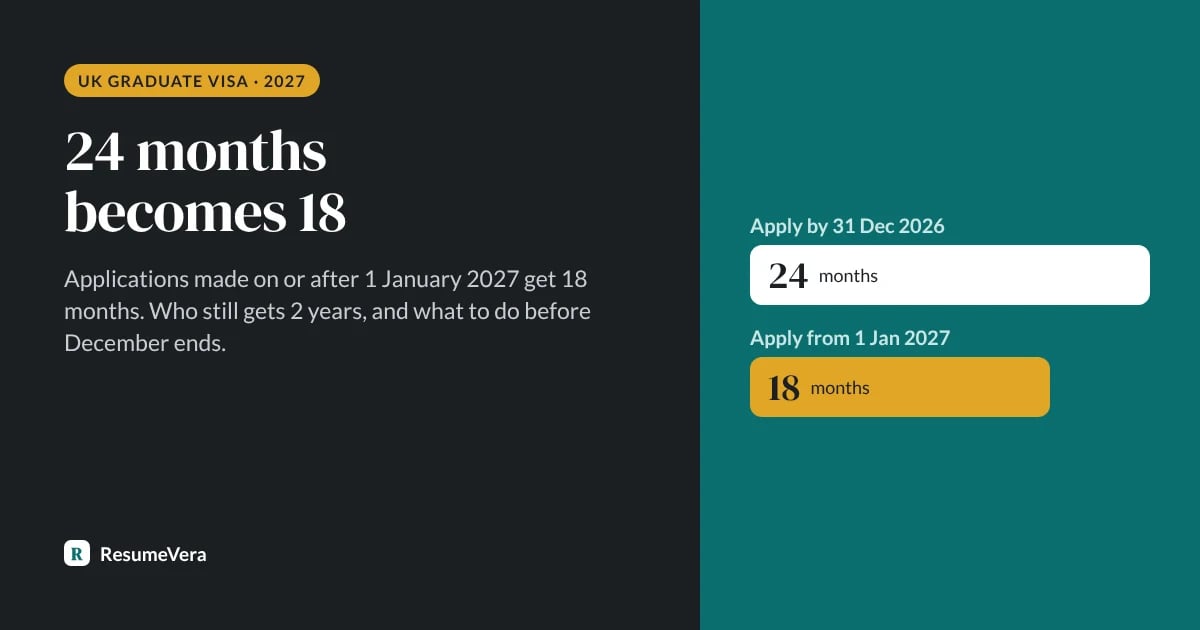
UK Graduate visa cut to 18 months from 1 January 2027: apply by 31 December for 2 years
The UK Graduate visa drops to 18 months for applications made on or after 1 January 2027. Here is who still gets two or three years, a decision table for the December deadline, what the Budget 2026 promise does and does not change, and a 90-day plan for your Skilled Worker job search.
Read More
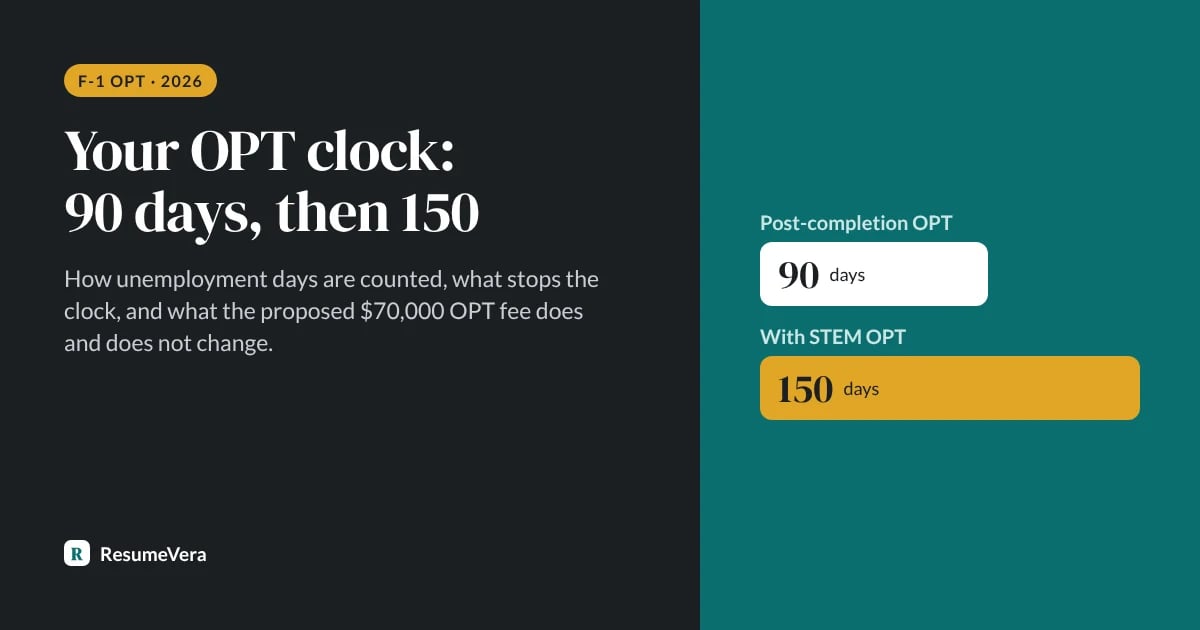
OPT unemployment days in 2026: the 90 and 150-day limits and the proposed $70,000 fee
Post-completion OPT allows 90 days of unemployment in total; STEM OPT raises that to 150, including any of the 90 you have left. Here is how the days are counted, what work stops the clock, worked examples, a 30-day job-search sprint, and where the proposed $70,000 OPT fee stands.
Read More
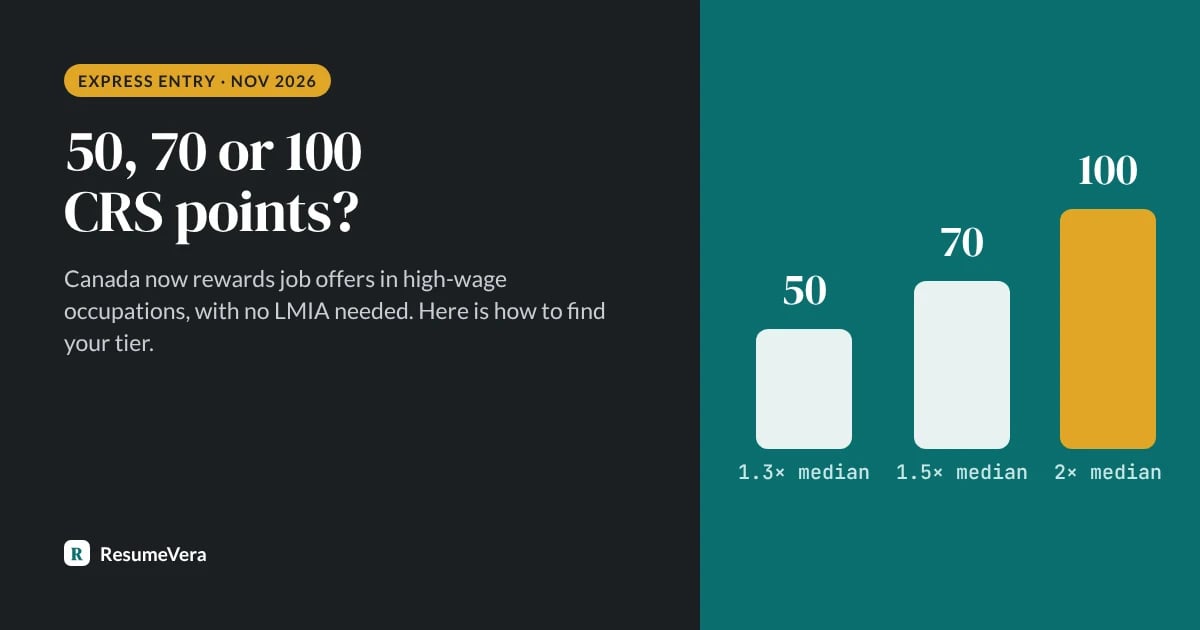
Canada's new Express Entry high-wage points: is your job worth 50, 70 or 100 CRS points?
Since 3 November 2026, Express Entry rewards work in 186 high-wage occupations. Here are the 50, 70 and 100 point tiers, where common NOC codes sit, worked examples, and the status of Canada's 2027-2029 levels plan.
Read More
Try it
Check this against your own resume
The post above is general. Your file is not. The checker reads it the way a parser would and tells you which of these points it actually breaks.
Check your resume free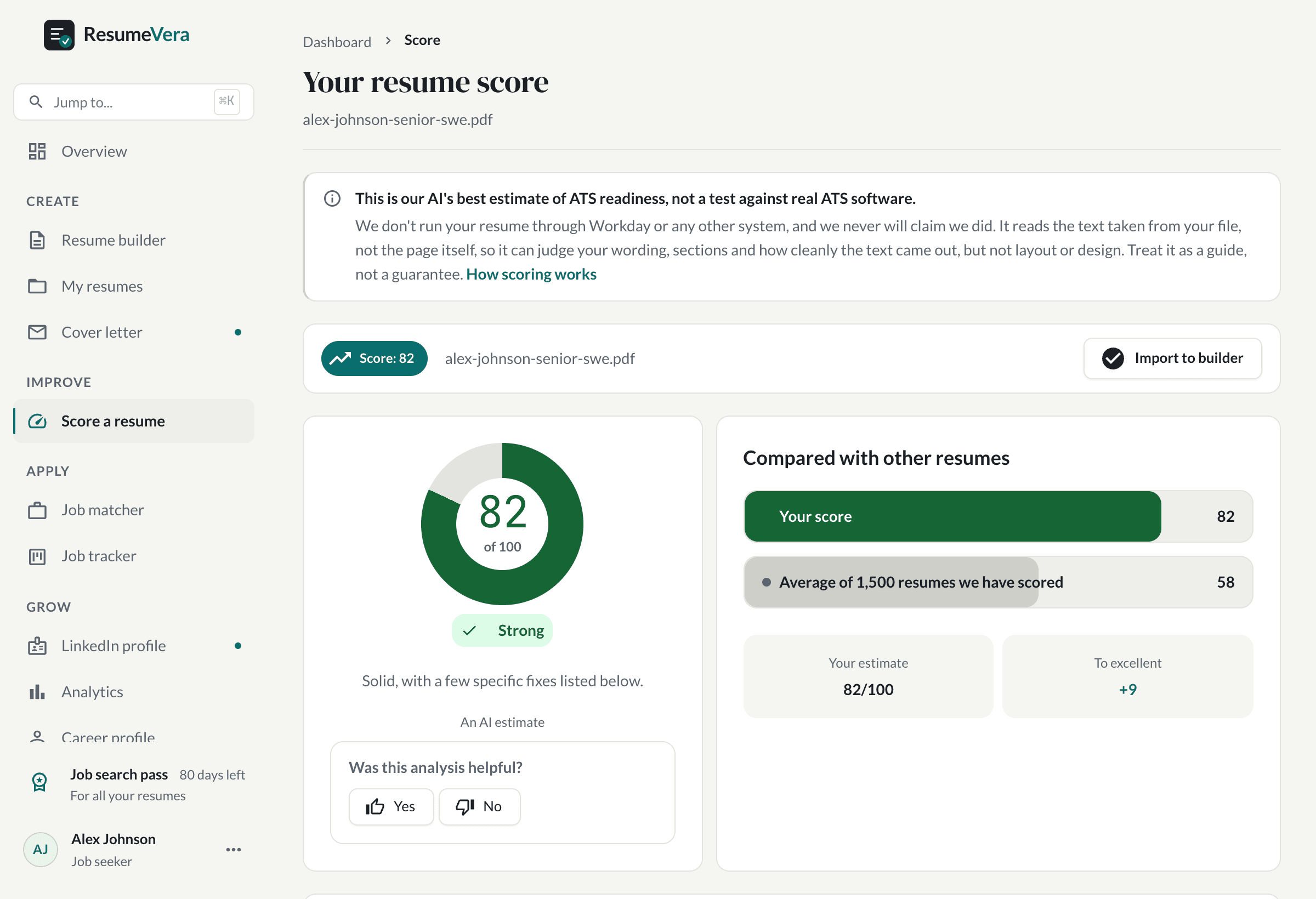
The real score page, with a sample resume and sample scores.
Now check it against your own resume
An honest resume score in seconds. No account, no card.