OPT unemployment days in 2026: the 90 and 150-day limits and the proposed $70,000 fee
Job Search · ResumeVera Editorial Team · November 3, 2026 · 13 min read
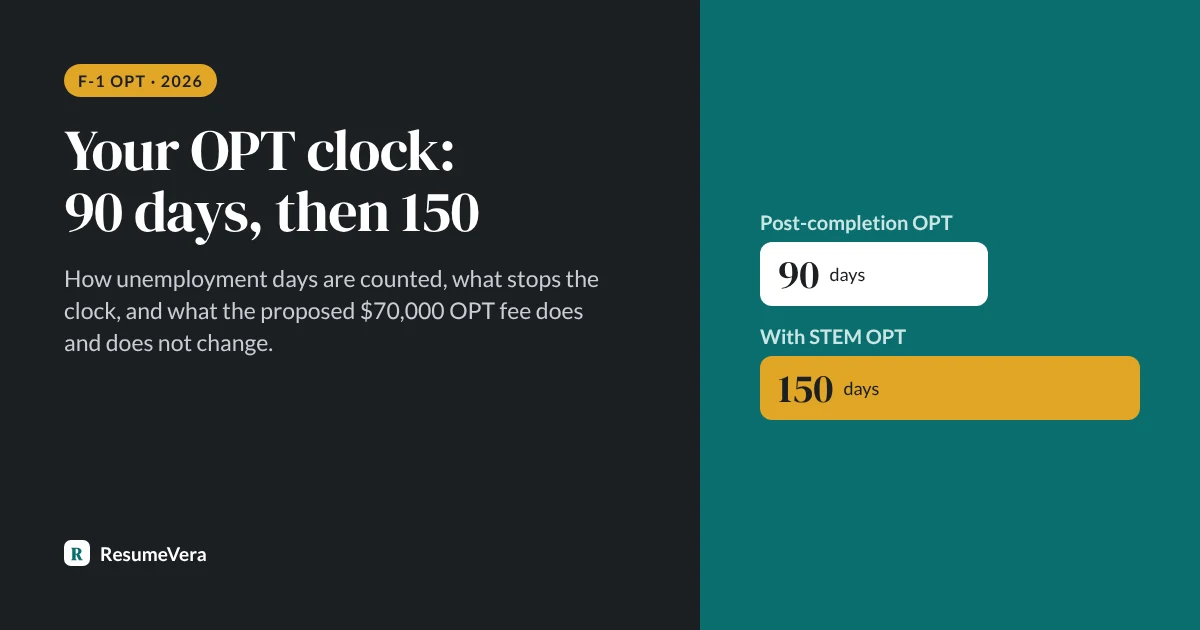
Short answer: On post-completion OPT you can be unemployed for 90 days in total. Once a STEM OPT extension is approved, the total becomes 150 days, which includes any of the original 90 you have left, per Study in the States (DHS). The $70,000 OPT fee DHS proposed on 8 October 2026 is not in force and does not change these limits.
Last reviewed: 3 November 2026. We update this page when the rules change.
If you are on OPT, two numbers decide how much room you have between jobs: 90 and 150. Everything else in this guide, the day counting, what counts as work, the proposed fees and the grace period fight in court, matters because of how it moves those two numbers or leaves them alone.
We have kept this to what the primary documents say. Where something is a proposal, we say so. Where something is not known yet, we say that too.
How many unemployment days do you get on OPT and STEM OPT?
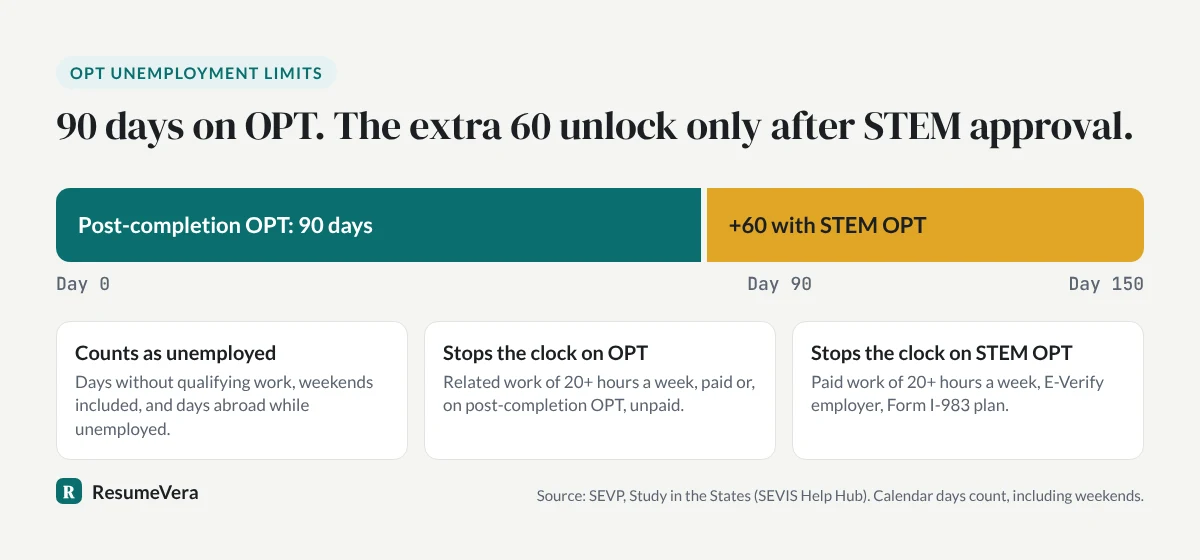
On post-completion OPT, you get up to 90 days of unemployment in total, according to Study in the States, the DHS student portal.
On STEM OPT, the same page says: "A student on STEM OPT can be unemployed for a total of 150 days. This includes any of the remaining 90 days." In practice that means the STEM extension adds 60 days to your allowance, not a fresh 150.
The extra 60 days apply once the STEM extension is approved. Until then, you are working with the 90-day limit, and you should plan around it.
The days are one running total, not a monthly allowance
The count does not reset when you find a job. If you used 40 days before your first job, those 40 days stay used. When you lose a job later, the clock picks up from 40, not from zero.
This is the single most misunderstood part of OPT. People treat each gap as its own 90 days. It is not.
Calendar days, and days abroad count
Unemployment days are counted as calendar days, so weekends and holidays count. Days you spend outside the US while unemployed also count as unemployment days, as Temple University's international student office explains.
So a two-week trip home between jobs costs you 14 days from the allowance, the same as 14 days of job hunting in your apartment.
OPT vs STEM OPT: what counts as employment?
The two stages have different rules about what work stops the clock. This is where most avoidable mistakes happen, because a role that counts on post-completion OPT may not count on STEM OPT.
| Rule | Post-completion OPT | STEM OPT |
|---|---|---|
| Unemployment limit | 90 days in total | 150 days in total, including any of the remaining 90 |
| What counts as work | Related to your field of study, at least 20 hours a week | Paid, related, at least 20 hours a week |
| Unpaid work | Can count (internship, volunteering) if related, 20+ hours a week and lawful | Does not count, the job must be paid |
| E-Verify employer | Not required | Required |
| Form I-983 training plan | Not required | Required |
Sources: Study in the States; Temple University ISSS.
Post-completion OPT: related work, 20 hours or more
On post-completion OPT, the work must be related to your field of study and at least 20 hours a week. It does not have to be paid. An unpaid internship or volunteer role can count if it is related, at least 20 hours a week and does not break labour law.
That last condition matters. Some unpaid roles at for-profit companies are not lawful, and an unlawful role is not a safe way to stop the clock. Ask your DSO before you rely on one.
STEM OPT: paid, E-Verify, I-983
On STEM OPT, the job must be paid, at least 20 hours a week, with an employer enrolled in E-Verify, and under a Form I-983 training plan. Unpaid work does not stop the STEM clock.
The practical consequence: if you plan to move from post-completion OPT to STEM OPT, the unpaid role that kept you in status on OPT will not carry you on STEM. Line up a paid E-Verify role before you need it.
Report it, or it does not exist on your record
You report employment through the SEVP Portal, and you can see your unemployment information there. Report a new job or a job loss promptly, within the deadline your DSO gives you.
Check the portal after every change. If a job you reported is not showing, your record may be counting days you think you were working. Fix it with your DSO while the evidence is fresh.
How to count your OPT unemployment days: worked examples
The arithmetic is simple once you treat the allowance as one running total. Here are four common situations.
Example 1: a slow start, a job, then a layoff
Priya graduates and takes 40 days to land a related full-time role. She works there for 6 months, then gets laid off.
- Days used before the first job: 40.
- Days used while working: 0.
- Days left on post-completion OPT after the layoff: 90 minus 40, which is 50.
If her STEM extension is then approved, her total allowance becomes 150. She has still used 40, so she has 110 days left in total.
Example 2: a trip home between jobs
Arjun has used 30 days. He leaves a job on a Friday and flies home for three weeks before starting the next one. Those 21 days count, weekends included, because days abroad while unemployed count. He is now at 51 days used, with 39 left on post-completion OPT.
Example 3: a related unpaid role on post-completion OPT
Mei has used 70 days. She takes a related unpaid research role at 25 hours a week while she keeps applying. On post-completion OPT, that can stop the clock at 70, as long as the role is related, at least 20 hours a week and lawful. If she later moves to STEM OPT, the same role would not count, because STEM work must be paid.
Example 4: a part-time role under 20 hours
Dev has used 60 days and picks up a related role at 15 hours a week. That is under the 20-hour floor, so it does not count as employment for OPT. His clock keeps running from 60.
| Scenario | Days used | Left on OPT (90) | Left after STEM approval (150) |
|---|---|---|---|
| Example 1, after layoff | 40 | 50 | 110 |
| Example 2, after trip home | 51 | 39 | 99 |
| Example 3, unpaid related role | 70 | 20 | 80 (but unpaid work no longer counts on STEM) |
| Example 4, 15 hours a week | 60 and rising | 30 and falling | 90 and falling |
Example 4 shows a role that does not stop the clock. Example 3 shows a role that stops it only until you move to STEM. Both catch people out.
What happens if you go over the unemployment limit?
If you exceed the limit, you are out of status. There is no partial version of this, and it is far easier to act before the limit than after.
Before you reach the limit, your options include:
- Start qualifying employment. A role that meets the rules for your stage stops the clock.
- Change your education level. Enrolling in a new program with a new Form I-20.
- Change status. Moving to another visa category, if you qualify for one.
- Depart the US. Leaving before the limit protects your record.
Talk to your DSO first, before you sign anything or book a flight. They can see your SEVIS record and know your school's process. If you have fewer than 30 days left, make that conversation this week.
Fewer than 30 days left? A 30-day job-search sprint
When the clock is short, a broad search wastes days you do not have. The goal is a role that counts for your stage, with an employer able to hire you quickly. Here is how we would run the month.
Days 1 to 3: get the facts and the documents straight
- Log in to the SEVP Portal and confirm your exact days used. Do not rely on your own count.
- Email your DSO with your number and ask what they need from you if you find a role, or if you need another option.
- Get your resume into a clean, single-column US format. Our guide to the US resume format covers what American recruiters expect.
- Run it through the free ATS resume checker to catch formatting and keyword gaps. The score is an AI estimate, not a real ATS test, but it shows what to fix.
Days 4 to 20: aim at employers who can actually hire you
- E-Verify employers. If you are on STEM OPT or about to move to it, the employer must be enrolled. Ask in the first conversation, not the last.
- Cap-exempt employers. Universities and research institutes are cap-exempt for H-1B purposes, which makes them a sensible long-term home as well as a quick one.
- Known H-1B sponsors. Our H-1B salary data by employer shows who already sponsors, so you can plan the move beyond OPT.
- Related roles of 20 hours or more. On post-completion OPT only, a related unpaid role can also stop the clock. Treat it as a bridge, not the goal.
Track every application, follow-up and interview in one place. The job application tracker is free and keeps you from losing a lead in a busy week.
Days 21 to 30: decide, and keep a fallback ready
- If an offer comes, confirm it meets your stage's rules (20+ hours, related, and for STEM: paid, E-Verify, I-983) before you accept.
- Report the new job in the SEVP Portal promptly, within the deadline your DSO gives you.
- If nothing has landed by around day 25, return to your DSO and settle your fallback: a new program, a change of status, or departure.
For broader tactics on landing a first role when many applications are screened by software, see our guide to the entry-level job search in the AI era.
Short on days? Keep every application, follow-up and interview date in one list so nothing slips while the clock runs. The tracker is free to use.
What is the proposed $70,000 OPT fee?
DHS announced the proposal in a press release on 7 October 2026. The proposed rule, "Optional Practical Training Fees", was published in the Federal Register on 8 October 2026 as document 2026-20660.
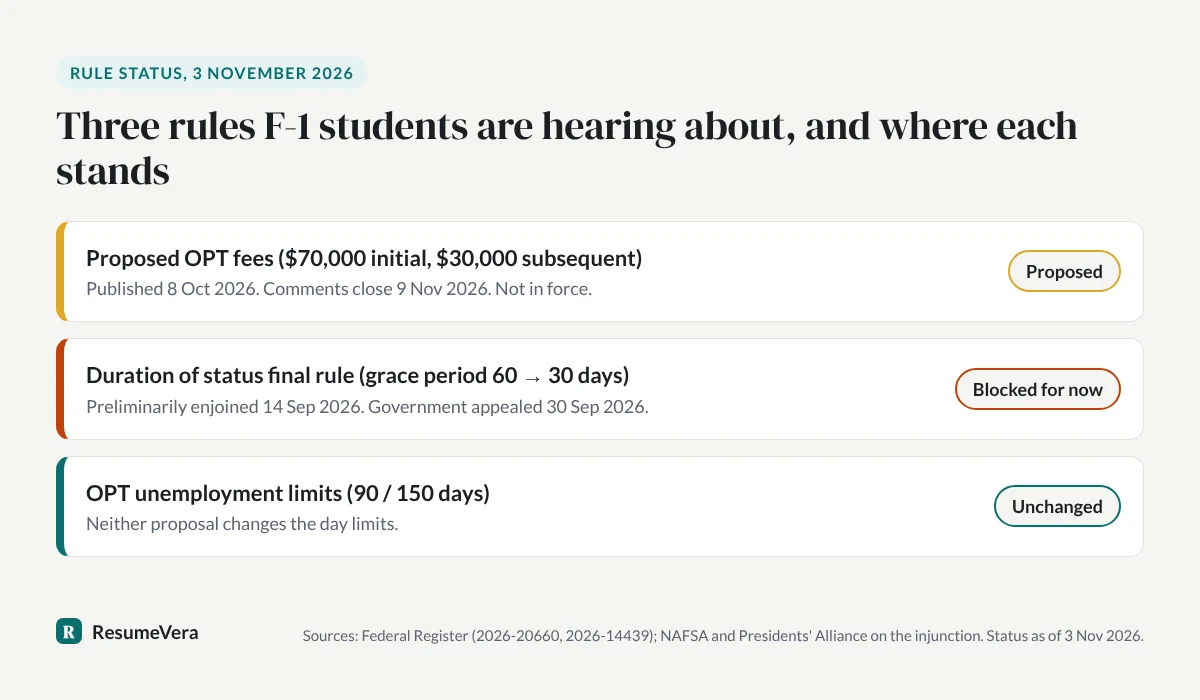
DHS proposes "$70,000 per F-1 nonimmigrant student for initial OPT and a $30,000 fee per F-1 nonimmigrant student for any subsequent OPT". It is a proposal. It is not in force.
Note the wording gap. The rule text says "any subsequent OPT". Study in the States describes the second fee as applying to "the second year of practical training, with no additional fees in subsequent years". Those are not obviously the same thing, and the final rule, if one comes, may settle which reading holds.
Who would pay it?
The fees are charged to schools, for the OPT recommendation, not filed by students directly. Schools could pass the cost on, and nothing in the proposal stops that, so do not assume you would be untouched.
When would it start, and does it affect you now?
Comments close on 9 November 2026. Paperwork Reduction Act comments are due on 7 December 2026.
If finalised, the rule would take effect 60 days after the final rule is published and apply only to OPT recommended or approved after that date, according to Yale's Office of International Students and Scholars. Yale's summary is direct: "Current OPT and STEM OPT rules and fees remain in effect."
Our view: if your school can recommend your OPT under today's rules, do not delay for any reason connected to this proposal.
Why DHS says it wants the fee
DHS estimates the fees would collect "$8.4 billion to $16.5 billion, with a primary estimate of $12.4 billion" a year. In the proposed rule, it also says that without the fees it "may shut down the program entirely".
That second line is worth reading carefully. It is a statement in a proposal, not a decision. But it tells you how the agency frames the choice.
What the $70,000 fee does and does not change
| Question | Under the proposal | Status today |
|---|---|---|
| Is the fee in force? | Not until a final rule, then 60 days later | No, proposal only |
| Who is charged? | Schools, for the OPT recommendation | No new fee |
| Amount, initial OPT | $70,000 per student | Not charged |
| Amount, subsequent OPT | $30,000 per student (wording differs between DHS sources) | Not charged |
| OPT already recommended or approved | Fee would apply only after the effective date | Current rules apply |
| 90-day OPT unemployment limit | Unchanged | Unchanged |
| 150-day STEM OPT unemployment limit | Unchanged | Unchanged |
Sources: Federal Register NPRM, 8 October 2026; Study in the States; Yale OISS.
Is the F-1 grace period 30 days or 60 days now?
For now, it is still 60 days. DHS's duration of status final rule (91 FR 44976, published 17 July 2026) would cut the F-1 grace period after a program or OPT ends from 60 days to 30 days.
A federal judge, Judge F. Dennis Saylor IV, granted nationwide preliminary relief on 14 September 2026, and the government appealed to the First Circuit on 30 September 2026. That is according to NAFSA, an advocacy group for international educators, and the Presidents' Alliance, which is a plaintiff in the case.
So the 60-day grace period still applies, but an appeal is live and that can change. Confirm the latest position with your DSO before you plan around either number.
The grace period is separate from your unemployment days. It is the time after your program or OPT ends, not a top-up for days spent between jobs. If you later move to H-1B, the rules after a layoff are different again, and our post on the H-1B grace period after a layoff covers them.
How many students are on OPT and STEM OPT?
Three figures circulate, and they measure different things. Keep them apart.
| Measure | Figure | Source |
|---|---|---|
| F-1 students granted OPT EADs who reported working for an employer, 2024 | 194,554 | DHS NPRM |
| Same measure, 2023 | 160,627 | DHS NPRM |
| SEVIS records with OPT authorization, 2024 | 340,066 | ICE SEVIS by the Numbers |
| SEVIS records with STEM OPT authorization, 2024 | 165,524 | ICE SEVIS by the Numbers |
| STEM OPT authorizations with employment start dates, 2024 | 95,384 | ICE SEVIS by the Numbers |
The NPRM figure counts pre-completion and post-completion OPT holders who reported working. The ICE record counts are authorizations in SEVIS. The start-date series counts STEM OPT authorizations whose employment began in a given year.
STEM OPT starts by year
The ICE annual series stayed between 61,543 and 72,116 a year from 2017 to 2023, then rose to 95,384 in 2024.
| Year | STEM OPT authorizations with employment start dates |
|---|---|
| 2017 | 64,481 |
| 2018 | 69,650 |
| 2019 | 72,116 |
| 2020 | 63,906 |
| 2021 | 61,543 |
| 2022 | 64,844 |
| 2023 | 62,036 |
| 2024 | 95,384 |
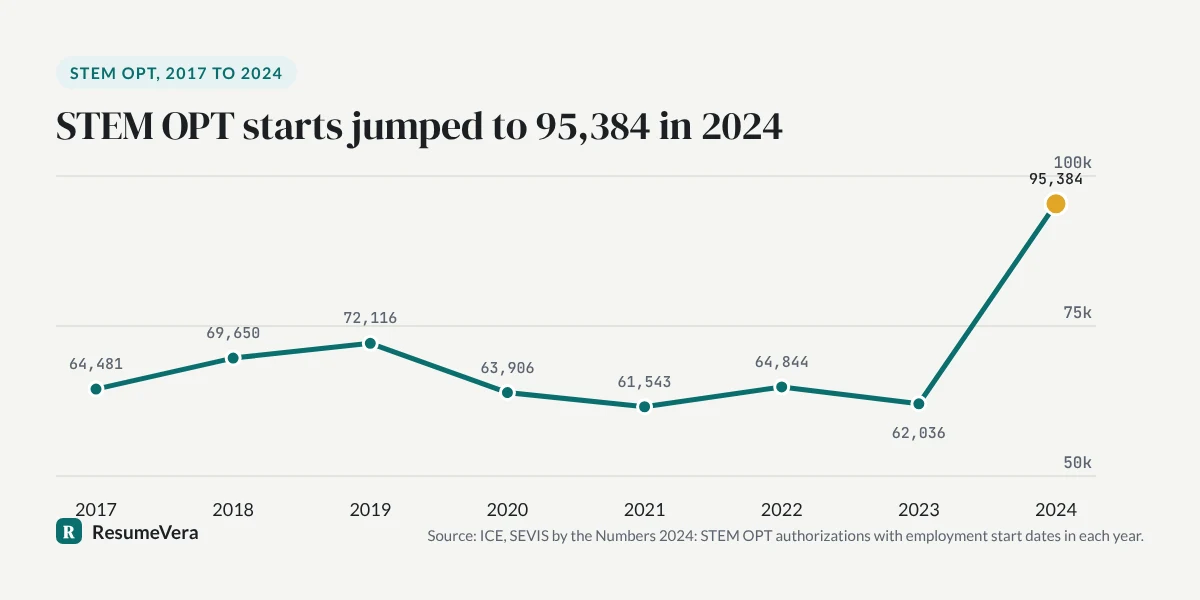
More people on STEM OPT means more people competing for E-Verify employers in the same fields. It is one more reason to start the STEM application and the job search early, rather than waiting for the post-completion clock to run low.
Planning beyond OPT
OPT is a bridge. The days matter most when you know where the bridge leads.
- Know your take-home pay. Our breakdown of take-home pay on OPT and H-1B helps you compare offers on what lands in your account.
- Know the H-1B route. The lottery and recent changes are covered in our guide to US visa changes in 2026.
- Prefer employers that sponsor. A STEM OPT employer that already sponsors H-1B workers gives you a path past OPT, not just a stop for the clock.
Plan the move from OPT. See which employers sponsor H-1B and what they pay, using public filing data. Free to browse.
What happens next, and what we will update
- 9 November 2026: the comment period on the OPT fee proposal closes. We will note it here.
- 7 December 2026: Paperwork Reduction Act comments on the proposal are due.
- If DHS publishes a final OPT fee rule: we will update the fee table, the amounts and the effective date, which would be 60 days after publication.
- When the First Circuit rules on the duration of status appeal: we will update the grace period section.
- If SEVP changes the 90 or 150-day limits: we will rewrite the counting examples. Nothing in the current proposals does this.
This is general information, not legal advice. Your SEVIS record, your school's process and your circumstances decide what applies to you. Talk to your DSO first, and to an immigration attorney if you are considering a change of status or are close to your limit.
Sources
- Study in the States (DHS), F-1 STEM Optional Practical Training, SEVIS Help Hub, reviewed 3 November 2026
- Federal Register, Optional Practical Training Fees, proposed rule, document 2026-20660, 8 October 2026
- DHS, press release on proposed OPT fees, 7 October 2026
- Study in the States (DHS), DHS publishes proposed rule establishing fees for OPT, October 2026
- Yale Office of International Students and Scholars, DHS proposes new fees for OPT, October 2026
- Federal Register, duration of status final rule, 91 FR 44976, 17 July 2026
- ICE, SEVIS by the Numbers 2024, SEVIS records with OPT, CPT and STEM OPT authorizations
- ICE, SEVIS by the Numbers 2024, annual OPT, STEM OPT and CPT authorizations with employment start dates, 2007 to 2024
- NAFSA (advocacy group), duration of status litigation, reviewed 3 November 2026
- Presidents' Alliance on Higher Education and Immigration (plaintiff), duration of status litigation, reviewed 3 November 2026
- Temple University ISSS, OPT and unemployment, reviewed 3 November 2026
Written and checked by ResumeVera Editorial Team. How we research and review
Questions
Frequently asked questions
Get free ATS tips every week
Actionable resume and ATS tips, when we publish them. No spam. Unsubscribe any time.
Related Articles
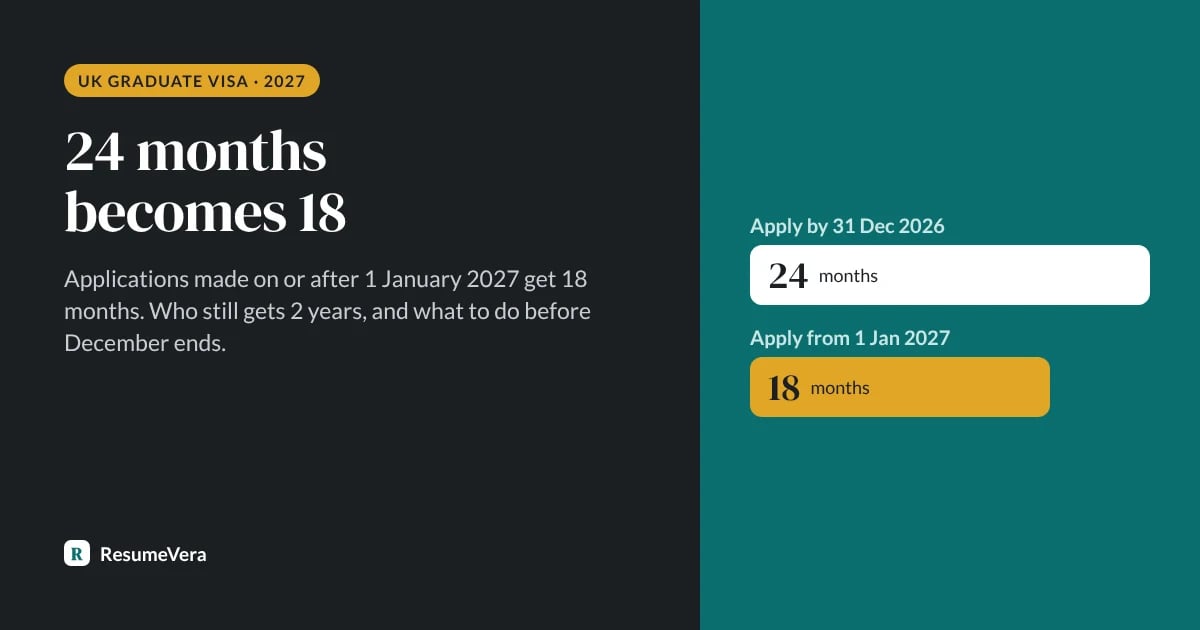
UK Graduate visa cut to 18 months from 1 January 2027: apply by 31 December for 2 years
The UK Graduate visa drops to 18 months for applications made on or after 1 January 2027. Here is who still gets two or three years, a decision table for the December deadline, what the Budget 2026 promise does and does not change, and a 90-day plan for your Skilled Worker job search.
Read More
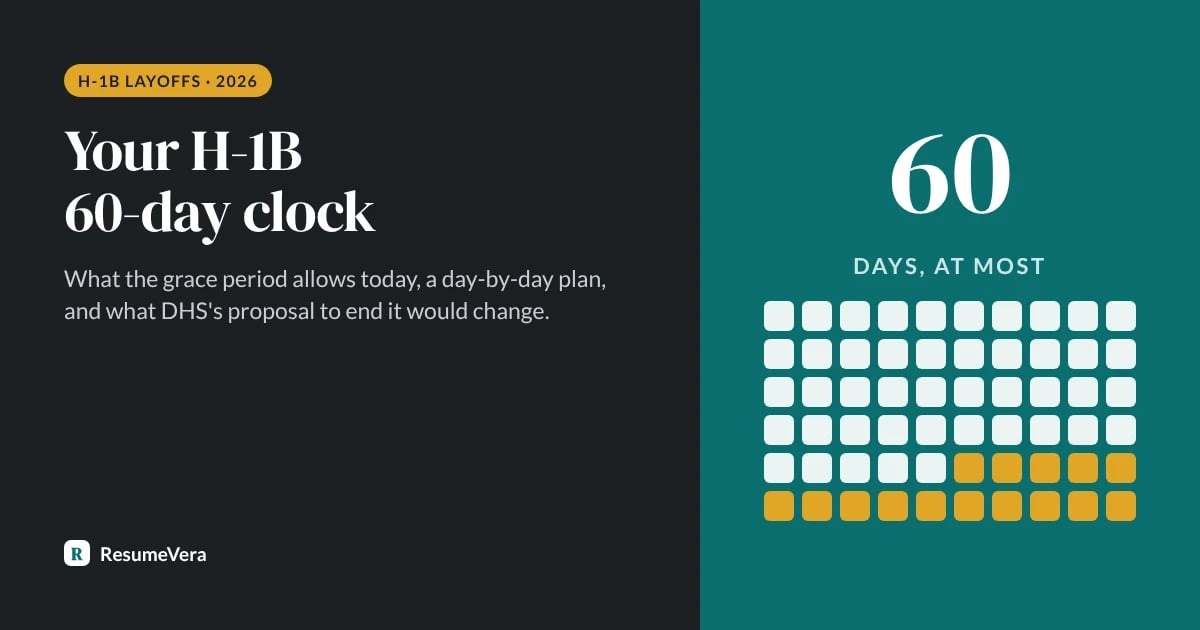
Laid off on an H-1B in 2026: your 60-day grace period and DHS's plan to end it
Laid off on an H-1B? You can generally stay up to 60 days, or until your I-94 ends if sooner, to transfer, change status or leave. DHS proposed ending the grace period on 11 September 2026, but it is not in force. Here is a day-by-day plan with worked date examples.
Read More
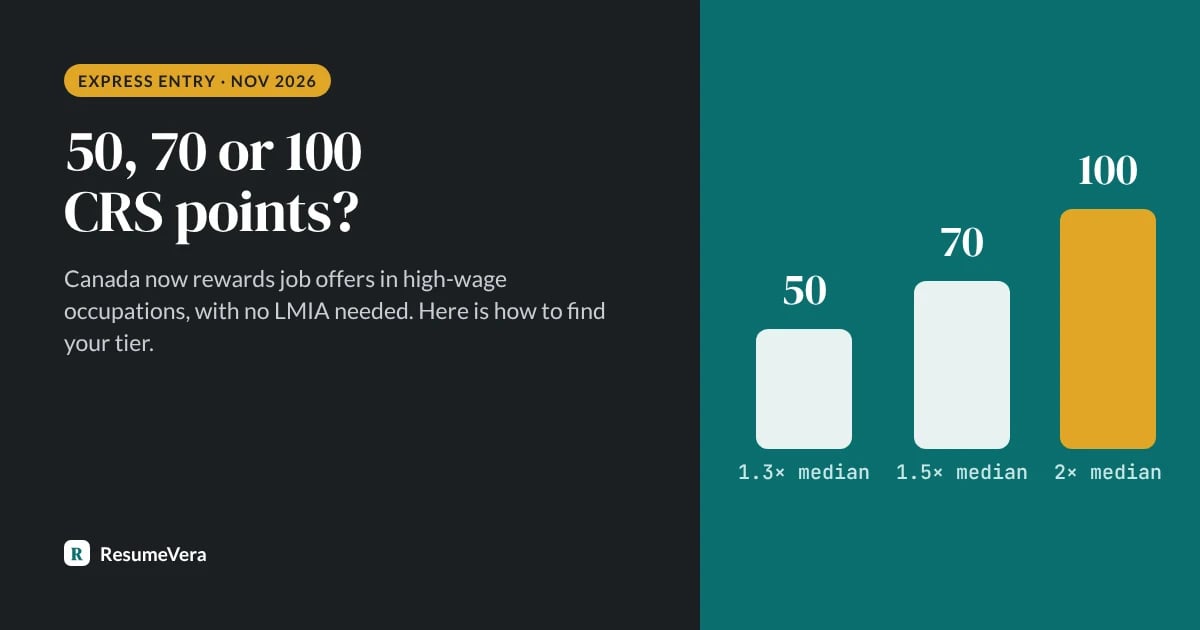
Canada's new Express Entry high-wage points: is your job worth 50, 70 or 100 CRS points?
Since 3 November 2026, Express Entry rewards work in 186 high-wage occupations. Here are the 50, 70 and 100 point tiers, where common NOC codes sit, worked examples, and the status of Canada's 2027-2029 levels plan.
Read More
Try it
Check this against your own resume
The post above is general. Your file is not. The checker reads it the way a parser would and tells you which of these points it actually breaks.
Check your resume free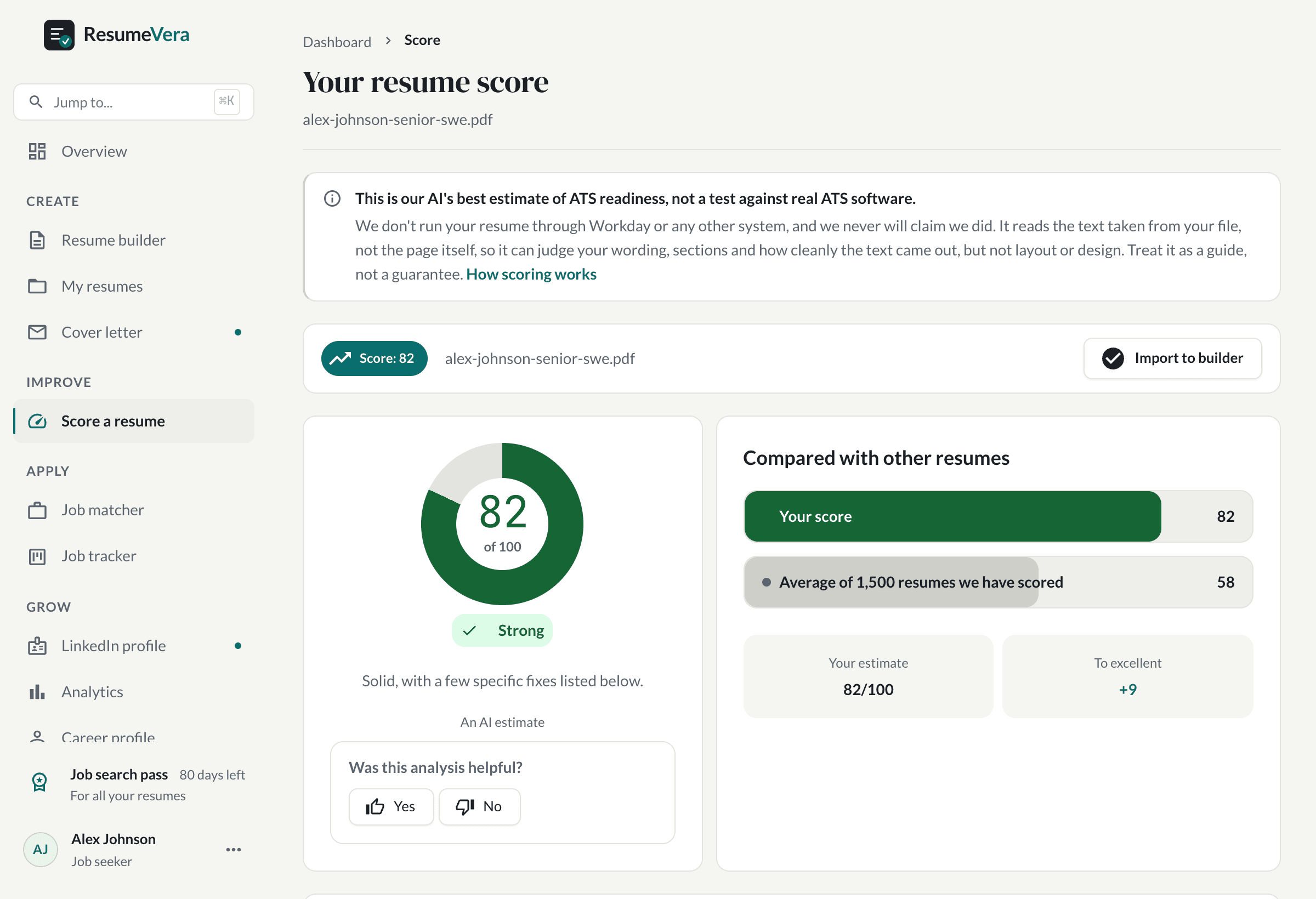
The real score page, with a sample resume and sample scores.
Now check it against your own resume
An honest resume score in seconds. No account, no card.