Written for the India job market, so salaries and formats follow Indian conventions. See the US version.
Career Growth
Gratuity in India
Last reviewed: 4 October 2026. Eligibility, the five-year rule, the formula, the Code on Social Security, time limits, nomination, claim steps and tax, from official sources.
The ResumeVera editorial team
Resume and hiring research, reviewed against current employer guidance.
Updated 2026-10-05T06:00:37.619Z
15 min
Section 01
Gratuity in India: the short answer
Last reviewed: 4 October 2026. This guide explains what official government sources say about gratuity and how people usually claim it. It is not legal or tax advice. Your appointment letter, your employer's gratuity policy and the current official text decide your case, and the links in the last section have the final word.
Gratuity is a lump sum an employer pays, as a statutory benefit, when you leave after long service. The Payment of Gratuity Act, 1972 is the long-standing law. The Code on Social Security, 2020 has a gratuity provision too, and the government made the four labour codes effective on 21 November 2025. The points below come from the official pages we read.
- The usual rule is five years of continuous service. The Act says the five years are not needed when employment ends because of death or disablement.
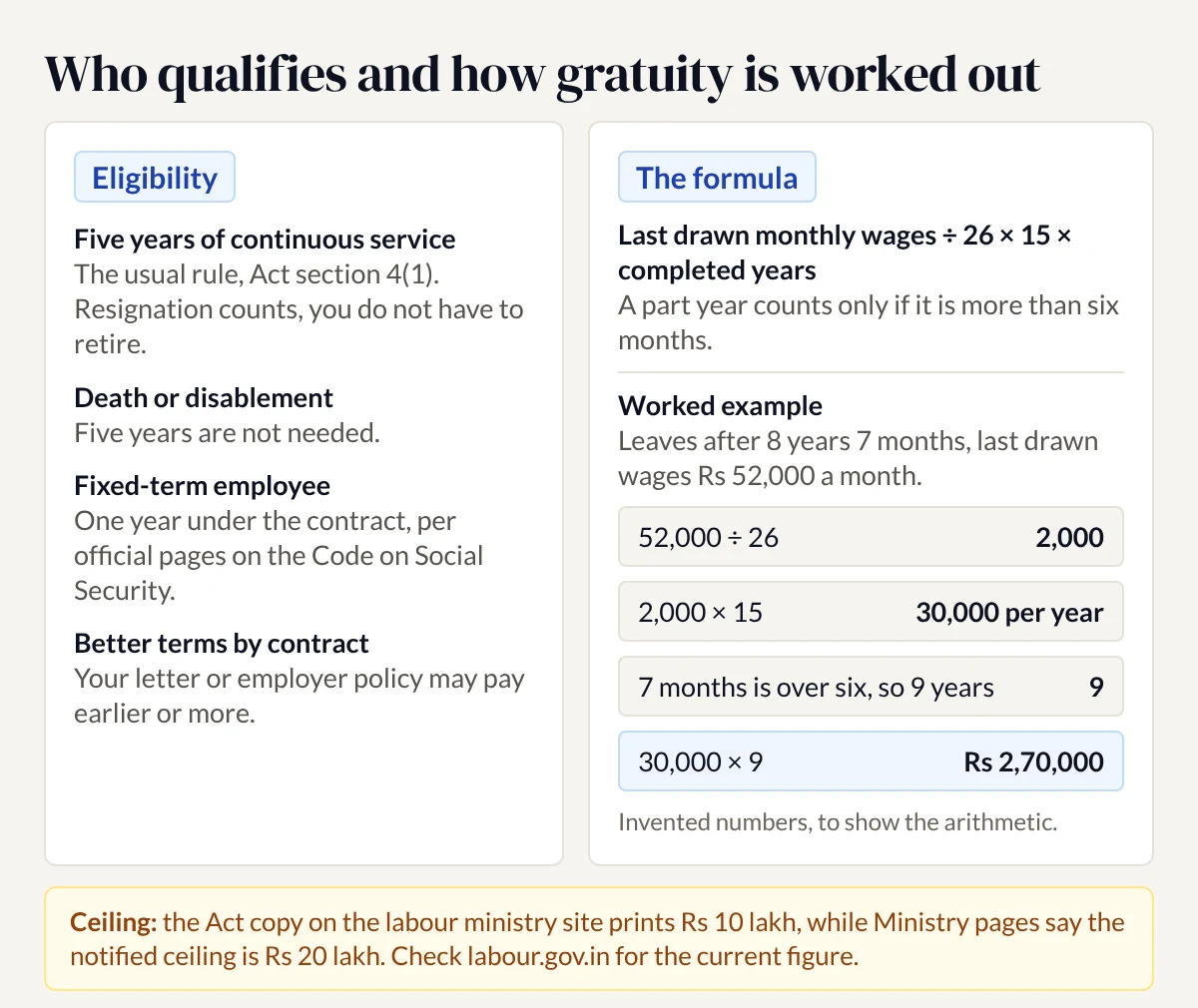
- For employees paid by the month, the Act's formula is the last drawn month's wages divided by 26, multiplied by 15, for each completed year of service, where a part year counts only if it is more than six months.
- The Act's text says the employer must pay within 30 days from the date the gratuity becomes payable, with simple interest at a notified rate if payment is late.
- The Act as printed on the labour ministry site shows a ceiling of ten lakh rupees, but the Ministry's brief on the 2018 amendment and its labour-code FAQ both say the notified ceiling is Rs 20 lakh.
- Under the Code on Social Security, official pages say a fixed-term employee becomes eligible after one year of service under the contract.
- We could not read the gratuity chapter of the Social Security (Central) Rules, 2026 (gazetted 8 May 2026), so form numbers and procedure details under the new rules are pointers, not claims.
| Question | What the sources say | Where |
|---|---|---|
| Standard eligibility | Five years of continuous service | Act s.4(1) |
| Exception | Death or disablement | Act s.4(1) |
| Fixed-term employee | One year under the contract | Ministry FAQ |
| Payment deadline | 30 days from payable date | Act s.7(3) |
For the whole exit settlement, see our guide to full and final settlement in India.
Section 02
Who is eligible and how the five-year rule works
Who the Act covers
Section 1(3) of the Payment of Gratuity Act applies to every factory, mine, oilfield, plantation, port and railway company, and to every shop or establishment in which ten or more persons are employed (or were employed on any day of the preceding twelve months). Section 2(e) defines an employee as a person, other than an apprentice, who is employed for wages. The same definition excludes government employees who are covered by another gratuity scheme. We did not read the Code's coverage provisions for this review, so check who is covered under the Code against the current official text.
The five-year rule
Section 4(1) makes gratuity payable when employment ends after the employee has rendered continuous service of not less than five years, on superannuation, on retirement, on resignation, or on death or disablement. Resignation is one of the listed events, so you do not have to retire. The Compliance Handbook gives the same five years for regular employees under the Code.
What counts as continuous service
Section 2A says an employee is in continuous service if the service is uninterrupted, and it counts interruptions caused by sickness, accident, leave, lay-off, strike or lockout that were not the employee's fault. Where service is not uninterrupted, the section treats a year as completed if the employee actually worked at least 190 days (for certain mines and for establishments that work less than six days a week) or 240 days (in any other case) in that year. Read the section itself for the exact wording.
We found no official page that says a probationary or notice period is excluded from continuous service. Ask HR how your service is counted, and see our guide to the probation period in India for what is known on that point.
Exceptions to the five-year rule
- Death or disablement. Section 4(1) says completion of five years is not necessary where employment ends because of death or disablement (the Act ties disablement to accident or disease). On death, gratuity goes to the nominee or, if there is no nomination, to the heirs.
- Fixed-term employees under the Code. Official pages say the Code on Social Security reduced the requirement for fixed-term employees to one year. See the section on the Code below.
- Better terms by contract. Section 4(5) says nothing in the section affects your right to better terms of gratuity under an award, agreement or contract. Some employers pay gratuity earlier or more generously than the statute requires. Your letter will say.
When gratuity can be forfeited
Section 4(6) allows gratuity to be forfeited in specific cases. It can be wholly or partly forfeited if the employee's services are terminated for riotous or disorderly conduct or an act of violence, or for an offence involving moral turpitude committed in the course of employment. It also covers termination for an act, wilful omission or negligence that causes damage or loss to the employer's property, to the extent of that damage or loss. This page cannot assess whether a case fits.
Section 03
The formula: 15 days, 26 days and what counts as wages
Section 4(2) of the Act says that for every completed year of service, or part thereof in excess of six months, the employer pays gratuity at the rate of fifteen days' wages based on the rate of wages last drawn by the employee. For an employee paid by the month, the Act says the fifteen days' wages are worked out by dividing the rate of wages last drawn for a month by twenty-six and multiplying the result by fifteen. For seasonal establishments the Act uses seven days' wages for each season.
| Step | Action | Source |
|---|---|---|
| 1 | Take last drawn wages for a month | Act s.4(2) |
| 2 | Divide by 26, multiply by 15 | Act s.4(2) |
| 3 | Multiply by completed years, rounding up a part year over six months | Act s.4(2) |
| 4 | Apply the notified ceiling | Act s.4(3) |
The same 15/26 arithmetic appears on the Income Tax Department's page on retirement benefits, in the exemption formula for employees covered by the 1972 Act.
What counts as wages under the 1972 Act
Section 2(s) defines wages as all emoluments earned by an employee while on duty or on leave that are paid or payable in cash, and says the term includes dearness allowance. It leaves out bonus, commission and overtime, among other items the section lists. Wages are therefore a narrower base than your full cost to company. Your CTC breakup shows how your employer splits pay, and our CTC calculator can help you see the pieces of a package. Which components count is for the payroll record and the current law.
What changes for wages under the Code
Section 2(88) of the Code on Social Security defines wages as including basic pay, dearness allowance and retaining allowance, and lists payments that are excluded (house accommodation value, conveyance allowance, house rent allowance, overtime, commission, bonus, gratuity and retrenchment compensation are among those listed). The Press Information Bureau document of 22 November 2025 describes an add-back rule: if the excluded payments exceed 50 per cent of total remuneration (or such percentage as the Government notifies), the excess is added back to wages. We did not read the proviso's own wording in the Code text, so that description is PIB's.
The Ministry's Additional FAQs on Labour Codes (as on 16 March 2026) say that gratuity on the revised definition of wages applies from 21 November 2025, and that any payment not covered by the components in section 2(88) is not considered for gratuity. They also say that gratuity is paid on the rate of wages last drawn on or after 21 November 2025 under the Code. The FAQs do not cover every payroll component, so ask your employer which of your components count.
The Compliance Handbook states the Code rate as 15 days' wages for each completed year of service, subject to the maximum notified by the Central Government. We could not read the Code's section 53 text in this review, so we cannot confirm from a primary source whether it repeats the 26-day divisor.
The ceiling, as officially stated
The copy of the 1972 Act on the labour ministry site prints section 4(3) as "ten lakh rupees". The Ministry's brief on the Payment of Gratuity (Amendment) Act, 2018 says the ceiling under the Act was enhanced from Rs 10 lakh to Rs 20 lakh from 29 March 2018 by a notification, and a Press Information Bureau release of 7 March 2019 says the same. The Ministry's FAQ on the labour codes says the maximum is as notified by the Central Government, currently Rs 20 lakh. We could not open the notification itself, so check the current notified figure on labour.gov.in before you rely on it.
Section 04
Worked examples
All names and numbers below are invented for illustration. They show arithmetic, not a norm for anyone's salary, and they use the 1972 Act formula. Your employer's calculation under the Code may differ.
Example 1: a year over six months is rounded up
Priya resigns after 8 years and 7 months. Her last drawn wages (basic pay plus dearness allowance) are Rs 52,000 a month.
- Completed years: 8, plus 7 months. Seven months is more than six, so it counts as one more year. Years counted: 9.
- Wages for 15 days: 52,000 divided by 26 is 2,000. Multiplied by 15, that is Rs 30,000 for each year.
- Gratuity: Rs 30,000 multiplied by 9 is Rs 2,70,000.
Example 2: a part year of six months or less is not counted
Rohan leaves after 7 years and 5 months with last drawn wages of Rs 52,000 a month. Five months is not more than six, so 7 years are counted: Rs 30,000 multiplied by 7 is Rs 2,10,000.
Example 3: the ceiling
Meera has served 30 years and her last drawn wages are Rs 1,80,000 a month. The formula gives 1,80,000 divided by 26, multiplied by 15, which is about Rs 1,03,846 for each year. Multiplied by 30, that is about Rs 31,15,385. If the notified ceiling is Rs 20 lakh, as the Ministry pages above say, the payable gratuity is capped at Rs 20,00,000.
Example 4: how the add-back rule works under the Code
This shows only the arithmetic of the add-back rule PIB describes for section 2(88), using the 50 per cent figure (PIB says the percentage can be changed by Government notification). A pay structure has basic pay Rs 30,000, house rent allowance Rs 40,000 and conveyance allowance Rs 30,000, a total remuneration of Rs 1,00,000. House rent and conveyance allowances are among the excluded items, so excluded payments are Rs 70,000. Fifty per cent of total remuneration is Rs 50,000. The excess, Rs 20,000, is added back, so wages for the Code are Rs 30,000 plus Rs 20,000, which is Rs 50,000. Real payslips have more components, so treat this as a way to understand the rule, not as your result.
Section 05
What the Code on Social Security, 2020 changes
The Press Information Bureau release of 21 November 2025 says the four labour codes became effective that day, and that during the transition the relevant provisions of the existing labour Acts and their rules remain in force. The Ministry's FAQs say existing rules apply till final notification of new rules under the Codes, to the extent they are in line with the Codes. The Ministry's gazette notification of 8 May 2026 publishes the Social Security (Central) Rules, 2026. We could not read its gratuity chapter, so the page cannot tell you which rule and form numbers now apply.
Fixed-term employees
This is the main change official sources describe.
- The Press Information Bureau document of 22 November 2025 says that under section 53 of the Code the government reduced the gratuity eligibility for fixed-term employees from five years to one year, and that where the employee completes one year of continuous service, gratuity applies on a proportionate basis.
- The Compliance Handbook says an employer shall pay gratuity to a fixed-term employee on termination of the contract period after completion of one year of service.
- The Industrial Relations Code defines fixed term employment as engagement on a written contract for a fixed period and says such a worker is eligible for gratuity if he renders service under the contract for a period of one year.
- The Additional FAQs (16 March 2026) say a fixed-term employee is eligible if he or she renders service under the contract for a period of one year from the start of the contract. Asked about a fixed-term employee engaged for 11 months, it gives the same reply.
Other changes
The wages definition and the add-back rule are covered above, and nomination is covered below. The Additional FAQs add that for contract labour the contractor pays gratuity on five years of continuous service.
Does the 1972 Act still apply?
The Additional FAQs say that gratuity is paid on the wages last drawn on or after 21 November 2025 as per the Code. We could not read the Code's repeal section or a notification stating the end date of the 1972 Act, so we do not state which text governs your claim. In your claim, ask your employer to say which it is applying.
Section 06
Time limits for payment and interest
| Step | Time limit stated | Where |
|---|---|---|
| Employee applies | Ordinarily within 30 days of it becoming payable | 1972 Rules, rule 7(1) |
| Employer notice (pay or reject) | Within 15 days of the application | 1972 Rules, rule 8(1) |
| Employer pays | Within 30 days of it becoming payable | Act s.7(3) |
| Application to controlling authority | Within 90 days of the cause | 1972 Rules, rule 10(1) |
| Appeal against an order | Within 60 days of receiving it | Act s.7 |
Read the rows with care. The Act's section 7(3) puts the 30-day duty on the employer from the date the gratuity becomes payable, whether or not you have applied. The rules' 30 days for the employee's application is worded as "ordinarily", and the Ministry's FAQ on the Social Security rules says delay in applying does not by itself forfeit a claim. The Compliance Handbook gives the Code's duty as payment within 30 days from the date it becomes payable.
Interest
Section 7(3A) of the Act provides for simple interest on delayed payment at a rate notified by the Central Government. According to the extract we read, interest is not payable where the delay was caused by the employee's own fault and the controlling authority has allowed that in writing. We could not confirm a current notified rate from an official page, so this guide gives no figure. Ask the labour authority for the rate in force. If the amount is not paid and the controlling authority issues a recovery certificate, section 8 allows recovery as arrears of land revenue, with interest.
Section 07
Nomination: who gets gratuity if you die
Section 6 of the Act requires an employee who has completed one year of service to make a nomination, within the time, form and manner prescribed. If you have a family when you nominate, the nomination must be in favour of one or more family members, and a nomination in favour of a person outside the family is void. You can divide the amount among more than one nominee. If you have no family, you may nominate anyone, but the nomination becomes invalid when you later acquire a family, and you then need a fresh nomination in favour of family members. You may modify a nomination by written notice.
Under the Payment of Gratuity (Central) Rules, 1972, as we read them:
- Form F is the nomination. It is submitted in duplicate by personal delivery with a receipt, or by registered post with acknowledgement due (rule 6(1)).
- An employee already employed for one year or more at the time of the rules was to nominate within 90 days. An employee who completes one year afterwards should do so within 30 days of completion.
- Form G is a fresh nomination when an employee without a family acquires one, and Form H modifies a nomination. These form details come from one extract of the Rules, so verify them on the official PDF.
The Act's section 4(1) says that if the employee dies, gratuity is paid to the nominee or, if no nomination has been made, to the heirs, and the share of a minor is deposited with the controlling authority. The Ministry's FAQ on the Social Security rules says a minor nominee's amount is invested in term deposits at specified nationalised banks.
The Compliance Handbook says the same one-year duty applies under the Code. Ask HR for the nomination form your employer uses now, fill it in during your first year, and keep a stamped copy.
Section 08
Forms and how to claim, with sample emails
Forms under the 1972 Rules
| Form | Purpose | Rule |
|---|---|---|
| Form F | Nomination | Rule 6 |
| Form I | Application by employee | Rule 7 |
| Forms L and M | Employer notice to pay, or rejecting the claim | Rule 8 |
| Form N | Application for direction to controlling authority | Rule 10 |
The same Rules, according to an extract we read, use Form J for a nominee's application and Form K for a legal heir's application (ordinarily within one year). Check those two against the official PDF.
Form numbers under the Social Security (Central) Rules, 2026 may differ. A Ministry FAQ on the Social Security rules says that workers may apply in advance if the date of retirement or leaving is known, and that employers cannot reject claims arbitrarily, because the process needs mandatory notices, reasoned orders, defined timelines and appeal mechanisms. We could not tell whether that undated FAQ describes draft or final rules, so confirm against the gazette copy.
Steps to claim
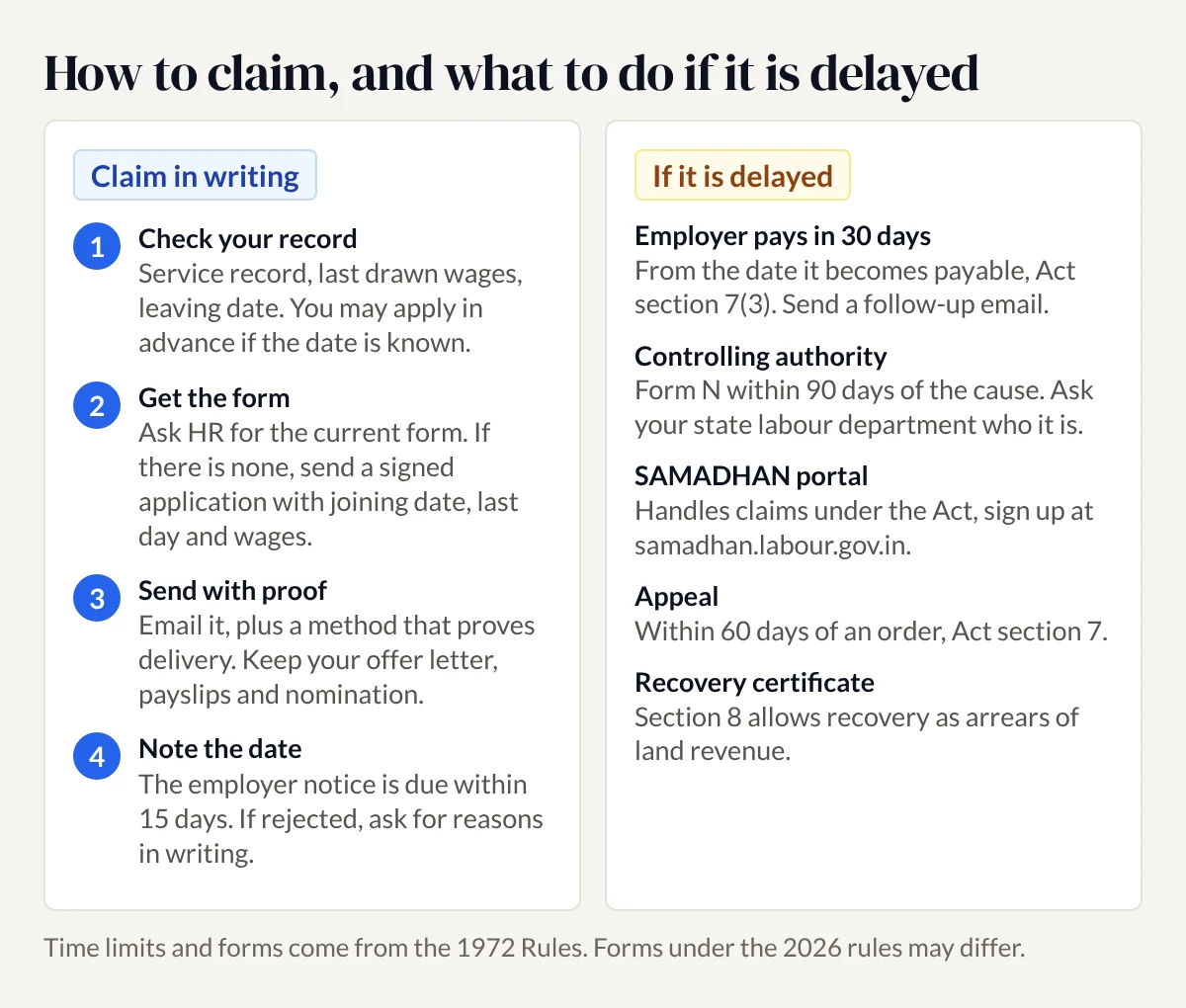
- Check your service record, last drawn wages and leaving date. If the date is known, you may apply in advance, as the Ministry's FAQ says.
- Get the current application form from HR. If there is none, send a signed written application citing your joining date, last working day and wages, and keep proof of the date you sent it.
- Send it to the employer by email and by a method that gives proof of delivery, and keep copies of your offer letter, payslips, relieving documents and nomination.
- Note the date. The employer's notice is due within 15 days of the application. If you receive a rejection, ask for the reasons in writing.
Gratuity is one line in the exit settlement. Our guides to the resignation letter and experience letter cover the documents you will want on file at the same time.
Sample A: gratuity claim email
These are samples to show the shape of the message. They are not legal documents. Replace every [bracketed] field and adapt it to your situation and to the current rules.
Subject: Application for payment of gratuity, [Your name], [Employee ID]
Dear [HR contact name],
I joined [Company name] on [joining date] and my last working day is [last working day] (or was [last working day]). I have completed [years and months] of continuous service. I am applying for payment of gratuity under the Payment of Gratuity Act, 1972 and, to the extent applicable, the Code on Social Security, 2020.
My last drawn wages were [amount]. I have attached [Form I or the application form your company uses], my nomination dated [date] and a copy of my appointment letter and last payslip.
Please send me the gratuity notice with the computation and the date of payment, and confirm which Act and rules your company is applying. I request payment to my bank account ending [last four digits] within the time the law provides.
Thank you,
[Your name], [designation], [phone or email]
Sample B: follow-up if there is no reply
Subject: Follow-up: gratuity application dated [date], [Your name], [Employee ID]
Dear [HR contact name],
I applied for gratuity on [date] and have not received a notice or payment. Please share the computation and the payment date, or the reasons in writing if the claim is not accepted, by [date]. If I do not hear back, I will have to approach the controlling authority under the Act.
Regards,
[Your name], [designation]
Section 09
Tax treatment of gratuity
This is a summary of what the Income Tax Department pages say, not tax advice. Check the department's page and your own return, or ask a qualified professional.
The Income Tax Department's page on the taxability of retirement benefits (which says it is as amended by the Finance Act, 2026) gives these rules for gratuity:
- Government employees (other than employees of statutory corporations): gratuity received is fully exempt. The department's benefits page cites section 10(10)(i).
- Other employees covered by the Payment of Gratuity Act, 1972: the exempt amount is the least of three figures: (15/26) multiplied by last drawn salary multiplied by completed years of service or part in excess of six months; Rs 20,00,000; and the gratuity actually received. The benefits page cites section 10(10)(ii).
- Employees not covered by that Act: the least of half a month's average salary multiplied by completed years of service; Rs 20,00,000; and the gratuity actually received. The benefits page cites section 10(10)(iii).
- Gratuity received during service: fully taxable.
The Ministry of Finance release of 7 March 2019 records the Rs 20 lakh income tax exemption under section 10(10)(iii) of the 1961 Act.
The Income-tax Act, 2025 says in section 1(3) that it comes into force on 1 April 2026. The department's page we read refers to the Finance Act, 2026, and we could not locate the matching provision in the 2025 Act text, so the section numbers above are the ones the department's pages used when we reviewed them. Look for the corresponding provision in the Income-tax Act, 2025 before you cite a section number in a return.
Section 10
If your employer delays or denies gratuity
- Put the claim in writing if you have not (Sample A) and follow up (Sample B). Ask for the computation and the legal basis of any refusal.
- Check the employer's notice. Under rule 8 of the 1972 Rules the employer sends a notice (Form L to pay, Form M to reject) within 15 days of the application. A rejection notice must give reasons.
- Apply to the controlling authority. The Rules provide Form N, an application for direction, within 90 days of the cause. The authority is appointed by the appropriate government. We could not find an official list on the pages we read, so ask your state labour department, or, for establishments in the central sphere, the central labour commissioner organisation, which lists the Payment of Gratuity Act among the enactments it enforces.
- Use the portal. The Ministry's SAMADHAN portal says it handles claims under the Payment of Gratuity Act, 1972. Its FAQ says users can sign up at samadhan.labour.gov.in, and that an appeal against an order under the Act goes to the concerned authority (Dy. CLC).
- Know the remedies. Under section 7 of the Act, a dispute about the amount or eligibility is decided by the controlling authority, and an appeal is filed within 60 days of the order. Section 8 allows a recovery certificate to the Collector. Section 9 sets out penalties, including fines and imprisonment, for non-compliance and for non-payment.
If your employer cites a notice shortfall or bond recovery, ask for the clause and amount in writing, and see our guides on the notice period buyout and the service bond and recovery.
Limits. This guide cannot say how a labour authority or court will decide your case. For a dispute, contact your state labour office, the Ministry of Labour and Employment at labour.gov.in, or a qualified lawyer.
Section 11
Sources and references
Limits. Gratuity law is moving from the 1972 Act to the Code on Social Security, the rules were gazetted on 8 May 2026, and we could not read their gratuity chapter. Some pages are undated, some are summaries, and the ceiling appears as ten lakh on one page and Rs 20 lakh on others. This page cannot say which regime applies to your employer or what a labour authority would decide. Your contract and employer policy may give you more than the law requires.
Every legal or tax statement above comes from an official page we opened on 4 October 2026, except where the text says we could not read or confirm something. Check each link for the current version.
- The Payment of Gratuity Act, 1972 (Ministry of Labour and Employment): Sections 1(3), 2(e), 2(s), 2A, 4, 6, 7, 8, 9 and 13: eligibility, formula, nomination, payment, interest, remedies.
- The Payment of Gratuity (Central) Rules, 1972 (Ministry of Labour and Employment): Rules 6, 7, 8 and 10 and Forms F, I, L, M and N: nomination, application, employer notice, controlling authority.
- Payment of Gratuity (Central) Rules, 1972, second copy (Ministry of Labour and Employment): Cross-check for Forms F to K and rule timelines (extracts differed on rule numbering).
- Payment of Gratuity (Amendment) Act, 2018 brought in force on 29th March, 2018 (Press Information Bureau): 2018 amendment and the enhancement of the ceiling to Rs 20 lakh.
- Brief on Payment of Gratuity (Amendment) Act, 2018 (Ministry of Labour and Employment): Ceiling raised from Rs 10 lakh to Rs 20 lakh from 29 March 2018 by notification.
- Income tax exemption for gratuity enhanced up to Rs. 20 lakhs (Press Information Bureau, 7 March 2019): Section 10(10)(iii) exemption and the Act ceiling notification of 29 March 2018.
- The Code on Social Security, 2020 (Ministry of Labour and Employment): Section 2(88) wages definition (inclusions and exclusions); fixed term employment definition.
- The Industrial Relations Code, 2020 (Ministry of Labour and Employment): Fixed term employment definition and one-year gratuity eligibility.
- Government Makes the Four Labour Codes effective (Press Information Bureau, 21 November 2025): Effective date 21 November 2025 and transition wording.
- Code on Social Security, 2020: Towards Universal and Inclusive Social Protection (Press Information Bureau, 22 November 2025): Fixed-term gratuity reduced to one year under section 53; proportionate basis; wages definition and the 50 per cent add-back description.
- Code on Social Security, 2020: Towards Universal and Inclusive Social Protection (Press Information Bureau factsheet, 22 November 2025): Second copy of the same points.
- Compliance Handbook for Employers Under the Four Labour Codes (Ministry of Labour and Employment): Gratuity under the Code: five years, fixed-term one year, 15 days, 30 days, nomination.
- FAQs on Labour Codes (Ministry of Labour and Employment): Existing rules continue till final notification; gratuity questions; maximum noted as Rs 20 lakh.
- Additional FAQs on Labour Codes (Ministry of Labour and Employment, as on 16 March 2026): Wages for gratuity from 21 November 2025; fixed-term eligibility; wages last drawn.
- FAQs on Social Security Rules (Ministry of Labour and Employment, undated PDF): Advance application, delay not forfeiting, minor nominee, no arbitrary rejection.
- Social Security (Central) Rules, 2026 (Ministry of Labour and Employment, gazette 8 May 2026): Publication of the rules; gratuity chapter not read.
- Taxability of Retirement Benefits (Income Tax Department): Gratuity exemption rules and the 15/26 formula; as amended by the Finance Act, 2026.
- Employees: Benefits allowable (Income Tax Department): Section 10(10)(i), (ii) and (iii) references.
- Taxability of Retirement Benefits tutorial (Income Tax Department, as amended by Finance Act, 2025): Earlier version of the same exemption rules.
- Income-tax Act, 2025 as amended by Finance Act, 2026 (Income Tax Department): Section 1(3): in force from 1 April 2026.
- SAMADHAN Portal FAQs (Ministry of Labour and Employment): Claims under the Payment of Gratuity Act; sign-up; appeal to Deputy Chief Labour Commissioner.
- SAMADHAN Portal (Press Information Bureau, 25 July 2024): Portal covers claims under the Payment of Gratuity Act, 1972.
- Labour enactments enforced in the central sphere (Chief Labour Commissioner (Central)): Lists the Payment of Gratuity Act, 1972.
Pro tips
Do these
Make your gratuity nomination in your first year and keep a stamped copy.
Keep payslips that show basic pay and dearness allowance, because wages last drawn drive the calculation.
Note your joining date and last working day, and check the count of completed years and any part year over six months.
Apply in writing as soon as you know your leaving date, and keep proof of delivery.
Ask the employer which Act and rules it is applying, and for the computation in writing.
Diary the 15-day notice and 30-day payment dates after you apply.
Check labour.gov.in for the current ceiling and rules before you quote a number.
Avoid these
Delete these
Assuming gratuity is calculated on your full CTC rather than on wages as defined.
Leaving without a nomination, so heirs have to claim.
Resigning before five years and expecting gratuity without checking your contract or the fixed-term rules.
Counting a part year of six months or less as a full year.
Waiting for the employer to send a form instead of sending a dated written application.
Not keeping the employer's notice or rejection letter, which you need for the controlling authority.
Missing the 90-day window for an application to the controlling authority.
Treating samples or this guide as legal or tax advice.
Put this into a resume
Building and editing are free, and free PDFs carry a small watermark.
Check your resume for freeQuestions
Frequently asked questions
How this guide is maintained
We review this guide every quarter and after any change to the hiring rules or portal behaviour it describes. It was last reviewed on 2026-10-05T06:00:37.619Z. Figures come from named sources, shown beside the number. Where we are estimating rather than measuring, we say so.
By the numbers
5 years
Continuous service condition in section 4(1) of the Payment of Gratuity Act, 1972
https://www.labour.gov.in/static/uploads/2025/06/072a4b7ea8246533c62b96b68a30da53.pdf
30 days
Employer payment period in section 7(3) of the Act
https://www.labour.gov.in/static/uploads/2025/06/072a4b7ea8246533c62b96b68a30da53.pdf
1 year
Gratuity eligibility for fixed-term employees under the Code on Social Security, per official pages
https://static.pib.gov.in/WriteReadData/specificdocs/documents/2025/nov/doc20251122702601.pdf
Try it
Check the guide against your own file
Everything above is general. Your resume is not. Paste it in and the checker tells you which of these points your file actually breaks.
Check your resume free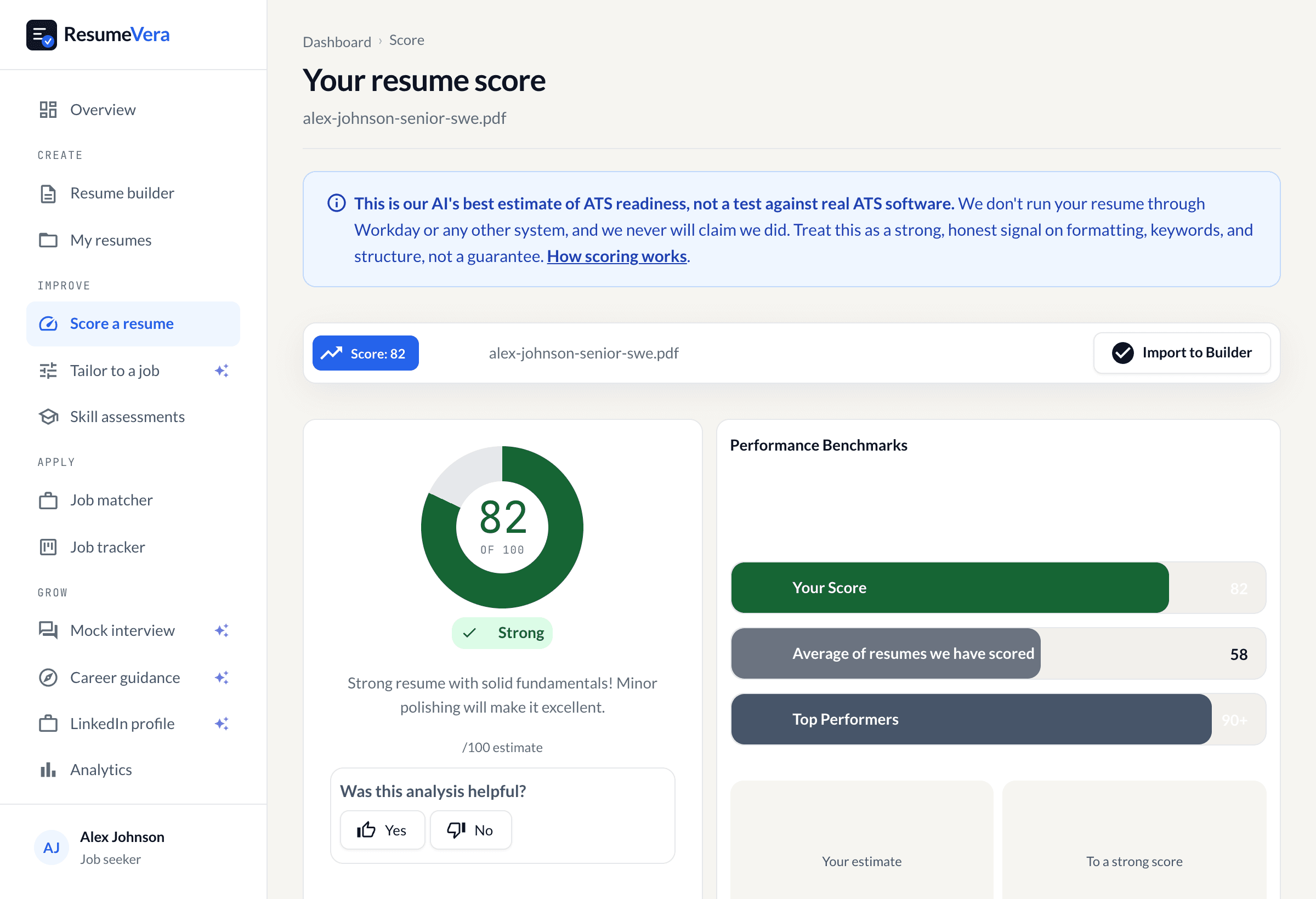
The real score page, with a sample resume and sample scores.
Is your resume ATS ready?
Run a free ATS score check and get specific improvements in seconds.