Written for the India job market, so salaries and formats follow Indian conventions. See the US version.
Career Growth
Probation period in India
Last reviewed: 4 October 2026. What it is, what official sources say about length, notice, confirmation, benefits and extension, plus sample emails.
The ResumeVera editorial team
Resume and hiring research, reviewed against current employer guidance.
Updated 2026-10-04T16:56:14.584Z
16 min
Section 01
Probation period in India: the short answer
Last reviewed: 4 October 2026. This guide explains what official sources say about probation and what Indian employers commonly do. It is not legal advice. Your appointment letter and the employer's written policy decide most details, and the sources we link have the final word.
A probation period is an initial stretch of employment during which the employer assesses whether you fit the role before treating you as a regular, confirmed employee. In India it is mostly a matter of contract and company policy. The main points from the official pages we read:
- We found no central statute that sets one probation length for every private job. The only fixed figure we could read in a government text is three months, in the 1946 model standing orders, and it applies to workmen in establishments covered by standing orders.
- Those model standing orders say a probationer is not entitled to notice or pay in lieu if their services are terminated. State shops and establishments laws can differ, and the Delhi Shops Act, for example, requires notice only once an employee has three months of continuous employment.
- No statute we read requires a "confirmation letter" or says you become confirmed automatically when the probation date passes. A 2026 Delhi High Court judgment on a bank employee said confirmation there was not an automatic consequence of mere passage of time.
- The labour codes took effect on 21 November 2025, the rules are still settling, and new model standing orders were reported in 2026. We could not open an official copy of them, so check labour.gov.in before relying on any figure here.
| Question | What we could confirm | Where |
|---|---|---|
| Fixed probation length | Three months in 1946 model orders | Central Rules, 1946 |
| Confirmation letter required | Not found in any source read | Pointer only |
| Notice in probation | None under 1946 model orders | Clause 13 |
| Appointment letter | Duty in OSH Code s.6(1)(f) | OSH Code |
Related reading on this site: the live guide on offer letter and appointment letter formats gives a short overview of probation, notice and bond clauses. This page goes deeper on probation itself.
Section 02
What probation means and how long it usually runs
Probation is not a legal status that every private employer must create. It is a term an employer writes into the appointment letter or employment contract. Typical contents are the length, what you will be assessed on, whether the period can be extended, what notice either side gives, and what happens at the end.
What official sources show about length
We did not find an official source that states a typical or maximum probation for private employers, so this page does not give one. Two examples from official texts show how different the numbers can be:
- The Industrial Employment (Standing Orders) Central Rules, 1946, Schedule I, clause 2, define a probationer as a workman "provisionally employed to fill a permanent vacancy in a post" who "has not completed three months' service therein", and a permanent workman as including a person "who has satisfactorily completed a probationary period of three months" (Central Rules, 1946 (Ministry of Labour and Employment)).
- In a 2026 Delhi High Court judgment about a State Bank of India employee, the appointment letter dated 27 June 2022 placed the petitioner on probation for six months, with the bank entitled to extend the period if work was unsatisfactory (Rajkiran Yadav v. State Bank of India, W.P.(C) 11860/2023 (Delhi High Court, 20 April 2026)). That is one employer's letter, not a norm.
So the practical answer is: read your own letter. Three months and six months both appear in official texts, but neither is a rule for every job.
Probation, trainee, apprentice and fixed-term are different things
- Probationer: hired into a permanent post and being assessed.
- Apprentice: a learner on an allowance. The 1946 rules describe an apprentice as "a learner who is paid an allowance during the period of his training", and the Payment of Gratuity Act and the OSH Code definition of employee both exclude apprentices, which is why the label on your letter matters.
- Fixed-term employee: engaged on a written contract for a fixed period. The Industrial Relations Code defines fixed term employment as "the engagement of a worker on the basis of a written contract of employment for a fixed period".
Section 03
Standing orders, model standing orders and the Industrial Relations Code
Standing orders are written rules of service that certain establishments must have. They are the one place in central law where "probationer" appears as a defined class.
The 1946 Act and its Schedule
The Industrial Employment (Standing Orders) Act, 1946 applied to establishments employing "one hundred or more workmen" on any day of the preceding twelve months. Its Schedule lists matters standing orders must cover, including "Classification of workmen, e.g., whether permanent, temporary, apprentices, probationers, or badlis" and "Termination of employment, and the notice thereof to be given by employer and workmen" (Industrial Employment (Standing Orders) Act, 1946 (India Code)).
What the 1946 model standing orders say about probationers
| Clause | Wording we read | Meaning |
|---|---|---|
| 2 (probationer) | Not completed three months' service in a permanent post | Probation ends at three months in these orders |
| 13 (permanent) | One month's notice if paid by the month, two weeks for others | Notice applies after confirmation |
| 13 (probationer) | No notice or pay in lieu | Probationers can be terminated without notice |
The Industrial Relations Code, 2020
The Industrial Relations Code, 2020 replaces the 1946 Act. Section 28 applies its standing-orders chapter to "every industrial establishment wherein three hundred or more than three hundred workers, are employed, or were employed on any day of the preceding twelve months", and section 29 says the Central Government "shall make model standing orders" (Industrial Relations Code, 2020 (Ministry of Labour and Employment)). A Press Information Bureau release of 21 November 2025 describes the threshold as "Raised from 100 to 300 employees" (India's Labour Reforms: Simplification, Security, and Sustainable Growth (Press Information Bureau)). The Industrial Relations Code (Amendment) Act, 2026, gazetted on 16 February 2026, lists the 1946 Act among enactments to be repealed and says it is deemed in force from 21 November 2025, with the exact repeal date tied to a notification (The Industrial Relations Code (Amendment) Act, 2026 (Ministry of Labour and Employment)).
Model standing orders issued in 2026
Legal-press reports say the Central Government notified new Model Standing Orders in May 2026 under section 29, and that the service-sector version contains probation terms. We could not open an official copy, so this page does not state their length, extension or notice terms. Search "Model Standing Orders 2026" on labour.gov.in or the e-Gazette and read the clause on probationers before relying on the 1946 figures above. An earlier Ministry release on draft model standing orders (2 January 2021) said that where an employer adopts the central model standing orders, they are "deemed to have been certified" (Draft Model Standing Orders release (Press Information Bureau, 2 January 2021)).
Whether any of this reaches your job depends on your employer's size and type. Many employers fall outside the standing-orders threshold, which is why your letter usually matters more.
Section 04
Shops and establishments acts: what two state pages say
Offices, shops, IT firms and many service businesses fall under a state Shops and Establishments Act rather than the standing-orders regime. These laws differ by state, and we read three official pages. None of them has a general probation clause.
Delhi Shops Act, 1954
- Notice (section 30): "No employer shall dispense with the services of an employee who has been in his continuous employment for not less than three months, without giving such person at least one months' notice in writing or wages in lieu of such notice". Notice is not required where services end "for misconduct, after giving him an opportunity to explain the charge or charges against him in writing".
- Appointment letter (section 34): "The employer shall furnish every employee with a letter of appointment" with particulars including the employer's name, the establishment's address, the employee's name, hours of work and date of appointment.
- Leave (section 22): not less than fifteen days of privilege leave after every twelve months' continuous employment and not less than twelve days of sickness or casual leave in every year; the page also states shorter qualifying periods (four months for five days of privilege leave, one month for one day of casual leave).
Source: The Delhi Shops Act, 1954 (Labour Department, Government of NCT of Delhi). The page has no mention of probation.
Maharashtra Shops and Establishments Act, 2017
Section 1(3)(a) applies the Act (except section 7) to "establishments employing ten or more workers". Under section 18(2) every worker is entitled to eight days of casual leave in a calendar year, added quarterly, and under section 18(3) a worker with "two hundred and forty days or more" in a calendar year gets leave with wages in the next year at one day for every twenty days worked. The extract we read had no probation, appointment-letter or notice provision (The Maharashtra Shops and Establishments (Regulation of Employment and Conditions of Service) Act, 2017 (India Code)).
Tamil Nadu
We read the Tamil Nadu Shops and Establishments Rules, 1948 on the state labour department site and found no rule on probation or probationers (Tamil Nadu Shops and Establishments Rules, 1948 (Labour Department, Government of Tamil Nadu)). The Act's India Code page showed no section text when we opened it. We read nothing on other states.
What this means: if your state's act applies, it may give you notice rights after a qualifying period, a letter of appointment and leave that accrues with service. It does not, on these pages, define probation. Check your state's current act and rules on the labour department site.
Section 05
The labour codes, appointment letters and where probation fits
The Press Information Bureau stated on 21 November 2025 that the four Labour Codes become effective on that date and that, "During transition, the relevant provisions of the existing labour Acts and their respective rules, regulations, notifications, standards, schemes, etc. will continue to remain in force" (Government Makes the Four Labour Codes effective (Press Information Bureau, 21 November 2025)). The Ministry's FAQ document (undated) says old rules stay in force "till final notification of new rules under the Code, to the extent these are in line with Codes" (FAQs on Labour Codes (Ministry of Labour and Employment)). We found no page confirming the exact position on 4 October 2026 for every rule, so treat transition questions as open and check labour.gov.in.
Appointment letter: where probation terms should sit
Section 6(1)(f) of the OSH Code requires the employer to "issue a letter of appointment to every employee on his appointment in the establishment, with such information and in such form as may be prescribed by the appropriate Government", and gives those without one three months from commencement (Occupational Safety, Health and Working Conditions Code, 2020 (Ministry of Labour and Employment)). The Code defines an employee widely, with an exclusion for apprentices engaged under the Apprentices Act, 1961. The prescribed form of the letter, and whether it must mention probation, we could not confirm. The Ministry's Compliance Handbook lists the appointment letter among employer duties and has no entry on probation (Compliance Handbook for Employers Under the Four Labour Codes (Ministry of Labour and Employment)).
Practical consequence: ask for the appointment letter and check it states the probation length, the extension clause, notice terms and how confirmation is communicated. The offer letter guide linked in section 1 covers the letter itself, so we do not repeat it here.
Section 06
Confirmation letter: what exists and what happens if none is issued
A confirmation letter is the employer's written statement that you have completed probation and are now a regular employee. Many Indian employers issue one and some do not. We read the Standing Orders Act, the 1946 central rules, the Industrial Relations Code, the OSH Code, the Compliance Handbook and the Delhi and Maharashtra shops acts, and none of them requires a confirmation letter by that name.
What the sources do say
- The 1946 model orders define a permanent workman as including "any person who has satisfactorily completed a probationary period of three months". That wording ties permanent status to completing probation satisfactorily, within covered establishments.
- In Rajkiran Yadav v. State Bank of India, the Delhi High Court (20 April 2026) placed the case where confirmation "depends upon the fulfilment of additional conditions and is not an automatic consequence of mere passage of time". The appointment letter there made confirmation subject to satisfactory character and antecedent reports (Judgment, Delhi High Court). That judgment concerns a public sector bank and its own terms, so it is one illustration, not a rule for private employers.
What we cannot say
We did not find a primary source saying that you are deemed confirmed if the probation date passes and nobody writes to you, or that you are not. The answer in a dispute depends on your letter, the company policy, the standing orders if any, and the facts, and is a question for a lawyer or the state labour office. Do not assume either way.
If the date has passed and you have heard nothing
- Reread the probation and confirmation clauses in your appointment letter and the HR policy.
- Ask your manager and HR in writing for the confirmation status (sample in section 10).
- Keep your payslips, performance reviews and any email calling you a permanent or confirmed employee.
- If the reply is unclear or there is a dispute, contact your state labour office or take legal advice.
Section 07
Notice during probation and termination in probation
There are two questions here: how much notice you must give if you leave, and how much the employer must give if it ends your employment. The answers come from your contract first and, where they apply, from standing orders or the state shops act.
| Source | Employer ending probation | Notes |
|---|---|---|
| 1946 model orders, clause 13 | No notice or pay in lieu for a probationer | Workmen in covered establishments |
| Delhi Shops Act, s.30 | One month's notice or wages once employment reaches three months | Misconduct exception with a chance to explain |
| Your appointment letter | Whatever it states | Often differs from both |
When you resign during probation
The statutes we read do not set a notice period for resigning from probation. The Delhi Shops Act page ties its notice duty to employees with three months of continuous employment. Your letter normally fixes the period, which is often shorter during probation, and the employer may accept shorter notice in writing. For buyout and recovery mechanics see our notice period buyout guide and, for the letter itself, the resignation letter format guide.
When the employer ends your probation
- Under the 1946 model orders no notice is due to a probationer; under the Delhi Shops Act notice is due once three months of continuous employment are complete, unless the exit is for misconduct after an opportunity to explain.
- In the Delhi High Court case, the court noted that communications styled as disciplinary at the start did not by themselves change the legal character of the final action.
- The Code on Wages, section 17(2), says that where an employee has been removed, dismissed, retrenched or has resigned, the wages payable "shall be paid within two working days" (Code on Wages, 2019 (Ministry of Labour and Employment)). Section 18(1) allows only deductions authorised under the Code. Whether a particular recovery is authorised we did not confirm.
- For the final payment, leave pay and documents, see our guides on full and final settlement and experience letters.
Worked example (illustrative, not a legal outcome)
Asha works in a Delhi office. Her letter gives a six month probation with fifteen days' notice either side. At month four the employer ends her employment without alleging misconduct. The letter says fifteen days, while the Delhi Shops Act page says one month's notice once employment reaches three months. Which term applies, and whether her establishment is covered, is for the labour office or a lawyer to say; the safe step for Asha is to ask for the notice basis in writing and keep her records.
Section 08
Leave and benefits during probation: PF, ESI, gratuity and leave
Being on probation does not, on the pages we read, switch off the statutory schemes. What matters is whether you are an employee of a covered establishment and whether you earn within the limits.
| Benefit | What the official page says | Probation point |
|---|---|---|
| Provident fund | Employee of a covered establishment is "compulsorily a member", unless excluded | Probationers not addressed; apprentices excluded |
| ESI | Covers establishments with 10 or more persons; wage limit stated | No probation carve-out found |
| Gratuity | Five years of continuous service; one year for fixed-term | Most probationers will not yet qualify |
| Leave | State acts set qualifying service | Check your state's page |
Provident fund
The EPFO FAQ says: "An employee of a covered establishment, if not excluded, is compulsorily a member of the employees' Provident Fund Scheme. The employer of the establishment himself makes the employee a member by following prescribed procedure". It says an apprentice should not be enrolled but "when he ceases to be an apprentice he should be enrolled immediately". It also describes a ceiling of Rs. 15,000 a month of basic plus dearness allowance for eligibility, with members above it continuing and contributing on a restricted wage (Frequently Asked Questions (Employees' Provident Fund Organisation)). The FAQ has no separate question on probationers; the page is undated. If your employer is covered and you are not an apprentice, ask for your UAN and check it appears on your payslip deductions, then look at the passbook on the EPFO portal.
ESI
The ESIC coverage page lists "all non-seasonal factories employing 10 or more persons" and a wage limit of Rs. 21,000 a month (Rs. 25,000 for persons with disability) "effective from 01.01.2017", and its statistics are as of March 2023, so it may be dated (Coverage (Employees' State Insurance Corporation)). The contribution page gives 0.75 per cent of wages from the employee and 3.25 per cent from the employer, effective 1 July 2019, and describes six-month contribution and benefit periods (Contribution (Employees' State Insurance Corporation)). The Compliance Handbook says ESI applies to establishments with 10 or more persons and to hazardous activities even with one employee. We found no probation exemption, so ask HR whether you are registered if your wage is within the limit.
Gratuity
The Payment of Gratuity Act, 1972, section 4(1), makes gratuity payable "after he has rendered continuous service for not less than five years", with exceptions for death or disablement, and section 7 requires payment "within thirty days from the date it becomes payable". Section 2(e) excludes apprentices; the extract we read did not mention probationers (The Payment of Gratuity Act, 1972 (Ministry of Labour and Employment)). The Compliance Handbook repeats five years under the Code on Social Security, and one year for fixed-term employees, which the Press Information Bureau also reported on 22 November 2025 (Code on Social Security, 2020: Towards Universal and Inclusive Social Protection (Press Information Bureau)). Whether probation months count towards continuous service depends on how service is counted from the date of joining; ask HR and read section 2A of the Act. We do not state the maximum amount because it is stated as a limit that the Central Government sets.
Leave
Leave in probation is usually set by company policy and the state act. The Delhi page shows leave building up with months of service, and the Maharashtra Act adds casual leave quarterly while privilege leave depends on days worked in a year. For maternity benefit, the Maternity Benefit Act has a minimum days-worked condition; the copy on labour.gov.in that we opened is the original 1961 text and later amendments exist, so we do not quote a figure and suggest reading the current Act (Maternity Benefit Act, 1961 (Ministry of Labour and Employment)). For leave encashment on exit, see our guide on leave encashment on resignation.
Section 09
Extension of probation
An extension means the employer keeps you on probation beyond the original date, usually because it wants more time to assess you. We found no statute or model order we could read that limits how often or how long probation can be extended for private employers. The 1946 model orders define probation as three months; they do not say whether it can be extended.
What the sources and common practice give you:
- The letter decides. In the State Bank of India case the appointment letter itself allowed extension "if work was unsatisfactory". Check whether yours has a clause and any cap on the total period.
- The 2026 model orders. See section 3: read the official text for any extension rule.
- Written, with reasons and dates. A fair extension is communicated before the original date, in writing, with the new end date and what you must achieve. That is our editorial advice, not a legal rule.
- Confirmation is not automatic. See section 6.
What to do if probation is extended
- Ask for the extension in writing, with the new end date and the criteria.
- Keep copies of reviews and emails.
Raise probation terms before you sign: see our guide on salary negotiation in India.
Section 10
How to ask for confirmation, with two samples
These are samples to show the shape of the messages. They are not legal documents. Replace every [bracketed] field and adapt the tone to your workplace.
Ask in the last two to three weeks before the probation end date, or soon after it if you have heard nothing. Write to your manager and copy HR so the request is on record.
Sample A: confirmation request email
Subject: Probation review and confirmation, [Your name], [Employee ID]
Dear [Manager's name],
I joined as [designation] on [joining date], and my appointment letter states a probation period of [length] ending on [probation end date]. I would like to request a review of my probation and confirmation of my employment.
Over this period I have [two or three specific contributions, for example the projects delivered, goals met or feedback received]. I would welcome any feedback on areas to improve before the review.
Could you please let me know the date of the review and what the process and timeline are for the confirmation letter? I have copied [HR contact name] so the records can be updated.
Thank you,
[Your name], [designation], [phone or email]
Sample B: reply to a probation extension
Subject: Re: Extension of probation, [Your name], [Employee ID]
Dear [Manager's name] and [HR contact name],
Thank you for informing me on [date] that my probation will be extended to [new end date]. I would like to confirm the details in writing.
- Please share the reasons for the extension and the specific goals I should meet by [new end date].
- Please confirm whether the extension changes my notice period, pay, leave or benefits as set out in my appointment letter dated [date].
- Please confirm the clause in my letter or policy that provides for the extension, and the date of the next review.
I am committed to meeting these expectations and would like to schedule a check-in on [proposed date]. Please share the written extension letter for my records.
Regards,
[Your name], [designation]
Where to complain if things go wrong
This guide cannot tell you what a court or labour authority would decide. For disputes about notice, wages or benefits, contact your state labour office or the Ministry of Labour and Employment through labour.gov.in, or a qualified lawyer.
Section 11
Sources and references
Limits. Labour rules are moving from the old Acts to the four codes, states have their own laws, and your contract decides most probation terms. This page cannot tell you which regime covers your employer, which notice applies, or what a court would decide. Some pages we read are undated or may be out of date, and we could not open the official 2026 model standing orders. For disputes, contact your state labour office or the Ministry of Labour and Employment at labour.gov.in, or a qualified lawyer.
Every legal or payroll statement above comes from an official page we opened on 4 October 2026. Check each link for the current version.
- Government Makes the Four Labour Codes effective (Press Information Bureau, 21 November 2025): Effective date 21 November 2025; transition wording; mandatory appointment letters.
- India's Labour Reforms: Simplification, Security, and Sustainable Growth (Press Information Bureau, 21 November 2025): Standing orders threshold raised from 100 to 300.
- Code on Social Security, 2020: Towards Universal and Inclusive Social Protection (Press Information Bureau, 22 November 2025): Gratuity eligibility for fixed-term employees reduced to one year.
- The Occupational Safety, Health and Working Conditions Code, 2020 (Ministry of Labour and Employment): Section 6(1)(f) appointment letter; definition of employee.
- The Industrial Relations Code, 2020 (Ministry of Labour and Employment): Sections 28 and 29 standing orders and model standing orders; fixed term employment definition.
- The Industrial Relations Code (Amendment) Act, 2026 (Ministry of Labour and Employment, gazette 16 February 2026): Lists the 1946 Standing Orders Act among enactments to be repealed; deemed in force from 21 November 2025.
- Code on Wages, 2019 (Ministry of Labour and Employment): Section 17(2) two working days; section 18(1) deductions.
- Compliance Handbook for Employers Under the Four Labour Codes (Ministry of Labour and Employment): Appointment letter, gratuity, ESI coverage; no probation entry.
- FAQs on Labour Codes (Ministry of Labour and Employment, undated): Old rules remain in force till final notification, to the extent in line with Codes.
- Industrial Employment (Standing Orders) Act, 1946 (India Code): Schedule items on classification (probationers) and termination notice; 100 workmen threshold.
- Industrial Employment (Standing Orders) Central Rules, 1946, Schedule I (Ministry of Labour and Employment): Clause 2 probationer definition; clause 13 notice; clause 14 misconduct.
- Government publishes the Draft Model Standing Orders (Press Information Bureau, 2 January 2021): Model orders adopted by an employer are deemed certified.
- The Delhi Shops Act, 1954 (Labour Department, Government of NCT of Delhi): Sections 22, 30 and 34: leave, notice after three months, appointment letter.
- The Maharashtra Shops and Establishments Act, 2017 (India Code): Applicability to ten or more workers; casual and privilege leave.
- The Tamil Nadu Shops and Establishments Rules, 1948 (Labour Department, Government of Tamil Nadu): Read for probation rules; none found.
- The Payment of Gratuity Act, 1972 (Ministry of Labour and Employment): Sections 1(3), 2(e), 4(1), 4(2), 7.
- Frequently Asked Questions (Employees' Provident Fund Organisation, undated): Compulsory membership of covered employees; apprentices; Rs. 15,000 ceiling.
- ESI Coverage (Employees' State Insurance Corporation): 10 or more persons; wage limit effective 1 January 2017.
- ESI Contribution (Employees' State Insurance Corporation): 0.75 and 3.25 per cent from 1 July 2019; contribution and benefit periods.
- Maternity Benefit Act, 1961 (Ministry of Labour and Employment): Original text; minimum days-worked condition exists; amended since.
- Rajkiran Yadav v. State Bank of India, W.P.(C) 11860/2023 (Delhi High Court, 20 April 2026): Probation of six months, extension, confirmation not automatic with passage of time.
Pro tips
Do these
Read the probation, notice and extension clauses of your appointment letter on day one and save a copy.
Put the probation end date in your calendar with a reminder three weeks before.
Keep a short log of goals met, feedback received and emails that show your performance.
Ask for confirmation, or for an extension decision, in writing and keep the reply.
Check that your UAN and PF deductions appear from the start if your employer is covered.
If probation is extended, ask for the reasons, new date and criteria in writing.
Check labour.gov.in for the current model standing orders and your state labour department site for the current shops act.
Avoid these
Delete these
Assuming you are confirmed automatically because the probation date has passed.
Assuming probation means you have no rights; wages, PF and ESI rules still apply where covered.
Not asking for the appointment letter, so probation terms exist only in conversation.
Accepting an extension verbally without a new end date or criteria.
Resigning without reading the notice and recovery clauses in your letter.
Treating a trainee or intern label as irrelevant when you are doing a regular job.
Relying on a forum or video for notice rules instead of the letter and the official sources.
Treating samples or this guide as legal advice.
Put this into a resume
Building and editing are free, and free PDFs carry a small watermark.
Check your resume for freeQuestions
Frequently asked questions
How this guide is maintained
We review this guide every quarter and after any change to the hiring rules or portal behaviour it describes. It was last reviewed on 2026-10-04T16:56:14.584Z. Figures come from named sources, shown beside the number. Where we are estimating rather than measuring, we say so.
By the numbers
3 months
Probationer definition in the 1946 central model standing orders (for covered workmen)
https://labour.gov.in/sites/default/files/industrialemploymentstandingorders1centralrules1946.pdf
Section 30
Delhi Shops Act notice duty once employment reaches three months
https://labour.delhi.gov.in/labour/delhi-shops-act-1954
Section 6(1)(f)
OSH Code duty to issue an appointment letter to every employee
https://www.labour.gov.in/static/uploads/2025/07/36fcfa5d8e6b9145e282bf7b950d6c47.pdf
Try it
Check the guide against your own file
Everything above is general. Your resume is not. Paste it in and the checker tells you which of these points your file actually breaks.
Check your resume free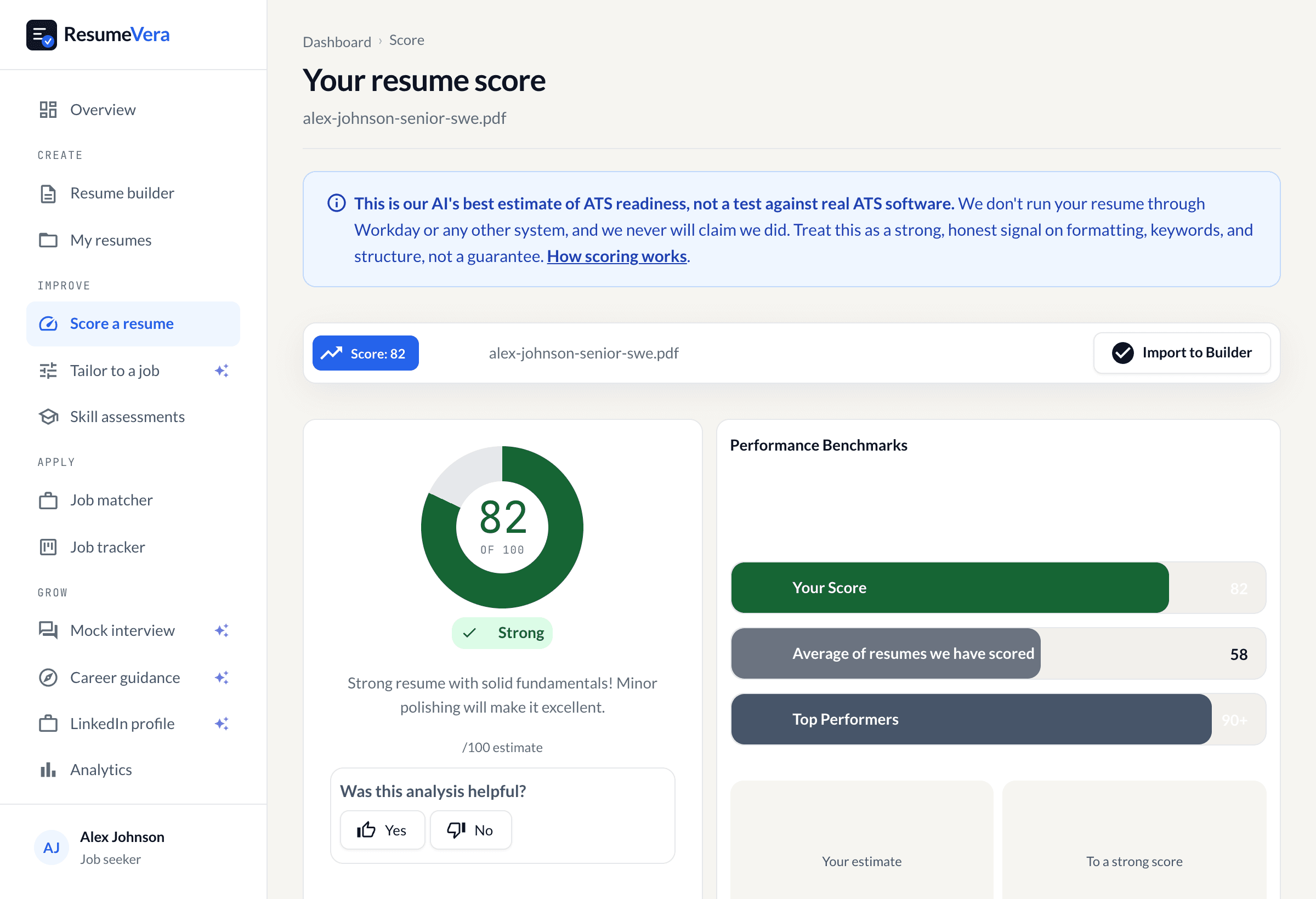
The real score page, with a sample resume and sample scores.
Is your resume ATS ready?
Run a free ATS score check and get specific improvements in seconds.