Written for the India job market, so salaries and formats follow Indian conventions. See the US version.
Career Growth
Service bond, training cost and notice recovery in India
Last reviewed: 4 October 2026. What the Contract Act and wage laws say, what to check in a clause, what to do before you sign, sample emails, and where to complain.
The ResumeVera editorial team
Resume and hiring research, reviewed against current employer guidance.
Updated 2026-10-04T16:56:16.398Z
16 min
Section 01
Service bond, training cost and notice recovery: the short answer
Last reviewed: 4 October 2026. This guide explains what official sources say about employment bonds and recovery clauses and what Indian employers commonly write. It is not legal advice. Your signed documents decide the details, how a court would treat a particular clause depends on the facts, and a lawyer should be consulted before you act on a dispute.
People search for this as service bond, employment bond, training cost recovery, notice period recovery or clawback. In plain terms, these are clauses in an offer letter, appointment letter or separate bond agreement that say you must stay for a minimum period, or pay money if you leave early or do not serve your full notice.
No official source we read defines "service bond" or "notice recovery" as a legal category. What the official texts do contain is general law that such clauses run into: the Indian Contract Act, 1872 on restraint of trade (section 27) and on compensation when a sum is named for breach (section 74), and the wage laws on what an employer may deduct from your pay.
| Clause | What it usually says | Ask first |
|---|---|---|
| Service bond | Stay for [N] months or pay [amount] | Does the amount reduce over time? |
| Training cost recovery | Repay course, certification or relocation spend | Is it actual, documented cost? |
| Notice recovery | Pay for unserved notice days | What is the daily rate and what base is used? |
For the wider offer-letter picture (offer versus appointment letter, CTC breakup, probation), see our guide on the offer letter and appointment letter format, which we do not repeat here.
Section 02
The three kinds of clause and how they are usually worded
The wording matters more than the label. Read your own document against these patterns.
1. Minimum service period (the bond)
The clause says you agree to serve for a fixed period after joining, or after a promotion, relocation or training. If you leave earlier, you agree to pay a stated sum, a formula, or "the cost incurred by the company". Some clauses are a flat sum for any early exit. Others reduce the amount for each completed month.
2. Training or joining cost recovery
The clause says the company will recover what it spent on your training, certification, visa, relocation or joining benefits if you leave within a period.
3. Notice period recovery
The clause says that if you leave without serving the full notice period in your contract, you pay for the shortfall days, usually at a daily rate worked out from a pay figure. The pay figure matters: fixed pay, a "basic plus allowances" figure and total CTC give very different daily rates. Our guide on notice period buyout covers how buyouts work in practice.
A related clause: non-compete
Some letters bar you from joining a competitor or approaching clients. That restrains what you do after you leave, which is what section 27 speaks to (next section).
Arithmetic illustration only
These placeholder numbers only show how a reducing schedule works. They are not typical figures.
| Clause wording | Months served | Amount claimed |
|---|---|---|
| Flat: Rs 60,000 if you leave within 12 months | 9 | Rs 60,000 |
| Reducing: Rs 60,000 reduced by Rs 5,000 for each completed month | 9 | Rs 15,000 |
Same period, same headline sum, a four-fold difference in what is claimed.
Section 03
What the Indian Contract Act says: sections 27 and 74
The Indian Contract Act, 1872 is on India Code (Government of India). We read India Code, The Indian Contract Act, 1872 on 4 October 2026. The text extract we obtained reads as follows. Check the wording against the PDF before relying on it.
Section 27: agreement in restraint of trade void
"Every agreement by which any one is restrained from exercising a lawful profession, trade or business of any kind, is to that extent void."
The same section carries an exception for a person who sells the goodwill of a business and agrees with the buyer to refrain from carrying on a similar business, within specified local limits, so long as those limits appear to the Court reasonable.
Section 73: compensation for breach of contract
Section 73 allows compensation for loss "which naturally arose in the usual course of things from such breach", and not for "any remote and indirect loss or damage sustained by reason of the breach".
Section 74: compensation when a sum is named
Section 74 deals with contracts that name a sum payable on breach. In the extract we obtained, it entitles the party complaining of the breach to receive "reasonable compensation not exceeding the amount so named". Its Explanation says that "a stipulation for increased interest from the date of default may be a stipulation by way of penalty". Read the full section in the PDF, because our extract elided part of its opening wording.
What this text does and does not tell you
| Text | Plain reading | Open question |
|---|---|---|
| Section 27 | Restraint of a lawful trade is void to that extent | Does your clause restrain work, or only set a cost for leaving early? |
| Section 73 | Compensation covers loss that naturally follows breach | What loss did the employer actually suffer? |
| Section 74 | Named sum: reasonable compensation up to that amount | Is the named sum reasonable for your facts? |
The right-hand column is the point. Whether a particular bond, training cost clause or notice recovery clause is enforceable, and for how much, is decided by a court on the facts: the wording, what you signed and when, what you received and what the employer actually lost. We do not quote any court judgment on this page because we could not locate and verify one on an official court website this run, so we make no claim about how courts have ruled. Consult a lawyer before you pay a large sum or refuse to pay one.
Section 04
Deductions from final pay: what the wage laws say
A common situation: the employer says it will "adjust" the bond amount or notice shortfall against your last salary or settlement. Whether it may deduct from wages is a separate question from whether the clause is valid. Two Acts are relevant, and which applies to you is left open by the sources (see the transition note below).
The Code on Wages, 2019
We read the Code on Wages, 2019 as published by the Ministry of Labour and Employment (Code on Wages, 2019). The extracts we obtained say:
- Section 18(1): "There shall be no deductions from the wages of the employee, except those as are authorised under this Code."
- Section 18(2) lists the authorised deductions, clauses (a) to (o). As extracted, they cover fines; absence from duty; damage to or loss of goods entrusted to the employee "where such damage or loss is directly attributable to his neglect or default"; house accommodation; amenities and services; advances and overpayment of wages; certain loans; income-tax, statutory levies and court-ordered deductions; provident fund and other social security contributions; co-operative society payments; trade union fees and the Prime Minister's National Relief Fund (both with written authorisation); and railway-administration losses.
- Section 18(3): the total of deductions under section 18(2) in any wage period "shall not exceed fifty per cent. of such wages".
- Section 17(2): on removal, dismissal, retrenchment or resignation, wages must be paid "within two working days".
- Section 60: a contract by which an employee relinquishes a right to any amount due under the Code is "null and void in so far as it purports to remove or reduce the liability of any person to pay such amount under this Code".
- Section 45: claims go to an authority appointed by the appropriate Government (see section 10 below).
In the list as extracted, no clause names recovery of a service bond, training cost or unserved notice as a deduction head. We did not read every rule around it, so we do not say no route exists. The practical question to put to HR is: which clause of section 18(2) authorises this deduction? Ask for the answer in writing. Note that written authorisation is named only in some heads (trade union fees, the relief fund), not as a general consent.
The Payment of Wages Act, 1936
The older Act (The Payment of Wages Act, 1936, India Code), says in section 7(1) that wages "shall be paid to him without deduction of any kind except those authorised by or under this Act". The Code on Wages, in section 69 as extracted, repeals it, and the Ministry's factsheet says the Code amalgamates it (Press Information Bureau factsheet, 23 November 2025).
Transition: which regime applies today?
The Press Information Bureau release of 21 November 2025 (Press Information Bureau, four Labour Codes) says "the four Labour Codes are being made effective from 21st November 2025" and that "during transition, the relevant provisions of the existing labour Acts and their respective rules, regulations, notifications, standards, schemes, etc. will continue to remain in force". The Ministry FAQs (FAQs on Labour Codes, Ministry of Labour and Employment, undated) say old rules remain in force till final notification of new rules, to the extent they are in line with the Codes, and the Annual Report 2025-26 (Annual Report 2025-26, Ministry of Labour and Employment) says the rules under the four Codes were pre-published for comments on 30 December 2025. We found no official page confirming final rules as of 4 October 2026, so check the Ministry's site.
The Ministry factsheet describes the deduction rules as applying to all employees regardless of salary level. Whether the Industrial Relations Code treats you as a "worker" (section 2(zr) excludes primarily managerial roles and supervisors above a stated wage limit) affects which dispute routes are open, so check it against your role.
Gratuity
In the Payment of Gratuity Act, 1972 (The Payment of Gratuity Act, 1972, Ministry of Labour and Employment), section 4(6) allows forfeiture of gratuity only where services were terminated for an act, wilful omission or negligence causing damage or loss to employer property, "to the extent of the damage or loss so caused". Section 7(3) says payment is due within thirty days from the date it becomes payable. We did not verify how the Code on Social Security treats this now. See our note on leave encashment on resignation.
Section 05
Notice period: what official texts say and what your contract decides
Notice recovery only arises if your contract has a notice period and you leave without serving it. The official texts we read show how some regimes handle notice, and none of them replaces your own contract.
| Source | What it says | Applies to |
|---|---|---|
| Model standing orders, clause 13(1) | Permanent workmen: one month in writing for those paid by the month, two weeks for others, by employer or workman | Workmen in covered establishments |
| Delhi Shops Act, 1954, section 30 | Employer needs one month's written notice or wages in lieu after three months' continuous employment; employee has a matching notice duty | Establishments under that Act in Delhi |
Sources: Industrial Employment (Standing Orders) Central Rules, 1946, Schedule I and The Delhi Shops Act, 1954, Labour Department, Government of NCT of Delhi. Clause 13(2) gives probationers and temporary workmen no notice or pay in lieu, and clause 13(3) says dues "shall be paid before the expiry of the second working day". These are examples, not a rule for every private office job. State shops and establishments Acts differ, and most corporate jobs are governed by the notice period in the appointment letter.
Check the notice length during probation and after confirmation, the recovery formula (days short times which daily rate, from which pay figure), whether a buyout or waiver is possible in writing, and whether leave can be adjusted against notice (company policy, so ask). Our resignation letter format guide covers wording the resignation and last working day.
No official source we read says a particular notice period or a particular recovery is mandatory for office employees generally. If an employer says the law requires it, ask for the provision.
Section 06
What to check in a bond or recovery clause
Mark each item "clear", "unclear" or "missing", and ask about every item that is not clear.
- The trigger: what starts recovery (resignation, termination, absconding, unfinished training)? Does it apply if the company ends your job or changes your role, location or pay?
- The period: how long, and from what date (joining, confirmation, end of training)?
- The amount: a named sum, a formula, or "actual cost"? If a formula, are all inputs defined?
- Reduction: does the amount fall as months pass (see the arithmetic in section 2)?
- The cost covered: real, documented spend, or a round figure? Will the company show you the invoices?
- Where the money comes from: does the clause say the company may deduct from salary or settlement? If so, see section 4 and ask which provision of the wage law authorises it.
- Documents: may the company hold your originals or delay your relieving letter until you pay? See section 8 and our guide on the experience letter format.
- Interest: is interest added, and from when? Section 74's Explanation says increased interest from default may be a stipulation by way of penalty.
- A non-compete or non-solicit clause: its length, area and what it covers (section 27 context).
- Your copy: do you hold the signed version, every annexure and any separate bond agreement?
Red flags in our own checklist (editorial)
- You are asked to sign on joining day with no time to read it.
- The amount is flat and does not reduce.
- The company holds your original certificates as security.
- The clause says "as per company policy" with no policy attached.
Section 07
Before you sign: what to do and a sample negotiation email
The best time to deal with a bond is before you sign it. After you have resigned elsewhere, your options narrow.
- Ask for the full text early: the appointment letter, any bond agreement and the notice policy, while the offer is open. Read them against section 6.
- Ask for specific changes in writing. Typical asks: a reducing schedule, a shorter period, actual documented costs only, no wage deduction without a stated legal basis, release of documents on the last day, and a waiver or buyout option in writing.
- Keep the whole thread. Our guide on salary negotiation in India covers raising terms politely.
- Do not resign from your current job until the new terms are in writing, and read your current contract's own notice and bond terms first.
- Consider a short legal review if the sum is large or the clause limits your next job.
Sample negotiation email (not a legal document)
Replace everything in [square brackets] with your own details.
Subject: Question on service period and recovery clause in my offer for [role]
Dear [HR contact name],
Thank you for the offer for the position of [designation], and for sharing the appointment letter dated [date]. I am keen to accept and would like to clarify a few points in clause [clause number] on [service period / training cost / notice recovery] before I sign.
1. The clause names [amount or formula] for an early exit within [period]. Could you confirm whether this reduces for each completed month of service, and if so share the schedule?
2. Could you confirm what costs it covers, and share the supporting figures for [training / certification / relocation]?
3. Could you confirm whether any recovery would be made as a deduction from salary or final settlement, and if so which provision it relies on?
4. Could you confirm that my relieving letter and experience letter will be issued on my last working day regardless of any amount in dispute?
5. If I serve [number] days of notice, could you confirm whether the balance can be waived or bought out, and on what terms?If any of these can be recorded in the letter itself, I would be happy to sign the revised version by [date]. Please let me know a convenient time to discuss.
Regards,
[Your full name]
[Phone] | [Email]
If the employer will not put any of it in writing, weigh that before accepting.
Section 08
If the employer withholds documents or pay
Bond disputes often show up as withheld paperwork or a delayed settlement. Keep every step in writing.
Step 1: build a record
- Save your appointment letter, any bond agreement, the resignation email and its acceptance, last salary slips and any settlement statement. Our guide on the salary slip format shows what a slip should show.
Step 2: ask in writing for the calculation
Ask HR for the clause number, the amount, the formula and the supporting figures, and ask which provision lets the company deduct it from your pay. A sample reply follows in section 9.
Step 3: know what the official texts say about timing
- Under the Code on Wages, section 17(2), wages are payable "within two working days" of resignation, and the Ministry's factsheet repeats this for resignation and termination. See our full and final settlement guide for the wider timelines.
- Unauthorised deductions are restricted (section 18) and the 50 per cent cap applies to authorised deductions in a wage period. A deduction you dispute is a matter for the claims route in section 10.
Step 4: provident fund without the employer
If the employer is slow to cooperate on provident fund, the EPFO FAQ page (Frequently Asked Questions, Employees' Provident Fund Organisation, undated) says a member can submit three types of claim without employer attestation, namely Form-19, 10C and 31, provided the UAN is active and bank and Aadhaar KYC are approved by the employer. Where the employer will not cooperate, it says the form may be attested by the manager of your savings bank, or KYC can be updated through the field office with attestation by an authorised official.
Step 5: original certificates and relieving letter
We found no official source saying whether an employer may hold original certificates, or withhold a relieving or experience letter until a disputed sum is paid, so we make no claim either way. Ask which clause allows it, get a dated receipt for any original held, request its return in writing, and take legal advice if it is withheld.
Step 6: escalate
If written requests fail, make a formal complaint (section 10). Do not sign a "no dues" document for an amount you dispute without reading it, and take advice first.
Section 09
Sample reply to a recovery demand
Use this if you receive a demand for a bond amount, training cost or notice shortfall. It asks for the basis and keeps the tone professional. It is a sample, not a legal notice, and it does not say the demand is invalid; that is for you and your lawyer to decide.
Subject: Your email dated [date] on recovery of Rs [amount]: request for calculation and basis
Dear [HR contact name],
I acknowledge your email dated [date] stating that Rs [amount] is recoverable from me under clause [clause number] of my [appointment letter / bond agreement] dated [date]. My last working day was [date].
I do not accept the amount as stated until I have reviewed its basis. Please share, within [number] working days:
1. A copy of the signed document and every annexure you rely on.
2. The calculation: the formula, the period I am said to be short, the pay figure used and the daily rate.
3. For training or relocation costs, the invoices and records showing the amount spent on me.
4. If you intend to deduct this from my salary or settlement, the provision of law and the clause of my contract that authorises the deduction.
5. A full and final settlement statement showing all amounts due to me, including [salary for the period / leave encashment / reimbursement / other items], and the date they will be paid.I request that my salary slips, relieving letter, experience letter and [Form 16 / original documents held] be released by [date]. I am willing to discuss [a reducing calculation / a waiver / payment in instalments of Rs [amount]] if you can share the above.
I reserve all my rights, including to seek advice and to approach the labour authorities.
Regards,
[Your full name]
[Employee ID] | [Phone] | [Email]
Notes on using it
- Send it by email so there is a timestamp.
- Do not admit a figure before you have the calculation, unless you have decided to settle.
- Get any settlement in a signed document that says what it closes out and that documents will be released.
- If the demand comes from a lawyer or sets a court deadline, get legal advice promptly.
Section 10
Where to complain
The right place depends on the issue and your State. These are the official routes we could confirm.
| Route | What it is | Use it for |
|---|---|---|
| State labour department | State government office with labour officers and claims authorities | Wage claims, shops and establishments matters |
| Claims under the Code on Wages, section 45 | Authority appointed by the appropriate Government | Unpaid wages, unauthorised deductions |
| Grievance Redressal Committee and conciliation (IR Code) | In-house committee for 20 or more workers, then conciliation officer | Disputes by "workers" |
| EPFiGMS | EPFO's online grievance portal | Provident fund and pension issues |
| CPGRAMS | Central public grievance portal | Complaint about a public authority's service |
State labour departments
Labour is a subject on which states run their own offices. As examples, the Tamil Nadu policy note for 2025-26 (Policy Note 2025-26, Labour Welfare and Skill Development Department, Government of Tamil Nadu) says Commissioners for Employees' Compensation have been designated to hear and decide claims arising out of delayed payments or unauthorised deductions under the Payment of Wages Act, 1936, and refers to an online labour services portal at labour.tn.gov.in. The Maharashtra Labour Department site (Mahakamgar, Labour Department, Government of Maharashtra) lists a grievances link on its homepage. We could not open the Karnataka and several other state labour sites, so find your state labour department through your state government's official website and ask the nearest labour office which officer hears wage claims for your type of establishment.
Wage claims under the Code on Wages
As extracted from section 45, the appropriate Government appoints authorities to hear claims. The employee, a registered Trade Union or the Inspector-cum-Facilitator may apply within three years (extendable on sufficient cause), and the authority may order compensation "which may extend to ten times of the claim determined". The Compliance Handbook (Compliance Handbook for Employers Under the Four Labour Codes, Ministry of Labour and Employment) says employers must display the Inspector-cum-Facilitator's name and address. Under the Payment of Wages Act, 1936 the claims route is section 15, and a Delhi Shops Act wage claim has its own one-year limit, so file early and ask the office which statute applies.
Industrial Relations Code route
Section 4 of the Industrial Relations Code, 2020 (The Industrial Relations Code, 2020, Ministry of Labour and Employment), as extracted, requires a Grievance Redressal Committee in establishments with 20 or more workers, applications within one year of the cause of action, a 30-day completion timeline and a 60-day appeal to the conciliation officer. This route is for persons who meet the "worker" definition, so it may not cover managerial or higher-paid supervisory roles.
Central establishments
A Ministry of Labour and Employment release of 20 October 2021 (Ministry of Labour and Employment release, 20 October 2021) lists "redressal of grievances of worker" among the functions of the Chief Labour Commissioner (Central). It gives no complaint procedure, and the Annual Report 2025-26 describes Shram Suvidha modules for employers only, so we cannot give a worker-facing central link. Ask your state labour office whether your employer falls under central or state jurisdiction.
Provident fund and public grievances
EPFiGMS (EPFiGMS, Employees' Provident Fund Organisation) describes itself as a portal to redress grievances for services provided by EPFO, with online lodging based on UAN. CPGRAMS (Centralised Public Grievance Redress and Monitoring System, Department of Administrative Reforms and Public Grievances) is available 24x7 to lodge grievances to public authorities on subjects related to service delivery. It is for service failures by public authorities, not for suing a private employer.
Civil recovery
If the employer sues you, or you want to challenge the clause itself, that is a civil court matter for a lawyer; we do not describe court procedure.
Section 11
Sources and references
Limits. Labour rules are changing as the four labour codes move from pre-published to final rules, states have their own laws, and your signed contract decides most terms. This page cannot tell you which regime covers your employer, whether a clause is enforceable, or what a court would decide. We quote no court judgment because we could not verify one on an official court website. For disputes, contact your state labour department or the Ministry of Labour and Employment at labour.gov.in, and consult a lawyer for advice on your own documents.
Every legal or payroll statement above comes from an official page opened on 4 October 2026. Our fetch tool returned text extracts, so check each quotation against the linked source, and check each link for the current version.
- The Indian Contract Act, 1872 (India Code): Sections 4, 5, 27 (with Exception 1), 73 and 74, as quoted in section 3.
- The Code on Wages, 2019 (Ministry of Labour and Employment): Sections 17, 18 (2) and (3), 45, 60 and 69.
- The Payment of Wages Act, 1936 (India Code): Sections 7(1), 7(2) and 15(1).
- Government Makes the Four Labour Codes effective to Simplify and Streamline Labour Laws (Press Information Bureau, 21 November 2025): Effective date and transition wording.
- Code on Wages, 2019 Safeguards Workers (Press Information Bureau factsheet, 23 November 2025): Wages within two working days on resignation, 3-year claim limit, amalgamated Acts, wage slips.
- FAQs on Labour Codes (Ministry of Labour and Employment, undated): Old rules remain in force till final notification of new rules.
- Annual Report 2025-26 (Ministry of Labour and Employment): Rules under the four Codes pre-published on 30 December 2025; Shram Suvidha modules.
- Compliance Handbook for Employers Under the Four Labour Codes (Ministry of Labour and Employment): Deductions, two working days, Inspector-cum-Facilitator notice, grievance committees.
- The Industrial Relations Code, 2020 (Ministry of Labour and Employment): Section 4 grievance committee, section 2(q), 2(zr) and 53.
- Industrial Employment (Standing Orders) Central Rules, 1946, Schedule I (Ministry of Labour and Employment): Clause 13 notice and payment on termination.
- The Delhi Shops Act, 1954 (Labour Department, Government of NCT of Delhi): Sections 21, 30, 34 and 45 as examples of state law.
- The Payment of Gratuity Act, 1972 (Ministry of Labour and Employment): Sections 4(6), 7(3), 7(3A) and 13.
- Frequently Asked Questions (Employees' Provident Fund Organisation, undated): Claims without employer attestation and alternatives.
- EPFiGMS (Employees' Provident Fund Organisation): Online grievance portal for EPFO services.
- CPGRAMS (Department of Administrative Reforms and Public Grievances): Central public grievance portal.
- Policy Note 2025-26, Labour Welfare and Skill Development (Government of Tamil Nadu): Example of a state claims route and labour portal.
- Mahakamgar (Labour Department, Government of Maharashtra): Grievances link on the department homepage.
- Ministry of Labour and Employment release (20 October 2021): Chief Labour Commissioner (Central) functions.
Pro tips
Do these
Ask for the appointment letter and any bond agreement before you resign from your current job.
Ask whether the bond amount reduces for each completed month of service.
Ask for documented training costs, not a round sum.
Ask which legal provision allows any deduction from salary or settlement.
Keep every email, signed copy and annexure in a folder you control.
Ask for a receipt for any original document the company holds.
Request the calculation in writing before you agree to pay a recovery demand.
Read your current contract's notice, bond and recovery terms before resigning.
Avoid these
Delete these
Signing on joining day without reading the bond or training agreement.
Assuming a clause is either always valid or always void, when outcomes depend on facts.
Resigning before the new employer's terms are in writing.
Paying or admitting a figure before seeing the calculation.
Leaving original certificates with the company with no receipt.
Signing a no-dues or settlement form for an amount you dispute without reading it.
Treating notice pay as a number to guess instead of checking base pay and daily rate.
Relying on this guide or a sample email as legal advice.
Put this into a resume
Building and editing are free, and free PDFs carry a small watermark.
Check your resume for freeQuestions
Frequently asked questions
How this guide is maintained
We review this guide every quarter and after any change to the hiring rules or portal behaviour it describes. It was last reviewed on 2026-10-04T16:56:16.398Z. Figures come from named sources, shown beside the number. Where we are estimating rather than measuring, we say so.
By the numbers
Section 27
Indian Contract Act: agreements restraining a lawful profession, trade or business are void to that extent
https://www.indiacode.nic.in/bitstream/123456789/2187/2/A187209.pdf
2 working days
Wages payable after resignation, Code on Wages section 17(2)
https://www.labour.gov.in/static/uploads/2025/06/c328da14bbb15fc4ad571dc33e7a4ab3.pdf
50%
Cap on authorised deductions in a wage period, Code on Wages section 18(3)
https://www.labour.gov.in/static/uploads/2025/06/c328da14bbb15fc4ad571dc33e7a4ab3.pdf
Try it
Check the guide against your own file
Everything above is general. Your resume is not. Paste it in and the checker tells you which of these points your file actually breaks.
Check your resume free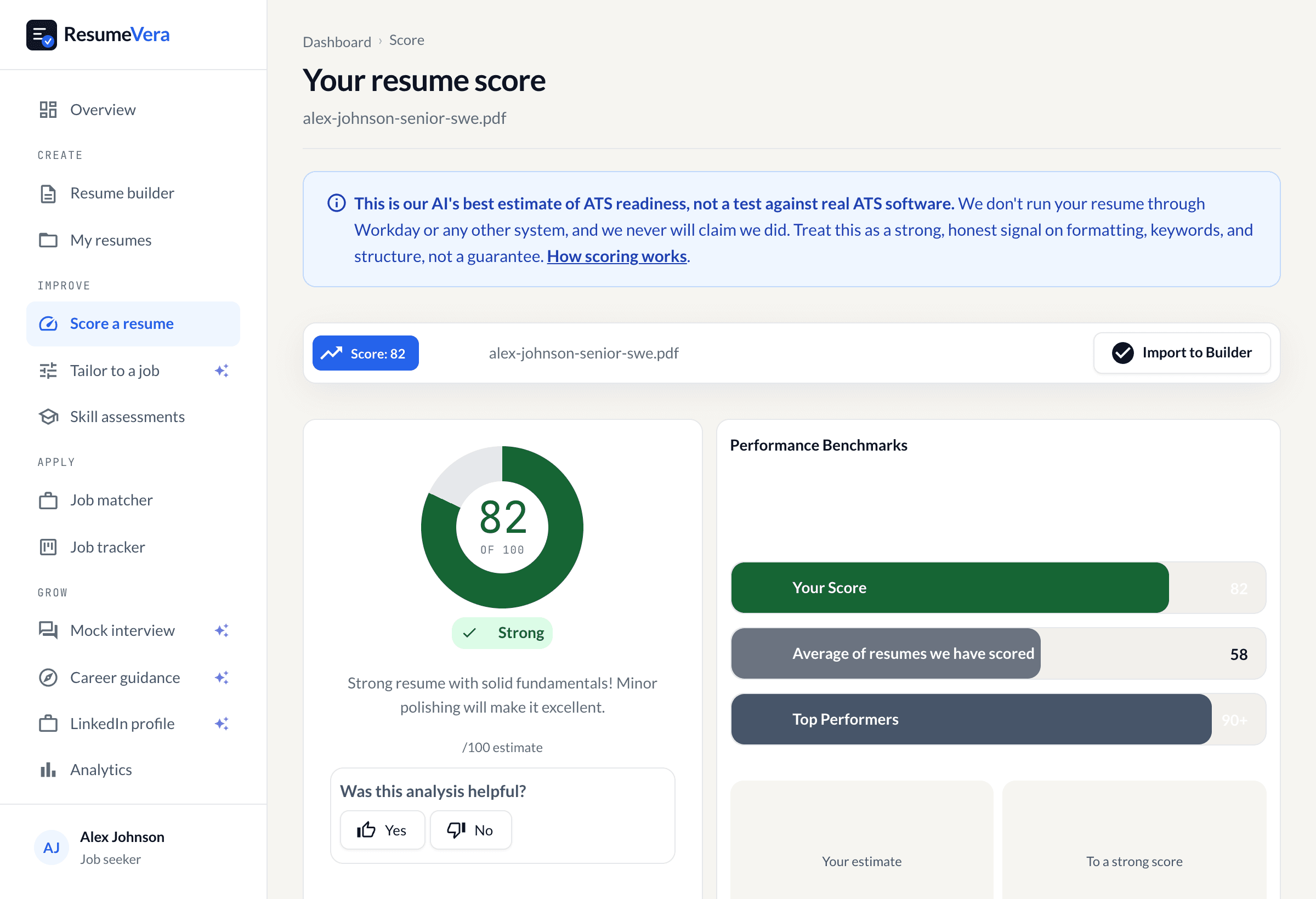
The real score page, with a sample resume and sample scores.
Is your resume ATS ready?
Run a free ATS score check and get specific improvements in seconds.