Written for the India job market, so salaries and formats follow Indian conventions. See the US version.
Career Growth
Maternity benefit and leave in India
Last reviewed: 4 October 2026. Eligibility, duration, ESI versus employer-paid benefit, what changes when you switch jobs, and sample emails to HR.
The ResumeVera editorial team
Resume and hiring research, reviewed against current employer guidance.
Updated 2026-10-05T06:27:32.361Z
17 min
Section 01
Maternity benefit in India: the short answer
Last reviewed: 4 October 2026. This guide explains what official sources say about maternity benefit and maternity leave for women who are changing jobs or job hunting. It is not legal advice and it gives no medical advice. Your appointment letter, your employer's written policy and the current official text decide the details.
In everyday speech "maternity leave" and "maternity benefit" are used for the same thing: paid time away from work around childbirth, paid by the employer or, in some cases, by the Employees' State Insurance Corporation (ESIC). The points below come from official pages we opened for this review:
In short, as the sources we read state it: eighty days actually worked with the employer claimed from in the twelve months before expected delivery (section 5(2)); up to twenty-six weeks, of which not more than eight may come before delivery, with the Act text giving twelve weeks for a woman with two or more surviving children; twelve weeks for adopting and commissioning mothers; protection from dismissal under section 12; and a crèche duty from 50 employees. Official pages describe the link between the 1961 Act and the Code on Social Security, 2020 in different ways, which section 2 sets out. Confirm with your employer which regime applies to you.
If you are between jobs, the key practical point is that section 5(2) refers to work for "the employer from whom she claims". We found no provision in the sources reviewed that adds days worked at a previous employer, so ask HR in writing how your days are counted. Section 5 of this guide works through examples.
Section 02
Maternity Benefit Act 1961 and the Code on Social Security 2020: which applies
The Maternity Benefit Act, 1961 was amended by the Maternity Benefit (Amendment) Act, 2017 (Act No. 6 of 2017, gazette date 28 March 2017 as shown on the labour.gov.in copy). The Ministry of Labour handbook says the Code on Social Security, 2020 subsumes nine labour laws. Three official statements on how the two relate are not worded alike:
- Ministry of Labour handbook: the Social Security Code "subsumes 9 labour laws", and a footnote lists the Maternity Benefit Act, 1961 among them.
- PIB, 21 November 2025. The release announcing that the four labour codes were made effective says: "During transition, the relevant provisions of the existing labour Acts and their respective rules, regulations, notifications, standards, schemes, etc. will continue to remain in force."
- Supreme Court order, 12 December 2025: in a writ petition challenging section 5(4) of the 1961 Act, the Court recorded that on 21.11.2025 the Ministry issued a notification "bringing into force several provisions" of the 2020 Code, that "w.e.f 21.11.2025, the Act, 1961 stood repealed", and that section 60(4) of the Code is "pari materia" to section 5(4). It let the petitioner amend the petition.
We cannot say from these pages which regime governs your claim, and we do not resolve the difference between the PIB statement and the Court's. The Social Security (Central) Rules, 2026 carry a date of 8 May 2026 on labour.gov.in. We could not read the Code's maternity chapter, the Rules' maternity provisions, or the commencement notification, because the PDFs we opened were cut off before them or would not load. Confirm with your employer, the labour department or labour.gov.in which regime applies to you.
| Point | 1961 Act (as amended) | Code, per official summaries |
|---|---|---|
| Days worked | 80 days | 80 days |
| Maximum period | 26 weeks | 26 weeks |
| Adoption or commissioning | 12 weeks | 12 weeks |
| Work from home | Mutual agreement, s.5(5) | If the work permits (PIB) |
| Crèche | 50 or more employees | 50 or more employees |
On the points in this table, the PIB backgrounder and the handbook describe the Code in terms that match the Act text we read. The reduction to twelve weeks for a woman with two or more surviving children is in the Act text we read; the PIB and handbook summaries of the Code do not mention it, and we could not check the Code text. Ask HR which provision the policy follows.
Section 03
Eligibility: the days-worked rule and who is covered
The eighty-day condition. Section 5(2) of the Act, as it appears on India Code, reads in the relevant part: no woman is entitled to maternity benefit "unless she has actually worked in an establishment of the employer from whom she claims maternity benefit, for a period of not less than eighty days in the twelve months immediately preceding the date of her expected delivery". The handbook and the PIB backgrounder of 22 November 2025 give the same eighty-day figure for the Code.
Three details in that wording matter for people who change jobs:
- "Actually worked". The text refers to days on which you actually worked. The extract of the Act we read also says the days counted include days for which a woman "has been laid off or was on holidays declared under any law for the time being in force to be holidays with wages". The sources we read do not say how part-days or approved leave are counted, so ask HR.
- "The employer from whom she claims". The condition is worded by reference to the establishment of the employer you claim from. We found no wording in the sources reviewed that adds time at a previous employer.
- "Twelve months before the expected delivery". The window runs back from the expected delivery date.
Which workplaces the Act covers. Section 2(1) applies to factories, mines and plantations, to establishments for equestrian, acrobatic and other performances, and to shops and establishments in which ten or more persons are or were employed on any day of the preceding twelve months. We did not find a plain statement, in the pages we could read, of whether the Code keeps the ten-person threshold for maternity benefit, so check the current text if your employer is small.
What the sources do not settle. We did not find, in the sources reviewed, any provision that sets a minimum length of employment other than the eighty-day rule, excludes women on probation, or treats fixed-term, contract or part-time staff differently. That is an absence in what we read, not a legal conclusion. Your appointment letter may say otherwise; see our guide on probation periods in India.
Section 05
Just joined a new employer, or job hunting while pregnant
The eighty-day rule is the main thing a new joiner needs to check. The Act text refers to the employer you claim from, and we found nothing in the sources reviewed that adds earlier employment, so the examples below start the count at the joining date. They are arithmetic only, not predictions, and assume a five-day week with no leave. Days of paid holiday or lay-off also count under the Explanation to section 5(2), which would change the figures.
| Example | Working days before delivery date | Eighty days reached? |
|---|---|---|
| Joins 13 weeks before expected delivery | About 65 | No, about 15 days short |
| Joins 20 weeks before expected delivery | About 100 | Yes, if nearly all worked |
If you fall short, we did not find in the sources reviewed a duty on the employer to pay under the Act. The questions below are worth asking, and none of the answers is a legal conclusion:
- Does the employer's own policy go beyond the Act? That is employer practice, not law; get it in writing.
- Is the establishment covered by ESI? If it is, ESIC maternity benefit may apply by a different route. Section 6 of this guide explains it; check the ESIC contribution-day conditions on the ESIC site.
- What does the probation clause say about leave? See the guide on probation periods, and check whether the letter treats leave differently in the first months.
Resigning and notice. Section 12 says it is unlawful for the employer "to give notice of discharge or dismissal on such a day that the notice will expire during such absence". That line covers notice from the employer. For your own resignation and notice period, see the guide on switching jobs and notice periods.
Disclosure while job hunting. We did not find, in the sources reviewed, a provision that requires a candidate to disclose a pregnancy before joining, or one that bans the employer from asking. The PIB release of 21 November 2025 lists "Gender discrimination legally prohibited" among the effects of the new codes but does not discuss interviews. A qualified employment lawyer or your state labour office can advise on your facts.
Section 06
ESI maternity benefit versus employer-paid benefit
Two systems can pay maternity benefit. Under the Act, the employer pays. Under the Employees' State Insurance scheme, ESIC pays insured women in cash. The Act itself deals with the overlap. Its section 2 says the Act does not apply to a factory or other establishment to which the Employees' State Insurance Act, 1948 applies, subject to sections 5A and 5B, which we read as follows:
- Section 5A: a woman entitled under the Act continues to be so entitled, despite the ESI Act applying to her workplace, "until she becomes qualified to claim maternity benefit under section 50 of that Act".
- Section 5B: a woman in an ESI-covered establishment whose wages for a month (excluding overtime) exceed the ESI Act's specified amount, and who meets the eighty-day condition, is entitled to maternity benefit under the Act.
| Your situation | Who pays, on this reading | Basis |
|---|---|---|
| Workplace not under the ESI Act | Employer | Act s.2 |
| ESI-covered, not yet qualified for ESI benefit | Employer continues | Act s.5A |
| ESI-covered, qualified for ESI benefit | ESIC | Act s.2, 5A; ESIC |
| ESI-covered, wages above ESI limit | Employer | Act s.5B |
ESIC describes its benefit as follows in material for its online claim portal, launched in November 2022: payment "at the rate of 100% of wages" for "26 weeks" to the insured woman, who must "meet the eligibility conditions". Under its Employees' State Insurance heading, the Compliance Handbook says the provisions "apply to every establishment employing 10 or more persons, except seasonal factories", and to hazardous or life-threatening establishments even with one employee. The ESIC coverage page gives a wage limit for coverage of Rs.21,000 (Rs.25,000 for Persons with Disability), effective from 01.01.2017, with a last-reviewed date of 2025-04-04, so check ESIC for the current limit.
Contribution-day conditions. The ESIC pages we could open do not set out the standing condition on contribution days, and ESIC's maternity page refused automated access, so we make no claim about it. A 2021 PIB release described a temporary relaxation to 35 days in two preceding contribution periods for January to June 2021; that is not a current rule. Ask ESIC how earlier contributions are counted.
We could not read the Code's own wording on this overlap, so this section describes the Act as amended. If the Code applies to you, we could not confirm this against an official text.
Section 07
Notice of intention, medical bonus and protection from dismissal
Giving notice
Section 6(1) says a woman entitled to maternity benefit "may give notice in writing in such form as may be prescribed" to her employer, naming who the benefit may be paid to and stating that she will not work in any establishment while she receives it. Section 6(2) says the notice must state the date from which she will be absent, "not being a date earlier than six weeks from the date of her expected delivery". Section 6(3) says a woman who did not give notice while pregnant "may give such notice as soon as possible after the delivery". We did not find, in the sources reviewed, a number of weeks by which you must give notice in advance. We could not reconcile the six-week wording in section 6(2) with section 5(3), which allows up to eight weeks before delivery, so we make no claim about the earliest start date. Ask HR which date the policy uses.
A labour.gov.in FAQ on the Social Security Rules, undated in the extract we read, says claims can be made "on plain paper or electronically" and cannot be rejected "solely due to non-use of prescribed formats".
Medical bonus
Section 8 of the Act gives a medical bonus to a woman entitled to maternity benefit if the employer provides no pre-natal confinement and post-natal care free of charge. The official sources we read give two different amounts:
| Source | Amount | What it says |
|---|---|---|
| Act text, section 8 (India Code) | Rs 1,000 | "a medical bonus of one thousand rupees"; the Central Government may increase it by notification, up to twenty thousand rupees |
| Ministry of Labour handbook | Rs 3,500 | "Employers are required to pay a medical bonus of Rs.3,500" |
| PIB backgrounder, 22 Nov 2025 | Rs 3,500 | Under "Section 64" of the Code, a medical bonus of Rs 3,500 if the employer does not provide free pre-natal and post-natal care |
We searched for a notification raising the Act's amount and did not find one, so we cannot say how the figures connect. The handbook and PIB describe the Code, while the Rs 1,000 comes from the Act text as it appears on India Code. Ask HR what the employer pays and on what basis, and check labour.gov.in.
Protection from dismissal
Section 12 says that when a woman absents herself in accordance with the Act, it is unlawful for her employer to "discharge or dismiss her during or on account of such absence", to give notice that expires during the absence, or to vary her service conditions to her disadvantage. Section 12(2)(a) says a dismissal during pregnancy does not by itself take away maternity benefit or medical bonus, except for prescribed gross misconduct. Under section 12(2)(b) a woman deprived of benefit may appeal within sixty days to the prescribed authority, whose decision is final. The 2017 advisory says such an employer "can be punished under Section 21 of the Act".
Section 08
What to ask in an offer or interview, and how to word it
Benefits questions are ordinary parts of an offer discussion. Section 11A expects the establishment to tell every woman in writing, at her initial appointment, about every benefit available under the Act, so asking for that in writing is reasonable. See our guides on offer letter formats and interview preparation.
| Ask | Why it matters | Anchor |
|---|---|---|
| Which legal entity employs me? | Act wording: the employer claimed from | Act s.5(2) |
| Is the establishment ESI-covered? | Decides who pays | Act s.5A, 5B |
| How are the eighty days counted? | Calendar or working days | Act s.5(2) |
| Does the policy exceed the statutory leave? | Policy is not law | Employer policy |
| Is work from home possible after leave? | Only by agreement | Act s.5(5) |
Wording that works
- Ask about policy, not about your own plans: "Could you share the maternity and parental leave policy for this role?" gives you the information without a personal disclosure.
- Ask for the answer in writing: "Could you confirm this in the offer letter or the leave policy document?"
Whether and when to mention your own circumstances is your decision. The sources we read do not tell you what to say, and we do not advise on it.
Section 09
Sample emails to HR with [bracketed] fields
These are samples only, not legal documents or prescribed forms. Section 6(1) refers to a notice "in such form as may be prescribed". Use your employer's form if it has one, and keep a copy of what you send.
Sample A: written notice for maternity benefit
Subject: Notice of maternity leave, [Your name], [Employee ID]
Dear [HR contact name],
I am writing to give notice under the maternity benefit provisions that apply to my employment. My expected date of delivery is [date]. I plan to be absent from work from [date], and to return on [date, or "I will confirm my return date later"].
Please confirm that I qualify under the eighty-day condition and how the company counted my days of work. Please also tell me which leave and benefit policy applies, whether the company provides pre-natal and post-natal care or pays a medical bonus, and where I should send the medical certificate. I would like any payment made to [my bank account on file / nominee name].
Please acknowledge this notice by reply.
Regards,
[Your name], [Designation], [Employee ID], [Phone number]
Sample B: questions before accepting an offer
Subject: Questions on leave benefits before I accept, [Your name]
Dear [Recruiter or HR name],
Thank you for the offer for the [role] position. Before I accept, could you share the policy documents for [maternity and parental leave, adoption leave, crèche or childcare support]? Could you also confirm in writing the name of the employing entity, whether it is covered by the ESI scheme, and how the company counts the days of work needed for maternity benefit?
Please also tell me how the probation period of [duration] interacts with leave entitlements, and where any benefit beyond the statutory minimum is stated.
Regards,
[Your name], [Phone number]
Section 10
Honest limits of this guide
This guide summarises official pages as we read them on 4 October 2026. It cannot tell you which legal regime covers your employer, whether you meet a condition on your facts, or what a labour authority or court would decide. Some official pages we read are undated or were reviewed before 2026. We could not read the Code's maternity chapter, the commencement notification or the Rules' maternity provisions, and the medical bonus amount differs between pages. Check every quoted sentence against the linked source.
Your appointment letter and the employer's written policy decide what you get beyond the statutory minimum. For disputes, contact your state labour office, the Ministry of Labour and Employment at labour.gov.in, or ESIC for ESI matters, or a qualified lawyer. If you want to refresh your resume while you plan a move, ResumeVera has a free resume checker with an AI-estimated score and an AI resume builder. The score is an estimate and not a real ATS test.
Section 11
Sources and references
Every legal statement above comes from an official page we opened for this review. Check each link for the current version, and note the dates shown against each source.
- The Maternity Benefit Act, 1961 as amended (India Code, Ministry of Law and Justice): Act text: eligibility, duration, adoption, ESI, bonus
- The Maternity Benefit (Amendment) Act, 2017, Act No. 6 of 2017 (Ministry of Labour and Employment): 2017 amending Act
- Advisory on the Maternity Benefit (Amendment) Act, 2017, letters of 12 April and 28 August 2017 (Ministry of Labour and Employment): 2017 advisory
- Compliance Handbook for Employers Under the Four Labour Codes (Ministry of Labour and Employment): Handbook: eligibility, bonus, crèche, ESI
- FAQ on the Social Security Rules, maternity items (Ministry of Labour and Employment): FAQ: claims, certificates, crèche
- Additional FAQs on Labour Codes, as on 16.03.2026 (Ministry of Labour and Employment): FAQs as on 16.03.2026: crèche
- Social Security (Central) Rules, 2026, dated 8 May 2026 (Ministry of Labour and Employment): Rules, dated 8 May 2026
- Code on Social Security, 2020: Towards Universal and Inclusive Social Protection, 22 November 2025 (Press Information Bureau): PIB backgrounder: Code maternity terms
- Labour code provisions for women, factsheet posted 27 November 2025 (Press Information Bureau): PIB factsheet: leave, crèche, work from home
- Government makes the four labour codes effective, 21 November 2025 (Press Information Bureau): PIB: transition sentence
- Maternity Benefit (Amendment) Act, 2017 implementation release, 13 February 2023 (Ministry of Labour and Employment, PIB): PIB 2023: Act implementation
- ESIC online maternity benefit claim portal launched, November 2022 (Ministry of Labour and Employment, PIB): PIB: ESIC portal, 100% of wages
- ESIC online maternity benefit claim portal press file (ESIC): ESIC press file: same
- Coverage (Employees' State Insurance Corporation): ESIC: wage limit
- ESIC takes major policy initiatives for insured women, 23 February 2021 (Ministry of Labour and Employment, PIB): PIB 2021: temporary ESI relaxation
- Hamsaanandini Nanduri v. Union of India, W.P.(C) 960/2021, order of 12 December 2025 (Supreme Court of India): Supreme Court order on repeal
- PMMVY Scheme Implementation Guidelines, September 2017 (Ministry of Women and Child Development): PMMVY 2017 guidelines, dated
Pro tips
Do these
Ask for the maternity and parental leave policy in writing before you accept an offer, and keep it with your offer letter.
Ask which legal entity employs you and whether it is ESI-covered, because the Act's wording ties eligibility to the paying employer and ESI coverage affects who pays.
Note your joining date and track days actually worked, so you can check the eighty-day condition early.
Use your employer's notice form if it has one, and send the notice by email so you hold a dated copy.
Ask for any work from home or crèche arrangement in writing; both depend on the employer's agreement or facilities.
Check labour.gov.in and ESIC before relying on a figure such as the medical bonus (Rs 1,000 in the Act text, Rs 3,500 in the handbook) or an ESI wage limit.
Avoid these
Delete these
Assuming, without asking HR, that days at a previous employer count towards the eighty days with a new one.
Assuming the longer twenty-six week period applies without checking the Act text on surviving children and which regime your employer follows.
Treating an employer's extra leave as a legal right when it is policy that can be changed.
Quoting an old ESI wage limit, or one of the two medical bonus figures (Rs 1,000 or Rs 3,500), without checking the current official position.
Giving notice only by phone, with no written record and no acknowledgement.
Relying on a blog or a forwarded message instead of the official text, which changed in 2017 and may be changing again with the Code.
Put this into a resume
Building and editing are free, and free PDFs carry a small watermark.
Check your resume for freeQuestions
Frequently asked questions
How this guide is maintained
We review this guide every quarter and after any change to the hiring rules or portal behaviour it describes. It was last reviewed on 2026-10-05T06:27:32.361Z. Figures come from named sources, shown beside the number. Where we are estimating rather than measuring, we say so.
By the numbers
80 days
Days actually worked in the 12 months before expected delivery (section 5(2))
https://www.indiacode.nic.in/bitstream/123456789/12874/1/the_maternity_benefit_act%2C_1961_no._53_of_1961_date_12.12.1961.pdf
26 weeks
Maximum maternity benefit period, up to 8 weeks before delivery
https://static.pib.gov.in/WriteReadData/specificdocs/documents/2025/nov/doc20251122702601.pdf
12 weeks
Adopting mother of a child below 3 months, or commissioning mother
https://www.indiacode.nic.in/bitstream/123456789/12874/1/the_maternity_benefit_act%2C_1961_no._53_of_1961_date_12.12.1961.pdf
Try it
Check the guide against your own file
Everything above is general. Your resume is not. Paste it in and the checker tells you which of these points your file actually breaks.
Check your resume free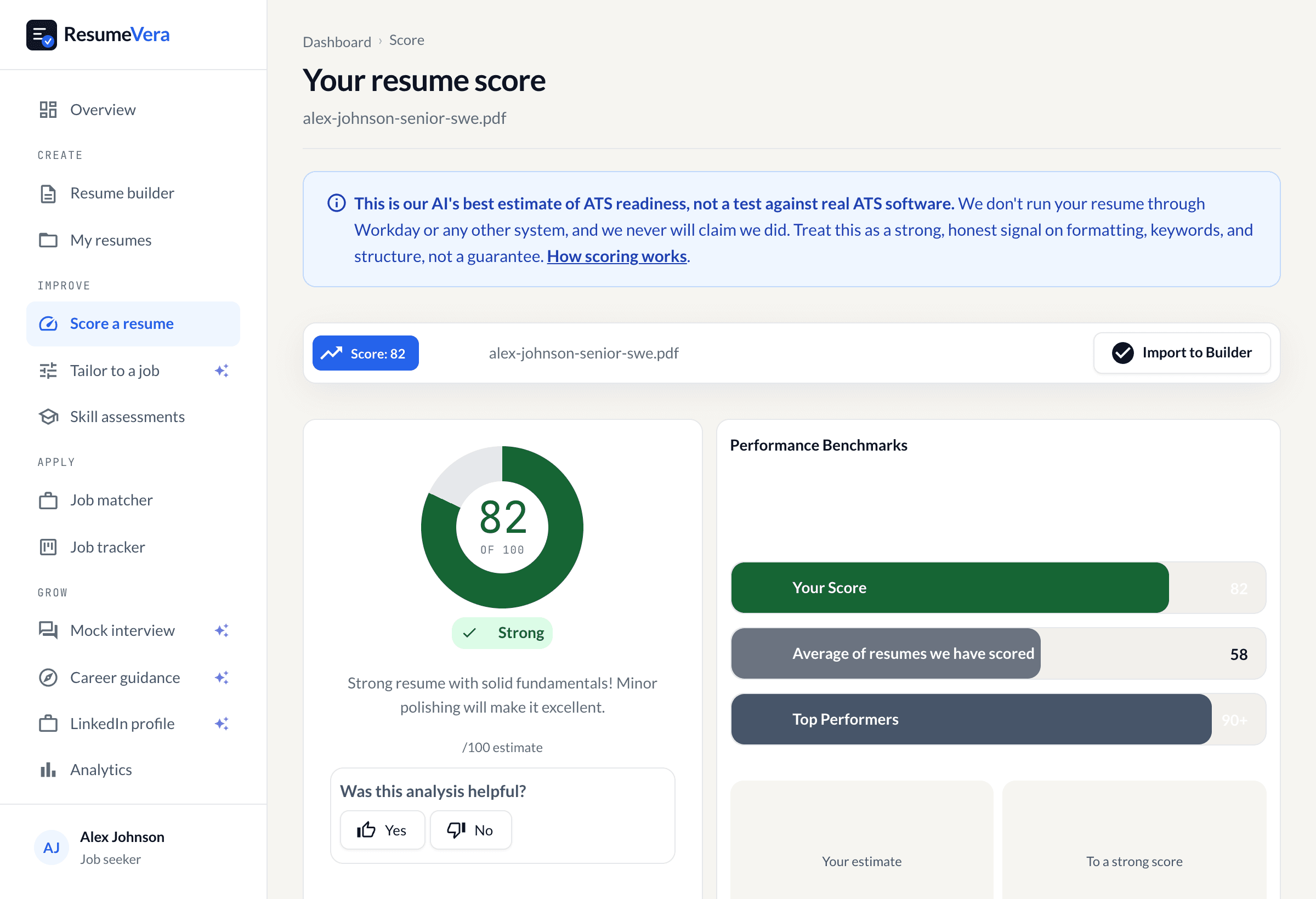
The real score page, with a sample resume and sample scores.
Is your resume ATS ready?
Run a free ATS score check and get specific improvements in seconds.