Written for the India job market, so salaries and formats follow Indian conventions. See the US version.
Career Growth
Switching jobs in India: managing your notice period
Last reviewed: 4 October 2026. Dates, early release, counter-offers, what official sources say about notice, an exit checklist and sample emails.
The ResumeVera editorial team
Resume and hiring research, reviewed against current employer guidance.
Updated 2026-10-05T06:02:46.253Z
16 min
Section 01
Switching jobs in India: the short answer
Last reviewed: 4 October 2026. This guide is about the stretch between saying yes to a new offer and your first day there: the notice period at your current employer, the date you join the next one, and the paperwork in between. It explains what official sources say and flags plainly where there is no official rule. It is not legal advice. Your appointment letter, your employer's policy and the sources we link decide the details.
The one-paragraph version:
- The length of your notice period is mostly a matter of contract. We found no central rule that sets one notice length for every private job. The only fixed figures we could read are in the 1946 central model standing orders (one month for workmen rated by the month, for covered establishments) and in the Delhi Shops Act (one month, once an employee has three months of continuous service).
- Your last working day and your joining date are two separate dates controlled by two different employers. Most trouble in a job switch comes from assuming they will line up.
- Whether your current employer will release you early is contract and employer dependent. There is no official rule or norm we can cite for it, and this guide does not invent one.
- Whatever is agreed, get it in writing: the last working day, any waiver or buyout, and the documents you will receive.
This page deliberately does not repeat two guides we already have. For the money side of leaving early, read our explainer on notice period buyout. For bonds and recovery clauses, read the service bond guide. This one is about the dates, the conversations and the order of steps.
Section 02
Notice period, last working day and joining date: how they relate
Three dates, two employers
| Date | Who controls it | Where it is fixed |
|---|---|---|
| Resignation (notice) date | You, by giving notice | Your current contract or policy says how notice is given |
| Last working day | Your current employer, under your contract | Notice period, or an agreed earlier date |
| Joining date | Your new employer, with your agreement | Offer or appointment letter |
The notice period is the length of time your contract says must pass between notice and the end of employment. The last working day is the date that period (or an agreed shorter one) ends. The joining date is a separate promise to a different employer. Nothing in the government sources we read ties the three together: that is for you to line up.
Why the exact last working day matters
The EPFO FAQ says: "Last working date or the date till when the wages earned is the date of exit." That date is what your provident fund record uses. The Code on Wages, in the copy on labour.gov.in, says the wages payable to an employee "shall be paid within two working days of his removal, dismissal, retrenchment or, as the case may be, his resignation." So the date your employment ends starts clocks that matter to you later. Ask HR to confirm it in writing.
How the count can go wrong
Contracts differ on whether notice is counted in calendar days or working days, whether the first day is day one, whether weekends and holidays inside the period count, and whether the clock starts on the day you send the email or the day the employer accepts. The government sources we read do not settle this: it is a contract question. A simple illustration (not a rule):
- You send your resignation on a Monday. Your letter says "30 days."
- One HR team counts from the Monday, another from the day after, a third from the day the manager accepts it. The last working day can differ by days.
The fix is boring and effective: ask HR to reply with "your last working day will be [date]" before you give that date to the new employer. If you are still drafting the resignation itself, use our resignation letter format guide.
Section 03
What official sources say about notice, in writing
This section is the legal floor as far as we could read it. Read it as a map of what we found, not as a statement of the rule that binds your employer.
| Source | What it says | Who it covers |
|---|---|---|
| Central model standing orders under the 1946 Act, clause 13(1) | Notice in writing by employer or workman: one month for workmen rated by the month, two weeks for others; pay may be given in lieu | Workmen in establishments covered by standing orders |
| Same, clause 13(2) | No temporary workman, probationer or badli is entitled to notice or pay in lieu on termination | As above |
| Delhi Shops and Establishments Act 1954, section 30 | Employer: at least one month's notice in writing or wages in lieu after three months' continuous employment (misconduct exception). Employee with three months' continuous service: notice of at least one month in writing | Employees under that Act in Delhi |
| Maharashtra Shops and Establishments Act 2017 (India Code copy) | We did not find a provision on notice of termination, resignation notice or service certificate in the extract we searched. This was not confirmed by a full-text check of the Act, so read the Act itself before relying on it | Establishments under that Act |
What this means in practice
Most white-collar employees in private companies read a notice figure (often longer than a month) in their own appointment letter. The sources above show that written notice is a recognised feature of Indian employment law in some settings, but they do not say that a three-month or a ninety-day notice period is mandatory or capped. If your letter and a state law both speak to notice, they may interact in ways we cannot judge here. The state labour office is the place to ask.
Standing orders and the Industrial Relations Code: what is still current
The Industrial Relations Code 2020, in the copy we read, applies its standing orders chapter to industrial establishments with "three hundred or more than three hundred workers" (section 28(1)) and has the Central Government make model standing orders (section 29). The Industrial Relations Code (Amendment) Act 2026, Act No. 1 of 2026, received Presidential assent on 16 February 2026 according to the copy we read. It is deemed in force from 21 November 2025 and lists the Industrial Employment (Standing Orders) Act 1946 among the enactments repealed, from the date appointed by a notification. The Press Information Bureau release on the four labour codes says that during transition "the relevant provisions of the existing labour Acts and their respective rules, regulations, notifications, standards, schemes, etc. will continue to remain in force."
We could not open an official page that confirms the repeal notification date or the text of any newer model standing orders. Legal-press commentary suggests new model standing orders were issued in 2026, but commentary is not a source for this page. Check labour.gov.in and the e-Gazette for the current position before relying on the clause 13 wording above.
Standing orders also matter because only some employees are "workmen" or "workers" in the legal sense. The Industrial Relations Code definition of worker, in our copy, excludes people "employed mainly in a managerial or administrative capacity." Whether you are covered is a fact question for your employer or labour office.
Section 04
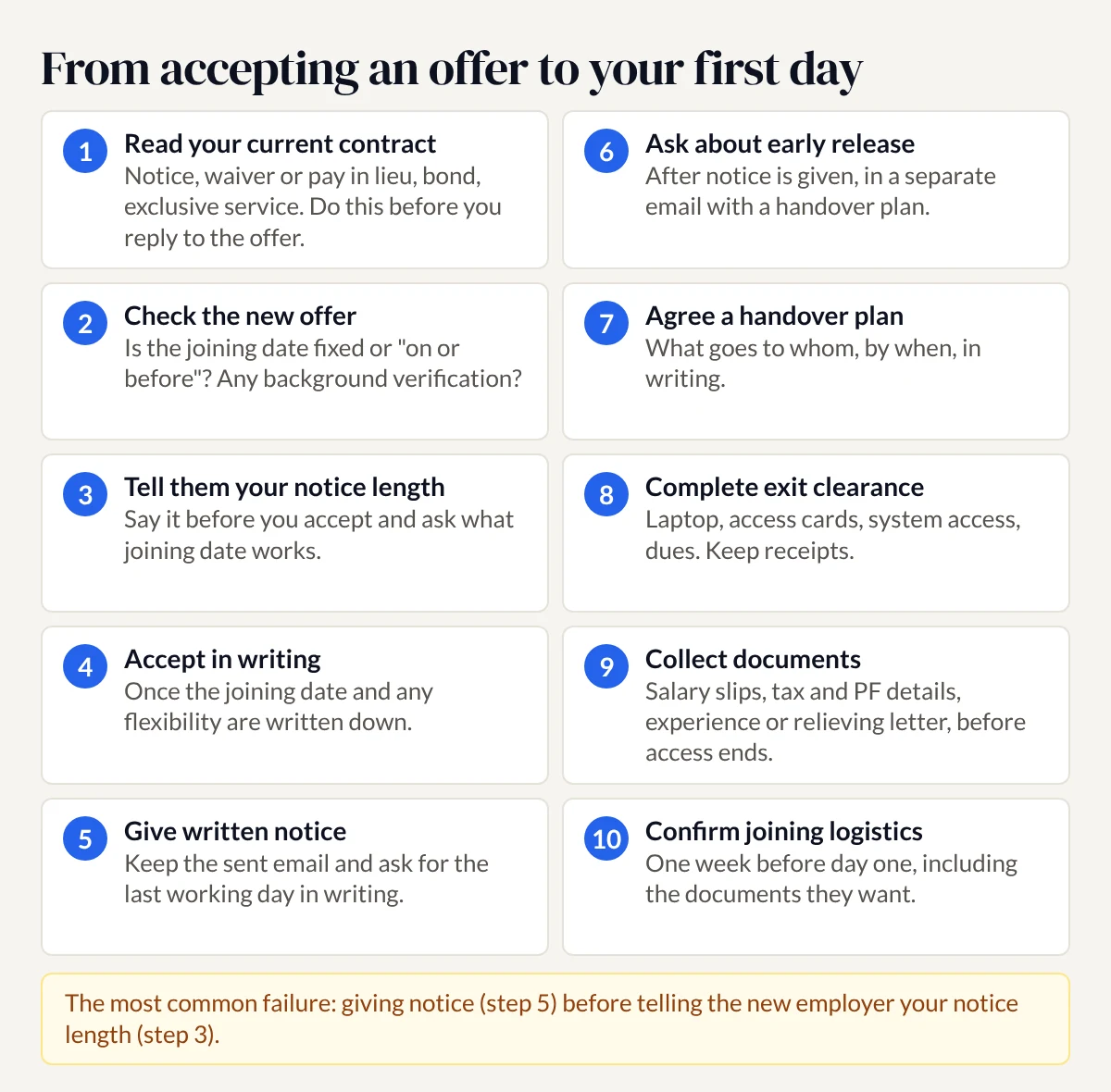
The order of steps: from accepting an offer to your first day
This sequence is editorial: it reflects what tends to reduce risk, not an official procedure. The order matters more than the exact timing.
- Read your current contract first. Find the notice clause, any clause on waiver or payment in lieu, any bond or recovery clause, and any clause on exclusive service. Do this before you reply to the offer. Our offer letter guide explains how to read the new offer itself.
- Check the new offer's conditions. Look for the joining date, whether it is fixed or "on or before", and conditions such as background verification. See our background verification guide.
- Tell the new employer your notice length before you accept. Say it plainly and ask what joining date works. Surprises later cost you trust. Sample B below helps.
- Accept the offer in writing once the joining date and any flexibility are written down.
- Give notice in writing to your current employer. Keep a copy and the sent email. Ask for written confirmation of the last working day.
- Raise early release only after notice is given, unless your contract says otherwise. Sample A below helps.
- Agree a handover plan with your manager in writing: what you hand over, to whom, by when.
- Complete exit clearance (laptop, access cards, system access, dues) and keep receipts.
- Collect documents before your access ends: salary slips, tax and PF details, and your experience or relieving letter if the employer issues them.
- Confirm joining logistics with the new employer one week before day one, including what documents they want.
The most common failure is doing step 5 before step 3: giving notice, then discovering the new joining date does not fit.
Section 05
Negotiating a shorter notice or a different joining date with the new employer
New employers see notice periods all the time. Editorially, the useful question is not "can you shorten my notice" but "what joining date works for both of us, given my notice ends on [date]". Whether a new employer will wait, and for how long, depends on the role and the employer. We have no official source for what is typical, so we give none.
What you can negotiate with the new employer
- A joining date that sits after your honest last working day, with a few days to rest and settle documents.
- A "joining on or before" date instead of a fixed one, so you can start earlier if your current employer releases you.
- Whether a joining date shift changes anything else in the offer, such as the stated start of salary or a joining bonus. Ask, and get the answer written.
What you should not promise
Do not promise a date that depends on your current employer agreeing to release you early. Tell the new employer the contractual last working day and mention early release as a possibility, not a commitment. For pay terms and any buyout cost the new employer may be willing to meet, our salary negotiation guide covers the conversation, and the buyout explainer linked at the top covers how buyouts work.
Sample B: negotiating a joining date with the new employer
Sample only, not a legal document. Replace every [bracketed] field and adjust to your situation.
Subject: Joining date for [role title], [your name]
Dear [recruiter or hiring manager name],
Thank you for the offer for the position of [role title]. I am glad to accept [or: I am keen to accept once we agree the joining date].
My current employment contract has a notice period of [notice length]. If I give notice on [date], my last working day would be [date], so the earliest I can join without breaching my current terms is [date].
The offer letter mentions a joining date of [date]. Could we move it to [proposed date]? I will also ask my current employer whether an earlier release is possible, and will tell you as soon as I have a written answer. If I am released earlier, I would be happy to join on or before [proposed date] if that suits the team.
Could you confirm by [date] whether this works, and update the offer or send a short written confirmation of the revised joining date?
Thank you,
[your name]
[phone number]
Section 06
Asking your current employer for early release
Plainly: there is no official rule we could find that gives an employee a right to early release, and none that says an employer must refuse it. Early release, waiver of notice, or payment in lieu are matters of your contract, the company policy and the manager's and HR's discretion. Some employers agree, some do not, and some agree only with conditions. We have no primary source for what is common, so we do not claim one.
What the sources do tell us is narrow but useful: the central model standing orders (clause 13(1)) contemplate "pay in lieu of notice" for workmen they cover, and the Delhi Shops Act refers to "wages in lieu" of notice on the employer's side. Neither says an employee can buy out at will. Check the exact clause in your contract.
How to ask
- Give notice first, in writing, so the formal clock has started.
- Ask in a separate email, addressed to your manager and HR, with the specific date you want.
- Offer something concrete: a written handover plan, training your replacement, remaining reachable for questions for a stated period.
- Ask what the employer would need to agree: a shorter period, adjusting unused leave against notice, or payment in lieu. Our leave encashment guide explains how leave interacts with exit.
- Accept a no politely and fall back to your contractual last day. Do not stop attending work and hope it resolves.
- If they agree, get the agreed last working day and any conditions in writing before you tell the new employer.
Sample A: request for early release
Sample only, not a legal document. Replace every [bracketed] field.
Subject: Request for early release, [your name], [employee ID]
Dear [manager name] and [HR contact name],
Further to my resignation dated [date], under which my last working day would be [date] as per my notice period of [length], I would like to request an earlier release on [requested date].
To keep the transition smooth, I propose the following: [handover steps, for example documentation of current work, handover sessions with named colleagues, closure of open items by dates]. I am also willing to remain available for reasonable queries for [period] after I leave.
I understand that this depends on the company's policy and my contract, and I am happy to discuss any condition, such as [leave adjustment or payment in lieu, if applicable].
Could you let me know in writing whether this is possible, and confirm my last working day either way?
Thank you for your consideration,
[your name]
[employee ID]
Section 07
Counter-offers: what they mean in practice
A counter-offer is what your current employer proposes, usually after you resign, so that you stay: a raise, a title change, a promise. It is not a legal concept in the sources we read. It is a commercial conversation, and the legal weight comes from what is written down.
What changes the moment you resign
- You have signed or accepted a new offer, so staying may mean going back on a commitment to another employer. That is a relationship cost, not a legal conclusion.
- Your resignation may be accepted quickly, which fixes the last working day. Ask yourself whether you would be comfortable if the answer to a counter-offer is "no, but we have accepted your resignation."
Can you withdraw a resignation?
The Supreme Court considered this in Dr. Mrs. Suman V. Jain v. Marwadi Sammelan (2024 INSC 127, decided 20 February 2024, a case against a private trust running a college). It cited Union of India v. Gopal Chandra Misra: "in the absence of anything to the contrary in the provisions governing the terms and conditions of the office/post, an intimation in writing sent to the competent authority by the incumbent, of his intention or proposal to resign his office/post from a future specified date can be withdrawn by him at any time before it becomes effective." The Court also said an employer's label of "final, binding and irrevocable" was not enough to bar withdrawal without the employee having agreed to such a term.
Read that carefully. It is a decision on its own facts, about a resignation from a future date, and it turns on the absence of contrary terms. Your contract, employer policy and what you agreed in writing may differ. It does not mean a new employer must accept your withdrawal from their offer, and it does not mean your current employer must give you the counter-offer.
How to treat a counter-offer sensibly
- Ask for it in writing, with the exact change in role, pay and date it applies from. Verbal promises are hard to rely on later.
- Compare it against the new offer using the same breakup of fixed pay, variable pay and benefits, so the two are measured the same way.
- Ask yourself why you decided to leave. If the reasons were role, manager or growth, check whether the counter-offer addresses them.
- If you decline, tell the new employer nothing has changed and confirm your joining plan. If you accept, tell the new employer promptly and politely.
- If you accept, ask for written confirmation that your resignation stands withdrawn.
Section 08
Overlapping notice and joining dates: common situations
| Situation | What to check | What to do |
|---|---|---|
| Joining date falls before your notice ends | Whether the current employer agrees to release you on the new date | Do not join the new employer until you have a written release or the notice has ended |
| Notice ends days or weeks before joining | Whether you will have a gap in PF or benefits | Plan for the gap, and ask HR to record the correct exit date |
| Employer asks you to leave before notice ends | The termination and pay-in-lieu clause in your contract | Ask for the date and any pay in lieu in writing |
| Both employers want an exact date | That both dates are written down | Keep both dates written down and consistent |
Why overlap is risky
We found no official page that states what happens if someone works for two private employers at once, so we make no claim. Many contracts contain an exclusive-service clause. Starting a new job before a release is confirmed could breach it, and the consequences are contract and employer dependent. A written release removes the question.
Your provident fund across the switch
The EPFO FAQ page explains that a member changing jobs should "necessarily get his PF account transferred to his present establishment" using Form 13(R), and that a member can submit a transfer claim online through the member interface. The EPFO FAQ describes the UAN as a 12 digit number linked to the member's currently active PF account, so give your existing UAN to the new employer. On the wait for withdrawal after resignation, sources differ: the FAQ page, which is undated, says a member has to wait two months, while the October 2025 releases we read say the premature final settlement period was changed to 12 months. We could not read the final text of the EPF Scheme 2026, so we cannot confirm which period applies today. The FAQ also says the date of exit can be updated online "After 60 Days from the date of leaving of services." These answers can change, so check the current EPFO member portal before you act, and see our EPF withdrawal and transfer guide for the dated sources.
If you have a gap between jobs and a gratuity question, see the next section.
Section 09
What to keep: handover, clearance, documents and the final settlement
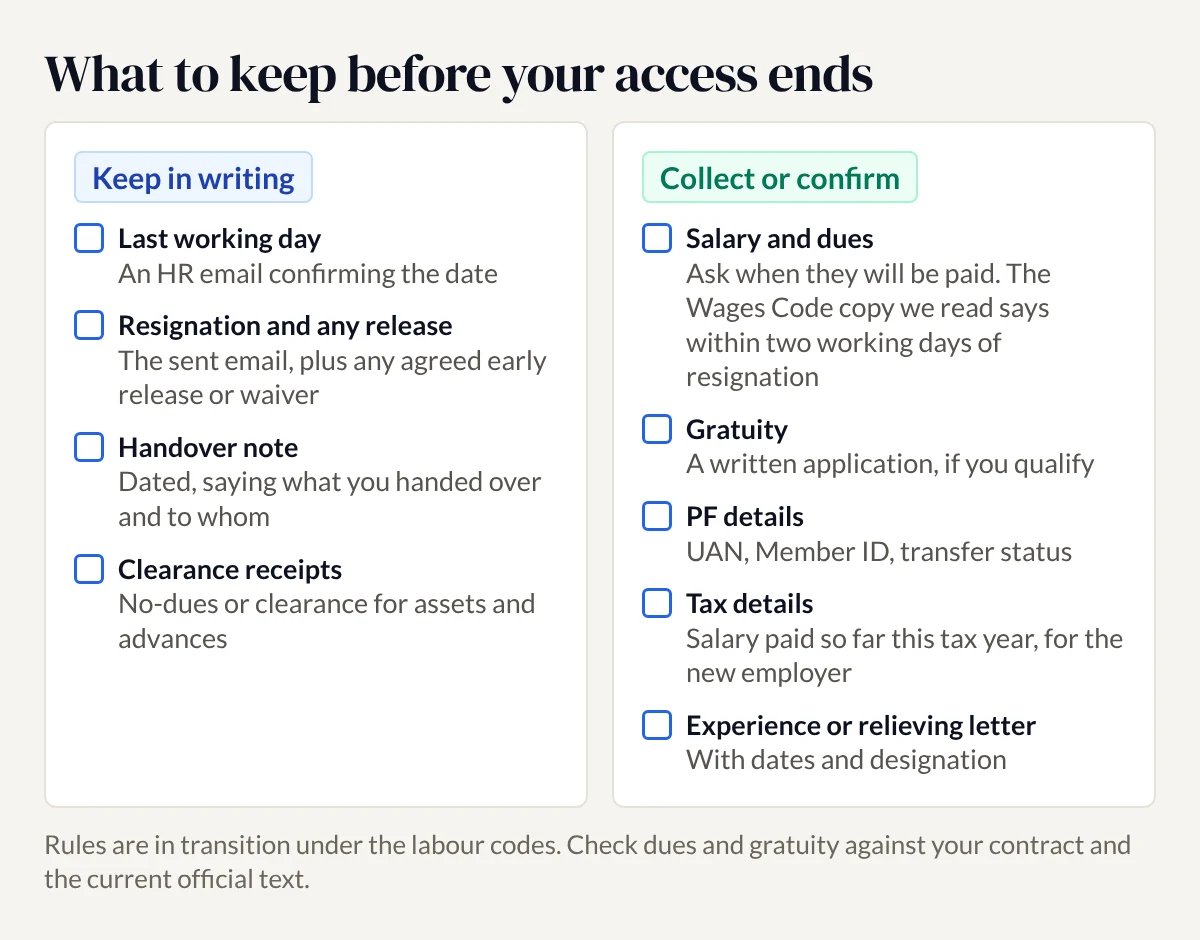
The weeks of notice are when you still have access to people and systems. Use them to collect what you will need later. Our full and final settlement guide covers settlement in depth; this checklist is for the switch.
| Item | What to keep or confirm | Source or basis |
|---|---|---|
| Written last working day | HR email confirming the date | EPFO FAQ: exit date is the last working date |
| Handover note | A dated note of what you handed over and to whom | Good practice, no official source |
| Clearance receipts | No-dues or clearance confirmation for assets and advances | Employer practice |
| Wages at exit | Salary and dues; ask when they will be paid | Wages Code s.17(2): within two working days of resignation, in the copy we read |
| Gratuity | Eligibility and written application if you qualify | Gratuity Act s.4(1), s.7 |
| PF details | UAN, member ID, transfer status | EPFO FAQ |
| Tax details | Salary paid so far this tax year for the new employer | Form 122 FAQ |
| Experience or relieving letter | Whatever the employer issues, with dates and designation | See below |
Wages and gratuity
Under the Code on Wages, in the copy on labour.gov.in, wages must be paid "within two working days of his removal, dismissal, retrenchment or, as the case may be, his resignation." The central model standing orders (clause 13(3)) say wages earned and other dues "shall be paid before the expiry of the second working day" after termination, for workmen they cover. Which regime applies to you depends on the transition position described earlier. The Gratuity Act (s.4(1)) makes gratuity payable on resignation after "not less than five years" of continuous service, and s.7(3) says the employer shall arrange payment "within thirty days from the date it becomes payable." The Compliance Handbook on labour.gov.in repeats the five-year condition. These do not apply to everyone, and the Act's own definitions decide.
Tax paperwork for the new employer
The Income Tax Department's Form 122 FAQ describes Form 122 as a declaration an employee submits to an employer reporting, among other things, salary income earned from any other employer during the same tax year, and it replaces Forms 12B and 12BAA under the Income-tax Act 2025 and I.T. Rules 2026. The page does not discuss job changes in particular, so check the form and your new employer's HR instructions. Keep your last payslip and tax deduction details to hand.
Documents at exit
Do official sources require an experience or relieving letter? In what we read, section 6(1)(f) of the Occupational Safety, Health and Working Conditions Code is about appointment letters and does not speak to exit documents. The central model standing orders (clause 16) say every permanent workman "shall be entitled to a service certificate at the time of his dismissal, discharge or retirement from service," which is a narrow rule for covered workmen. Otherwise, it is employer practice. Our experience letter guide explains the document, and if your new employer will run checks, see the background verification guide linked earlier so you know what they may ask for. If you are still on probation, our probation guide covers what is different.
Section 10
Honest limits and where to go if there is a dispute
This page cannot know your contract, your employer's policy, your state's rules, or whether you are covered by standing orders or a shops act. We could not open some official pages, and a few answers rest on short extracts of long documents, so a human check against the source is worthwhile. Rules are in transition under the labour codes. Treat every figure here as "as stated on the official page when we last reviewed it, 4 October 2026."
- Disagreement about notice or release: start with HR in writing, then consider your state labour office. The Ministry of Labour and Employment site (labour.gov.in) is the central starting point.
- Dues not paid: keep your confirmation of the last working day, payslips and emails, and raise it in writing before approaching an authority.
- Recovery demands or bonds: read the service bond guide linked at the top and consider qualified legal advice.
Two free tools may help in the same weeks. The resume checker gives an AI-estimated score on your resume without needing an account to start, and the AI resume builder can help you update it. The score is an estimate, not a real applicant tracking system test. If you are still preparing for a switch, our interview preparation guide may help.
Section 11
Sources and references
Every legal or payroll claim above comes from one of these official pages, as we read them on 4 October 2026. Some pages are dated or undated, and several are copies of older consolidated texts, so check the current notification or Act text.
- Industrial Employment (Standing Orders) Central Rules 1946, Schedule I, Model Standing Orders (Ministry of Labour and Employment): Clause 13 notice (one month, two weeks), no notice for probationers, wages within second working day; clause 16 service certificate.
- Delhi Shops and Establishments Act 1954 (Labour Department, Government of NCT of Delhi): Section 30 notice of one month by employer and employee after three months' continuous service; section 34 appointment letter.
- Industrial Relations Code 2020 (Ministry of Labour and Employment): Sections 28 and 29 on standing orders; worker definition.
- Industrial Relations Code (Amendment) Act 2026, Act No. 1 of 2026 (Ministry of Labour and Employment): Presidential assent 16 February 2026; deemed commencement 21 November 2025; repeal of the 1946 Act from a notified date.
- Press release on implementation of the four Labour Codes (Press Information Bureau): Codes effective 21 November 2025; existing Acts continue during transition.
- Code on Wages 2019 (Ministry of Labour and Employment): Section 17(2) payment within two working days of resignation; section 18 deductions.
- Payment of Gratuity Act 1972 (Ministry of Labour and Employment): Section 4(1) five years; section 7 thirty days; section 2A continuous service.
- Compliance Handbook on the Labour Codes (Ministry of Labour and Employment): Appointment letter, model standing orders, wages within two working days, gratuity.
- Occupational Safety, Health and Working Conditions Code 2020 (Ministry of Labour and Employment): Section 6(1)(f) appointment letter.
- Maharashtra Shops and Establishments (Regulation of Employment and Conditions of Service) Act 2017 (India Code): No provision on termination notice or service certificate found in the extract we searched; not confirmed against the full text.
- Frequently asked questions (Employees' Provident Fund Organisation): Date of exit, UAN, PF transfer, withdrawal wait and exit date update. Page carries no date.
- Dr. Mrs. Suman V. Jain v. Marwadi Sammelan, 2024 INSC 127, judgment of 20 February 2024 (Supreme Court of India): Withdrawal of a resignation effective from a future date, absent contrary terms.
- Form No. 122 FAQs (Income Tax Department): Declaration to the employer of other-employer salary in the same tax year; replaces Forms 12B and 12BAA.
Our own guides linked above are not used as sources for facts.
Pro tips
Do these
Read your notice, waiver and exclusive-service clauses before replying to the new offer.
Tell the new employer your contractual last working day before you accept.
Ask HR to confirm your last working day in a written reply.
Raise early release in a separate email after giving notice, with a concrete handover plan.
Write down every agreed change: release date, payment in lieu, joining date.
Collect payslips, PF and tax details, and letters before your system access ends.
Keep a dated handover note and your clearance receipts.
Use an on or before joining date if early release is possible but not confirmed.
Avoid these
Delete these
Giving notice before telling the new employer how long your notice is.
Promising the new employer a date that depends on early release.
Joining the new employer before a written release or the end of notice.
Counting the notice days yourself instead of getting the last working day confirmed.
Accepting a verbal counter-offer with nothing in writing.
Stopping work or going silent while waiting for a release decision.
Leaving without handover notes, clearance receipts or documents you will need later.
Assuming a rule that applies to one state or one kind of employee applies to your job.
Put this into a resume
Building and editing are free, and free PDFs carry a small watermark.
Check your resume for freeQuestions
Frequently asked questions
How this guide is maintained
We review this guide every quarter and after any change to the hiring rules or portal behaviour it describes. It was last reviewed on 2026-10-05T06:02:46.253Z. Figures come from named sources, shown beside the number. Where we are estimating rather than measuring, we say so.
By the numbers
Two working days
Code on Wages section 17(2): wages payable within two working days of resignation, as stated in the copy on labour.gov.in
https://www.labour.gov.in/static/uploads/2025/06/c328da14bbb15fc4ad571dc33e7a4ab3.pdf
One month
Central model standing orders, clause 13: notice for workmen rated by the month in covered establishments
https://labour.gov.in/sites/default/files/industrialemploymentstandingorders1centralrules1946.pdf
Thirty days
Payment of Gratuity Act section 7(3): employer shall arrange payment within thirty days from when it becomes payable
https://www.labour.gov.in/static/uploads/2025/06/072a4b7ea8246533c62b96b68a30da53.pdf
Try it
Check the guide against your own file
Everything above is general. Your resume is not. Paste it in and the checker tells you which of these points your file actually breaks.
Check your resume free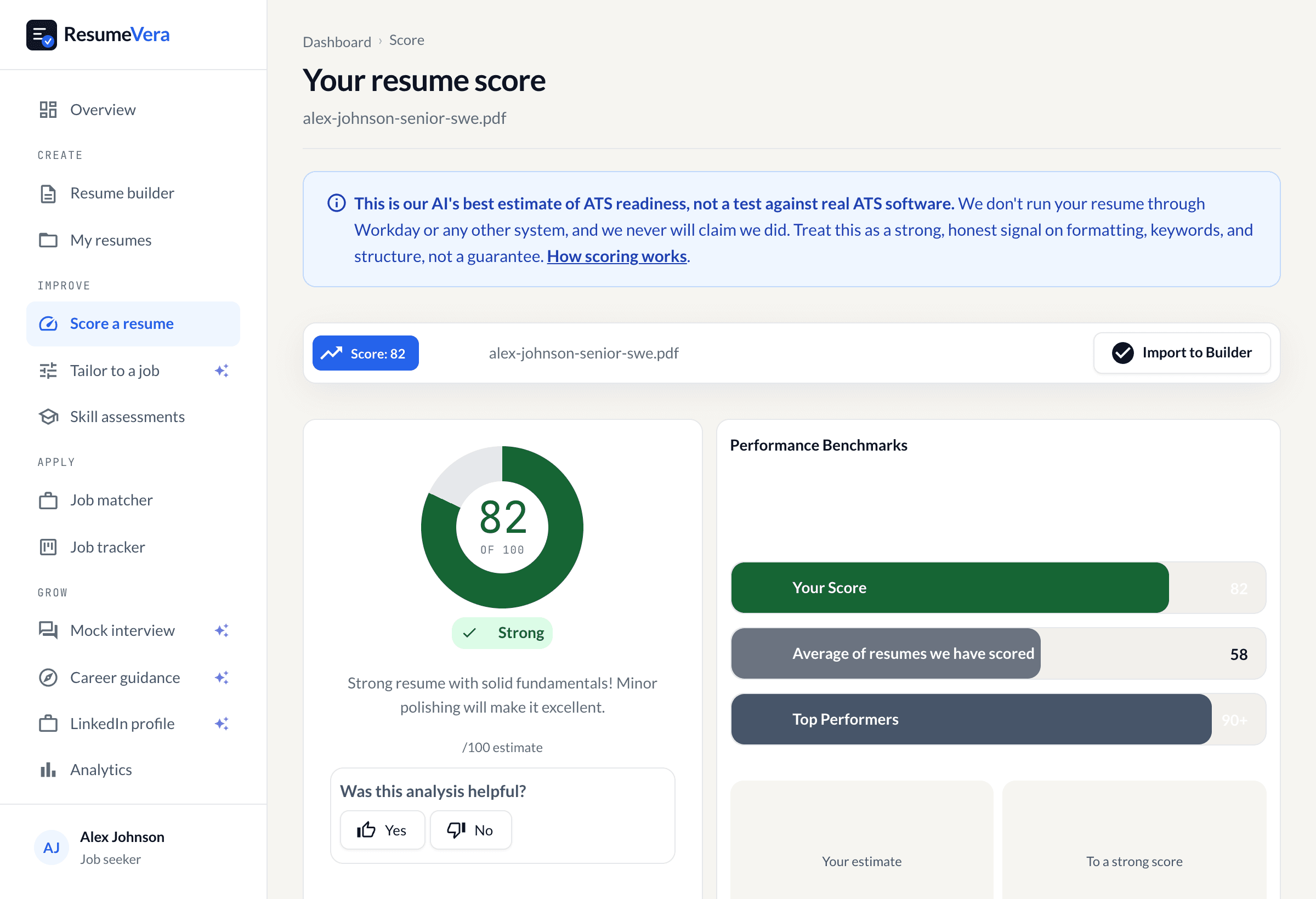
The real score page, with a sample resume and sample scores.
Is your resume ATS ready?
Run a free ATS score check and get specific improvements in seconds.