Written for the India job market, so salaries and formats follow Indian conventions. See the US version.
Career Growth
Resignation acceptance, withdrawal and exit in India
Last reviewed: 5 October 2026. When a resignation takes effect, what the sources say about withdrawal and abscondment, and how exit links to final settlement.
The ResumeVera editorial team
Resume and hiring research, reviewed against current employer guidance.
Updated 2026-10-05T06:28:41.296Z
15 min
Section 01
Resignation acceptance, withdrawal and exit in India: the short answer
Last reviewed: 5 October 2026. This guide explains what official sources say about how a resignation takes effect, whether it can be withdrawn, how it differs from termination, what the model standing orders say about unauthorised absence, and what usually happens at exit. It is not legal advice. Your appointment letter, offer terms and company policy decide most of the detail, and the sources linked at the end have the final word. For letter wording, see our separate guide to the resignation letter format. This page does not repeat templates.
- Taking effect: we found no single central rule that says a private-sector resignation takes effect on a fixed day. Notice terms come from your contract and, where they apply, standing orders or a state shops and establishments law.
- Acceptance: in the sources we reviewed, we did not find a provision that requires an employer to "accept" a resignation in a particular form. Written acknowledgement is still the safest record for you.
- Withdrawal: there is no general official "withdrawal procedure" we could find. The Indian Contract Act has a section on revoking proposals and acceptances, and a 2024 Supreme Court judgment dealt with a resignation that was to take effect on a future date. Both are explained below with their limits.
- Money: the Code on Wages says wages are payable within two working days of resignation, and gratuity has its own conditions. Details are in the exit interview and clearance section.
| Question | What we could confirm | Source |
|---|---|---|
| Notice in writing | Required in the Delhi Shops Act and the 1946 model orders, in the cases they cover | Notice section |
| Employer must accept | Not found in sources reviewed | Acceptance section |
| Wages after resignation | Within two working days | Code on Wages s.17(2) |
| Unauthorised absence | Listed as misconduct in the 1946 model orders | Abscondment section |
Section 02
When a resignation takes effect and what the notice rules say
A resignation is the employee's decision to end the employment. When it actually ends the job depends on the notice or release terms that apply to you. Official texts we read set out three layers.
Layer 1: your contract and policy
Notice terms may appear in the appointment letter or the employee handbook. We did not find a central statute that fixes one notice length for every private job. How a notice period can be shortened, bought out or served in part is covered in our guide to notice period buyout and our page on switching jobs and the notice period.
Layer 2: notice in writing under the central model standing orders
Clause 13 of Schedule I of the Industrial Employment (Standing Orders) Central Rules, 1946, as published on labour.gov.in, reads: "For terminating employment of a permanent workmen, notice in writing shall be given either by the employer or the workmen". The clause sets one month's notice for workmen rated by the month and two weeks' notice for other workmen, and adds that pay in lieu of notice may be paid. The Industrial Employment (Standing Orders) Act, 1946 says it applies to "every industrial establishment wherein one hundred or more workmen are employed, or were employed on any day of the preceding twelve months", and its Schedule lists "Termination of employment, and the notice thereof to be given by employer and workmen" as a matter standing orders must cover. Two cautions: these texts use the word "workmen", and whether you fall in that group and in a covered establishment is a question for your HR or a labour office.
Layer 3: state shops and establishments laws
The Delhi Shops Act, as published by the Delhi labour department, says in section 30(2): "No employee who has put in 3 months' continuous service shall terminate his employment unless he has given to his employer a notice, of at least one month, in writing. In case he fails to give one month's notice he will be released from his employment on payment of an amount equal to one month's pay." That is the Delhi text only. Other states may have their own acts, and we have not summarised them here. Check your state labour department.
The labour codes and the transition
The Press Information Bureau release of 21 November 2025 says the four labour codes "are being made effective from 21st November 2025" and that "During transition, the relevant provisions of the existing labour Acts and their respective rules, regulations, notifications, standards, schemes, etc. will continue to remain in force." The Industrial Relations Code, 2020, as published, uses a threshold of "three hundred or more than three hundred workers" for its standing orders chapter (section 28(1)) and says the Central Government "shall make model standing orders" (section 29(1)). We could not confirm against an official text whether new model standing orders have been notified, so we state no clause from them. Check labour.gov.in and the e-Gazette for the current text.
Worked example of the dates
Suppose a Delhi shop employee has completed more than three months and sends a written notice on 1 March asking to leave. Under the Delhi text quoted above, at least one month's notice in writing is the starting point, so the earliest last working day on the notice would be around 1 April, unless the employer agrees in writing to an earlier release or the contract says otherwise. The dates here are illustrative, not a legal outcome. Always ask for the last working day in writing (sample B below).
Section 03
Does the employer have to accept a resignation?
In the official sources we reviewed, we did not find a provision that requires an employer to "accept" a resignation, to do so within a set time, or to issue an acceptance letter. The texts we did read speak about notice. The Delhi Shops Act talks about the employee giving notice in writing and being released on payment of one month's pay if notice is not given. The 1946 model standing orders speak about notice in writing by either side.
Two general contract provisions are often discussed. Section 4 of the Indian Contract Act, 1872, as published on India Code, says "The communication of a proposal is complete when it comes to the knowledge of the person to whom it is made." Section 7 says acceptance must be "absolute and unqualified". These are general rules about contracts, and whether and how they apply to a particular resignation depends on the contract and the facts. We are not saying they decide your case.
What follows in practice, as editorial advice rather than law:
- Send the resignation in writing, by email to the person your policy names, with HR in copy.
- Ask for a written acknowledgement and the agreed last working day. Silence is not the same as agreement on dates.
- If your employer replies with a different last working day, answer in writing, either agreeing or stating your position, so the thread shows what each side said.
Sample B below is a short email for asking for written acceptance and the last working day.
Section 04
Withdrawing a resignation: what the sources say
We found no official form or procedure for "withdrawing a resignation" in the sources we read. What exists is general contract law and court decisions on particular facts. Treat both as background, not as a right you can assume.
Indian Contract Act, section 5
Section 5 of the Indian Contract Act, 1872 (India Code text) reads: "A proposal may be revoked at any time before the communication of its acceptance is complete as against the proposer, but not afterwards." The section also allows an acceptance to be revoked before its communication is complete as against the acceptor. Its illustration deals with a proposal and an acceptance sent by letter. The section is written about proposals and acceptances. Whether a resignation is analysed that way in your case depends on the contract and the facts, so we do not claim it gives you a right to withdraw.
A 2024 Supreme Court judgment on a future-dated resignation
In Dr. Mrs. Suman V. Jain v. Marwadi Sammelan, decided on 20 February 2024 by a bench of J.K. Maheshwari and K.V. Viswanathan JJ. (judgment on the Supreme Court website), the court set out a passage from an earlier decision: "in the absence of anything to the contrary in the provisions governing the terms and conditions of the office/post, an intimation in writing sent to the competent authority by the incumbent, of his intention or proposal to resign his office/post from a future specified date can be withdrawn by him at any time before it becomes effective". On the facts of that case, the appellant's letter of 25 March 2003 was a resignation effective 24 September 2003, which she withdrew by a letter of 9 September 2003, two weeks before the effective date. The management had earlier, by a letter of 8 April 2003, described the resignation as "final, binding and irrevocable", and the court noted that this declaration lacked her prior consent. Read it as a decision on its own facts, about a resignation with a future effective date and with no contrary terms, not as a general promise.
What this means in practice
- Withdraw as early as possible, in writing, before the last working day and before the employer has acted on the resignation (for example, announced a successor or processed the exit).
- Check your contract and policy for a clause on irrevocability or on employer consent.
- Expect that the employer may agree or decline. Keep the reply on record. If the employer declines and you disagree, the route is your state labour office or legal advice, not an online template.
- If you have already received and accepted a relieving date, withdrawal may be harder to argue. Ask HR plainly what stage the exit is at.
Sample A below is a short email requesting withdrawal. It is a request, not a legal notice.
Section 05
Resignation versus termination
The two end the job in different ways, and the paperwork, notice and records differ.
| Point | Resignation | Termination |
|---|---|---|
| Who starts it | The employee | The employer |
| Notice (central model orders) | Written notice by the workman, clause 13 | Written notice by the employer, clause 13 |
| Notice (Delhi Shops Act) | Section 30(2): one month in writing after 3 months' service | Section 30(1): one month's notice or wages in lieu, with a misconduct exception |
| Wages after exit | Within two working days, Code on Wages s.17(2) | Same section covers removal, dismissal, retrenchment |
Some definitions to know. The Industrial Relations Code, 2020 defines "retrenchment" as termination by the employer of a worker's service for any reason, otherwise than as disciplinary punishment, and lists exclusions such as voluntary retirement and superannuation. Clause 14(2) of the 1946 central model standing orders says a workman "may be suspended for a period not exceeding four days at a time, or dismissed without notice or any compensation in lieu of notice, if he is found to be guilty of misconduct". Delhi section 30(1) says: "No employer shall dispense with the services of an employee who has been in his continuous employment for not less than three months, without giving such person at least one months' notice in writing or wages in lieu of such notice", with an exception where services are dispensed with for misconduct "after giving him an opportunity to explain the charge or charges against him in writing".
Two practical notes. First, a request to "resign instead of being terminated" is a contract matter, so get the terms in writing before agreeing. Second, we did not find an official text that treats a negotiated exit as resignation or termination for every purpose.
Section 06
Abscondment: what the sources say and what to do
"Absconding" is an everyday term in HR emails and offer letters. In the sources we reviewed, we did not find a definition of it. What the 1946 central model standing orders do contain is language on absence:
- Clause 14(3)(e) lists "habitual absence without leave or absence without leave for more than 10 days" among acts and omissions treated as misconduct.
- Clause 14(2) says a workman found guilty of misconduct may be dismissed without notice or compensation in lieu of notice.
- Clause 14(4) covers the procedure, including a written statement of reasons for suspension, a right to appear in person or be represented by a trade union office-bearer, and an inquiry process.
- Clause 9(3) deals with leave: a workman who stays absent beyond leave granted "shall lose his lien on his appointment unless he (a) returns within 8 days of the expiry of the leave and (b) explains to the satisfaction of the employer or the officer specified in this behalf by the employer, his inability to return before the expiry of his leave."
The Delhi Shops Act also contains the misconduct exception quoted in the resignation versus termination section: notice is not needed where services are dispensed with for misconduct, but only "after giving him an opportunity to explain the charge or charges against him in writing". These are texts for covered workers and establishments. Your own contract may use the term "absconding" or "abandonment" differently.
Practical steps if you are on notice and want to leave early
- Do not simply stop attending. Ask in writing for early release or leave adjustment.
- If you are unwell or have an emergency, inform your manager and HR in writing the same day and keep the message.
- If you receive a show-cause or "abscondment" notice, reply in writing and by the date given, with dates and proof of your communications.
If your employer calls you an absconder
Reply in writing, attach your resignation email and any acknowledgement, and state the last working day you understood. If it becomes a dispute, the official route is the state labour office, and legal advice is a separate step this page cannot give. We did not find a rule in the sources reviewed that sets what an employer may withhold in such a case, so do not assume either way.
Section 07
What to keep as evidence
Exit disputes usually turn on dates and written records. Keep copies in a personal account, not only on a company laptop, and only of documents that are yours to keep. Do not take confidential company data.
- Your appointment letter, any revised letters and the notice clause of the policy you were given.
- The resignation email as sent, with date, time and recipients, and any delivery or read receipt.
- Every acknowledgement or acceptance, and any reply that sets the last working day.
- If you asked to withdraw: that email and the reply.
- Leave records and approvals during the notice period, plus messages about early release.
- Handover note, list of assets returned and any no-dues or clearance form.
- Your final payslips, the full and final statement and bank credit entries.
- The experience or relieving letter, once issued.
Take screenshots of any HR portal status such as "resignation submitted" or "resignation approved" with the date. Note any phone or meeting conversations the same day in a short email to yourself or HR, so there is a dated record.
Section 08
Exit interview and clearance: what is practice, not law
In the sources we reviewed, we did not find a statute that requires an exit interview or a particular clearance checklist. These are normal employer practices and vary by company.
Exit interview
Usually a short conversation or form with HR or a manager about why you are leaving. Be factual and polite. You are not required to criticise anyone, and you can decline to write sensitive details. Keep anything you submit consistent with your resignation email.
Clearance or no-dues
Typical steps: return the laptop, ID and access cards, hand over work, close expense claims, and clear any advance or loan. Ask for the checklist early in your notice, and ask each department to sign off in writing. Items such as recovery of notice pay or a service bond depend on the contract, which our guide on service bonds and notice recovery discusses.
Link to final settlement
Some employers treat clearance as the trigger for the final settlement; we could not confirm this against an official text. The Code on Wages, section 17(2), says: "the wages payable to him shall be paid within two working days of his removal, dismissal, retrenchment or, as the case may be, his resignation." The Compliance Handbook for Employers under the four labour codes (labour.gov.in) states: "When an employee leaves an establishment, whether by resignation, dismissal, or termination, the employer is required to pay all due wages within two working days." A PIB factsheet on the Code on Wages, posted 23 November 2025, says "On termination or resignation; wages must be paid within two working days." Section 18(1) says there shall be no deductions "except those as are authorised under this Code". Our guide to full and final settlement explains the statement in detail, and our page on leave encashment on resignation covers that part.
Gratuity, PF and the experience letter
The Payment of Gratuity Act, 1972, section 4(1), says gratuity is payable "on the termination of his employment after he has rendered continuous service for not less than five years" on superannuation, retirement or resignation, or on death or disablement, and section 7(3) says "The employer shall arrange to pay the amount of gratuity within thirty days from the date it becomes payable". See our gratuity guide. For PF, the EPFO FAQ page says "Last working date or the date till when the wages earned is the date of exit" and that "After 60 Days from the date of leaving of services, the member can him self submit / update Date of Exit online through Member Portal", with transfer and withdrawal covered in our PF withdrawal and transfer guide. The EPFO page shows no date, so confirm the current process on the member portal.
For the experience letter, clause 16 of the 1946 central model standing orders says: "Every permanent workman shall be entitled to a service certificate at the time of his dismissal, discharge or retirement from service." The clause does not name resignation, and we could not confirm against an official text that a statute requires an experience letter on resignation, so treat it as company practice unless your contract says otherwise. See experience letter format.
Section 09
Sample emails with bracketed fields
These are samples to adapt, not legal documents. Replace every [bracketed] field, keep the tone factual and send them to the person your policy names with HR in copy.
Sample A: request to withdraw a resignation
Subject: Request to withdraw resignation dated [date of resignation], [your name], [employee ID]
Dear [Manager or HR name],
I submitted my resignation by email on [date], with [last working day as stated or proposed] as the last working day. I would like to request that I be allowed to withdraw it.
[One or two factual lines on the reason, for example: My circumstances have changed and I would like to continue in my role as [designation].] I have not [accepted another offer / yet received a relieving date], and I am happy to discuss this at your earliest convenience.
Please let me know in writing whether the withdrawal can be accepted, and if there is a form or process I should follow. I will continue to fulfil my responsibilities in the meantime.
Thank you for considering this request.
Regards,
[Your name], [Employee ID], [Contact number]
Sample B: asking for written acceptance and the last working day
Subject: Resignation dated [date]: request for written confirmation of last working day, [your name], [employee ID]
Dear [HR name],
I submitted my resignation on [date] by [email / HR portal]. I understand the notice period in my appointment letter is [notice period as stated in your letter].
Could you please confirm in writing that the resignation has been received and accepted, and confirm my last working day as [date]? If a different date applies, please let me know the basis for it so we are both working from the same record.
I would also appreciate the clearance or no-dues checklist and the expected timeline for the full and final settlement and the experience letter. I will complete my handover as agreed with [manager name].
Thank you.
Regards,
[Your name], [Employee ID], [Contact number]
Keep a copy of the sent message and any reply.
Section 10
Honest limits of this guide
This is a general explainer based on official texts we could open on 5 October 2026. It is not legal or tax advice, and it is not a substitute for your appointment letter, your employer's policy or an official notification. Please keep these limits in mind:
- The four labour codes took effect on 21 November 2025 according to PIB, while the earlier Acts' provisions continue during the transition. We could not open an official copy of the 2026 model standing orders, so nothing here is drawn from them.
- The 1946 model standing orders and the Delhi Shops Act are two examples. Your state, sector and establishment size decide which rules apply, and we have not covered other states.
- Court decisions turn on their own facts. The Supreme Court judgment mentioned above concerned a specific resignation effective on a future date.
- For disputes about acceptance, withdrawal, absence or unpaid dues, contact your state labour office or the Ministry of Labour and Employment at labour.gov.in, or a qualified adviser.
If you are updating your resume after an exit, our free resume checker gives an AI-estimated score with no account needed to start, and the AI resume builder helps you draft the next one. The score is an estimate, not a real applicant tracking system test.
Section 11
Sources and references
Every source below is an official page we opened on 5 October 2026. Pages can change, and some are undated, so check the current official text before acting.
- The Indian Contract Act, 1872 (India Code): Sections 4, 5 and 7 quoted above.
- Industrial Employment (Standing Orders) Central Rules, 1946 (Ministry of Labour and Employment): Clauses 9(3), 13, 14 and 16 of Schedule I.
- Industrial Employment (Standing Orders) Act, 1946 (India Code): Section 1(3) applicability and Schedule matters on termination and misconduct.
- Delhi Shops and Establishments Act, 1954 (Delhi Labour Department): Section 30(1), 30(2), 30(3) and the Delhi text on notice.
- The Industrial Relations Code, 2020 (Ministry of Labour and Employment): Retrenchment definition, sections 28(1) and 29(1).
- The Code on Wages, 2019 (Ministry of Labour and Employment): Section 17(2) wages within two working days on resignation, and section 18(1).
- The Payment of Gratuity Act, 1972 (Ministry of Labour and Employment): Sections 4(1), 2A and 7(3).
- Four Labour Codes made effective, release of 21 November 2025 (PIB): Effective date and the transition statement.
- Code on Wages, 2019 factsheet, posted 23 November 2025 (PIB): Wages within two working days on termination or resignation.
- Compliance Handbook for Employers under the Four Labour Codes (Ministry of Labour and Employment): Wages within two working days on leaving; model standing orders overview.
- Frequently asked questions (EPFO), page undated: Date of exit and updating it on the member portal.
- Dr. Mrs. Suman V. Jain v. Marwadi Sammelan, judgment of 20 February 2024 (Supreme Court of India): Withdrawal of a resignation effective on a future date, on the facts of that case.
Pro tips
Do these
Send the resignation in writing to the person your policy names, with HR in copy, and keep a copy.
Ask for written acknowledgement and the agreed last working day, and answer in writing if the date changes.
If you want to withdraw, say so as early as possible and in writing, before the last working day.
Never just stop attending. Ask for early release or leave adjustment in writing.
Ask for the clearance checklist early in your notice period.
Keep a dated record of every call or meeting about your exit, in a short follow-up email.
Check your appointment letter for notice, bond and recovery clauses before you resign.
Check the final settlement against the official wage and gratuity rules, and ask HR about any gap.
Avoid these
Delete these
Resigning by phone or chat only, with no written notice.
Assuming silence from HR means your resignation was accepted on your preferred date.
Assuming you can withdraw a resignation at any time without the employer agreeing.
Stopping attendance during notice and leaving the record to speak for you.
Ignoring a show-cause or absence notice instead of replying in writing by the date given.
Signing a clearance or exit form without reading what it says about dues and recovery.
Taking confidential company files as proof instead of keeping your own emails and documents.
Relying on one state's rule or a blog summary when your state and contract differ.
Put this into a resume
Building and editing are free, and free PDFs carry a small watermark.
Check your resume with the free checkerQuestions
Frequently asked questions
How this guide is maintained
We review this guide every quarter and after any change to the hiring rules or portal behaviour it describes. It was last reviewed on 2026-10-05T06:28:41.296Z. Figures come from named sources, shown beside the number. Where we are estimating rather than measuring, we say so.
By the numbers
Two working days
Code on Wages section 17(2): wages payable after resignation
https://www.labour.gov.in/static/uploads/2025/06/c328da14bbb15fc4ad571dc33e7a4ab3.pdf
One month
Notice in writing in Delhi Shops Act section 30(2), after 3 months' continuous service
https://labour.delhi.gov.in/labour/delhi-shops-act-1954
More than 10 days
Absence without leave listed as misconduct in clause 14(3)(e), 1946 central model standing orders
https://labour.gov.in/sites/default/files/industrialemploymentstandingorders1centralrules1946.pdf
Try it
Check the guide against your own file
Everything above is general. Your resume is not. Paste it in and the checker tells you which of these points your file actually breaks.
Check your resume free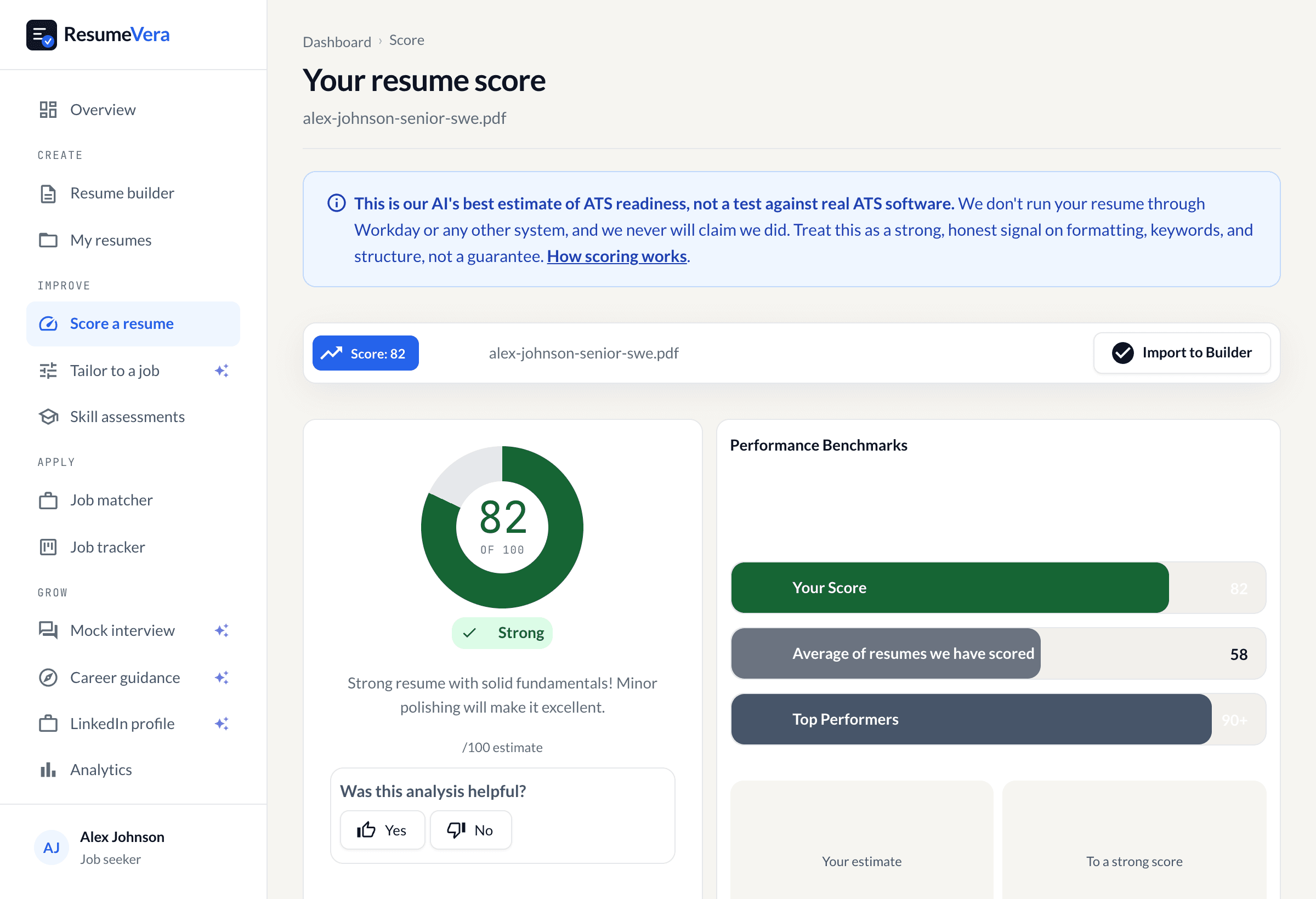
The real score page, with a sample resume and sample scores.
Is your resume ATS ready?
Run a free ATS score check and get specific improvements in seconds.