Written for the India job market, so salaries and formats follow Indian conventions. See the US version.
Career Growth
Form 16 when you change jobs in India
Last reviewed: 4 October 2026. What Form 16 contains, who issues it, how to handle two employers in one year, and how to check and correct your TDS.
The ResumeVera editorial team
Resume and hiring research, reviewed against current employer guidance.
Updated 2026-10-05T06:26:15.541Z
16 min
Section 01
Form 16 when you change jobs: the short answer
Last reviewed: 4 October 2026. This guide explains what Income Tax Department pages say about Form 16, salary from two employers in one year, and how to check and correct your TDS. It is not tax advice. Your payslips, your employers and the official pages linked at the end decide the details, and tax rules change.
If you left one employer and joined another in the same financial year, the main points from the official pages we read are:
- Each employer that deducted tax from your salary issues its own certificate for the period you worked for it. The Department's Form 16 page says: "In case an employee has worked or is currently working with multiple employers in a financial year, each employer is obligated to provide Part A of Form 16 for the duration the employee was employed under them."
- You may give the new employer details of salary and tax deducted by the old employer, so that it can take them into account when deducting tax. Section 192(2) of the 1961 Act describes this, and the form for it was Form 12B. Under the Income-tax Rules, 2026 the equivalent is Form 122, which the Department's FAQ says replaces Forms 12B and 12BAA.
- The employer deducts tax on salary at the "average rate" on estimated income for the year, and can adjust an earlier excess or deficiency later in the same year. Check the totals.
- Compare each Form 16 with your annual tax statement (Form 26AS; the Department's pages are not consistent on whether it is called Form 168 from tax year 2026-27, see section 7) and with your Annual Information Statement (AIS) before you file.
- Form names changed on 1 April 2026 with the Income-tax Act, 2025 (see section 10).
Related reading on this site: switching jobs and notice period covers the exit, and salary slip format helps you read payslips.
Section 02
What Form 16 contains: Part A and Part B
Form 16 is the certificate an employer gives you to show tax deducted at source (TDS) on salary. Section 203 of the 1961 Act requires a person who deducts tax to "furnish to the person to whose account such credit is given or to whom such payment is made ... a certificate to the effect that tax has been deducted, and specifying the amount so deducted, the rate at which the tax has been deducted and such other particulars as may be prescribed" (Section 203, Income-tax Act, 1961 (Income Tax Department)). The page shows an older version of the text, so check the current wording.
Part A
The Department says "Part A provides information on the tax that has been deducted" (Form 16 and Form 16A (Income Tax Department)). The official Form 16 format lists "Name and address of the Employer/Specified Bank", the PAN and TAN of the deductor, the PAN of the employee, an "Assessment Year", a "Period with the Employer" with From and To dates, and a quarter-wise summary with columns for receipt numbers of the original quarterly statements, amount paid or credited and amount of tax deducted (Form No. 16 format (Income Tax Department)).
The TRACES help page says Part A is generated by the TDS Centralised Processing Cell from the quarterly TDS statements the employer files, on a request raised by the employer, and that "Part B information will be issued by the employer" (TRACES FAQs on Form 16 (TDS-CPC)).
Part B
"Part B includes details related to the employee's salary, such as allowances, deductions, rebates, etc." In the official Form 16 format the Part B annexure has headings for "Gross Salary", "Less: Allowances to the extent exempt under section 10", "Standard deduction under section 16(ia)" and "Deductions under Chapter VI-A". We did not confirm the later headings of that annexure.
The 2026 version, Form 130
For tax year 2026-27 onwards the Department's FAQ says "Form No. 130 replaces Form 16 issued under the Income-tax Rules, 1962" and describes it as "a certificate for Tax Deducted at Source (TDS) issued annually by an employer to a salaried employee or a pensioner" (Form No. 130 FAQs (Income Tax Department)). The Department's form summary lists a Part A with employer and employee details, a Part B summarising amounts paid and tax deducted, and an annexure with salary details and a declaration (Forms 130 to 133 (Income Tax Department)). The form page describes it as a "Certificate under section 395 for tax deducted at source on salary" (Form No. 130 (Income Tax Department)).
Section 03
Who must issue Form 16, and by when
The Department's page says: "Where the employer has deducted tax under Section 192 from the employee's salary...the employer is required to issue TDS certificate in Form 16." The due date it gives is: "Form 16 is required to be issued by the employer up to 15th June of the financial year immediately following the financial year in which the amount was paid and tax has been deducted."
| Period | Form and duty | Due date |
|---|---|---|
| Salary paid up to 31 March 2026 | Form 16, section 192 of the 1961 Act | 15 June 2026 |
| Salary paid from 1 April 2026 | Form 130, section 392 and 393(1) of the 2025 Act | 15 June 2027 |
The dates in this table are our application of the rules quoted on this page to those years: 15 June after the end of the financial year or tax year in which the salary was paid. The second row comes from Rule 215 of the Income-tax Rules, 2026, which sets Form 130 for sections 392 and 393(1) "By the 15th June of the financial year immediately following the tax year" (Rule 215, Income-tax Rules 2026 (Income Tax Department)). The Form 130 FAQ adds that the employer or specified bank "responsible for deducting tax under sections 392 or 393(1)" must issue it.
What about an employer you have left?
We did not find a separate due date for employees who have left. The pages we read apply the same 15 June date and say each employer provides a certificate for the period of employment with it. So the old employer's certificate is due on the same date as everyone else's, and you do not have to wait for your new employer.
Form 16A is a different certificate. The Department's page says it is for tax deducted under provisions other than section 192 and a few others it lists, and the Department's verification page is titled for Form 16A only (TDS certificate (Form 16A) verification (Income Tax Department)).
Section 04
Two employers in one year: two Form 16s and how to use them
The Form 130 FAQ answers the question directly: "In case a person was employed with more than one employer, then each employer is required to issue a separate certificate" for the respective employment period. The 1961 Act version says the same through the Form 16 page quoted above.
A simple worked example
Take a hypothetical employee, Meera, who works for Employer A from 1 April to 31 July and for Employer B from 1 August to 31 March of the same financial year. She should expect:
- One certificate from Employer A showing the period 1 April to 31 July, the salary paid and the tax deducted in those months.
- One certificate from Employer B for 1 August to 31 March.
- If she gave Employer B the details of Employer A's salary and tax, Employer B's calculation can include them, so its certificate may show her income across both jobs. If she did not, Employer B only knows what it paid.
That last point is this page's reading of section 192(2) and the Form 122 FAQ, not a sentence from either. We did not find an official statement of what an employer does if no details are given, so read the figures on both certificates.
How the two certificates are used
- When you file your income tax return, salary from both employers is part of your income for the year. The tax deducted by each employer is the credit you claim.
- The ITR-1 FAQ says ITR forms are "annexure-less forms", so you are not required to attach TDS certificates, and it advises you to "Download AIS and Form 26AS and check the actual TDS / TCS / tax paid" (File ITR-1 (Sahaj) Online FAQs (Income Tax Department)).
Section 05
Declaring previous employer income to your new employer: Form 12B and Form 122
Under the 1961 Act. Section 192(2) says: "Where, during the financial year, an assessee is employed simultaneously under more than one employer, or where he has held successively employment under more than one employer, he may furnish to the person responsible for making the payment ... such details of the income under the head 'Salaries' due or received by him from the other employer or employers, the tax deducted at source therefrom and such other particulars, in such form and verified in such manner as may be prescribed, and thereupon the person responsible for making the payment ... shall take into account the details so furnished" (Section 192, Income-tax Act, 1961 (Income Tax Department)).
Rule 26A says "The assessee may furnish to the person responsible for making the payment ... the details of the income under the head 'Salaries' due or received by him from the other employer or employers ... and of any tax deducted at source from such income in Form No. 12B" (Rule 26A, Income-tax Rules, 1962 (Income Tax Department)). The word is "may", so this is something you choose to do.
Under the 2025 Act. Section 392(4)(a) says the employer "shall take into account the following particulars furnished by the assessee, at his option..." (Section 392, Income-tax Act, 2025 (Income Tax Department)). Rule 204(1) of the 2026 Rules says "The assessee may furnish the following particulars in Form No. 122 to the person responsible for making the payment" (Rule 204, Income-tax Rules 2026 (Income Tax Department)).
What Form 122 is, as the Department describes it
- The FAQ header reads "Form No 122 (Earlier Form Nos. 12B & 12BAA)" and the form is titled "Form for furnishing details of income under section 392(4)(a) of the Income-tax Act 2025" (Form No. 122 (Income Tax Department)).
- The FAQ says "A salaried employee is required to file Form No 122 with his employer to report salary income from any other employer or in case he wishes to claim loss under the head House property income or report tax deducted/collected at source from any other income", and also that "While not mandatory by law, it is beneficial to the employee as it ensures correct tax deduction, avoiding excess deduction and consequent filing of claim for refunds." The two sentences read differently, and Rule 204(1) says the assessee "may" furnish it.
- Its salary part asks for the other employer's name, PAN and TAN, the period of employment, salary, taxable allowances, perquisites and "Amount of tax deducted during the year".
- On the time limit, two Department documents say different things. The FAQ says "There is no prescribed time-limit within which Form No 122 is to be submitted, to the employer." The form document says "It is expected that the form is submitted at the earliest possible, but not later than 31st March of the Financial Year, so that tax liability could be computed and tax could be deducted accordingly." We could not find an official text that reconciles the two. Our suggestion, which is not an official statement, is to give it soon after joining so the employer can use it in later deductions.
The official pages we read do not list attachments, so ask your new employer's payroll team what they accept. The exit statement in your full and final settlement is a likely supporting document.
Other forms you may meet
- Form 124 (earlier Form 12BB): a statement by the employee to the employer about deductions and exemptions to be considered in TDS. The FAQ says it is filed "only if the employee wants his claim of deductions or exemptions etc to be considered" (Form No. 124 FAQs (Income Tax Department)).
- Form 123 (earlier Form 12BA): the employer's statement of perquisites, for salary above Rs 1,50,000 a year, issued "by 30th of April of the following year" (Form No. 123 FAQs (Income Tax Department)).
Section 06
TDS on salary, and the risk of excess or short deduction
Section 392(1) of the 2025 Act says a person paying salary "shall deduct income-tax on the amount payable...", and the Department's page describes the deduction as at an "average rate of income-tax computed on the basis of the rates in force for the tax year" in which payment occurs. Section 192(1) of the 1961 Act says the deduction is "at the average rate of income-tax computed on the basis of the rates in force for the financial year in which the payment is made, on the estimated income of the assessee under this head for that financial year."
Both sections also say the employer may adjust earlier errors: "increase or reduce the amount to be deducted under this section for adjusting any excess or deficiency..." (section 392(5)(c)), and section 192(3) says "increase or reduce the amount to be deducted under this section for the purpose of adjusting any excess or deficiency arising out of any previous deduction or failure to deduct during the financial year."
Why a job change is a risk point
This is our reading of the wording above, not an official statement. Each employer estimates tax from the salary it pays and what it is told. If you tell the new employer about the old salary and tax, the deduction can be based on the combined income, which is the stated purpose in the Form 122 FAQ: employees "are less likely to overpay tax and need to claim a refund". If you do not, each employer may deduct on only part of your income, so the total can be short or, if both give the same claims, mismatched.
Excess and short deduction
If too much was deducted, the employer can reduce later deductions in the same year (section 392(5)(c)), and the FAQ above refers to claiming a refund through the return. If too little was deducted, section 392(5)(c) lets the employer increase later deductions for a deficiency. We did not find official pages on refund timelines or interest in this context, so check the current rules or ask a professional.
Section 07
Checking Form 16 against Form 26AS (Form 168) and AIS
The Department publishes two statements you can compare with your certificates, and both are viewed after logging in.
| Statement | What it shows | Where |
|---|---|---|
| Form 26AS (Annual Tax Statement); see the note on Form 168 below | TDS, tax payments, demand and refund | TRACES or e-filing portal, after login |
| AIS | TDS and other reported information | e-filing portal |
| Your Form 16 or 130 | What your employer certified | From the employer |
The Department's TRACES page is titled "View Annual Tax Statement [Form 26AS (Upto Previous Year 2025-26 and From Tax Year 2026-27 onwards)]" and lists "Form 26AS (Annual Tax Statement, Applicable from Tax Year 2026-27 onwards as per Income-tax Act, 2025)" and "Form 26AS (Annual Tax Statement, Applicable upto Assessment Year 2026-27 as per Income-tax Act, 1961)" (View Annual Tax Statement on TRACES (Income Tax Department)). The Form 26AS document lists "Information relating to tax deducted or collected at source", "Information relating to payment of taxes" and "Information relating to demand and refund" (Form 26AS (Income Tax Department)).
The AIS FAQ says that "From AY 2023-24 onwards, Annual Tax Statement (Form 26AS) available on TRACES portal displays only TDS/TCS related data of the taxpayer. Other details pertaining to the taxpayer are available in the AIS (Annual Information Statement)." It adds that "AIS also provides the taxpayer the option to give feedback on the transactions reported" (AIS FAQs (Income Tax Department)). The portal help page says AIS has Part A with personal details and Part B with tax deducted or collected at source information, with an optional feedback button; the Taxpayer Information Summary (TIS) gives an aggregated view for prefilling (Annual Information Statement (Income Tax Department)).
The Department's pages are not worded the same on Form 168. The FAQ titled "Form No. 168 - Frequently Asked Questions (FAQs) Annual Information Statement (AIS)" carries the header "Form No. 168 (Earlier Form No. 26 AS)" and begins "AIS stands for Annual Information Statement" (Form No. 168 FAQs (Income Tax Department)), while the TRACES page above uses the name Form 26AS for tax year 2026-27 onwards. We could not confirm against an official text which name the statement carries from 2026-27, so follow the menu names inside the portal.
A short check
- Match the tax deducted under each employer's TAN in the annual tax statement with each certificate.
- Match gross salary on each certificate with your payslips and any salary shown in AIS.
- Check each employer's period of employment against your joining and leaving dates.
- Note any difference and decide whether it is the employer's figure or the reported data.
Section 08
Correcting mistakes, and what to do if Form 16 does not arrive
If a figure is wrong
- Tax is missing from the annual tax statement. The tax credit mismatch FAQ says: "Inform the employer / deductor responsible for deducting TDS from your income. Your employer / deductor needs to file a revised TDS return" (Tax credit mismatch FAQs (Income Tax Department)). The Department also explains that deductors correct statements by filing correction statements through TRACES (TDS/TCS correction statement (Income Tax Department)).
- The certificate disagrees with your payslips. Write to payroll with your payslips and ask for a correction.
- AIS shows something wrong. The AIS help describes a feedback option on each item (see section 7).
If the old employer does not issue Form 16
- Ask in writing after the due date has passed, using the sample in section 11, and keep proof of sending.
- Check your annual tax statement and AIS. If tax was deducted and deposited, it should appear there. The ITR-1 FAQ's advice to download AIS and Form 26AS and "check the actual TDS / TCS / tax paid" applies here.
- If the old employer did not deposit or report the tax, the credit may not show, and the mismatch FAQ route is to ask the employer to file a revised TDS return.
- Keep payslips and the final settlement statement as your record.
On the employer's side, the section 272A page of the 1961 Act (legislation shown as amended through 2000) lists, at 272A(2)(g), failure "to furnish a certificate as required by section 203" and says "he shall pay, by way of penalty, a sum of one hundred rupees for every day during which the failure continues" (Section 272A, Income-tax Act, 1961 (Income Tax Department)). A different Department page, in an answer about Form 16A for Q4 of FY 2025-26, says "Under Section 272A(2)(g) of the old Act, a penalty of Rs. 500 per day for the period of default can be levied" (TDS compliance (Income Tax Department)). The two pages give different amounts, and we could not confirm against an official text which figure applies to a missing Form 16. We did not find the penalty provision for Form 130 under the 2025 Act in the sources reviewed.
The portal's grievance manual lists a CPC-TDS category covering "Form 26AS/ATS Related" matters (Submit grievances user manual (Income Tax Department)). We did not find an official page naming a specific route for a missing Form 16, so ask your employer, check the portal's options and consider professional advice.
Section 09
Which ITR form generally applies, and the old versus new regime
ITR form
The e-filing portal's page for salaried individuals for AY 2026-27 (income of FY 2025-26) says (Salaried individuals for AY 2026-27 (Income Tax Department)):
- ITR-1 (Sahaj): for a "Resident (other than Not Ordinarily Resident) Individual" with salary or pension, one house property and other sources such as interest, family pension and dividend, agricultural income up to Rs 5,000 and long-term capital gain under section 112A up to Rs 1,25,000, with total income up to Rs 50 lakh. The page lists conditions that rule ITR-1 out, such as being a company director, foreign assets or income, or short-term capital gains.
- ITR-2: an individual or HUF with income under any head other than profits and gains of business or profession who is not eligible for ITR-1.
- ITR-3: individuals with business or profession income who are not eligible for ITR-1, ITR-2 or ITR-4. ITR-4 (Sugam) is for presumptive income under section 44AD, 44ADA or 44AE.
Having two Form 16s is not named as a condition for any particular form on that page. The Department's scope page says returns for AY 2026-27 are filed on the forms prescribed under the old Act (Objective and scope of the new Act (Income Tax Department)). We did not find the return forms for tax year 2026-27 in the sources reviewed.
Old versus new regime when you change jobs mid-year
The official statements we found are:
- The new regime is the default. The Department's FAQ (written for AY 2024-25, so dated) says "the employee has to intimate the employer regarding his intended tax regime during the year. If the employee does not make an intimation, it shall be presumed that the employee continues to be in the default tax regime", and "An individual with non business income can switch between the new and old tax regimes every year" (FAQs on new tax vs old tax regime (Income Tax Department)).
- It also says: "In case of non-business cases, option to choose the regime can be exercised every year directly in the ITR to be filed on or before the due date specified under section 139(1)."
- Under section 202(1) of the 2025 Act the tax is computed at the rates in its table unless the person "exercises the option in the manner provided under sub-section (4)", and for people without business income that option goes with the return of income for the tax year (Section 202, Income-tax Act, 2025 (Income Tax Department)).
What we did not find is an official page that says how a mid-year change of employer changes the regime intimation. So the safe reading is: tell the new employer which regime you want deducted for, as the FAQ says an intimation is expected, and remember that the choice that counts for your tax is the one made in the return for that year. Form 124 is not described as a regime form; its FAQ focuses on deductions and exemptions. The FAQ also lists HRA exemption and Chapter VI-A deductions (with listed exceptions such as 80CCD(2)) as not available in the new regime, so the choice affects what claims you can make.
Section 10
The Income-tax Act 2025 transition and form names
The Press Information Bureau release of 1 April 2026 says: "With its coming into force from 1st April, 2026, the Income-tax Act, 2025 marks a new chapter" and "The Income-tax Rules, 2026 were notified by the Central Board of Direct Taxes on 20th March, 2026" (Income-tax Act, 2025 comes into force from today (PIB)).
The Department's transition FAQ says:
- "The ITR for income earned during FY 2025-26 will be filed for Assessment Year 2026-27 under the provisions of the Income-tax Act, 1961."
- "Any sum paid or credited on or before 31st March, 2026 shall be governed by the provisions of the Income-tax Act, 1961" and "Any sum paid or credited on or after 1st April, 2026 shall be governed by the corresponding withholding provisions of the Income-tax Act, 2025."
- "A 'tax year' is a period of twelve months contained in a financial year. It replaces the term 'previous year' used in the Income-tax Act, 1961." (FAQs on interplay and transition (Income Tax Department))
| Item | 1961 Act, to FY 2025-26 | 2025 Act, from 2026-27 |
|---|---|---|
| Salary TDS section | 192 | 392 |
| Salary certificate | Form 16 | Form 130 |
| Previous employer details | Form 12B | Form 122 |
| Deduction claim to employer | Form 12BB | Form 124 |
| Perquisite statement | Form 12BA | Form 123 |
| Annual tax statement | Form 26AS | Form 26AS or Form 168 (Department pages differ, see section 7) |
For a job change between April 2025 and March 2026, the return is filed for AY 2026-27 under the 1961 Act and the old forms apply. For salary paid on or after 1 April 2026, the transition FAQ says the corresponding withholding provisions of the 2025 Act govern, and the Form 130 and Form 122 pages above are the matching forms. We did not find an official page that says how a certificate for a mixed period is issued. Many people still say "Form 16" for both, which is why this guide uses both names.
Section 11
Sample emails with [bracketed] fields
These are samples to adapt, not legal or tax documents. Remove anything that does not apply and keep the tone polite.
Sample A: request for Form 16 from your former employer
Subject: Request for Form 16 / Form 130, [Employee name], [Employee ID]
Dear [HR or payroll team],
I worked with [Company name] from [joining date] to [last working day] ([Employee ID], PAN ending [last four characters, if you wish to share]). I would be grateful if you could share my Form 16 (Form 130 if the salary was paid on or after 1 April 2026) for [financial year or tax year], covering Part A and Part B.
The Income Tax Department's pages state that Form 16 is due by 15 June of the financial year following the year of deduction. If a certificate has already been issued, please resend it to [personal email]. If there is a delay or a mismatch between the certificate and my payslips, please tell me what is needed from my side.
Please also confirm the [quarters] in which tax deducted from my salary was deposited and reported, so I can match it with my annual tax statement.
Thank you,
[Name] | [Phone] | [Personal email]
Sample B: note submitting Form 12B / Form 122 to the new employer
Subject: Previous employer salary and TDS details, [Employee name], [Employee ID]
Dear [Payroll team],
I joined [New company] on [joining date]. Before that, I worked with [Previous employer] from [from date] to [to date] in the same [financial year or tax year]. As permitted under section 192(2) of the Income-tax Act, 1961 (Form 12B) or section 392(4)(a) of the Income-tax Act, 2025 (Form 122), I am attaching the completed form with the details of salary received and tax deducted at source from that employment, along with [last payslip / exit statement / Form 16 or Form 130 if available].
Please take these into account when computing my tax deduction for the rest of the year, and let me know if you need the form in a different format. Please confirm how I record my choice of the [new / old] regime for TDS.
Thank you,
[Name] | [Employee ID]
Share your PAN only through the channel your payroll team provides.
Section 12
Sources and references
Limits. Tax law is changing from the 1961 Act to the 2025 Act, rules and forms are updated often, and your own circumstances decide what applies. This page cannot tell you how much tax you owe, how a particular employer works, or what the Department would decide in a dispute. Some pages we read are undated or show older text, and the Department's own pages are not always worded the same. For the final word, use the e-filing portal at incometax.gov.in, the Income Tax Department site at incometaxindia.gov.in or a qualified tax professional.
Related reading: gratuity and PF withdrawal and transfer cover other exit money, and experience letter and offer letter cover the other documents in a job change.
Every tax statement above comes from an official page we opened for this review, most of them through a summary tool that returns an extract rather than the full text, so quoted wording should be spot-checked against each link. One Department page on viewing the annual tax statement could not be loaded when we re-checked, so it is not cited. We could not confirm against an official text the following points: the name of the annual tax statement from 2026-27, the current amount of the section 272A penalty for a missing Form 16, and how the two Form 122 time-limit statements fit together. Check each link for the current version.
- Form 16 and Form 16A (Income Tax Department): who issues Form 16, Part A and B, 15 June due date, multiple employers.
- Form No. 16 format (Income Tax Department): Part A fields, period with the employer, Part B annexure headings.
- TRACES FAQs on Form 16 (TDS-CPC): Part A generated by TDS-CPC, Part B by the employer, rule 31(1).
- Section 203, Income-tax Act, 1961 (Income Tax Department): certificate for tax deducted (older text version).
- Section 192, Income-tax Act, 1961 (Income Tax Department): sub-sections (2) and (3), previous employer details and adjustment.
- Section 392, Income-tax Act, 2025 (Income Tax Department): average rate, 392(4)(a) and 392(5)(c).
- Rule 26A, Income-tax Rules, 1962 (Income Tax Department): Form 12B and Form 12BA.
- Rule 204, Income-tax Rules 2026 (Income Tax Department): Forms 122, 123 and 130.
- Form No. 122 FAQs (Income Tax Department): what Form 122 is, replaces 12B, no time-limit, not mandatory.
- Form No. 122 (Income Tax Department): title and parts of the form.
- Form No. 123 FAQs (Income Tax Department): employer perquisite statement.
- Form No. 124 FAQs (Income Tax Department): employee statement of claims, earlier Form 12BB.
- Form No. 130 FAQs (Income Tax Department): replaces Form 16, due date, multiple employers.
- Form No. 130 (Income Tax Department): title and description of the form.
- Forms 130 to 133 (Income Tax Department): structure of Form 130.
- Rule 215, Income-tax Rules 2026 (Income Tax Department): Form 130 due date.
- View Annual Tax Statement on TRACES (Income Tax Department): Form 26AS from tax year 2026-27 and up to AY 2026-27, how to view.
- Form 26AS (Income Tax Department): contents of Form 26AS.
- Form No. 168 FAQs (Income Tax Department): header "Form No. 168 (Earlier Form No. 26 AS)" and AIS description.
- Annual Information Statement (Income Tax Department): AIS parts, feedback, TIS.
- AIS FAQs (Income Tax Department): AIS versus Form 26AS, feedback.
- Tax credit mismatch FAQs (Income Tax Department): inform employer, revised TDS return.
- TDS/TCS correction statement (Income Tax Department): correction statements through TRACES.
- TDS certificate (Form 16A) verification (Income Tax Department): verification is for Form 16A.
- Submit grievances user manual (Income Tax Department): grievance categories including CPC-TDS.
- Section 272A, Income-tax Act, 1961 (Income Tax Department): daily penalty for not furnishing certificate (shown as Rs 100, version amended through 2000).
- TDS compliance (Income Tax Department): Q&A on penalty for a Form 16A default for Q4 of FY 2025-26.
- Salaried individuals for AY 2026-27 (Income Tax Department): which ITR form applies.
- File ITR-1 (Sahaj) Online FAQs (Income Tax Department): annexure-less return, check AIS and Form 26AS.
- FAQs on new tax vs old tax regime (Income Tax Department): default regime, intimation to employer (AY 2024-25).
- Section 202, Income-tax Act, 2025 (Income Tax Department): default regime and option for non-business income.
- FAQs on interplay and transition (Income Tax Department): which Act governs which period, definition of tax year.
- Objective and scope of the new Act (Income Tax Department): 1961 Act repealed 1 April 2026, forms for AY 2026-27.
- Income-tax Act, 2025 comes into force from today (Press Information Bureau): commencement 1 April 2026, Rules notified 20 March 2026.
Pro tips
Do these
Ask the old employer for the exit statement showing salary paid and tax deducted up to your last day.
Give the new employer Form 12B or Form 122 details soon after joining, in writing (the Form 122 FAQ and form document differ on any time limit).
Compare each Form 16 or Form 130 with your payslips and the annual tax statement before you file.
Check the period of employment on each certificate against your joining and leaving dates.
Tell your new employer which tax regime you want TDS calculated under.
Keep payslips, certificates and emails to payroll for the return.
After 15 June, follow up in writing if a certificate has not arrived.
Avoid these
Delete these
Assuming one Form 16 from the new employer covers the whole year.
Not telling the new employer about previous salary and tax deducted, then finding the total tax short.
Filing a return before checking the annual tax statement and AIS.
Treating the Form 122 or Form 12B as a pure formality and leaving the figures vague.
Mixing up the 1961 Act and 2025 Act form names for the year you are filing.
Ignoring a mismatch in tax deducted instead of asking the employer to file a revised TDS return.
Waiting for the old employer's certificate without a written request.
Treating this guide or any sample email as tax advice.
Put this into a resume
Building and editing are free, and free PDFs carry a small watermark.
Check your resume for freeQuestions
Frequently asked questions
How this guide is maintained
We review this guide every quarter and after any change to the hiring rules or portal behaviour it describes. It was last reviewed on 2026-10-05T06:26:15.541Z. Figures come from named sources, shown beside the number. Where we are estimating rather than measuring, we say so.
By the numbers
15 June
Date by which the employer is to issue Form 16, as stated on the Income Tax Department page
https://www.incometaxindia.gov.in/w/form-16-and-form-16a
Form 122
Form replacing Forms 12B and 12BAA from the Income-tax Rules, 2026
https://www.incometaxindia.gov.in/documents/d/guest/form-122-faqs
1 April 2026
Date the Income-tax Act, 2025 came into force
https://www.pib.gov.in/PressReleasePage.aspx?PRID=2248005®=3&lang=1
Try it
Check the guide against your own file
Everything above is general. Your resume is not. Paste it in and the checker tells you which of these points your file actually breaks.
Check your resume free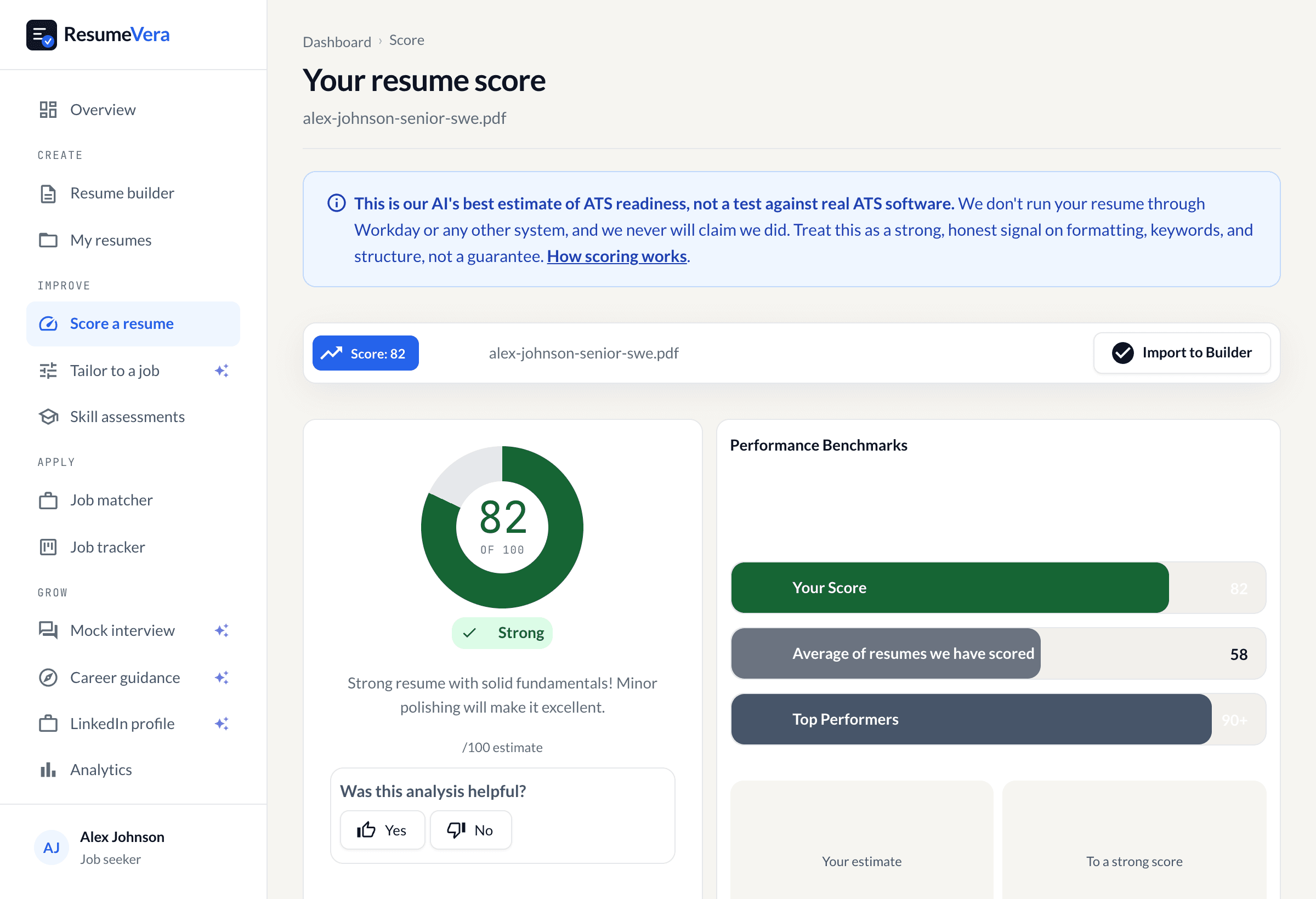
The real score page, with a sample resume and sample scores.
Is your resume ATS ready?
Run a free ATS score check and get specific improvements in seconds.