Career Growth
Relieving letter in India
Last reviewed: 6 October 2026. What it contains, what official sources say, why employers ask for it and what to do if it is delayed, with samples.
The ResumeVera editorial team
Resume and hiring research, reviewed against current employer guidance.
Updated Oct 6, 2026
15 min
Section 01
Relieving letter in India: the short answer
Last reviewed: 6 October 2026. This guide explains what official sources say and what Indian employers commonly do. It is not legal advice. Your appointment letter, the company's written policy and the law that applies to your employer decide the details, and the official pages we link have the final word.
A relieving letter (people also say relieving order or release letter; these are everyday names, not legal terms) is the letter in which your employer confirms that you have been released from your duties and that your employment ended on a stated date. New employers and background-verification agencies often ask for it. The points that matter most:
- In the official texts we read, we did not find a section that defines a "relieving letter" or says every private employer must issue one. It is mainly an employer practice and a contract matter.
- The nearest statutory wording we found is a "service certificate" clause in the 1946 central model standing orders, which is a different document and covers only certain workmen. See section 3.
- The relieving letter, the experience letter and the acceptance of your resignation are three separate documents. Section 2 shows the difference.
- The labour codes were made effective from 21 November 2025, but the official release says existing Acts and rules continue during the transition, so check which rules apply to your employer.
| Question | What we could confirm | Where |
|---|---|---|
| Relieving letter required by law | Not found in sources read | Pointer only |
| Service certificate clause | Yes, for permanent workmen | Model orders, cl. 16 |
| Dues after exit | Two working days (wages) | Code on Wages s.17(2) |
| Appointment letter duty | Yes, OSH Code s.6(1)(f) | OSH Code |
Section 02
Relieving letter vs experience letter vs resignation acceptance
People often use these words as if they meant the same thing. They are three different documents with different jobs, and a company may combine two of them in one page. None of the three is a government form with a fixed template, so the labels below describe common practice, not a legal definition.
| Document | What it does | When you get it |
|---|---|---|
| Resignation acceptance | Confirms the employer received and accepted your resignation and fixes the last working day | Soon after you resign |
| Relieving letter | Confirms you were released from duties and your employment ended on a date | On or after the last working day |
| Experience letter | Describes your role, designation and period of service | At or after exit |
Resignation acceptance
This comes first. It is the employer's reply to your resignation letter. It usually states the date of acceptance and your last working day. If you have not written your resignation yet, see the live guide on the resignation letter format. If you want to understand how notice works when you leave, see switching jobs and notice period. Keep the acceptance, because it fixes the dates your relieving letter should match.
Relieving letter
This is the closing document. It says you are relieved, usually from a specific date, and often notes that you have handed over company property and responsibilities. Many employers issue it only after the exit formalities are done, such as handover and return of assets. That is employer policy and we found no official text that sets it.
Experience letter
This describes the work you did. We already cover its format, the service certificate clause, EPF records and Form 16 in detail in the guide on the experience letter format, so this page does not repeat that material. Some employers issue one document that serves as both relieving and experience letter. Check that yours contains both the exit confirmation and the details of your role if a new employer wants both.
Section 03
Is a relieving letter required by law in India?
This is the question most readers want answered, so here is what the official texts we fetched say, and what they do not say.
What we found
- Service certificate in the central model standing orders. Schedule I of the Industrial Employment (Standing Orders) Central Rules, 1946, clause 16, reads: "Every permanent workman shall be entitled to a service certificate at the time of his dismissal, discharge or retirement from service." (source: Central Rules, 1946). The clause names dismissal, discharge and retirement. We did not confirm from an official text whether it also covers a worker who resigns, or whether an office or IT employee counts as a "workman". Ask your state labour office if this matters to you.
- Appointment letter duty. The Occupational Safety, Health and Working Conditions Code, 2020, section 6(1)(f), reads: "issue a letter of appointment to every employee on his appointment in the establishment, with such information and in such form as may be prescribed by the appropriate Government". (source: OSH Code). That is about the letter when you join, not when you leave.
- Industrial Relations Code. In the extract of the Industrial Relations Code, 2020 that we read, we did not find a provision on a service certificate or a relieving letter (source: IR Code). Section 28(1) applies the standing orders chapter to establishments with "three hundred or more than three hundred workers", and section 29(1) says the Central Government "shall make model standing orders".
- State shops and establishments laws. In the Delhi Shops Act page we read, we did not find a section requiring a certificate of service or experience (source: Delhi Shops Act, 1954). Other states have their own laws and we did not read them.
What the transition means
A Press Information Bureau release dated 21 November 2025 says: "the four Labour Codes - the Code on Wages, 2019, the Industrial Relations Code, 2020, the Code on Social Security, 2020 and the Occupational Safety, Health and Working Conditions Code, 2020 are being made effective from 21st November 2025". The same release says: "During transition, the relevant provisions of the existing labour Acts and their respective rules, regulations, notifications, standards, schemes, etc. will continue to remain in force." (source: PIB release). We could not confirm from an official page which rules are final as of 6 October 2026, so re-check labour.gov.in.
Plain conclusion
We did not find a rule in the sources reviewed that makes a relieving letter mandatory for every employee. Whether you get one usually depends on your appointment letter and company policy. If your contract or HR policy says one will be issued, that promise is the basis for asking.
Section 04
What a relieving letter usually contains (employer practice, not law)
This section describes employer practice, not law. Because no official template was found, the layout below reflects common employer practice. Your employer may use a shorter or longer version. What matters is that the facts match your other documents.
| Element | What it says | Check |
|---|---|---|
| Company letterhead | Name, address, registration details | Real, current entity |
| Date and reference | Issue date and a reference number | After last day |
| Your details | Full name, employee ID, designation, department | Spelling |
| Resignation reference | Date you resigned and date accepted | Matches acceptance |
| Relieving date | Last working day, effective date of release | Matches payroll |
| Handover line | Duties and assets handed over | Only if true |
| Signature | HR or authorised signatory, name and title | Signed, not blank |
Details to check in your copy
- Dates. The date of joining, last working day and relieving date should agree with your payslips, your PF record and your experience letter. A mismatch is the most common reason a new employer asks questions.
- Designation. It should be the designation you held at exit, as shown in your own records.
- Tone. A relieving letter normally records facts. If it carries remarks you did not expect, ask HR in writing what they are based on.
- Signature and source. It should come from an official company email or letterhead and name an authorised signatory.
The relieving date is also the date other records should follow. EPFO's own booklet asks members to mark an exit date when the employer has not updated it (see section 9), so a clear relieving date helps you there too.
Section 05
Why new employers ask for it in background verification (practice, not law)
Many offer letters make joining conditional on documents from your last employer. The relieving letter is commonly on that list because it shows you left on a recorded date and are free to join. We did not find an official source that lists which documents a private employer must request, so this is recruiter and verification-agency practice, not law. The decision to accept or reject a document is the new employer's.
Why it matters in practice:
- It supports the end date of your previous employment, which verification agencies compare against your resume.
- It helps show there is no overlap between your old and new employment dates.
- It sits with your experience letter and payslips as the exit paperwork.
For the full picture of what verification checks and how long it can take, see the live guide on background verification in India. Keep the dates on your resume consistent with these documents. If you are updating your resume before the new job, you can run it through the free resume checker, which gives an AI-estimated score and needs no account to start.
If you do not have the letter on the first day, tell the new HR team early and share what you do have: the resignation acceptance, the last payslip, and your written request for the letter. Some employers allow a short window to submit pending documents, but that is each employer's own policy, so ask for it in writing.
Section 06
Relieving letter and full and final settlement
These are linked but not the same. The full and final settlement is the payment side of your exit. The relieving letter is the paperwork side. Employers sometimes release one only after the other, and that is where disputes start.
What the law says about wages after exit
Section 17(2) of the Code on Wages, 2019 reads: "Where an employee has been, removed or dismissed from service; or retrenched or has resigned from service, or became unemployed due to closure of the establishment, the wages payable to him shall be paid within two working days of his removal, dismissal, retrenchment or, as the case may be, his resignation." (source: Code on Wages, 2019). Section 17(3) lets the appropriate Government provide another time limit where it considers it reasonable. The Ministry's "Compliance Handbook for Employers Under the Four Labour Codes (Central Government Sphere)" says the same in plain words (its scope is the central government sphere, so check whether it covers your employer): "When an employee leaves an establishment, whether by resignation, dismissal, or termination, the employer is required to pay all due wages within two working days." (source: Compliance Handbook). The Handbook shows no publication date in the text we read (the section it quotes is numbered 3.1(iv)).
The central model standing orders also say, at clause 13(3), that where employment is terminated, "the wages earned by him and other dues, if any, shall be paid before the expiry of the second working day from the day on which his employment is terminated." (source: Central Rules, 1946).
What we did not find
None of these texts says an employer may withhold or must release a relieving letter in exchange for wages, or the other way round. We did not find a rule on that point in the sources reviewed. So treat the letter and the dues as two separate requests in your messages, even if the employer ties them together. For what is in a full and final settlement, how it is calculated and what to check, read our guide on full and final settlement. We do not repeat its gratuity, leave and PF detail here.
If notice pay or a bond is the reason the employer is holding the letter, the guides on service bonds and notice recovery and the explainer on notice period buyout cover those clauses. Your contract decides most of that.
Section 07
If your employer delays or refuses the letter: steps in order
Start with the lowest-friction step and keep every message in writing. Steps 1 to 4 are practical suggestions, not legal requirements.
- Check your own documents. Look in your appointment letter, offer letter and the HR policy for any line about a relieving letter or exit formalities. If a clause lists conditions (handover, asset return, clearance), see whether they are done.
- Clear the formalities. Return assets, complete the handover and get the clearance or no-dues confirmation in writing. This removes the most common reason for delay.
- Email HR with a clear request. Use the sample email in section 10. State your last working day, the documents you need and a reasonable date. Copy your reporting manager if that is normal in your company.
- Follow up once, then escalate inside the company. Write to the HR head or the grievance contact named in your policy. Keep to facts and dates.
- Use the official routes. The routes below are the ones we found on official pages. Which one fits depends on what you are complaining about.
Official routes we found
| Route | What the page says | Best for |
|---|---|---|
| Samadhan portal | Single platform for grievances, claims, disputes | Unpaid dues, employment grievance |
| Grievance Redressal Committee | Required in establishments with 20+ workers | Individual grievance at work |
| EPFiGMS | EPFO grievance portal | PF issues only |
| CPGRAMS | Central grievance platform | Service delivery by authorities |
- Samadhan. The portal home page describes it as "a digital initiative of the Ministry of Labour and Employment, Government of India", and its FAQ describes it as giving "a single platform for raising their grievance in the form of industrial dispute, charter of demand, claims under applicable labour laws and other grievances related to employment" (samadhan.labour.gov.in, Samadhan FAQ). The FAQ answers "No, It is advisory for union/workers to file complaint through SAMADHAN Portal", so using it is optional for workers. Whether a missing relieving letter alone is something the portal handles, we could not confirm, so state your grievance in full, including any unpaid dues.
- Grievance Redressal Committee. Section 4(1) of the Industrial Relations Code says: "Every industrial establishment employing twenty or more workers shall have one or more Grievance Redressal Committees for resolution of disputes arising out of individual grievances." Section 4(5) says an application may be filed "within one year from the date on which the cause of action of such dispute arises" (source: IR Code). The Code's definition of "worker" excludes people employed mainly in a managerial or administrative capacity, and some supervisory staff above a stated wage, so check whether you count as a worker.
- EPFiGMS. The portal describes itself as "a customised portal of EPFO with an aim to redress grievances for the services provided by EPFO" and says "Grievance can be lodged by PF member, EPS Pensioner, Employer and Others" (epfigms.gov.in). It is for EPFO services, such as an exit date that is not updated, not for the relieving letter itself.
- CPGRAMS. It is described as "an online platform available to the citizens 24x7 to lodge their grievances to the public authorities on any subject related to service delivery" (pgportal.gov.in). Its list of matters not taken up includes court-related or sub judice matters and grievances of government employees about their service matters (unless the employee has already exhausted the prescribed channels). It is about public authorities, so it fits a private employer only indirectly.
For the final word on any route, or if the dispute is large or involves a bond or a legal notice, speak to your state labour office or a qualified lawyer.
Section 08
When the company has shut down or cannot be reached
This happens after a startup closes, an office moves or the HR team has left. You may not be able to get a fresh signed letter. Here is what the official pages we read say, and what you can do in practice.
Wages and PF
- Section 17(2) of the Code on Wages covers an employee who "became unemployed due to closure of the establishment", and says wages payable shall be paid within two working days (source: Code on Wages, 2019). If wages are unpaid, the Samadhan route in section 7 is where claims under labour laws can be raised.
- The EPFO members' FAQ says: "In respect of closed establishment, where the employee finds it difficult to get the attestation of the employer, the member can update the KYC by submitting a request to concerned field office duly attested by one of the authorised officials." (source: EPFO FAQ). The page is undated, and the text we read does not name the authorised officials, so confirm with the field office.
- Another EPFO FAQ page says a member can submit three types of claims, Form-19, 10C and 31, without employer attestation, provided "his UAN is activated and at least the bank account and Aadhaar KYC's in respect of his account are approved by the Employer using his Digital Signature Certificate". It adds: "In such a scenario, the claim form may be attested by the Manager of the Bank in which your savings Bank Account is currently maintained." (source: EPFO FAQ page). That page is also undated, so check the EPFO member portal for the current process.
Proving your employment
The following is practice and common sense, not law and not legal advice. A new employer or verifier decides what it accepts.
- Gather what you already hold: offer and appointment letters, payslips, bank statements showing salary, your PF passbook, Form 16 and any email from HR about your exit.
- Look for a former manager or director who can confirm your role and dates in writing on their own letterhead or email, and say so honestly to the new employer.
- Tell the new HR team the company has closed, and ask what alternative documents they will accept. Do not create or alter a letter yourself. A forged document can end an offer and cause bigger problems, and we did not read the penal provisions, so take advice if unsure.
We did not find an official page that sets out how to obtain a relieving letter from a company that has closed. Your state labour office can say what records it holds and what it can do.
Section 09
EPFO exit date and your relieving date
Your relieving date should line up with your EPF record. If your employer has not updated your date of exit, EPFO describes a self-service "Mark Exit" route on the Member portal. Two EPFO pages describe when you can use it, and they do not say the same thing:
| Source | What it says | Wait |
|---|---|---|
| EPFO Employees' Information Booklet, Q29 | "My employer has not updated my date of exit despite lapse of two months after leaving job. How can I update my date of exit?" | Two months |
| EPFO FAQ page | "After 60 Days from the date of leaving of services, the member can him self submit / update Date of Exit online through Member Portal." | 60 days |
Neither page is dated, and we could not tell which is current, so check the Member portal for the rule that applies when you try. The booklet lists these steps: visit the Member Unified Portal, enter UAN, password and CAPTCHA, go to Manage and click Mark Exit, choose the PF account number, enter the date of exit and reason of exit, request an OTP on your Aadhaar-linked mobile number, select the checkbox, click Update, then OK. The FAQ page also says "The Employer can make a request to the concerned PF Office for corrections" and "once the date of exit is updated, it cannot be changed". Our guide on PF withdrawal and transfer covers the claim process.
Use the date on your relieving letter and the date you enter on the portal consistently. If they differ, ask the employer which is correct before you mark the exit, because EPFO says a date, once updated, cannot be changed.
Section 10
Sample relieving letter and sample request email
The samples below are for understanding only. They are not legal documents and not an official format. Replace every [bracketed] field with your facts and adapt the wording to your employer. An employer may issue a different layout.
Sample relieving letter (what an employer might issue)
[Company letterhead]
Date: [issue date]
Reference: [reference number]
Relieving letter
To,
[Employee full name]
[Employee ID]
[Address]
Dear [First name],
This is with reference to your resignation dated [date of resignation] and our acceptance dated [date of acceptance]. We confirm that you have been relieved from your duties as [designation] in the [department] department with effect from the close of business on [last working day].
You joined the company on [date of joining]. We confirm that you have handed over your responsibilities and company property as per the exit process [delete if not applicable].
We thank you for your contribution and wish you success in your future work.
Yours sincerely,
[Name of authorised signatory]
[Title], [Company name]
[Signature and company seal, if used]
Sample email requesting the letter
Subject: Request for relieving letter, [Your name], [Employee ID]
Dear [HR contact name],
My last working day was [date], as confirmed in the resignation acceptance dated [date]. I have completed the handover and returned [assets] on [date]. [Delete if not true.]
My new employer has asked for my relieving letter [by date]. Could you please share a signed copy showing my designation, date of joining and relieving date by [date]? If anything is pending from my side, please tell me and I will complete it.
Please also confirm when I can expect my full and final settlement statement. I will treat these as two separate requests.
Thank you,
[Your name]
[Phone and personal email]
Follow-up line (after a week)
"Following up on my email of [date] about the relieving letter. Could you confirm the expected date, or tell me what is pending?"
Section 11
Limits of this guide and where to check
This page reports what the official sources we fetched say on 6 October 2026 and what employers commonly do. It cannot know your contract, your state's rules, or which of the older Acts and the new codes applies to your employer today. Labour codes were made effective on 21 November 2025, but the release says existing provisions continue during transition, and the status of final rules can change. The EPFO pages we cite carry no date. Treat every rule as something to confirm on the source.
For labour disputes, start with the Samadhan portal and your state labour office, and speak to a qualified lawyer for legal advice. For PF issues, use the EPFO member portal and EPFiGMS. To see what to check in your joining documents, read our guide on the offer letter format. If you are comparing offers before you resign, the salary negotiation guide may help.
What we could not confirm
- Whether a resigning employee (as opposed to one who is dismissed, discharged or retiring) is covered by the service certificate clause.
- Whether a relieving letter can lawfully be withheld until notice pay, a bond amount or dues are settled.
- Which rules under the four codes are final as of today.
- Any official process for getting a letter from a company that has closed.
Section 12
Sources and references
Every link below is an official page we opened while verifying this guide on 6 October 2026. Several pages carry no date, so check for newer versions.
- The Code on Wages, 2019, section 17 (Ministry of Labour and Employment): Section 17(2) and 17(3): wages within two working days of resignation, removal or closure.
- Industrial Employment (Standing Orders) Central Rules, 1946, Schedule I (Ministry of Labour and Employment): Clause 16 service certificate, clause 13 notice and dues, clause 15 complaints.
- PIB release, 21 November 2025 (Press Information Bureau): Labour codes effective 21 November 2025; existing Acts continue during transition.
- The Industrial Relations Code, 2020 (Ministry of Labour and Employment): Sections 4, 2(zr), 28 and 29: grievance committee, worker definition, standing orders.
- The Occupational Safety, Health and Working Conditions Code, 2020 (Ministry of Labour and Employment): Section 6(1)(f) appointment letter; section 2 employee definition.
- Compliance Handbook for Employers Under the Four Labour Codes, Central Government Sphere (Ministry of Labour and Employment): Two working days for wages on exit (section 3.1(iv)); undated in the text read.
- Delhi Shops and Establishments Act, 1954 (Labour Department, Government of NCT of Delhi): Section 30 notice; we read the whole page and found no certificate-of-service section (only a registration certificate under section 5); state example only.
- Employees' Information Booklet (EPFO): Question 29, Mark Exit steps; EPFiGMS mention. Undated.
- EPFO frequently asked questions (EPFO): Exit date update (60 days), employer correction request, closed establishment KYC. Undated.
- EPFO FAQ page (EPFO, pmvbry.epfindia.gov.in): Claims without employer attestation; bank manager attestation. Undated.
- EPFiGMS (EPFO): Description of the EPFO grievance portal and who can use it.
- Samadhan portal (Ministry of Labour and Employment): Digital initiative of the Ministry for grievances and disputes.
- Samadhan FAQs (Ministry of Labour and Employment): What can be filed; filing is advisory for unions and workers.
- CPGRAMS (Government of India): Central grievance platform and its stated exclusions.
Pro tips
Do these
Ask for the relieving letter and experience letter in writing before your last day, naming the date you need them.
Keep the resignation acceptance, last payslip and handover email together.
Make sure the dates in all exit documents match your payslips and PF record.
Treat the letter and the full and final settlement as two separate requests in your emails.
Tell the new HR team early if the letter is delayed and ask what alternatives they accept.
Save a PDF and a printed copy of every exit document.
Avoid these
Delete these
Resigning without checking what your contract says about exit documents.
Waiting until after joining the new company to ask for the letter.
Accepting a letter with the wrong dates or designation and fixing it later.
Mixing the dues request and the letter request in one angry email.
Marking an EPFO exit date without checking it against the letter.
Creating or editing a letter yourself when the company has closed.
Put this into a resume
Building and editing are free, and free PDFs carry a small watermark.
Check your resume for freeQuestions
Frequently asked questions
How this guide is maintained
We review this guide every quarter and after any change to the hiring rules or portal behaviour it describes. It was last reviewed on October 6, 2026. Figures come from named sources, shown beside the number. Where we are estimating rather than measuring, we say so.
By the numbers
2 working days
Time for wages after resignation under Code on Wages section 17(2)
https://www.labour.gov.in/static/uploads/2025/06/c328da14bbb15fc4ad571dc33e7a4ab3.pdf
Clause 16
Service certificate for permanent workmen in the 1946 central model standing orders
https://labour.gov.in/sites/default/files/industrialemploymentstandingorders1centralrules1946.pdf
21 Nov 2025
Date the four labour codes were made effective, with existing Acts continuing in transition
https://www.pib.gov.in/PressReleseDetailm.aspx?PRID=2192463®=3&lang=2
Try it
Check the guide against your own file
Everything above is general. Your resume is not. Paste it in and the checker tells you which of these points your file actually breaks.
Check your resume free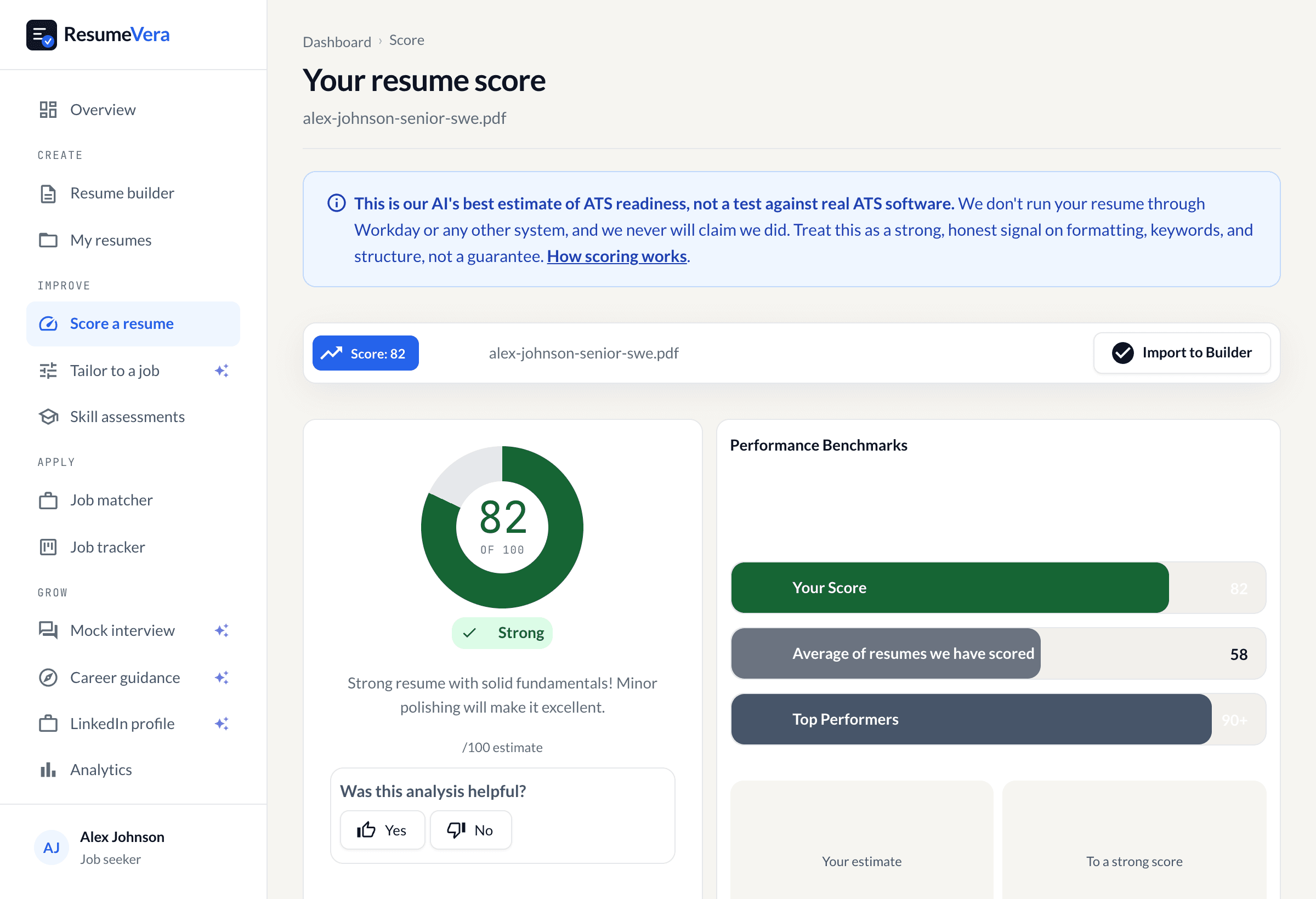
The real score page, with a sample resume and sample scores.
Is your resume ATS ready?
Run a free ATS score check and get specific improvements in seconds.